
Topic 2.6 key terms
- Newton’s law of universal gravitation
- Every two objects with mass attract each other with a force of magnitude , along the line between their centers of mass, where r is the center-to-center distance.
- universal gravitational constant G
- : the constant in Newton’s law of gravitation. Its tiny size is why everyday objects don’t noticeably attract each other.
- gravitational field
- The gravitational force per unit mass on a test object at a point: , in N/kg (= m/s²). About 10 N/kg (9.8) near Earth’s surface.
- weight
- The gravitational force exerted by an astronomical body on a relatively small nearby object: .
- apparent weight
- The magnitude of the normal force exerted on a system, which is what a scale reads. It differs from the gravitational force whenever the system accelerates: with up positive.
- apparent weightlessness
- A system appears weightless when no forces are exerted on it, or when the gravitational force is the only force exerted on it (free fall). Gravity is not zero.
- equivalence principle
- An observer in a noninertial (accelerating) frame cannot distinguish an apparent weight caused by the acceleration from a gravitational force caused by a gravitational field.
- inertial mass
- The property of an object that determines how much its motion resists changes when it interacts with another object: the m in .
- gravitational mass
- The property of an object that determines the gravitational force of attraction between it and other objects: the m in . Experiments show it equals inertial mass.
Transcript
2,492 words · 9 parts
Ninety-nine point seven percent
Somewhere over the Bay of Biscay, about six kilometers up, a big white jet is flying perfectly level. The people inside are about to do something most of us only see in movies. The pilots haul the nose up until it points about fifty degrees into the sky. For twenty seconds, everyone in the cabin is pressed into the floor almost twice as hard as normal. Then the roar of the engines drops away, and for the next twenty-two seconds, every person in that cabin floats.
They call this a zero-g flight. But up here, at the top of the climb, about eight and a half kilometers up, the Earth still pulls on these people with ninety-nine point seven percent of their weight at home.
Earth’s pull up here is almost as strong as it is where you’re sitting, yet the bathroom scale bolted to that floor reads zero. So how can both be true at once? By the end of this lesson, you’ll be able to explain it, and tell me what that scale reads at every second of this flight. Then the pilots pull out of the dive, with another twenty seconds at almost twice the push. To explain all of it, we’ll start with the pull itself.
A room which should remain constantly shut
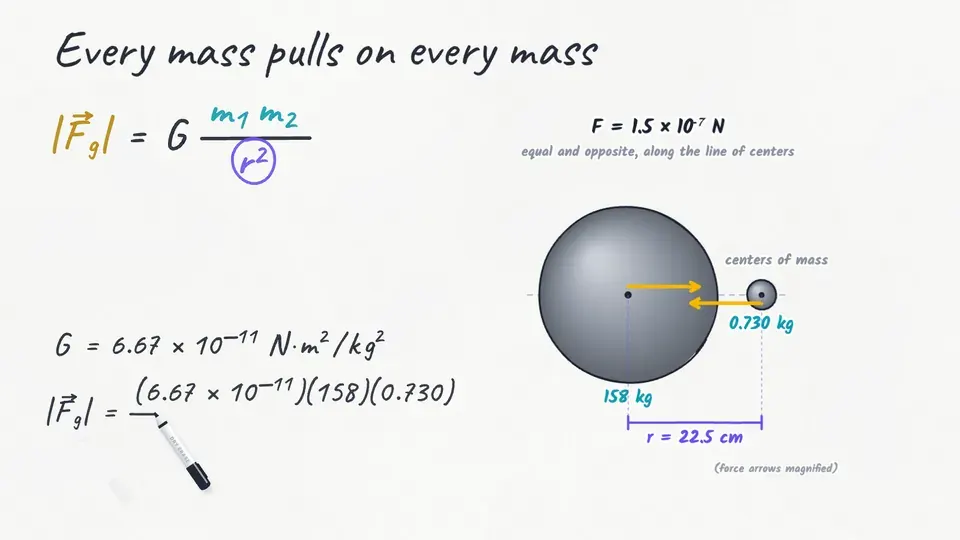
The best place to start is a dark room near London, in 1797, where a very shy man named Henry Cavendish is about to watch two balls of lead pull on each other. Inside the long case, a six-foot arm hangs from a thin wire, with a small lead ball of about three-quarters of a kilogram on each end. Beside it sit two big lead balls of a hundred fifty-eight kilograms each.
The force he was hunting was so tiny that his body heat could stir the air and hide it. So he sealed the apparatus “in a room which should remain constantly shut.” He watched the arm from outside, through a telescope. He swung the big balls into place with a rope from outside. One swing of the arm took about seven minutes, so we’re watching sixty times faster.
It works. The small balls creep toward the big ones, pulled by about one and a half ten-millionths of a newton. So every object with mass pulls on every other object with mass, even two lumps of lead in a dark room.
The big ball pulls on the small ball with about one and a half ten-millionths of a newton. How hard does the small ball pull back on the big one?
Isaac Newton wrote down the rule for this pull about a century earlier. We call it the law of universal gravitation. The force is a tiny constant, G, times one mass times the other, divided by the distance between their centers, squared.
More mass on either side means more pull. More distance means a lot less pull, because the distance is squared. And r always runs from center to center, never across the gap. This law is on the AP equation sheet. The exam checks that you know each letter, and r is the one people miss.
G is tiny, six point six seven times ten to the negative eleven, with the units you see on the board. That tiny G is why you never feel the person next to you pulling on you. The force pulls along the line joining the two centers, as if each ball’s mass sat at its center.
Twice as far
Let’s do something Cavendish never could, and rebuild his apparatus however we like. If we slide the big ball out to twice the distance, center to center, what happens to the force between them? Watch both arrows as it slides. At twice the distance, the pull drops to a quarter. At three times the distance, it drops to a ninth.
On paper, think in factors. Multiply by each mass factor, then divide by the distance factor squared. The yellow curve shows how fast that drops. Double the distance, and the force is a quarter as strong.
Triple it, and it’s a ninth. Double one mass, and the force doubles. Double both, and it’s four times as strong. Twice as far feels like it should give half the pull, like the gray curve. The real law gives a quarter.
You take the controls. Make the pull four times as strong as Cavendish’s, then find a second way to do it.
Weighing the Earth
That small ball feels two pulls at once. The big lead ball pulls it sideways, and the whole Earth pulls it straight down. That downward pull is its weight. Take a guess. If the sideways arrow is one millimeter long, how long is the weight arrow, drawn to the same scale?
Forty-seven kilometers, from the same law on the same small ball. One pull comes from a lead ball next door, and the other from a whole planet. Let’s go and see what’s doing that pulling. We’ll leave through the roof and keep climbing. That’s Clapham Common below, with Cavendish still at his telescope.
And there’s the whole planet, the one he weighed from a shut room. Each of these arrows shows the pull on one kilogram at its spot. They all point at Earth’s center. That’s what down really means, wherever you stand. Physicists call that pull on each kilogram the gravitational field. Every mass has one, and a planet’s is strong enough to notice.
In symbols, the field g is the gravitational force on a test object, divided by that object’s mass. A planet of mass M pulls on a test mass m with G big M little m over r squared. Divide by little m, and it cancels.
So the field is G M over r squared. It depends only on the planet’s mass and how far you are from its center. Your second law says acceleration is the net force on each kilogram. So when the gravitational force is the only force, the acceleration is the field itself. Even the units agree, since a newton per kilogram is a meter per second squared.
So the field at Earth’s surface is just how fast anything you drop speeds up, nine point eight. Look familiar? It’s the g you’ve used since Unit 1. On the AP exam, you can round it to ten. When a planet pulls on something near it, we call that pull its weight. Weight is mass times field, so a sixty-kilogram student weighs about six hundred newtons.
At a planet’s surface, r is just its radius, big R. Try one yourself. Planet X has twice the mass of Earth and twice its radius. What’s the field strength at its surface, in newtons per kilogram?
Here’s how that shut room weighs the planet. Cavendish read his tiny force from how far the wire twisted. With both masses and the distance known, the law has one unknown left, G.
Then turn g equals G M over big R squared around for M, and put in ten, Earth’s radius and G. Out comes about six times ten to the twenty-fourth kilograms, the mass of the planet under your feet. Cavendish’s result, published in 1798, came within about one percent of today’s. Not bad for a shy man with a wire and four lead balls.
Out to the Moon
Farther from Earth, the arrows get shorter, but only slowly at first. At our zero-g plane, the field is still ninety-nine point seven percent of its surface value. How far out do you have to go to cut the field to a quarter? Drag the probe to the spot where Earth’s field is one quarter of its surface value.
Keep going, and Earth’s field never quite runs out. It still reaches the Moon, just far weaker. Graph the field over the first ten kilometers above the ground, where planes fly and almost every physics problem happens. The curve is almost flat.
So when your distance from Earth’s center barely changes, the gravitational force is nearly constant. That’s why ten newtons per kilogram works everywhere from your desk to the top of our plane’s arc.
What the scale really reads
Back on the plane, here’s a strange claim. You have never once in your life felt your own weight. In level flight, two forces act on our sixty-kilogram passenger. The Earth pulls down, and the scale pushes up on their feet. That push is the normal force. It’s what the scale measures, and what you feel as heaviness.
In the pull-up, the floor has to push harder, hard enough to give the passenger the plane’s upward acceleration. The normal force swells to almost twice their weight. The Earth’s pull doesn’t change at all.
Over the top, the engines just cancel the air drag. Now the plane, the passenger and the scale all fall together, so the floor doesn’t need to push. The normal force drops to zero, but the Earth still pulls with six hundred newtons.
Look at when the floating starts. The nose still points almost fifty degrees up, and the plane is still climbing at about a hundred meters per second. Falling means accelerating downward, whichever way you’re moving. The whole plane is a ball tossed into the air.
The size of that push has its own name, your apparent weight. It’s the size of the normal force, the number a bathroom scale shows. To find it, use the second law from last lesson, with up as positive. The normal force minus m g equals m times the acceleration. So the normal force is m times g plus a. Label that downward arrow F sub g, or m g, never just g. g is the field, and AP readers won’t take it as a force.
Let’s do the pull-up. As it begins, the cabin accelerates upward at about eight meters per second squared. So the normal force is sixty kilograms times ten plus eight. That’s sixty times eighteen, one thousand eighty newtons.
Now do the top with me. The cabin is in free fall, so its acceleration is ten meters per second squared, downward. That’s negative ten. Ten plus negative ten is zero, so the scale reads zero.
Over the top, the scale reads zero because the gravitational force is the only force left. That’s weightless. So “zero gravity” is the wrong name, because Earth’s pull is the one force still acting. The pull-out at the bottom is the pull-up in reverse. The plane is still diving, but its acceleration points up, so the scale reads one thousand eighty again.
Draw it yourself. For each phase of the flight, set the gravitational force and the normal force on the passenger, with arrow lengths that match their sizes. Try one on your own. The pilots can also fly a Moon parabola, where the cabin accelerates downward at eight point four meters per second squared. What does the sixty-kilogram passenger’s scale read, in newtons?
Planet or plane?
Let’s pull the window shades down during the pull-up, so nobody can see out. The scale reads almost twice the passenger’s weight. It feels like Earth’s ten newtons per kilogram, plus eight more from the plane’s upward acceleration, eighteen in all.
Imagine waking up inside this closed box, a small one that isn’t spinning. Could any experiment in here tell this plane apart from standing on a planet whose field is eighteen?
Albert Einstein had this idea in 1907, sitting in a chair at the patent office in Bern. Years later he remembered the thought, “If a man falls freely, he would not feel his weight.” Over the top, with the shades down and everyone floating, only Earth’s pull acts. Far out in deep space, nothing would. From inside, you couldn’t tell which, and both count as weightless.
One more prediction while everyone’s floating. A twenty-kilogram toolbox and a half-kilogram ball are both weightless, and we push each one with the same twenty-newton force. Which one speeds up more?
There they go. The same twenty-newton push gives the ball forty meters per second squared, and the toolbox just one. Mass still resists the push, even while nothing holds them up. Look at Earth’s pull on them, even while they float. It pulls the toolbox forty times harder than the ball, two hundred newtons against five.
But the toolbox is also forty times harder to speed up. Two hundred newtons over twenty kilograms is ten. Five over a half is ten. They fall together, with the cabin, so they float together.
So mass has two jobs. The mass that Earth’s pull acts on is the gravitational mass. The mass that resists a push is the inertial mass. Experiments find the two are equal, so every object gets the same ten.
Suppose platinum’s gravitational mass were a tiny bit bigger than its inertial mass. How would a platinum ball fall, compared with a titanium one?
The sentence that earns the point
Here’s a question where a lot of students lose points. A planet has Earth’s mass but a larger radius. Is a dropped ball’s acceleration there greater, smaller, or the same, and why? Plenty of students write “gravity is weaker there,” and that loses the point. Gravity isn’t a quantity, so the answer never says what changes, or why.
Here’s a full-credit version. The gravitational field strength at the surface is smaller, because g equals G M over R squared, with the same mass and a larger radius. The gravitational force is the only force on the ball, so its acceleration equals g, and it’s smaller too. When AP readers scored a question like this in 2024, the first mistake on their list was writing “gravity” instead of naming the gravitational force or field.
Try spotting it on a new planet, with Earth’s radius and three times Earth’s mass. Which answer earns full credit for explaining what happens to a dropped ball’s acceleration? Now write one yourself. A planet has Earth’s mass and half its radius. What happens to a dropped ball’s acceleration there, and why?
Gravity never switched off
Now you can keep my promise from the beginning yourself. Drag each piece of the graph to the scale reading you expect, then fly it to see how close you came.
Every mass pulls on every other mass with G m one m two over r squared, along the line between their centers. The field is G M over r squared, about ten newtons per kilogram near the ground, where it barely changes. When the gravitational force is the only force on you, it’s your acceleration. Your weight is m g, but a scale reads the normal force. It changes whenever you accelerate up or down, and drops to zero when the gravitational force is the only force left.
Inertial mass equals gravitational mass, so everything falls together. And inside a closed box, nobody can tell a stronger field from an accelerating floor. So the next time you see people floating in a zero-g plane, you’ll know that gravity never switched off up there. The only thing that changed was the floor, which stopped pushing.