
Topic 2.5 key terms
- Newton's second law
- The acceleration of a system's center of mass equals the net force exerted on the system divided by the system's mass, , and points in the same direction as the net force.
- net force
- The vector sum of every force exerted on a system, . Along one axis, add the forces with their signs. It is not one more force: draw it beside a free-body diagram, never on the dot.
- unbalanced forces
- A set of forces whose vector sum is not zero. Only unbalanced forces change a system's velocity; balanced forces (net force zero) leave it constant.
- newton (N)
- The SI unit of force: 1 N = 1 kg·m/s², the net force that gives a 1-kg mass an acceleration of 1 m/s².
- directly / inversely proportional
- For a fixed mass, acceleration is directly proportional to the net force (double ΣF, double a). For a fixed net force, it is inversely proportional to the mass (double m, half a).
- free-body diagram
- A diagram of one system as a dot with an arrow for every force exerted on it, each labeled by what exerts it, pointing in its direction (lengths roughly to scale).
- system
- The object or group of objects you choose to study. The choice decides which forces are internal (between parts of the system) and which are external (from outside it).
- internal force
- A force that one part of a system exerts on another part. Internal forces come in equal and opposite pairs, so they add to zero and cannot change the velocity of the system's center of mass.
- external force
- A force exerted on a system by something outside it. Only a nonzero net external force changes the velocity of the system's center of mass (CED 2.5.A.3).
- tension
- The pull a rope, string, cable or coupler exerts along its length. It equals a hanging object's weight only when that object's acceleration is zero.
Transcript
2,651 words · 8 parts
66,000
Sixty-six thousand. Someone on the deck holds that number up in front of a fighter jet, just before the catapult launches it. This is catapult one on a US Navy aircraft carrier. In a few seconds, that jet is going to go from standing still to flying.
First, the crewman in front of the nose holds up a sign with one number on it, the jet’s weight, sixty-six thousand pounds. Once the pilot agrees, the crew uses that number, with the type of jet and the wind, to set the catapult’s push. The engines go to full afterburner, and the deck starts to shake. Then the shooter, the officer in charge of the launch, crouches and touches the deck, and the catapult fires.
The Navy says its catapults do that from zero to a hundred and fifty miles an hour in about two hundred seventy feet, in under three seconds. Set the push too gentle for that much mass, and the jet rolls off the bow too slow to fly. Pilots call that a cold cat shot, and there are real ones on record.
So how hard does the catapult have to push a sixty-six-thousand-pound jet? Give me the jet’s mass and the acceleration it needs, and you’ll work that out yourself. There’s a stranger question, too. How can a jet rolling forward at a hundred and fifty miles an hour, with its engines at full power, have an acceleration that points backward?
What a push really does
Let’s freeze the jet at the start of the stroke, with the catapult and the engines both pushing it forward. Say the catapult’s push stays perfectly steady all the way down the track.
Before we run it, I want your prediction. If the catapult pushes with the same steady force the whole way down the track, what happens to the jet’s speed during the stroke?
Watch the speed graph as the jet goes down the track. It’s a perfectly straight line. Every tenth of a second, the jet gains the same amount of speed, about two point seven meters per second. The ghost images show the same thing. The gap between them grows by the same amount every time.
Then the jet passes the bow and the catapult lets go. The speed doesn’t drop at all. It keeps climbing, just much more gently, because now only the engines push it forward, against the drag of the air.
Most of us grow up thinking a steady push gives a steady speed, and that’s wrong. It only seems true when something pushes back just as hard, like friction on a sliding box. Then the net force is zero.
What a net force really does is change the velocity. The harder it pushes, the faster the velocity changes. How fast the velocity changes is the acceleration you already know from kinematics.
Same push, twice the mass
So what happens when the mass changes? Here are two jets on the two bow catapults, one that weighs sixty-six thousand pounds and one that weighs half that. Both catapults are going to push with the same force.
Both catapults are about to push with the same force, and one jet has half the mass. When they fire, how will the light jet’s speed graph compare with the heavy jet’s?
When they fire, the lighter jet pulls ahead right away. Its speed graph is twice as steep, because the same push on half the mass gives twice the acceleration. Now give two identical jets different pushes, with twice the total forward push on one of them, catapult and engines together. Twice the net force on the same mass gives twice the acceleration, so this time that jet’s graph is twice as steep.
So the acceleration follows two rules. Double the net force, and you double the acceleration. Double the mass, and you cut the acceleration in half. Newton’s second law puts both rules into one line. The acceleration of a system’s center of mass equals the net force on the system divided by its mass. The system is the object, or the group of objects, that you choose to study.
This sigma F is the net force. Sigma means add them all up, so it’s the sum of every force on the system, with their directions. A push forward and a push backward partly cancel.
The little arrows on top mean these are vectors. The mass is a positive number, so the acceleration always points the same way as the net force. Double both, and the two changes cancel. Put in words, the acceleration is directly proportional to the net force, and inversely proportional to the mass. That’s the wording to know for the AP exam.
Multiply both sides by m, and you get the version everybody’s heard of, the net force equals mass times acceleration. The AP exam prints this equation for you. What it tests is whether you can add up the forces correctly.
That also tells you what a newton is. One newton is the force that gives one kilogram an acceleration of one meter per second squared. So a net force of six hundred thousand newtons on a thirty-thousand-kilogram jet gives it twenty meters per second squared.
If the forces on something don’t add up to zero, we call them unbalanced. Only unbalanced forces change an object’s velocity. If they add up to zero, they’re balanced, and the velocity holds steady. That’s Newton’s first law.
Put that to work on the deck. Suppose the crew sets the catapult for a jet that weighs forty-four thousand pounds, but the jet on the catapult really weighs sixty-six thousand. With the same push, what happens to the jet’s acceleration?
With two thirds of the acceleration, the jet reaches the bow well short of flying speed. Its wings can’t hold it up, so it sinks toward the water. This time the pilot finds enough speed to climb away, just above the waves.
Add up every force
Let’s work out the catapult’s push the way the AP exam expects. First, I’ll shrink the jet to a single dot at its center of mass. Then I’ll show every force acting on it. Earth pulls it down with its weight, and the deck pushes up with a normal force that’s just as big. The jet stays on the deck, so up and down, the forces balance.
Along the deck, the catapult pushes forward, and so do the engines. The air pushes back a little too, but this early in the stroke that drag is small, so I’ll leave it out and make a note that I did. Now add them up. The forward forces slide down onto the axis, tip to tail, and they make one arrow, the net force. I draw it beside the diagram, with the acceleration right next to it, pointing the same way.
You’ll often see a free-body diagram with an extra arrow on the dot labeled net force. AP readers mark that wrong. The net force is the sum of the forces already there, so drawing it on the dot counts it twice.
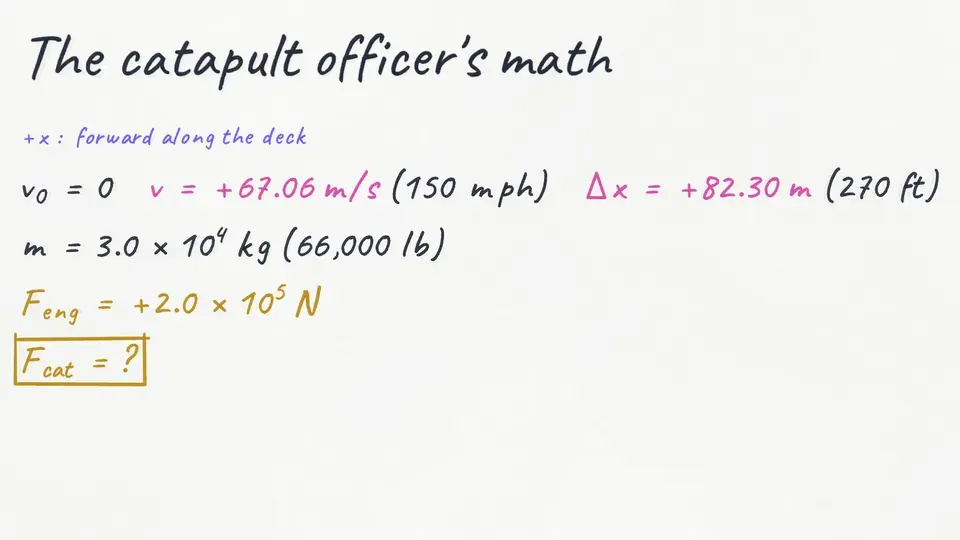
Forward along the deck is positive. The sign says sixty-six thousand pounds, the weight of about thirty thousand kilograms. The two engines push with about two hundred thousand newtons, and we want the catapult’s force. The speed graph already gave us the acceleration. The jet gained two point seven meters per second every tenth of a second, which is twenty-seven meters per second every second.
Then comes Newton’s second law, along the deck. The net force is the catapult plus the engines, and it has to equal m times a. So before I put in a single number, the catapult’s force is m a minus the force of the engines.
Thirty thousand kilograms times twenty-seven is eight hundred ten thousand newtons. The engines supply two hundred thousand of that, so the catapult supplies the other six hundred ten thousand, pointing forward. Let’s check it. The units come out in newtons, and the sign is positive, so it pushes forward.
That’s what the number on the sign is for. It gives you the mass, and the mass sets the push. It’s your turn to be the person that sign is for. A new jet is rolling onto catapult one, and the force has to come from you.
This jet weighs fifty-two thousand pounds. The panel shows its mass in kilograms. It needs thirty meters per second squared, and its engines add two hundred kilonewtons. A kilonewton is a thousand newtons. Find the catapult’s force in kilonewtons, then fire.
Backward at 150 miles an hour
Time to turn it around and land. The moment the jet touches the deck, the pilot pushes the engines to full power, in case the hook misses every wire and the jet has to fly off and come around again. This time the hook catches the wire, so let’s freeze it right there. The jet is still rolling forward fast, and its engines are at full power. At this instant, which way does its acceleration point?
Let’s run it in slow motion with the arrows on. The velocity points forward and shrinks. The engines push forward, but the wire pulls back much harder. So the net force points backward, and the acceleration points backward with it.
The jet is moving forward and accelerating backward, and that’s no contradiction. The acceleration answers only to the forces acting right now. The velocity is just what the jet already had, and the wire needs about three seconds to take it all away.
Here’s a landing like that in numbers, with forward positive again. Say a twenty-thousand-kilogram jet catches the wire at seventy meters per second and stops in three seconds, with its engines still at full power. Start with the acceleration. What is the jet’s acceleration, with its sign, in meters per second squared?
The net force is m times a. Twenty thousand times negative twenty-three point three is about negative four hundred seventy thousand newtons, backward. The wire pulls harder still, because it also has to beat the engines.
This is why the pilot keeps the engines at full power. If the hook skips over the wires, there’s no wire force at all. The thrust beats the drag, so the net force points forward, and the jet accelerates forward and flies away. The velocity was almost the same in those two moments. One force disappeared, and that was enough to flip the acceleration from backward to forward.
The AP exam loves to ask this with graphs instead of arrows. Suppose a jet is sinking off the bow after a cold shot. Its forward velocity is on top, and its vertical velocity, with up as positive, is underneath, over two seconds. Look at both graphs. Which way does the net force on the jet point during these two seconds?
Seven kilometres of iron
On June twenty-first, two thousand and one, a mining company in Western Australia ran the heaviest train ever. Six hundred eighty-two wagons of iron ore stretched seven point three five kilometers. Their total mass was almost a hundred million kilograms. Fly along it, and you notice something strange. There are locomotives in the middle of the train, and even one near the very back.
Eight locomotives ran in five groups, all controlled by one driver at the front. Why spread them out? The answer starts with choosing a system. Draw a box around the whole train, and call everything inside it our system. Every coupler pulls on the two wagons it joins, just as hard on one as on the other, in opposite directions.
Inside the box, those pairs cancel. However enormous the coupler forces get, they add nothing to the net force on the train. It’s like trying to move a car by sitting inside it and shoving the dashboard. Your hands push the car forward, the dashboard pushes your hands back just as hard, and inside one box those two pushes cancel.
Only forces from outside the box count. The rails push forward on the driving wheels of the locomotives. Rolling resistance pushes back a little. Only a net external force can change how the train’s center of mass moves.
Try a different system, just the wagons between two of the locomotive groups. The couplers at the two cuts are outside this box now, so they count. The front one pulls that whole stretch forward, and the back one hardly pulls at all.
The acceleration is the same, because the whole train moves together. What changed is the mass in your box and the list of forces you count. Now you choose the system. Put all eight locomotives at the front, with the train pulling at point zero five meters per second squared, and ignore the small rolling resistance. We want the tension in coupling three forty-one, halfway down.
Draw the box yourself, from that coupling to the end of the train, so the coupling is the only thing pulling it forward. Then use the mass in your box to predict the coupling’s tension.
With all eight at the front, the very first coupler has to pull the whole train behind it, about twice what you just found. The gauges at the front go far past the red line, the most a coupler should carry. So the record train spread its locomotives out. Each group only pulls its own stretch of wagons, and no coupler has to drag the whole train.
The sentence that earns the point
Let’s finish with a classic AP setup for this law. A two-kilogram cart sits on a level, frictionless track, tied by a string over a pulley to a one-kilogram block hanging off the edge. Then we let go.
While everything speeds up, how does the tension in the string compare with the hanging block’s weight? The exam usually words this as starting with Newton’s second law. We’ll do that one object at a time, calling the way each one moves positive. For the cart, right is positive. The string’s tension is the only sideways force on it, so T equals m c times a.
For the block, down is positive, so its weight minus the tension equals m h times a. The string doesn’t stretch, so both accelerations have the same size. Add the two equations, and the tension cancels out, like the couplers in the train. That leaves m h times g equals the total mass times a, so a equals m h g over m c plus m h. That’s the form the exam wants.
That’s one kilogram times ten, or ten newtons, over three kilograms, about three point three meters per second squared. That makes sense, because it’s less than g. To find the tension, go back to the block’s own equation. Its weight pulls down and the string pulls up. m h g minus T equals m h a, which rearranges to T equals m h times g minus a.
That’s one kilogram times six point seven, or about six point seven newtons, a third less than the block’s ten-newton weight. Before I write it out, you choose it. Which of these sentences would earn the justification point on the exam?
On the exam, this is the sentence that earns the point. The hanging block accelerates downward, so the net force on it has to point down, so the upward tension must be smaller than its downward weight. The answer that loses the point says the tension equals the weight, because the string holds the block up. It never connects the forces to the acceleration.
Back to the sign
One line did all of this. The acceleration is the net force over the mass, counting only forces from outside your system. It points along the net force, whichever way the object moves.
Next time a crewman holds up that sign, you’ll know what it’s for. It’s the m in F equals m a. The crew’s book of catapult settings is this same law, worked out ahead of time for every kind of jet.