
Topic 2.7 key terms
- kinetic friction
- The friction force between two surfaces that slide over each other. Its magnitude is , and on each surface it points opposite to that surface's motion relative to the other.
- coefficient of kinetic friction ()
- A number with no units that depends on the pair of surfaces in contact and their condition (wet or dry, rough or smooth). Not on the area of contact.
- normal force
- The perpendicular component of the force a surface exerts on an object, directed away from the surface. It equals only in special cases (level surface, nothing else pushing or pulling perpendicular to it).
- static friction
- The friction force between two surfaces in contact that are not sliding relative to each other. It takes whatever value and direction stop the slip, up to a maximum.
- maximum static friction
- : the largest static friction the surfaces can exert. Static friction reaches it only at the edge of slipping; in general .
- coefficient of static friction ()
- The ratio of the maximum static friction to the normal force. For a given pair of surfaces it is typically larger than , which is why starting something sliding takes more force than keeping it sliding.
- slipping / sliding
- Two surfaces moving relative to each other. A walking foot that grips the ground is not slipping, so the ground exerts static friction on it; a runner dragged over sand slides, so the sand exerts kinetic friction.
Transcript
2,656 words · 7 parts
The man with the jar
About three thousand nine hundred years ago, a painter worked by lamplight in a governor’s tomb above the Nile. He painted a giant stone statue of that governor on its way home, riding on a wooden sledge.
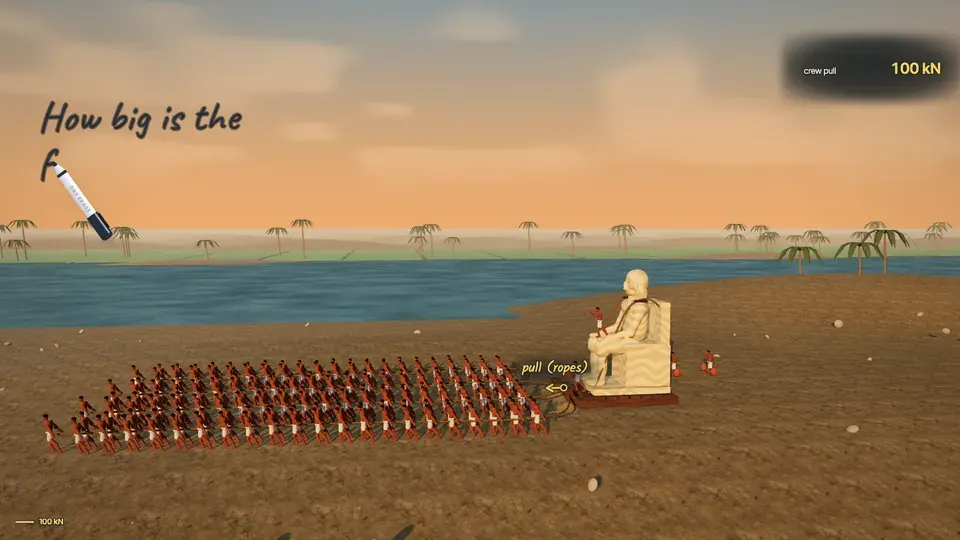
The statue was nearly seven meters tall and weighed at least fifty-eight metric tons, by the only estimate anyone has. In the painting, a hundred and seventy-two men haul it, while a man standing on the statue’s knees claps out the rhythm. At the front of the sledge, one more man is doing something strange. He’s pouring water from a jar onto the ground, right in front of the runners.
In 1895 the archaeologist Percy Newberry published a copy of this painting. He guessed the water was perhaps just part of a ceremony. He wrote that water poured on the ground couldn’t help the dragging. Then in 2014, physicists in Amsterdam dragged a model sledge across trays of wet and dry sand and measured how hard they had to pull.
What was the man with the jar really doing? You’ll work it out. Then you’ll use friction alone to test whether these hundred and seventy-two men could drag this statue across sand at all, even wet sand. To get there we need two kinds of friction, and since this statue is already sliding, let’s start with the one that acts on things that slide.
What the sand does
Let’s freeze it down at the level of the sand. The runner is sliding forward over the sand, and whenever two surfaces slide over each other, there’s a force we call kinetic friction. The sand drags back on the runner, against the way it slides. That’s why the crew has to keep pulling, just to keep the statue moving.
The runner drags the sand under it forward, too. Friction acts on both surfaces, and on each one it points against the way that surface slides past the other. Here are all the forces on the sledge and statue. Earth pulls them down, the ground pushes up, the ropes pull forward, and the sand drags back.
How big is that friction? For most pairs of surfaces it depends on just two things, and we write it as the kinetic friction force equals mu sub k times the normal force. Mu sub k is the coefficient of kinetic friction, a plain number with no units. It belongs to the two surfaces together, and to their condition, like wet or dry.
The normal force is the surface’s push on the object, at right angles to the surface. On level ground with a level rope, it’s just the statue’s weight. That’s a special case, and later we’ll watch it fail. If the ground pushes up with a thousand newtons and mu is a half, the friction is five hundred newtons.
What about the area of contact? Leonardo da Vinci was already testing that more than five hundred years ago, with blocks lying flat and standing on end. Let’s pull a wooden block across a table at a steady speed, first lying flat and then standing on its narrow end, touching the table with a quarter of the area. How do you think the friction compares?
Let’s put real numbers on the statue. On dry, desert-like sand, the 2014 test sled measured a kinetic coefficient of about point five four, and we’ll use that for our runner. How hard does the crew have to pull to keep the statue sliding at a steady speed? I’ll work it out on the board.
First I sketch the sledge, with x forward and y up. Fifty-eight metric tons is five point eight times ten to the fourth kilograms. The AP exam lets us use ten for g, and mu sub k is point five four. The speed is steady, so the acceleration is zero. That’s a classic AP setup, and a equals zero is the first thing I write down.
Up and down, the normal force balances the weight, m times g, which is five point eight times ten to the fifth newtons. Along the ground, the crew’s pull balances the kinetic friction. That’s point five four times the normal force, about three point one times ten to the fifth newtons. Does that make sense? It’s in newtons, it points forward, and it’s about half the statue’s weight, which makes sense, because mu is about a half.
Now… let’s see what his jar of water does to that number. Tip the jar and pour as much or as little water as you like, and see if you can find the amount that makes the crew’s job as easy as possible.
Dry sand piles up into a little hill in front of the runner, and the crew has to bulldoze it. On wet sand, tiny bridges of water hold the grains together, like a sandcastle, so the runner rides over the top. The water doesn’t grease the sand at all, it stiffens it. Pour too much and the bridges merge, the sand goes soft, and the friction climbs back up. Nothing changed but the sand’s condition, and that alone cut mu by about forty percent.
Before it moves
Every haul starts with a statue that isn’t moving. Let’s rewind to the moment before the first step, with the ropes still slack on the sand. The crew leans in, and the pull climbs to a hundred thousand newtons, and the statue doesn’t budge.
The crew is pulling with one hundred thousand newtons, and the statue still hasn’t moved. How big do you think the friction force from the ground is right now?
The ground’s friction is as big as the pull, and it points the other way. This is static friction, the friction between two surfaces that aren’t sliding over each other. At two hundred thousand newtons of pull the friction is two hundred thousand newtons, at three hundred thousand it’s three hundred thousand, and every point lands on one straight line.
Static friction isn’t a fixed number at all. It’s the ground answering the pull. It gives just as much force as it takes to stop the runners slipping, and not a newton more. This time you’re in charge of the crew. Pull harder and harder until the statue breaks away, and watch what the friction does at that moment.
At about four times ten to the fifth newtons, the grip gave way and the statue lurched forward. The friction dropped to three point one times ten to the fifth newtons, the kinetic value we worked out on the board. Getting it started took more force than keeping it going.
I’ll put that graph on the board. Across the bottom is the crew’s pull, and up the side is the friction. While the statue is stuck, the friction just matches the crew’s pull, so the graph climbs in a straight line, and that whole climb is static friction. The top of the climb is the most static friction these surfaces can give, and we call it mu sub s times the normal force, where mu sub s is the coefficient of static friction.
Once it slides, the friction is mu sub k times the normal force, flat however hard they pull. It drops because mu sub s is usually bigger than mu sub k. That’s why the first heave is the hardest.
That gives us two laws. Static friction is less than or equal to mu sub s times the normal force. Kinetic friction equals mu sub k times the normal force. Watch that less-than-or-equal sign. Static friction can be any size, up to the ceiling.
The AP equation sheet puts both laws in one line, with that same sign and a capital N on the normal force. Less than means static friction is holding. Equal means it’s about to slip, or already sliding with mu sub k.
That sign trips up a lot of students. One study asked university physics students about a car parked on a hill, and only one in six got the friction right. About four in ten just multiplied mu sub s by the normal force. Mu sub s times the normal force is a ceiling, and static friction only reaches it at the very moment before slipping starts.
A worker pushes a crate with a force that grows steadily from zero, and keeps pushing harder until well after the crate starts to slide. Which graph shows the friction on the crate over time?
Which way?
Which way does friction point? The best place to start is under the feet of the haulers. This man is leaning into the rope and stepping forward. Which way does the ground’s friction push on his foot?
So friction can push things forward. That’s how walking works, and each of these men only moves because the ground pushes him forward with static friction. This time the crew parks the statue on a causeway tilted ten degrees. The ground’s static friction points up the slope, because gravity is trying to drag the runners downhill.
Now the crew starts pulling uphill, and the friction arrow shrinks. The rope is doing more of the work of holding the statue, so the ground has less to do. Now it’s gone completely. Pull harder, and it comes back pointing down the slope, because now the runners want to slip uphill. It grows until it hits its limit and loses, and the statue lurches up the ramp.
Now you take the rope. Set how hard the crew pulls, so that the ground isn’t pushing along the slope at all and the gold arrow disappears.
Friction doesn’t simply oppose motion. Kinetic friction points against the way each surface slides over the other. Static friction points whichever way stops the slipping, up the ramp, down the ramp, or forward on a foot. If you remember that friction opposes slipping, instead of motion, you’ll get the direction right every time.
Parked on the causeway
Picture the statue parked on its ten-degree causeway again, with the ropes slack. I’ll draw its free-body diagram. For anything on a slope I tilt my axes, with x along the slope and y perpendicular to it. Then gravity is the only force I have to split into pieces.
With theta as the slope’s angle, the weight splits into m g sine theta down the slope and m g cosine theta pressing into the ground. Static friction points up the slope, because the statue would slip downhill.
Perpendicular to the slope nothing accelerates, so the normal force is m g cosine theta. That’s not m g. The ground only pushes back on the part of the weight that presses into it. Here that’s five point seven times ten to the fifth newtons, just under the weight. On a steeper slope it would be smaller still.
The statue weighs five point eight times ten to the fifth newtons. How big is the static friction holding it on this ten-degree slope, in newtons?
That’s how hard you pulled on the ramp to make the friction vanish. Then the rope did the ground’s job. What’s the most the ground could give? It’s mu sub s times the normal force.
It’s the same dry sand, and the normal force barely changed, so that’s still about four times ten to the fifth newtons, the pull where the statue broke loose. So the statue at rest is using only a quarter of the grip. The sand could hold it four times over.
The AP exam loves to ask whether the static friction on a parked object equals mu sub s times the normal force, and to make you justify your answer. A full-credit answer says no, then gives the evidence and the reasoning. The statue is at rest, so the net force along the slope is zero. Static friction just balances m g sine theta, about one point zero times ten to the fifth newtons.
Mu sub s times the normal force, about four times ten to the fifth newtons, is only the most the ground could give before the runners slip, and the statue needs far less. An answer like “no, because it isn’t moving” gets the claim right, but it earns nothing for the reasoning. It never uses a physics principle. Static friction is at most mu sub s F n, and equals it only when the object is about to slip. That’s the sentence that earns the point.
What the feet say
Now we can test the 2014 story properly. There’s a second friction in that painting that the 2014 experiments left out, under the feet of the haulers. Until now, I let the crew pull as hard as each job needed. Real feet can’t always give that much.
Watch their feet as the crew pulls harder on the best wet sand. The rope tightens, and their feet slide back before the statue moves at all. Why can’t a hundred and seventy-two men move it? One hauler’s free-body diagram tells us.
I’ll draw one hauler on his own. The rope pulls him backward. The only thing pushing him forward is static friction from the ground. Say he’s sixty kilograms, and give his feet a generous mu sub s of one point zero. Then the most he can pull is his own weight, six hundred newtons.
If he pulls any harder, his feet slip, however strong his legs are. All hundred and seventy-two men together can pull at most about one point zero times ten to the fifth newtons. To keep the statue sliding, the crew has to beat the sledge’s friction, mu sub k times its normal force. That has to stay below their limit.
You have both numbers on the board. What’s the largest mu sub k under the sledge that this crew could still beat?
That’s the problem. The best wet sand in the 2014 experiments had a mu sub k of point three one, almost twice that limit. Starting the statue takes even more, so their feet slip before it moves, just as you saw. A painting isn’t a head count, and men can dig their heels into footholds, so sand isn’t impossible. But in our model it fails by a wide margin.
The archaeologist who called the water a ceremony suggested the answer himself. Newberry thought the last stretch ran over great wooden beams laid along the road. The Egyptologist Mark Lehner adds the other half. On sand, water stiffens the ground. But pour it on Nile mud spread over timber, and it works like grease.
Back in the world, the crew is still stuck on wet sand. Now it’s your haul. Choose the ground, the size of the crew and how well their feet grip, and find a setup where the statue actually starts to move.
On wet timber beams, mu is about point one in our model. It’s the same hundred and seventy-two men and the same jar of water, and the statue moves. So the man with the jar really was doing physics. He kept the friction under the sledge small, while the ground kept the friction under everyone else’s feet big.
The man with the jar, again
Let’s pull it all together. Kinetic friction equals mu sub k times the normal force, and on each surface it points opposite to the way that surface slides relative to the other. Static friction is less than or equal to mu sub s times the normal force, and it takes whatever size and direction it needs to stop the slipping, up to that ceiling.
Mu belongs to the pair of surfaces and their condition, and the area of contact doesn’t matter. The normal force is the surface’s perpendicular push, and it equals m g only in special cases. Mu sub s is usually bigger than mu sub k, which is why starting something is harder than keeping it going. Now, when you look at this painting, you can see both kinds of friction at work, more than three thousand years before anyone wrote them down.