
Topic 2.9 key terms
- uniform circular motion
- Motion around a circle at a constant speed. The speed is constant but the velocity is not, because its direction keeps changing.
- centripetal acceleration
- The component of an object's acceleration directed toward the center of its circular path, with magnitude (EK 2.9.A.1).
- radial (inward) part of the net force
- The component of the net force toward the center of the path; it always equals and is made of real forces (a track, a string, gravity, a tilted road). "Centripetal" names this job; it is never an extra force on a free-body diagram. If the speed is also changing, the net force has a tangential part too (EK 2.9.A.2–A.4).
- minimum speed at the top of a loop
- At the top of a vertical circle, the slowest speed that keeps an object on the circle: gravity alone provides the centripetal acceleration, , so (EK 2.9.A.2.i).
- radius of curvature
- The radius of the circle that best fits a curved path at one point (the "kissing circle"); it is the r in there. Teardrop loops have a large radius at the bottom and a small one at the top.
- tangential acceleration
- The rate at which an object's speed changes, directed tangent to its path (EK 2.9.A.3). The net acceleration is the vector sum of the centripetal and tangential accelerations (EK 2.9.A.4).
- justify
- AP task verb: support a claim with evidence (data or a representation such as a free-body diagram) and reasoning that applies a physics principle.
- banked curve
- A tilted road. With no friction, the horizontal component of the normal force alone provides the centripetal acceleration, so (EK 2.9.A.2.ii; friction on a bank is described only qualitatively).
- conical pendulum
- A mass on a string moving in a horizontal circle: the vertical component of the tension balances the weight and the horizontal component provides the centripetal acceleration, (EK 2.9.A.2.iii).
- period, T
- The time to complete one full circle, rotation or cycle (EK 2.9.A.5.i). For uniform circular motion, .
- frequency, f
- The number of revolutions completed per unit time (EK 2.9.A.5.ii); . Unit: hertz (1/s), or revolutions per day, per minute.
- Kepler's third law (circular orbits)
- For a satellite in a circular orbit, gravity alone provides the centripetal acceleration, which gives : for every orbit around the same central body, is the same number, set only by the central mass M (EK 2.9.B.1).
Transcript
2,899 words · 10 parts
Why no loop is a circle
Keep your eyes on the riders at the very top of this loop, because for a split second, upside down, they’ll barely be touching their seats. There, at the top, the seat pushes on them with almost nothing at all. A second later, at the bottom, it shoves up with three or four times their usual weight.
Now look at the shape. A perfect circle as tall as this loop doesn’t fit it, because the steel pinches in tight at the top and curves up much more gently at the bottom. Engineers build every modern loop this way, taller than it is wide. But the first loops weren’t. In 1895, the Flip Flap Railway at Coney Island sent riders around a perfect circle twenty-five feet across, and they complained of whiplash and neck pain.
By the end, you’ll know the slowest a car can go over the top and why that first loop hurt. Then the same idea will let you weigh a black hole. It starts with a question that sounds too simple to ask. Is something going around a circle at a steady speed accelerating at all?
Turning is accelerating
Here’s the simplest circle I could build. It’s a steel ring lying flat on the ground, half a meter in radius. A ball rolls around inside it at a steady two meters per second. The speed never changes, but the velocity arrow keeps turning. Velocity includes a direction, so a new direction means a new velocity, and that means the ball is accelerating.
Something has to make that happen. The only thing pushing sideways on the ball is the ring’s wall. So here’s an arrow for the acceleration that push gives it, pointing in, toward the center.
Let’s take that push away. In a moment, a piece of the ring will lift out of the way just ahead of the ball, so which path do you think the ball takes at the gap?
It goes dead straight, along the line its velocity pointed at the instant it reached the gap, and the inward acceleration arrow vanished the moment the wall stopped pushing. That’s Newton’s first law, so the wall’s whole job was to keep bending the ball’s velocity toward the center, a tiny bit at every instant.
So which way does the velocity change? Here it is at one moment, and here it is a split second later, the same length, just turned a little. Slide them so their tails touch, and the little arrow from the first tip to the second is the change in velocity, delta v, pointing right at the center of the circle.
Acceleration is the change in velocity over the time it took, so it points the same way, toward the center, and we call it centripetal acceleration, from the Latin for center-seeking. Its size is the speed squared divided by the radius, a sub c equals v squared over r, and it’s printed right on the AP exam’s equation sheet.
On our ring, that’s two squared over zero point five, or eight meters per second squared, toward the center. Double the speed, and eight becomes thirty-two, four times bigger, because the speed is squared. Double the radius instead, and eight drops to four, a gentler turn. So let’s cross out the idea that a steady speed means no acceleration, because on a circle the speed can be steady while the acceleration is never zero.
Keep the speed at two meters per second. Use the radius dial to make the acceleration four times bigger, thirty-two meters per second squared.
Heavier at the bottom
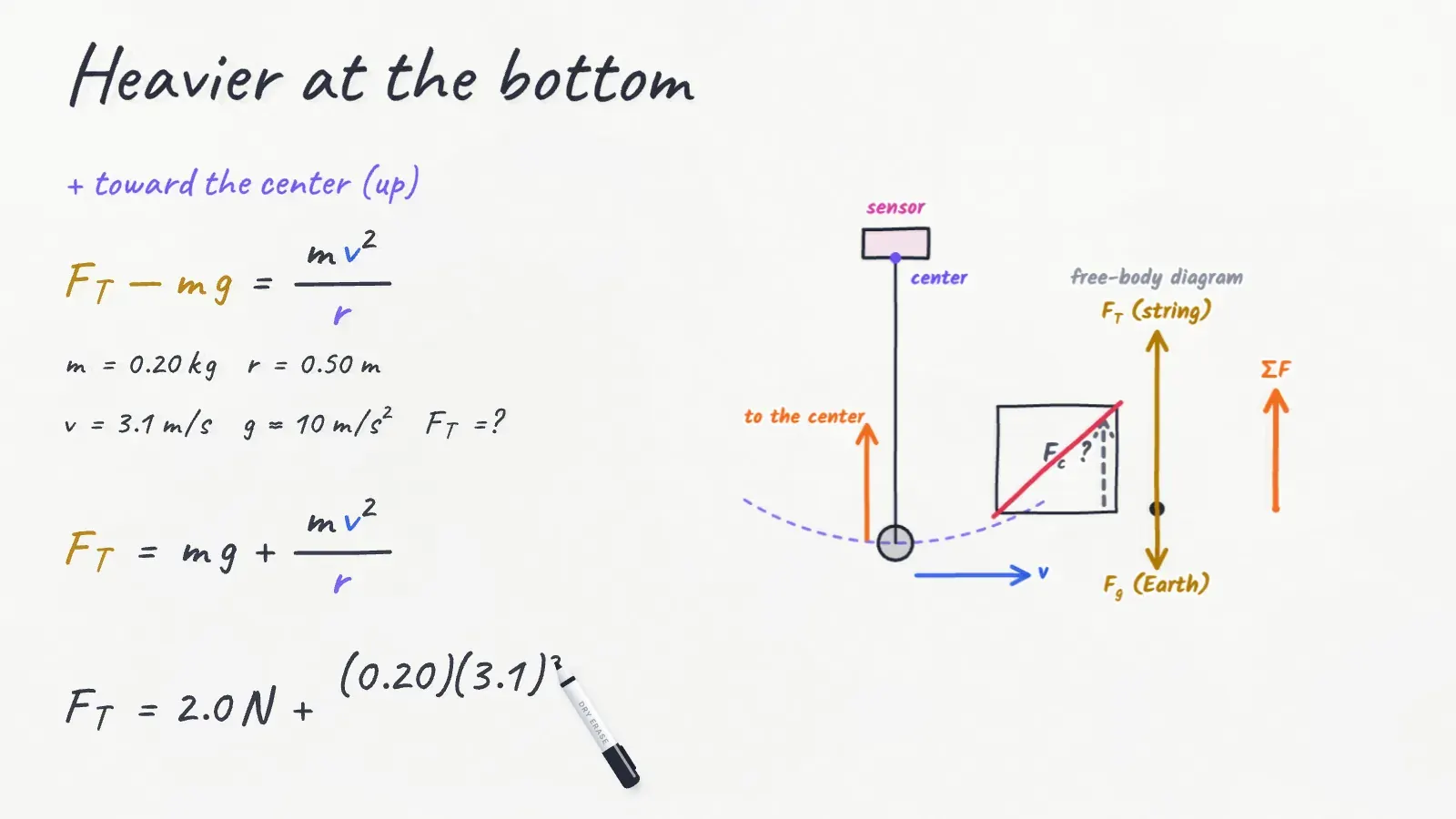
Here’s a classic AP question. This bob weighs two newtons and hangs from a force sensor on a string half a meter long, so hanging still, the sensor reads two newtons. I’ll pull it out until the string is horizontal and let go, and at the very bottom of the swing, for one instant, it’s neither speeding up nor slowing down.
At that bottom point, what do you think the sensor reads? It reads almost six newtons, nearly three times the bob’s weight. It isn’t speeding up, but it’s still going around a circle centered on the top of the string, so it has a centripetal acceleration pointing straight up, and some force has to provide it.
Let’s draw only the real forces on it, each with something doing the pulling, so the string pulls up, and Earth pulls down with its weight. Lots of students add a third arrow called the centripetal force, and AP readers have flagged that mistake more than once, because there’s no third thing pulling on the bob.
Centripetal names a job, pulling the bob toward the center, and here the sum of the string’s pull and gravity does that job. The string pulls up harder than gravity pulls down, so their sum points up.
Use Newton’s second law along the radius, and call toward the center positive. Here that’s up, so the string’s pull minus the weight equals m v squared over r. The bob’s mass is zero point two kilograms, its speed at the bottom is about three point one meters per second, and the radius is the half-meter string.
That makes m v squared over r about three point eight newtons. Add the two-newton weight, and the string pulls with about five point eight, within a tenth of the sensor’s five point nine. Put a rider at the bottom of the Flip Flap. The loop was twenty-five feet across, about seven point six meters, so the radius is about three point eight. Our simulated car comes through at about fourteen meters per second.
Divide everything by the rider’s weight. The seat pushes with one plus v squared over g r times their weight. I’ll use g as ten, which the AP exam accepts. That makes the seat’s push about six point two times their weight. Six times your weight, slammed on in a fraction of a second, is a big part of why those riders complained about their necks.
Upside down
Now let’s go to the top of the loop. Up here, the cart is upside down, and the track is above it. Before I draw anything, which way do you think the track pushes on the upside-down cart?
From above, the track can only push down, and gravity pulls down too. So both forces point toward the center, which is now below the cart. Watch what happens as I send it over more and more slowly. The smaller v squared over r gets, the less the track pushes, until at one speed it doesn’t push at all and gravity does the whole job.
Newton’s second law along the radius gives us that speed. Call toward the center positive, which is now down. The normal force plus the weight equals m v squared over r. At the minimum speed the normal force is zero, so m g equals m v squared over r, and the mass cancels from both sides.
Multiply both sides by r, and v squared equals g r. Take the square root, and the minimum speed at the top is the square root of g times r. There’s no mass in it, so a heavy cart and a light cart that are too slow peel off at exactly the same place.
For the Flip Flap, that’s the square root of ten times three point eight, about six point two meters per second. The simulation uses the real g, so it gets six point one. Any slower, and gravity bends the path into a tighter curve than the track, so the cart pulls away from the rails and falls. Real coasters have wheels under the rail to hold them on, but an AP cart doesn’t, so the track can only push.
Now you find it. Set the cart’s speed at the top, send it, and see how slowly it can go and still make it all the way over.
The teardrop
So what did the Flip Flap get wrong? Here’s the circle that best fits the track right where the train is, called the kissing circle. On a circular loop, it’s the loop itself, three point eight meters everywhere. But on a teardrop, it swells at the bottom, where the train is fastest, and shrinks at the top, where it’s slowest.
Let’s put numbers on it. Say the train comes through the bottom at fourteen meters per second on either loop. On the circle, a sub c is fourteen squared over three point eight, about fifty-two meters per second squared. The teardrop’s bottom radius is twice as big, seven point six meters, so work out in your head what happens to a sub c. It halves, to about twenty-six meters per second squared, because the radius is on the bottom of the fraction.
The seat pushes with one plus a sub c over g times the rider’s weight. So it drops from six point two to one plus twenty-six over ten, about three point six. At the top, a tighter curve puts a smaller r in the square root, so the train can go over more slowly. The teardrop’s top radius is about one point nine meters. What’s the slowest speed over its top, in meters per second?
On the way up there’s something else going on, because halfway up the side, gravity points straight down along the track, so it’s slowing the train down. That’s a second piece of acceleration, along the track, called tangential acceleration, the rate at which the speed changes, while the centripetal piece turns the direction.
So right here, halfway up the loop, which way does the train’s actual acceleration point? It points down and toward the center. The real acceleration is the sum of the two pieces.
Now design your own loop. Reshape the circle until the riders never feel more than four and a half times their weight at the bottom, while the train still makes it over the top.
Justify it
Let’s write a full-credit answer to an AP-style justify question. On a circular loop, does the track push harder at the bottom or at the top? My claim is short and direct. The track pushes harder at the bottom. For evidence, look at the two free-body diagrams with me, with the track pushing up against gravity at the bottom and down along with gravity at the top, toward the center both times.
My reasoning is Newton’s second law along the radius. At the bottom, the track holds up the weight and does all the turning. At the top, gravity does part of the turning, so the track has less to do.
The train is also slower at the top, on the same radius, so v squared over r is smaller up there too. Compare an answer that just says it’s bigger at the bottom because of centripetal force, which names no real force and no law, so a reader has nothing to give credit for.
Try a new question about the bottom of a swing. Is the string’s tension there bigger than the bob’s weight? Which of these answers would earn full credit?
Banks and swings
A road can do the turning too, if you tilt it. Daytona tilts its turns thirty-one degrees, on a radius of about three hundred meters. Cover the road in ice, so there’s no friction. Then just two forces act on the car, its weight and the road’s push.
The road pushes at right angles to its surface. So when the road tilts thirty-one degrees, its push tilts thirty-one degrees from straight up. On a ramp you’d split forces along the slope. But this car goes around a level circle, so its acceleration points level, at the center. That’s why we split the push into a vertical part and a level part.
The vertical part holds up the weight, m g. The level part does all the turning, m v squared over r. In this triangle, the level part over the vertical part is the tangent of theta. The mass cancels, and tan theta equals v squared over g r. Solve for v, and the speed that needs no friction is the square root of g r tan theta.
Your turn. With a radius of three hundred meters, and the tangent of thirty-one degrees about zero point six, what’s that ice speed, in meters per second?
Race cars go about ninety meters per second, more than twice the ice speed. The road’s push can’t do that much turning, because its vertical part still has to match the weight. So on ice, a race car would slide up the bank. Friction from the tires pushes it back down, toward the inside.
A slower car takes the same bank at thirty meters per second. Which way does friction from its tires push? A chair swing is the same triangle, with the chain’s pull in place of the road’s push. Its vertical part holds the rider up, its level part pulls them around, and tan theta equals v squared over g r again.
The sky goes in circles
In January 1610, Galileo pointed one of the first telescopes at Jupiter. Night after night, little stars beside it slid from one side to the other. They were moons going around Jupiter in circles, seen edge-on. Today we call them Io, Europa, Ganymede and Callisto. Io goes around once every one point seven seven days, and that time for one lap is the period, capital T.
Flip it over and you get the frequency, the laps per unit of time, about zero point five seven laps a day for Io, so T equals one over f. In one period, Io travels the whole circumference, two pi times its orbit radius, capital R. So its speed is two pi R over T. Nothing touches Io, so the only force on it is Jupiter’s gravity, and if I switch that off, Io heads off along the tangent in a straight line, just like the ball leaving the ring.
On the AP exam, the first line of an orbit derivation is the sentence that earns the point. Gravity is the only force on the moon, so it provides the centripetal acceleration. In symbols, G M m over R squared equals m v squared over R, and the moon’s own mass cancels. Put in v equals two pi R over T. Then v squared over R is four pi squared R over T squared, and that’s the right side.
Multiply both sides by R squared T squared, then divide by G M, and T squared equals four pi squared over G M, times R cubed. That’s Kepler’s third law for a circular orbit. The only mass left in it is Jupiter’s, so measure how big an orbit is and how long it takes, and you’ve weighed the planet without going anywhere near it.
So let’s weigh Jupiter. Pick what goes on each axis until the four moons make one straight line through the origin, then drag the slope triangle onto it.
Here’s that line. All four moons sit right on it, and its slope is four pi squared over G M. The slope comes out at about three point one times ten to the negative sixteen seconds squared per meter cubed. Divide four pi squared by G times that slope. Jupiter comes out at about one point nine times ten to the twenty-seven kilograms, over three hundred Earths.
For moons of one planet, T squared goes with R cubed. Ganymede orbits one point six times as far out as Europa, which takes three point five five days. One point six cubed is about four. What’s Ganymede’s period, in days?
Weigh a black hole
Now for the black hole I promised you. At the very center of our galaxy, a star called S2 goes around something nobody can see, once every sixteen years. Its orbit is a long ellipse. Its average distance is about a thousand times Earth’s distance from the Sun.
Jupiter’s moons all circled one mass. Here we compare two different ones, so solve Kepler’s law for the mass. It goes with R cubed over T squared. Use Earth as the ruler. Its orbit, one Earth distance and one year long, weighs exactly one Sun.
S2’s orbit is a thousand times wider, so R cubed is a billion times bigger. Its year is sixteen times longer, so T squared is two hundred fifty-six times bigger. So divide a billion by two hundred fifty-six. How many million Suns is the thing in the middle? Reinhard Genzel and Andrea Ghez tracked these stars for decades, and they shared the 2020 Nobel Prize.
What to keep
Here’s what to keep from today. Turning is accelerating, even at a steady speed, and a sub c is v squared over r, toward the center. Real forces you can name do that turning, never an extra force called centripetal. Over the top of a loop, the slowest speed is the square root of g r. In an orbit, gravity alone does the turning, so an orbit’s size and period weigh whatever is in the middle.
That’s why the Flip Flap hurt. Its circle was just as tight at the bottom, where the car was fastest, as at the top. Today’s designers make loops tight at the top and gentle at the bottom. And if you’re wondering where the train gets all that speed in the first place, that’s energy. It’s the very next thing we’ll take apart.