
Topic 3.1 key terms
- translational kinetic energy
- The energy an object has because it moves from place to place: K = ½mv², with m its mass and v its speed relative to the observer. Measured in joules.
- translational
- Moving from one place to another as a whole, as opposed to spinning in place (rotational motion, Unit 6).
- joule (J)
- The SI unit of energy: 1 J = 1 kg·m²/s². A baseball tossed gently at about 3.6 m/s carries about one joule.
- scalar
- A quantity with a size but no direction. Kinetic energy is a scalar, so the kinetic energies of the parts of a system simply add; and because v² can’t be negative, K is never negative either (other scalars, like work, can be).
- frame of reference (observer)
- The point of view a measurement is made from. Different observers measure different speeds for the same object, so they measure different kinetic energies (EK 3.1.A.3).
- closing speed
- The speed of one object relative to another, the size of the difference of their velocities. A window feels a debris grain’s closing speed.
- linearize
- Choose what to plot so a model becomes a straight line: dent volume against speed squared is a straight line through the origin if the dent is proportional to K.
Transcript
2,378 words · 10 parts
The crack in the window
In November 2025, three Chinese astronauts were one day away from flying home from their space station. Then their commander, Chen Dong, noticed a tiny triangle on the window of the capsule that was meant to take them back.
The crew checked it with a pen-shaped microscope that magnifies forty times. It was a set of cracks, and Chen Dong said later that some of them went all the way through. Something had hit that window in orbit, most likely a piece of space debris. China decided the capsule wasn’t safe to ride home in, and the crew came back nine days late, in a different spacecraft.
Nobody has ever said how big that piece of debris was. The strange part is that it didn’t need to be big at all, because everything up here moves incredibly fast. So how much energy can a speck like that carry? You’re going to work it out, and see why, up here, a grain of sand can hit like a fastball. You’ll also see why the astronauts inside, racing around the Earth just as fast as the debris, had no kinetic energy at all from where they sat.
The clay that took a side
What does speed do to the energy a moving thing carries? For decades, some of the smartest people in Europe argued about it. A lump of clay settled it, in a room a lot like this one. Followers of Descartes said a moving body carries its mass times its speed. Leibniz said it carries its mass times its speed squared.
In 1722, in Leiden, Willem ’s Gravesande, a professor who had backed Descartes’ side himself, let the clay decide. He dropped brass balls into a tray of soft clay and measured the dents. Here’s the lighter ball, dropped from a quarter of a meter. It lands at about two point two meters per second. Then we fill the dent with water to see how much clay it pushed aside.
In this clay, every cubic centimeter takes the same energy to push aside. So the dent measures the energy the ball brought in. Next, we’ll drop the same ball from four times as high. From Unit one, you know it lands twice as fast. Descartes’ side bets on twice the dent, and Leibniz bets on four times.
The ball now hits twice as fast as before. How much clay will it push aside this time? It landed at four point four meters per second, twice as fast. It takes four times as much water to fill, right up to the four-times outline. Twice the speed made four times the dent, so the clay sides with Leibniz.
From nine times the height, the ball lands three times as fast and pushes aside nine times the clay. Three squared is nine. A second ball, the same size but with twice the mass, drops from the same quarter meter.
It pushes aside twice the clay. Twice the mass made twice the dent, so the mass counts once, and the speed counts twice. Leibniz was right about the square. Descartes’ mass times speed is real too. It’s momentum, and you’ll meet it in Unit four.
Mass counts once, speed counts twice
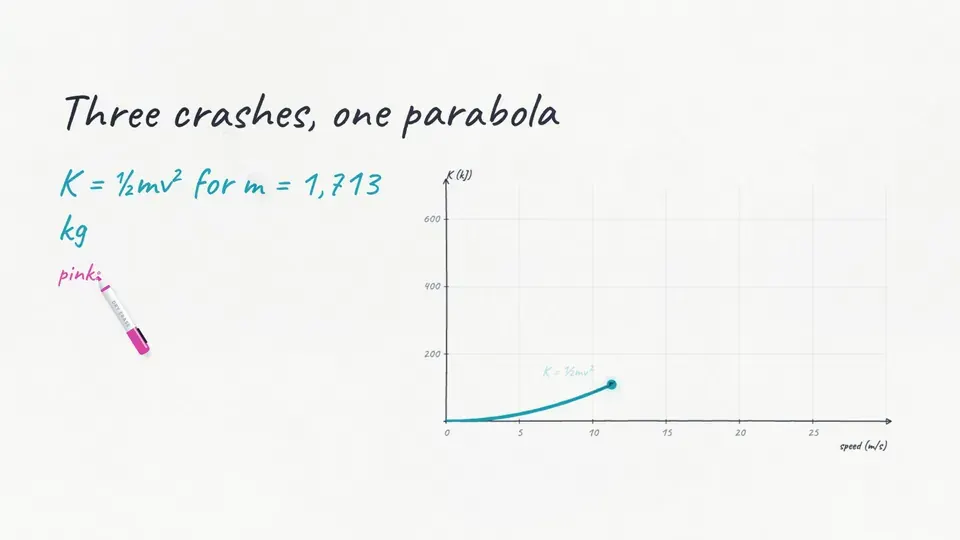
The clay was measuring kinetic energy, the energy something has because it’s moving. We write it as K equals one half m v squared. The one half has a reason too, and you’ll see it next lesson. The m is the mass, and it counts once. The v is the speed, and it’s squared, so it counts twice, just as the clay showed.
Translational means moving from place to place. Spinning gets its own kinetic energy later in the course. With the mass in kilograms and the speed in meters per second, the units come out as kilogram meters squared per second squared. We call that a joule.
To get a feel for how big a joule is, picture a baseball tossed gently underhand, at about eight miles an hour. That ball carries about one joule. The AP equation sheet prints this formula, so you’ll never have to memorize it. The exam tests whether you can use it.
Let’s try it on a two-kilogram ball. At one meter per second, it has one half times two times one squared, one joule. At two meters per second, it has four joules. At three meters per second, how much kinetic energy does the ball have, in joules?
The points curve upward, in a parabola from zero. If the energy were proportional to the speed, the graph would be this straight line, and it isn’t. A cart’s mass doubles while its speed drops to half. What happens to its kinetic energy?
A ball lighter than a penny
On the ground, engineers test spacecraft shields by firing small aluminum balls at panels like this one. Let’s fire one up here, one centimeter across, coming in at ten kilometers a second, a typical speed for space debris. That flash is the ball’s kinetic energy turning into heat, light and shattered metal. The readout says about seventy-one thousand joules. Let’s work out where that number comes from.
We’ll do it the way the AP exam wants, starting with a quick sketch. Here’s the window, the ball, and an axis pointing to the right. The ball flies left, toward the window, so its velocity is negative.
The ball’s mass is about one point four grams, lighter than a penny. In kilograms, that’s one point four one times ten to the minus three kilograms. Its velocity relative to the window is negative ten thousand meters per second. We want K.
The equation that ties K, m and v together is K equals one half m v squared. In goes the mass in kilograms, and the velocity in meters per second, minus sign and all. Squaring negative ten thousand gives positive one hundred million. Multiply by the mass and take half, and you get about seventy-one thousand. The units come out as joules.
So the ball carries about seven point one times ten to the fourth joules. The answer is positive even though the velocity was negative, because squaring wiped out the sign. Suppose the same ball hit at half the speed, five kilometers a second. How much kinetic energy would it carry, in joules?
Speed is what cracks it
Shrink the ball down to a grain one millimeter across, about the size of a grain of coarse sand. It’s ten times smaller every way, so it has a thousand times less mass, just one point four milligrams.
At ten kilometers a second, it still brings about seventy joules. That’s the kinetic energy of a baseball thrown at seventy miles an hour. How can a speck match a fastball? A seventy-mile-an-hour fastball moves about thirty-one meters a second. The grain moves ten thousand meters a second. That’s about three hundred twenty times faster.
Three hundred twenty squared is about a hundred thousand. The baseball has about a hundred thousand times the grain’s mass. So the squared speed makes up for all that missing mass. That’s how a speck you can barely see can crack a window.
You get to fire this time. This grain comes in at five kilometers a second, carrying about eighteen joules. Set its speed so it carries four times as much energy, then fire it. Fire a few more speeds, and the points bend upward into the same kind of parabola we drew on the board.
A number with no direction
Step back and watch the station go once around the Earth. Its ninety-two-minute orbit takes fifteen seconds here. Keep your eye on the velocity arrow. It swings all the way around, because the station’s direction keeps changing.
Now look at the astronaut’s kinetic energy. It doesn’t budge. The speed never changes, so the kinetic energy doesn’t either. Kinetic energy is a scalar, a number with no direction at all. A turning velocity doesn’t touch it.
A two-kilogram cart moving right at three meters per second has nine joules. Moving left at three meters per second, it has the same nine joules. Negative three squared is positive nine.
The mass is always positive, and a square is never negative. So kinetic energy is never negative. The smallest it can be is zero, for something that isn’t moving. Now put both carts on one track, heading straight at each other at three meters per second each. What’s their total kinetic energy, in joules?
Relative to what?
Let’s go inside the station. An astronaut floats by the window, and a one-kilogram wrench drifts across the cabin at half a meter per second. Measured from inside the station, the astronaut isn’t moving at all, so the astronaut’s kinetic energy is zero. The wrench has about an eighth of a joule.
Now ride along with the center of the Earth instead. The whole station, astronaut and all, flies past at seven point seven kilometers every second. For an astronaut of about eighty kilograms, K is one half times eighty times seven thousand seven hundred squared. That comes to about two point four billion joules.
Zero joules, and two point four billion joules, for the same astronaut at the same instant. Both answers are correct. Each point of view is a reference frame, like the ones you used in Unit one. The speed in the formula is always a speed relative to someone. So before you calculate a kinetic energy, ask yourself, relative to what?
Try the dial yourself. Find a point of view where that little wrench has more kinetic energy than the astronaut. So which speed decides whether the window cracks? The window feels the grain’s speed relative to the window, its closing speed.
The grain and the station both circle the Earth at seven point seven kilometers a second. How fast one hits the other depends on how their paths meet. If their paths meet at a shallow angle, they’re moving almost the same way. The grain closes in at about one point six kilometers a second, and brings less than two joules. Head-on, the two speeds would add, seven point seven plus seven point seven, fifteen point four kilometers a second.
That’s almost ten times the closing speed. About how many times as much kinetic energy does the same grain bring head-on? Most debris hits land somewhere in between, near the ten kilometers a second we used.
Our two carts were hiding the same question. That eighteen joules is what the track measures. Imagine you’re riding on the left cart. From there, what’s the total kinetic energy of the two carts, in joules?
The square at work
The square matters on the road, too. In 2019, safety researchers crashed identical SUVs into the same barrier at different speeds. At forty miles an hour, the car still earned the top safety rating. At fifty-six, the cabin crushed in toward the driver.
Fifty-six miles an hour is one point four times forty. How many times as much kinetic energy did the faster car bring into the crash?
Back to the clay, the way a lab question would show it. Plot each dent against the impact speed, and the points curve upward. By eye, it’s hard to tell a square from some other curve. So plot the same dents against the speed squared instead. Now the points fall on a straight line through zero, and you can check that with a ruler.
In a real lab, that straight line through zero is your evidence. It shows the dent is proportional to the speed squared. For one ball, K grows with the speed squared as well, so the dent tracks K.
The AP exam’s graders flagged a common mistake in their 2024 report. A thousand-kilogram car speeds up from ten to twenty meters per second. How much kinetic energy does the car gain, in joules?
A cart starts from rest and speeds up with a constant acceleration. Which graph shows how its kinetic energy changes with time? This one’s yours, from start to finish. A cyclist on a bike, eighty-five kilograms together, rides at twelve meters per second. How fast would a thirteen-hundred-sixty-kilogram car have to roll to carry the same kinetic energy, in meters per second?
Fix NASA’s slide
Let’s finish where we started, with space debris. NASA’s debris scientists like to compare a one-centimeter sphere at ten kilometers a second with a heavy safe at highway speed. A NASA slide from 2025 says the sphere matches a two-hundred-kilogram safe at ninety miles an hour. The AP exam loves asking you to check a claim like this, so let’s check it.
Here’s that sphere again, frozen at ten kilometers a second, and a two-hundred-kilogram safe on a rocket sled. Both kinetic energies share one scale. Before we calculate anything, you drive the sled. Find the speed where the safe’s kinetic energy matches the sphere’s.
Give the safe the slide’s ninety miles an hour. Its energy shoots right past the sphere’s, to more than twice as much. Check it with the formula. Ninety miles an hour is about forty meters per second. Half of two hundred kilograms, times forty squared, is about one point six times ten to the fifth joules.
That’s two and a quarter times the sphere’s seventy-one thousand. So the slide is off. On the exam, you’d have to explain why. Here’s an answer with the claim and the evidence already written.
Ninety miles an hour is one and a half times the sixty your sled found. Which sentence finishes it and earns full credit? You just checked a NASA slide with one formula and a square.
Speed counts twice
So, kinetic energy is one half m v squared, in joules. The mass counts once, and the speed counts twice. It’s a scalar with no direction, so the energies of two carts simply add, and it’s never negative. It depends on who’s measuring, even for a window, so always ask, relative to what? When the speed changes, square each speed before you subtract.
A grain you could barely see can keep a crew from flying home. At ten kilometers a second, the square turns a speck into a fastball. The astronauts inside move just as fast. From their seats, they have no kinetic energy at all.
Next time, we’ll find out where kinetic energy comes from in the first place. It comes from work, a force pushing something through a distance, and that’s where the one-half finally makes sense.