
Topic 3.4 key terms
- system
- The object or objects you choose to analyze, drawn inside a boundary. Everything else is the surroundings; forces from outside can do work on the system.
- kinetic energy
- The energy of motion, K = ½mv². A system made of a single object can only have kinetic energy.
- potential energy
- Energy stored in a system of objects that interact through conservative forces (an object and the Earth), or in something that changes shape reversibly (a spring, a bent pole). It belongs to the system, not to one object.
- mechanical energy
- The sum of a system's kinetic and potential energies, E = K + U.
- conserved
- Energy is conserved in all interactions: it is never created or destroyed, only moved between forms or between a system and its surroundings.
- constant (energy of a system)
- A system's total energy stays constant only if no net energy crosses its boundary, that is, if outside forces do no net work on it. Its mechanical energy also needs no friction or drag inside.
- work done by outside forces
- Energy transferred into (positive) or out of (negative) a system across its boundary. If a system's total energy changes, the change equals this work: ΔE_system = W.
- dissipated energy
- Mechanical energy that friction or drag turns into thermal energy and sound. It isn't destroyed. If the things that warm up are inside your system, its total stays constant while K + U falls; if they are outside, that energy has left the system.
Transcript
3,508 words · 9 parts
Mondo’s number
In March 2026, in an indoor arena in Uppsala, Sweden, Armand Duplantis asked the officials to raise the bar to six point three one meters, one centimeter higher than any human being had ever vaulted. He sprinted down the runway, jammed his pole into the box, and let it throw him upside down over a bar more than six meters in the air.
It was the fifteenth world record for Mondo, which is what everyone in the sport calls him, and every single one of them had beaten the old mark by exactly one centimeter. Let’s watch it again, ten times slower, and this time I want you to follow the energy. Most of the kinetic energy he builds on the runway, at about ten meters per second, pours into the pole as it bends, and then the pole straightens and pours it back out into height.
By the end of this lesson, you’ll be able to take his run-up speed, work out how high it alone could carry him, and land within about ten centimeters of the bar he cleared. To get there, we need to answer a question that sounds almost too simple to ask, which is whose energy we’re actually talking about, and it turns out that question is the whole lesson.
Whose energy is it?
Here he is, frozen a couple of strides before the plant. Let’s draw a dashed line around just him and call everything inside it our system. If we treat him as one object, the only energy that system can have is kinetic energy, about fifty joules for every kilogram of him.
Now let’s let him vault with that line in place. His kinetic energy goes up and down as the pole and gravity push and pull on him, and nothing inside the line can store any of it, because the pole and the Earth are outside our system, working on him from out there. So let’s move the line out to include the pole. A bent pole springs back, so the vaulter–pole system can store energy in the pole’s shape, and we call that spring potential energy.
Now let’s stretch it all the way down to swallow the Earth. Once the Earth is inside, gravity isn’t pulling from outside anymore, so instead of an arrow of work crossing the line we get a new bar, the gravitational potential energy of the vaulter–Earth system. And now watch the dashed line at the top, which is the total. The bars trade back and forth, motion into the pole and the pole into height, and the total doesn’t move at all.
Now you try it. Drag the boundary around until you find the system whose total energy stays perfectly level through the whole vault, then let him jump.
So the same vault tells three different stories depending on where you draw the line, and only one of them has a total that stays put. Picking that system is a choice the AP exam asks you to make over and over. Kinetic energy plus all the potential energies is the system’s mechanical energy, E equals K plus U, and the potential part only exists when something inside the system can store energy, like two objects pulling on each other, or a pole that bends and springs back.
That’s why I’ll always say the vaulter–Earth system’s potential energy, never just his. Height energy lives in the pair, him and the planet pulling on each other, so if the Earth isn’t in your system, that energy isn’t either.
And drawing the system and its bars first is exactly how the AP exam starts. In 2025 the big energy question opened with these bar charts, and about three out of four students got them right. But fewer than one in five finished the derivation that came next, and by the end of today you’ll be able to do both.
Conserved, and constant
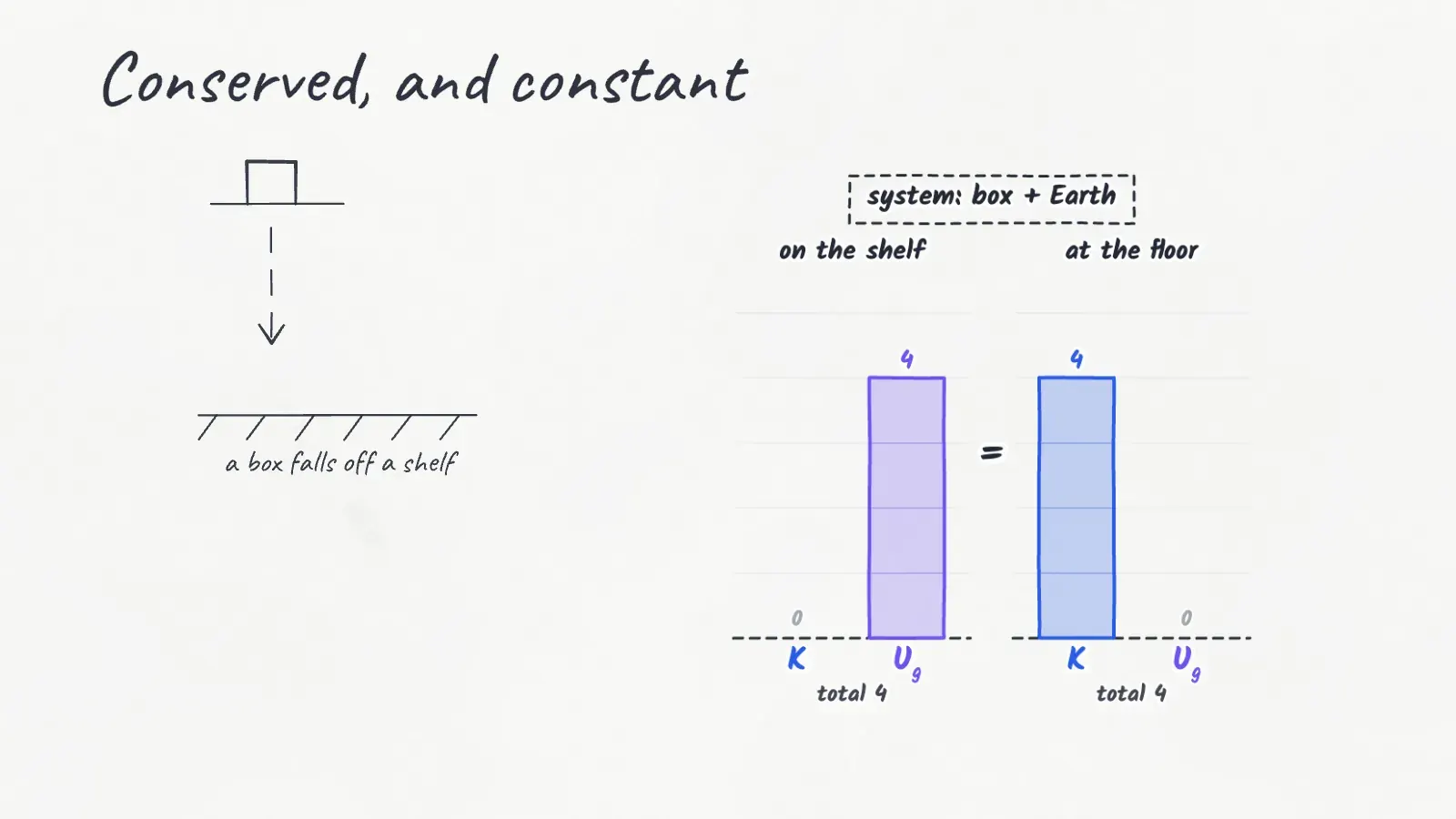
Here’s a simpler one, a box of cereal falling off a shelf. If the box and the Earth are both in my system, the potential energy goes down as it falls and the kinetic energy goes up by exactly the same amount, so the total stays the same. Now let’s draw the line around just the box. A single box can only have kinetic energy, so as it speeds up the system’s energy goes up, and the extra came in from outside, because the Earth’s gravity did work on it the whole way down.
Both stories are true, and neither one creates or destroys a single joule, so energy is conserved in both. What changed is whether the system’s energy stayed constant, and that only happens when no net energy crosses its boundary.
So conserved is a promise about the whole universe, and it never breaks. Constant is a much smaller promise about one system you chose, and it only holds when nothing outside does net work on it. So if you claim a system’s total is constant, you owe a reason, and energy is conserved, so the total is constant, isn’t one, because it skips naming your system and checking whether any energy crosses its boundary.
Would you stand here?
Now let’s put your own face on the line. This is a thousand-kilogram steel wrecking ball on a twenty-meter cable, in an old turbine hall that’s been empty for years. You’re standing on a catwalk with the ball pulled back until it touches your nose, five meters above the bottom of its swing, and in a moment I’m going to let go, and you’re not allowed to flinch.
If I release the ball from rest, right at your face, where does it stop when it swings back toward you? Okay, I’m letting go now, so keep your head perfectly still. It stops a couple of centimeters from your nose. Then it heads back the other way.
So why were you safe? Let’s find out. Our system is the ball, the Earth and the air in the hall. The cable always pulls at right angles to the way the ball is moving, so it never speeds it up or slows it down, and it does no work at all.
Nothing outside pushes the ball along its motion, so the total can’t grow, and the ball can never climb higher than where it started. It stopped a little short because on every swing the ball has to shove its way through the air, which turns a tiny bit of mechanical energy into thermal energy and sound, that thin sliver on the chart.
Now imagine we pump every bit of air out of the hall, and the hook at the top turns without any friction. Where does the ball stop this time?
Let’s test it. The air is gone, the dust has stopped drifting, and here it comes. It came all the way back and just kissed your nose. Lots of people think the air is what keeps this ball from hitting you, and they have it backwards, because even in a perfect vacuum the ball can’t come back higher than it started, since nothing outside did any work on it.
So the air only explains the last couple of centimeters. So how would you get hit? Something outside would have to do work on the system, like a shove as it’s released, and then the total goes up by exactly that much work, and the ball climbs higher by exactly the height that extra energy can buy. Let’s swap your face for a pane of glass. I’d rather break glass than noses.
Now the push is yours. Send the ball back up to the glowing ring, exactly one meter higher than where you let go. Work out how many kilojoules the push has to do, then set the push meter and release it.
Here’s that ten-kilojoule push, one more time, and keep your eye on the glass, because when the ball swings back around, it arrives with energy to spare. And there’s the whole rule in one smashed pane of glass, because the total went up by exactly the work you did, and not one joule more.
Now it’s your experiment. Pick any height you like for the ring, between five and a half and eight meters, work out the push that sends the ball back to exactly that height, and smash another pane.
Now let’s put the air back and run fifty swings in fast-forward. Each swing is a little smaller than the last, and every bit of mechanical energy it loses shows up in the thermal bar, warming the air by an amount you’d never feel. That’s what dissipated means. Every joule is still out there, spread out as thermal energy and sound in places we usually stop counting.
Galileo described one more experiment almost four hundred years ago. He put a peg in the string’s path, so halfway through the swing the ball has to whip up a shorter, tighter arc, and we’ve pumped the air out again. The peg is in the way now. So how high does the ball climb on the far side?
Okay, here it goes, so keep your eye on that line. It climbs right back up to the very same line. The path changed completely, and with no energy added or lost, the ball–Earth system has to end up with the same gravitational potential energy it started with, so the height comes back the same.
Before and after
Let’s turn all that into an equation. When nothing outside does work on the system and nothing inside turns motion into thermal energy, K initial plus U initial equals K final plus U final, and that’s the line you’ll write first on almost every energy problem.
Let’s start with the wrecking ball. I’ll put zero height at the bottom of the swing, and ask how fast the ball is moving there, when it started from rest five meters up, with all of the ball–Earth system’s energy stored as gravitational potential energy. So zero plus m g h equals one half m v squared plus zero, and look what happens to the mass. It’s on both sides, so it cancels, which means a ball twice as heavy would be going exactly as fast.
That leaves v equals the square root of two g h. For g I’ll use ten meters per second squared, the value the AP course itself works with, and the graders won’t mind nine point eight either, so it’s the square root of two times ten times five, a hundred meters squared per second squared, which is ten meters per second. That’s about twenty-two miles an hour, and it’s exactly the speed you’d get by dropping the ball five meters straight down, because with nothing lost along the way, the same drop in height gives the same speed, whatever path the ball takes.
Now let’s do one together. Top Thrill 2, at Cedar Point in Ohio, sends its train straight up a tower a hundred and twenty-eight meters tall, about forty stories, so how fast does the train need to be going at the bottom to coast all the way to the top?
Pick the system first. With the train and the Earth, once the motors stop pushing, nothing outside does work, as long as we ignore friction and air, so think about what it has at the bottom and what it has at the top. At the bottom it’s all kinetic energy, and to just barely make it over it reaches the top with almost no speed, so all of it has become gravitational potential energy.
The mass cancels again, so v is the square root of two times ten times a hundred twenty-eight, about fifty-one meters per second, or roughly a hundred and thirteen miles an hour. The real launch is a hundred and twenty miles an hour, a bit faster than our hundred and thirteen. The extra covers friction and air on the way up. Launch it too slowly, and the train stops short of the top and rolls back down.
Now it’s your turn, with Fury 325, at Carowinds, which crawls over the top of its lift hill and then drops ninety-seven and a half meters. Call its speed at the top zero, ignore friction and air, and work out how fast it’s going at the bottom of the drop, in meters per second.
The park says the real top speed is ninety-five miles an hour, about forty-two and a half meters per second, a little less than our forty-four, so where did the rest go? Most of the drop’s energy arrives as kinetic energy, and the rest became thermal energy in the wheels, the rails and the air, plus the roar you hear from the ground.
When the total changes
The rule for any system at all is that its energy changes by exactly the net energy that crosses its boundary, which in our problems is the work done by forces from outside, so if no net work is done on it, the total stays constant. And when friction or drag acts inside the system, we add the thermal energy it makes on the right, so every joule still has somewhere to go.
There’s a classic puzzle that fits right here. A car rolls down a long hill and keeps speeding up, even with the driver pressing the brakes the whole way, so how can it speed up while the brakes take energy away? Let’s draw the bars for the car, the brakes and the Earth, ignoring the air. At the top there are six blocks of gravitational potential energy and two of kinetic. At the bottom the potential energy is gone, and the speedometer shows it’s going faster, with the kinetic energy up to five blocks.
Finish the chart for me. Drag the thermal bar until the bookkeeping balances, and then we’ll see how the car managed to speed up. So that’s how the car sped up with the brakes on. The hill gave up six blocks, the brakes took only three of them, and the other three went into speed.
Here’s the kind of question the AP exam loves, where one motion gets two different answers. A box slides down a rough ramp from rest, rubbing against it the whole way, and speeds up as it goes.
How does the mechanical energy change for the box alone, and for the box–Earth system? Same slide, two honest answers, and the only thing that changed is where you drew the line.
The sentence that earns the point
Let’s finish with the kind of question that showed up on the 2025 exam, with our own numbers. A two-kilogram block starts from rest on a frictionless thirty-degree ramp, slides half a meter, hits a spring, and squeezes it another half a meter before it stops for an instant.
Let’s put the block, the spring and the Earth in our system, so both potential energies live inside it, with zero height at the lowest point. At release it’s all gravitational, when it touches the spring some has become kinetic, and at the bottom, where it has stopped, it’s all spring energy.
Starting with conservation of energy, the gravitational energy at the top equals the spring energy at the bottom, and the height is where most people lose the point. The block slides a full meter along the ramp, but it only drops that meter times the sine of thirty degrees.
Now I put that in for delta h, and k is the only unknown left, which means I can double both sides and divide by d squared to get it by itself. So k is two m g, times D plus d, times sine theta, over d squared, which with our numbers is twenty joules over a quarter of a square meter, or eighty newtons per meter.
Now let’s draw the energy-versus-position graph. The total stays level at ten joules, gravitational energy falls in a straight line, spring energy is zero until the block touches the spring and then curves up like a parabola, and kinetic energy is the gap that’s left.
And here’s the moment that tripped up a lot of students in 2025. When the block first touches the spring, does it start slowing down right away? Look at the gap, because it keeps growing for a little while after contact. Over the first ten centimeters of squeeze, gravitational energy drops by a whole joule but the spring only stores four tenths of a joule, so the kinetic energy goes up by six tenths, and the block is faster ten centimeters in than when it first touched.
The question says, is the block moving faster when it first touches the spring, or ten centimeters later? Justify your answer. Which of these justifications would earn full credit?
This is the sentence that earns the point on the exam. In 2025 only about one student in five wrote a justification like it, and most answers never put the two energy changes side by side, so name the system and compare both changes.
Mondo’s number
Now let’s go back to Uppsala and keep that promise. Here’s Mondo at the instant the pole hits the box. When a biomechanist measured his run-ups in 2024, Mondo was averaging ten point zero five meters per second over his last three steps, and elite vaulters take off with their center of mass about one and a quarter meters off the ground, so those are our two inputs.
Let’s put the vaulter, the pole and the Earth in our system, exactly the way the exam would want it, and measure height from the runway. At the plant the system has his kinetic energy plus a little gravitational potential energy, because his center of mass starts a meter and a quarter up.
At the top the pole is straight again and he’s barely moving, so almost all of it has become gravitational potential energy. And there goes the mass again, which means we never need to know how heavy he is, so the height he can reach is h naught, his starting height, plus v squared over two g, and now the last step is yours.
Use that equation with his ten point zero five meters per second. Set the bar at the height where the model says his center of mass will peak, then let him go. The world uses the real g, nine point eight one meters per second squared, but ten will get you close.
With the real g, the model puts his center of mass at about six point three nine meters, and the bar he cleared was at six point three one. From his run-up speed and one estimate of his starting height, we’ve landed within about eight centimeters, a hand’s width, of the highest bar anyone has ever cleared.
A real vault loses a little energy at the plant. His arms add a little back on the pole. Our model ignores both, and it still lands a hand’s width from the record. Now take the same run-up to the Moon. Gravity there is a sixth as strong.
On Earth he started one point two four meters up and rose five point one five more. On the Moon, each meter up costs a sixth as much energy. Where does his center of mass peak? Gravity now pulls him back a sixth as hard. In this ideal model he soars to about thirty-two meters, roughly a ten-story building.
Count every hiding place
So before you write a single equation in this unit, draw your system, because what’s inside the line decides which energies even exist. If we treat something as a single object, its only energy is kinetic, and potential energy lives in a system that can store it, like an object and the Earth, or a spring. A system’s total energy changes only when energy crosses its boundary, which here means net work from outside, and its mechanical energy stays constant only when no net work is done on it and nothing inside turns it into thermal energy and sound.
Feynman explained this with a story about a little boy who has twenty-eight blocks that can never break. His mother counts them at the end of every day and always finds twenty-eight, and on the day she finds only twenty-six, she doesn’t decide two blocks vanished, she sees the window is open and finds the other two outside. That open window is your system boundary, and every new hiding place she learns to check, like a toy box she has to weigh, or blocks sunk in a dirty bathtub, is another kind of energy.
In his own words, it is just a strange fact that we can calculate some number, and when we finish watching nature go through her tricks and calculate the number again, it is the same, and today you learned where to look for every joule. Next time we’ll ask how much energy something can transfer every second, which is power, and it’ll tell us how hard Mondo’s legs work to pour all that kinetic energy in during a few seconds of sprinting.