
Topic 3.2 key terms
- work
- The energy a force transfers into or out of a system as the force is exerted on it over a distance. Into the system: positive; out of it: negative. Measured in joules.
- joule (J)
- The unit of work and of every form of energy: 1 J = 1 N·m = 1 kg·m²/s². Lifting a 100 g apple 1 m takes about 1 J.
- positive, negative and zero work
- A force with a component along the motion does positive work (energy in); against the motion, negative work (energy out); perpendicular to the motion, or with no displacement of its point of application, zero work.
- W = Fd cos θ
- Work done by a constant force: the force component parallel to the displacement times the displacement, , with θ the angle between the force and the displacement (tails together).
- work–energy theorem
- The change in an object's kinetic energy equals the net work, the sum of the work done on it by all the forces: .
- conservative force
- A force (gravity, a spring) whose work depends only on the initial and final configurations of the system, not the path, and is zero round any closed path. Only conservative forces have potential energies.
- nonconservative force
- A force (friction, air resistance) whose work depends on the path. Friction removes mechanical energy equal to the friction force times the length of the path.
- point of application
- Where a force acts on a system. Work uses the displacement of this point: if it moves but the system's center of mass does not (drawing a bow), the work changes the system's configuration instead of its kinetic energy.
- area under an F∥–x graph
- For a force that changes along the way, the work equals the area under the graph of the force component along the motion against displacement; area below the axis counts as negative work.
Transcript
2,658 words · 12 parts
Eight hundred sixty meters of ice
Every January, the fastest downhill skiers on Earth squeeze into a wooden hut above Kitzbühel, in Austria, at the top of the Streif, the most feared course in skiing. When the clock beeps, they throw themselves down the start pitch, and seconds later they’re flying through the air at the Mausefalle. From start to finish they drop eight hundred and sixty meters. This number climbing beside the altitude is gravity’s work on a ninety-kilogram racer. It reaches about seven hundred sixty thousand joules by the bottom.
This pale racer is a ghost with nothing but gravity doing work on it. If all of that work became kinetic energy, it would come off the mountain at about four hundred and seventy kilometers an hour.
Real racers are much slower. The fastest top out at about a hundred and forty-five kilometers an hour on the last speed trap. That’s under a third of the ghost’s speed, and kinetic energy goes with the speed squared, so they keep only about a tenth of it. Something took the other nine-tenths.
By the end of this lesson, you’ll add up the work every force does on that racer, and find out where it went. Let’s freeze our racer halfway down and look at every force pushing or pulling on them.
What a force pays
Here’s our racer on a straight stretch. Gravity pulls straight down with the racer’s weight, just under nine hundred newtons. The snow pushes back straight out of the surface. That’s the normal force. On a slope like this, it’s almost as big as the racer’s whole weight.
The snow’s friction and the air push backward along the path. The green arrow down the slope is the racer’s displacement. Before we define anything, here’s a gut check. The snow pushes on the racer almost as hard as their weight. Over the next hundred meters, how much work does that push do on the racer?
It does no work at all. The push is enormous, but it points at right angles to the way the racer is moving. It can’t speed them up or slow them down.
In physics, work is the energy a force moves into a system or out of it. It only happens when the spot where the force pushes actually moves. Gravity hands our racer energy, and the air takes some away.
For a steady force, take the part of the force along the motion and multiply it by how far the force’s spot moves. That’s the work, and it’s on your AP equation sheet. The skill is picking the right part of the force.
Newtons times meters are joules, the same joules as kinetic energy last lesson. One joule is about what it takes to lift an apple one meter. A force along the motion puts energy in, so its work is positive. A force against the motion takes energy out, so its work is negative. A force at right angles does zero work.
Say the air pushes back with two hundred newtons while the racer slides a hundred meters. Two hundred times a hundred is twenty thousand joules. The air takes that energy out, so its work is negative twenty thousand joules. Work has a sign but no direction. It’s a scalar, a number of joules going in or coming out, so you’ll never see an arrow on it.
Only the part along the path
Most forces don’t line up with the motion. The cosine counts only the part along it. So W equals F d cosine theta, where theta is the angle between the force and the displacement, drawn tail to tail.
At zero degrees the cosine is one, and all of the force counts. At ninety degrees the cosine is zero, and none of it does. Past ninety, the cosine turns negative, and so does the work.
Now try it with your own hands. Drag the force around until the work it does turns negative, and watch its shadow on the displacement.
Now gravity on a fifteen-degree stretch, about the Streif’s average. Put gravity and the motion tail to tail, and they’re ninety minus fifteen, seventy-five degrees apart. Cosine seventy-five is the same as sine fifteen. So only the slice of gravity along the slope, m g sine fifteen degrees, does work. It’s the ramp component you used in unit two.
In a carved turn, the snow also pushes the racer sideways. That push is perpendicular to the motion, so it does no work. It swings their direction around without changing their speed. Sorting forces by the sign of their work is a classic AP question. Let’s practice on our racer.
Drag each of these six forces into its pile, by the sign of the work it does. For each force, compare its direction with the motion, and the sign of its work follows.
I do: gravity’s work on the whole run
Let’s find gravity’s work on the whole run, the way you would on the exam. I’ll draw the course as one straight slope, about three point three kilometers long, with an eight-hundred-sixty-meter drop.
The slice of gravity along the slope, m g sine fifteen degrees, pushes the racer the whole length, L. But L times sine fifteen degrees is just the drop. So gravity’s work is the weight times the drop, m g h. Our racer is ninety kilograms with skis and suit, an assumed round number. For g, we’ll use nine point eight meters per second squared, all lesson long.
Ninety kilograms times nine point eight, times eight hundred sixty meters, is about seven hundred sixty thousand joules, or seven hundred sixty kilojoules. That’s the number gravity’s counter climbed to at the start. Notice that the slope’s length dropped out. Only the drop mattered.
The real course bends and changes steepness. Chop it into short, straight pieces, and on each one gravity does m g times that piece’s drop. The drops always stack up to eight hundred sixty meters.
Zero work, and why your arms still ache
Now try this. Hold a twenty-kilogram barbell perfectly still over your head for a minute. Your arms will shake and burn, but you’ll have done zero work on the barbell, because it never moved. A table could hold it up for a year using no energy at all. Your arms tire because your muscles turn chemical energy into thermal energy inside you.
So there are two ways to get zero work. The force’s spot doesn’t move, like the barbell, or the force is at right angles to the motion, like the snow’s push.
We do: where did nine-tenths go?
Here’s the last speed trap, which our model puts at the finish. In January twenty twenty-six, Switzerland’s Alexis Monney hit a hundred forty-five point five kilometers an hour here. That’s about forty meters per second.
Let’s run that last stretch again, with a counter for every force. Gravity’s work climbs, while the air’s and the snow’s go negative. And the change in kinetic energy always equals their total.
That’s the work-energy theorem. Add up the work every force does, and you get the change in kinetic energy. It’s on your AP equation sheet too. Say that on one stretch, gravity puts in fifty thousand joules, and the air and the snow take forty thousand together. Then the racer’s kinetic energy grows by ten thousand joules.
For our racer, the total is gravity’s work, plus the snow’s push, plus the snow’s friction, plus the air’s. The snow’s push does zero work, as we saw. The racer started from rest and reached about forty meters per second at the trap. What’s their kinetic energy there, in joules?
Now move gravity’s work to the other side. Seventy-two kilojoules minus gravity’s seven hundred sixty leaves about negative six hundred ninety kilojoules for the snow and the air. They took back nine-tenths of what gravity put in.
Let’s test the theorem on one more stretch. On this long, gentle glide, the racer holds a steady speed while gravity keeps pulling them downhill. Over that steady stretch, which statement about the work done on the racer is true?
Any line, the same gravity
Now let’s change the line. Here are two racers between the same two gates, one on the tight, direct line and one swinging wide. Watch their counters as they race. Gravity’s work comes out the same for both, because they start and finish at the same heights.
The snow takes far more on the wide line, because that racer slid over many more meters of snow. The air’s number hardly changes. The wide racer is slower, so the air pushes less hard, but over more meters.
Before the gondola takes the racer back up, make a prediction. Over the whole round trip, down the course and back up to the start hut, how much work does gravity do on the racer?
Let’s ride the gondola back to the top and see. The racer goes up while gravity pulls down, so gravity’s work on the way up is negative seven hundred sixty kilojoules. So over the round trip, gravity’s total work is zero. But the air and the snow kept every joule they took, and no ride back up will ever give it back.
Physicists call a force like gravity conservative. Its work depends only on where you start and end. So it’s the same on every path, and zero around any closed loop, like the gondola trip. Friction and the air are nonconservative. Their work depends on the path and how you travel it, and around a loop they never give it back.
A steady friction force takes its size times every meter you slide. That’s why the snow took more from the wide line. A third racer takes an even wider line between the same two gates. Compared with the direct line, what happens to gravity’s work and the snow’s?
This clears up a common trap. A smooth ramp isn’t less work than the stairs to the same height. It trades less force for more distance, and your work against gravity comes out the same.
A force that changes as you pull
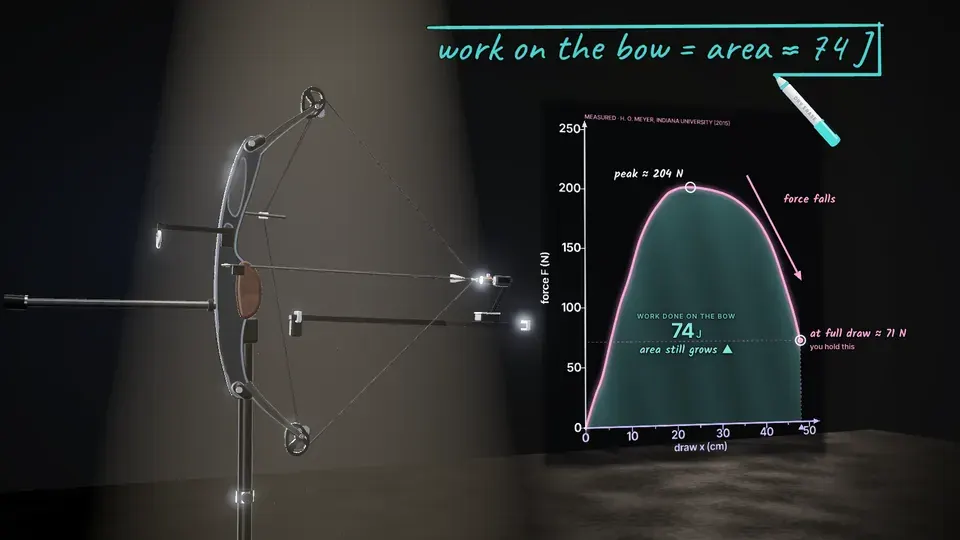
So far our forces have been steady, but plenty of forces change as you push. This is a compound bow, and its force changes in a strange way as you pull. This graph is a real measurement by a physicist at Indiana University, with the force up the side and the draw along the bottom. As the string comes back, the force climbs to about two hundred four newtons.
Now watch the last twenty-five centimeters. The cams roll over, and the force falls, all the way down to about seventy-one newtons at full draw. That’s why an archer can hold it steady while they aim. Look at the graph and the numbers on it. Which of these is the archer’s work on the bow?
How much work did the archer do? Split the pull into tiny steps. Each strip’s height is the force and its width is the step, so its area is that step’s work. So the total work is the whole area under the graph.
On this grid, each square is twenty newtons by five centimeters, which is five hundredths of a meter, so each square is one joule. Count the squares under the curve and you get about seventy-four. The archer did about seventy-four joules of work on the bow. The force fell at the end, but every centimeter still added work, so the area kept growing.
Remember the force’s spot? Its proper name is the point of application. In W equals F d, d is how far that point moves. Here it’s the string, forty-eight centimeters. But the bow’s center of mass didn’t move, so the bow didn’t speed up.
The archer did seventy-four joules of work, but the bow didn’t speed up. Where did that energy go? The work went into the bow’s shape. Its limbs bent and its cams turned. Physicists call that changing the bow’s configuration.
Now the archer holds the string at full draw for ten seconds. How much more work do they do on the bow? When the archer lets go, the string pushes the arrow over that same forty-eight centimeters. The arrow moves with the point the string pushes, so the string’s work becomes its kinetic energy.
Most of the seventy-four joules leave with the arrow, and the rest shake the limbs and the string. The bow was different. It bent, so the archer’s work went into its shape. The work-energy theorem is for things that keep their shape, like the arrow or our racer.
Read the area
When a force changes along the way, graph the force along the motion against the distance moved. The area under that graph is the work. Newtons times meters are joules. If a force points against the motion for part of the trip, its graph dips below the axis, and that part of the area counts as negative work.
This rope pulls a cart forward for the first four meters. For the last two, it pulls backward while the cart keeps rolling forward. How much work does the rope do on the cart over the whole six meters, in joules?
Count each area with its sign. The total is the work. To measure a graph like the bow’s in an AP lab, clamp the bow, pull the string in small steps, and read a force sensor and a meter stick at each one. Then plot force against draw and find the area.
You do: the run-out
This one’s yours. After the finish line, a racer skids sideways to a stop, and only the snow’s friction slows them down. Say a racer crosses the line at twenty meters per second. While they skid, the snow’s friction pushes back with four hundred fifty newtons.
On the flat, gravity and the snow’s push are at right angles to the motion, so only friction does work. How long a run-out does the racer need to stop, in meters? Forty meters of snow, for a racer at twenty meters per second.
The fastest racers come through at about forty meters per second, twice as fast. With the same friction, how many times as long a run-out do they need? Stopping distance grows with the square of the speed. That’s why the fastest racers need so much room after the line.
The sentence that earns the point
Let’s finish with the kind of question the AP exam loves. Two blocks rest on frictionless ice, one kilogram and four kilograms. You push each with the same ten newtons over the same two meters.
Which block ends up with more kinetic energy? Fewer than a third of students get this right, even after a full physics course. Most wrong answers say something true but skip one link. A student says the four-kilogram block ends up with more kinetic energy because it’s heavier. Which response earns full credit for explaining why the student is wrong?
The numbers agree. Ten newtons times two meters is twenty joules of work on each, so each block gains twenty joules of kinetic energy. The heavy one just ends up slower.
Where the 760 kJ went
Let’s go back to our racer’s run. Gravity put in seven hundred sixty kilojoules, through the slice of its pull along the slope. The snow’s push, at right angles, moved no energy at all. Add up every force’s work and you get the change in kinetic energy. Only about a tenth stayed as speed.
Gravity’s work depends only on where you start and end. The air and the snow took the other six hundred ninety, and what they take depends on the path. And when a force changes, like the bow’s, the work is the area under its graph.
Here’s our racer crossing the line. About a tenth of gravity’s energy stayed as speed. In our model, the air took about half, and the snow took most of the rest. Gravity pays the same on every line down this mountain, and the air and the snow charge for the line you choose. Next time, we’ll give gravity’s work a number you can write at every point on this mountain, its potential energy. Only conservative forces get one.