
Topic 3.3 key terms
- system
- The objects you choose to study together. Potential energy belongs to a system of two or more interacting objects, never to one object alone.
- conservative force
- A force whose work depends only on the start and end positions, so a round trip gives back every joule (gravity, an ideal spring). Friction and air resistance are not conservative.
- potential energy
- A scalar, in joules, stored in the arrangement (the positions) of the objects in a system that interact through conservative forces.
- gravitational potential energy (near a surface)
- For an object and a planet near its surface, the change is , where Δy is the change in vertical position (the path does not matter).
- zero of potential energy
- A reference you choose to make a problem easier. Moving it changes every value of U by the same amount and never changes ΔU. U is negative when the system sits below the zero.
- elastic potential energy
- The potential energy of an ideal spring system, , the area under its force–stretch graph.
- equilibrium length
- A spring’s relaxed length, where it exerts no force. Δx in is measured from here, never from the wall.
- spring constant k
- How stiff a spring is: the force per meter of stretch or compression, in N/m.
- gravitational potential energy (general)
- For two spherical masses whose centers are r apart, , with zero at infinite separation, so every real U is negative.
- sum over pairs
- The total potential energy of three or more objects is the sum of the potential energies of every pair in the system.
Transcript
3,770 words · 8 parts
The lake that answers the final whistle
On the fourth of July, 1990, about twenty-five million people in Britain sat down in front of their TVs to watch England play West Germany in the semi-final of the World Cup, and the game went all the way to a penalty shoot-out. England lost. And the moment it ended, millions of people got up off the couch to put the kettle on, open the fridge and switch on the lights, and within a few minutes Britain’s grid had to find two thousand eight hundred extra megawatts, the biggest surge of its kind it has ever recorded.
Most power stations can’t start up anywhere near that fast, so years before that night, engineers in Wales had built a machine for exactly that kind of moment, and the machine is this lake. When the grid calls, gates open under the lake, and the water falls about half a kilometer through the inside of the mountain into a cavern as tall as a fifteen-story building, where six turbines, already spinning on standby, go from zero to thirteen hundred megawatts of output in twelve seconds.
By the end of this lesson, you’ll be able to point at this lake and say exactly where its energy is stored, which turns out not to be in the water at all, and you’ll work out with one line of algebra how much energy the water and the Earth store in this one lake. So let’s start with the strangest part of that promise, because if the energy isn’t in the water, then where on earth is it?
Where is the energy?
Here’s a liter of water from the top lake, and here’s a liter from the bottom lake. They’re made of exactly the same stuff, and if you put them side by side in a lab, nobody could tell them apart. And yet the one up top can spin a turbine on its way down and the one at the bottom can’t, so the difference can’t be anything inside the water.
The only thing that’s different is where each liter is, how far it sits from the Earth. So physicists give this energy to the water and the Earth together, two objects pulling on each other, and they call that pair a system. The energy is stored in how the system is arranged, in how far apart the water and the Earth are.
Let’s test that with a thought experiment, and I want you to commit to an answer before we try it. Imagine we could take the Earth away completely. What happens to the potential energy stored with this lake? So there’s no water–Earth system left, and no potential energy to talk about, because it never belonged to the water in the first place. It belonged to the pair.
And that’s the first habit I’d fix in almost anyone’s notes. People say the water has potential energy, or the ball has potential energy, and AP questions are careful about this, so from now on we’ll say what’s really true, which is that the water–Earth system has it. In general, a system of two or more objects can store potential energy when the objects interact with each other only through conservative forces, and gravity is the most famous one of those.
You met conservative forces in the lesson on work, and the quickest test is a round trip. Lift a book onto a shelf and lower it again, and gravity hands back every joule you put in, but drag a box across a carpet and back, and friction takes energy both ways and returns none of it, so friction can never store potential energy.
And notice what kind of number this is. Potential energy is a scalar, measured in joules, with a size and no direction at all, and for a given system, the only thing that changes it is where the objects are. Okay, let’s see if you can spot it. Which one of these systems can store potential energy and give it back later?
ΔU = mgΔy
So how much energy does a system store when you lift something? Let’s work it out from what you already know about work. If you lift a box at a steady speed, you push up with a force equal to its weight, m g, the whole way.
Work is force times the distance you move in the direction of the force, so the work you do is m g times the height you lift it, delta y, And that energy doesn’t vanish. It goes into the box–Earth system and sits there in its new arrangement, so the change in gravitational potential energy is m g delta y.
This is on the equation sheet you get on the exam, and it comes with one condition, which is that you’re near the surface of a planet, where g barely changes as you go up, and that condition will matter later. Keep an eye on the sign. Lift something and delta y is positive, so delta U is positive and the system has stored energy. Let the water fall and delta y is negative, so delta U is negative, which means the system gave energy away, in this case to the turbines.
Back at the mountain, I can send a tonne of water to the bottom lake three different ways, straight down the shaft, along a long sloping tunnel, or, if I’m feeling rich, hanging under a helicopter over the ridge. All three trips end with exactly the same change in potential energy, because the only thing that counts is how far the water ended up below where it started.
And this is exactly where students lose points on the AP exam. In 2025, one of the free-response questions had a block sliding down a ramp into a spring, and only about four in ten students plugged in the right height or the right compression. A lot of them couldn’t turn the distance along the ramp into a height, when the block actually dropped a height of d sine theta, so with up as positive, delta y is negative d sine theta.
Let’s do the first one on the real mountain. One liter of water has a mass of one kilogram, and it drops about five hundred meters from the top lake to the bottom one, So delta y is negative five hundred meters, and for a real plant we’ll use g equals nine point eight meters per second squared.
One kilogram times nine point eight times negative five hundred meters comes out to negative four thousand nine hundred joules. It’s negative because the system’s potential energy went down, and at the plant that energy goes to the turbines. A kilogram times meters per second squared times meters is a newton-meter, which is a joule.
Now try one with me that sounds enormous. A cube of water one meter on each side has a mass of a whole tonne, a thousand kilograms. If we lift it one meter, about as high as your waist, how much energy have we stored? A thousand times nine point eight times one is nine thousand eight hundred joules, and since a watt-hour is thirty-six hundred joules, that’s about two point seven watt-hours, which is less than one AA battery holds.
A whole tonne of water, lifted a whole meter, and the water–Earth system gains less than one little battery holds, and that’s exactly why the big gravity batteries have to be mountains. Every kilogram adds so little that you need billions of kilograms falling hundreds of meters.
Now you run the crane. One AA battery holds about twelve thousand six hundred joules. How high would you have to lift this tonne of water so that the water–Earth system stores as much energy as one AA battery? Drag the hoist and find out.
So now it’s your turn to do the whole mountain. The water the plant can use has a mass of about six point seven times ten to the ninth kilograms, and it falls about five hundred meters. Find the change in potential energy of the water–Earth system, in units of ten to the thirteenth joules.
And that’s the nine point one gigawatt-hours the physicist David MacKay lists for this plant, worked out the same way, which is enough to charge more than four hundred million phones, even after the plant’s losses. You just measured a mountain with one line of algebra.
Zero is a choice
There’s something I’ve been quietly skipping over. If I ask you for the potential energy of the water–Earth system with this liter sitting up in the top lake, you’d have to ask me a question back, which is measured from where?
Let’s start where maps start, at sea level. The top lake is six hundred thirty-six meters up, so with g rounded to ten, the way the AP exam lets you, the potential energy is sixty-three hundred sixty joules with the liter up top, and a thousand joules with it down in the bottom lake, which sits about a hundred meters above the sea. These are the full-lake levels, a five hundred thirty-six meter drop, so it’s a bit more than the five hundred I rounded to before.
But an engineer at the plant doesn’t care about the sea. They’d put zero at the bottom lake, and now the system is worth fifty-three hundred sixty joules with the liter up top and exactly zero with it at the bottom. And someone standing on the dam up top might put zero right at their feet, and then the potential energy with the liter at the bottom is negative fifty-three hundred sixty joules, because it sits below the zero they picked.
So that’s three people with three different numbers for the same water, and every one of them is right. But look at the change from top to bottom, because it never moved, and it’s negative fifty-three hundred sixty joules for all three. The zero is a choice you make to keep the arithmetic easy, exactly like choosing where zero goes on an axis, and the change in potential energy is the physics, which is the only part nature actually cares about.
Now you try it. Drag the zero plane until the system’s potential energy is positive with the liter at the top and negative with the liter at the bottom, and keep an eye on the change while you do it.
Let’s put all three observers in one table so you can see it at a glance. Each row is a different choice of zero, and next to them I’ll write the change, the bottom value minus the top value.
In the first row, a thousand minus sixty-three hundred sixty is negative fifty-three hundred sixty, and the other two rows give exactly the same answer, even though not one other number in the table matches. Which also takes care of a very common belief, that potential energy can’t be negative. It’s negative whenever the system is arranged below the zero you chose, and soon you’ll see a zero that makes it negative for all of us, all the time.
Springs
Gravity isn’t the only force that stores energy in an arrangement. This is a peacock mantis shrimp, a small animal on tropical reefs, and it hunts snails by punching them. It slowly squeezes a spring built into its arm, holds it with a latch, and then lets go, and its club flies out at up to twenty-three meters per second, hard enough to crack a shell.
A spring stores energy the same way, in the block–spring system, and this time the arrangement that matters is how far the spring is squeezed or stretched from its relaxed length, which we call its equilibrium length. You know from the lesson on springs that the force it takes to hold a spring squeezed by delta x is k times delta x, where k is the spring constant, which measures how stiff the spring is, so the force grows in a straight line as you squeeze.
And you know from the lesson on work that the work you do is the area under the force-versus-distance graph. Here that area is a triangle with a base of delta x and a height of k delta x, so the work, and the energy stored in the spring, is one half times delta x times k delta x.
Put the two delta x’s together and you get one half k delta x squared, which is the spring line on your equation sheet. And delta x is always measured from the spring’s relaxed length, never from the wall it’s attached to. That little square has a big consequence. Squeeze the spring twice as far, and the triangle gets twice as wide and twice as tall at the same time, so its area, which is the energy, goes up by a factor of four.
Let’s see if you can use that. The spring is squeezed two centimeters right now, so squeeze it until the block–spring system stores four times as much energy as it does now.
Let’s do one properly, the way you’d write it on the exam. A spring with a spring constant of eight hundred newtons per meter is compressed five centimeters. I draw the relaxed length, the squeezed length and the delta x between them, and I turn those five centimeters into point zero five meters right away.
One half times eight hundred times point zero five squared is four hundred times point zero zero two five, which is one point zero joules, and newtons per meter times meters squared is a newton-meter, a joule. And here’s why I converted first. If you plug in five instead of point zero five, you get ten thousand joules, which is enough to lift a whole person fourteen meters straight up, out of a spring you could hold in one hand, so that answer fails the sanity check right away.
Now go the other way. A spring with a constant of two hundred newtons per meter is storing point nine zero joules. How far is it compressed, in centimeters?
The well we live in
So far every change in height has been a few hundred meters at most, and over that kind of distance g barely changes. But the farther you get from Earth, the weaker its pull becomes, so to follow a system all the way out into space, we need the real rule.
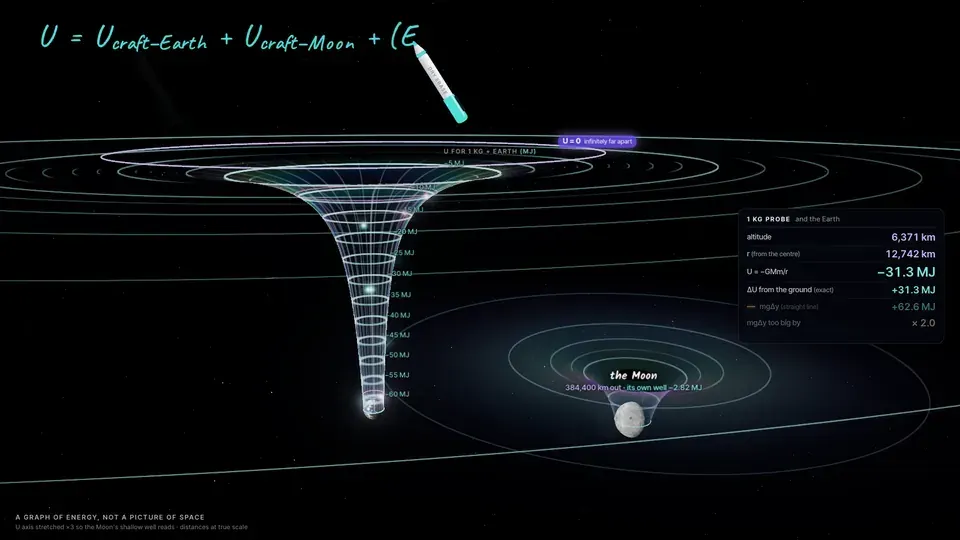
This funnel is a graph. The height of its surface at each distance from Earth’s center is the potential energy of a one-kilogram probe and the Earth, and the formula that draws it is negative G times the two masses, divided by the distance between their centers.
Physicists put the zero for this formula where the two objects are infinitely far apart, so far apart that their pull on each other has faded away completely, which is out at the flat rim. And that one choice has a strange consequence, because every real arrangement sits below the rim, so its potential energy is negative.
You could put zero on the ground instead, the way the engineer did at the bottom lake. Then the ground reads zero, every number above it turns positive, and the changes stay exactly the same. But physicists keep it out at infinity, because that’s the one zero that works for every pair of objects anywhere, a probe and the Earth, the Moon and the Earth, two stars, without anyone having to agree on whose ground to measure from.
Right now, the system made of you and the Earth has a negative potential energy, about negative sixty-three million joules for every kilogram of you. To climb all the way out to zero, each kilogram would need more energy than a kilogram of gasoline holds. Down near the bottom, the wall is almost perfectly straight, and that straight line is our old friend m g delta y.
At the top of Everest, it’s off from the true curve by only about a tenth of a percent. That’s why it works so well for mountains. But keep climbing to the space station, and the straight line has peeled away from the curve by almost seven percent, and out at the GPS satellites it overestimates the change by a factor of four, which is what near the surface really means.
Here’s one to figure out with your hands. Drag the probe up the wall until the potential energy is half as negative as it is on the ground.
And look at the sign of that change. Going from negative sixty-two to negative thirty-one million joules is an increase, because negative thirty-one is higher up the graph, so climbing away from Earth always increases the system’s potential energy, exactly like lifting a box does.
Now let’s add a third object. Put the Moon out here at its real distance, with its own much shallower well, Now the potential energy has a term for every pair, and two of them change as the craft moves, one for the craft and the Earth, and one for the craft and the Moon. Add the two wells along the Earth–Moon line, and the total has a highest point, a ridge.
Before I show you where it is, find it yourself. Drag the craft along that line to where you think the top is, and keep adjusting until it sits right on top.
So the two wells add up to a ridge, and its top sits about thirty-eight thousand kilometers in front of the Moon, right where the Earth and the Moon pull equally hard. In April 2026, the four astronauts of Artemis II coasted up this slope and over the top, after climbing about ninety-eight percent of the way out of Earth’s well.
They didn’t go over at this exact spot, though. This spot is really a mountain pass, the lowest way over the ridge, and their path ran tens of thousands of kilometers off to one side, so they went over a little higher up.
Let’s put that on the board. Here’s the curve again, negative sixty-two point six divided by r, with r counted in Earth radii, and the straight m g delta y line just touching it at the surface.
Double the distance from the center and the potential energy becomes half as negative, and double it again and it halves again, which is exactly what dividing by r does. And don’t let the minus signs trick you. Negative thirty-one is more energy than negative sixty-two, because it’s closer to zero, the same way five degrees below zero is warmer than ten below.
With three objects there are three pairs, so the total has three terms. The Earth–Moon pair counts too, but in this picture we hold the Earth and the Moon still, so that term never changes and it drops out of every delta U. Let’s put real numbers on the ridge. For each kilogram of craft at the top, the craft is three hundred forty-six thousand kilometers from Earth’s center and thirty-eight thousand kilometers from the Moon’s.
The Earth term is negative G times the Earth’s mass times one kilogram, divided by that distance in meters, which comes to about negative one point one five million joules, and the Moon term works out the same way to about negative point one three million joules. Add the two pairs and you get about negative one point two eight million joules, the same height the world shows for the ridge, and the Earth–Moon term would add the same constant to every point, so it can’t move the top.
Two energies, one system
Now let’s put both kinds of potential energy into one system, because that’s exactly how the AP exam likes to ask about it. A block starts from rest at the top of a frictionless ramp, slides down, and runs into a spring at the bottom.
The system is the block, the spring and the Earth, so two of its three pairs have potential energy that changes here, the block and the Earth with m g delta y, and the block and the spring with one half k delta x squared, and the total potential energy is the two of them added together. Which of these four graphs shows the gravitational potential energy of the block–Earth system as the block moves along the ramp?
When the exam asks you to justify a sketch, this is where the points are won or lost. Here’s an answer that earns full credit. The gravitational potential energy of the block–Earth system decreases linearly as the block slides, because delta U g equals m g delta y, and the height drops by d sine theta, so every meter along the ramp takes the same bite out of the potential energy, and a steady drop like that is a straight line.
Now compare that with an answer like, the block loses potential energy as it goes down, which wouldn’t convince a reader, because it gives the energy to the block alone and never says why the graph is a straight line. When you name the system and tie the shape to m g delta y, you’ve written the sentence that earns the point.
Let’s try one more. After the block touches the spring, how does the potential energy of the block–spring system change, and why? Which answer earns full credit?
Back to the mountain
Back in Wales, it’s past midnight, and electricity is cheap because almost everyone is asleep. So the machines inside the mountain run backward, pumping the water half a kilometer back up, and with every tonne that rises, the water–Earth system stores energy for tomorrow’s surprise. So if anyone ever points at this lake and asks you where its energy is, you can tell them. It’s stored in the water and the Earth together, in how far apart they are. That’s the answer we promised you at the very start.
Let’s pull together what we found. Potential energy belongs to a system of objects that push or pull on each other only through conservative forces, never to one of them, and near the ground its change is m g delta y, where only the vertical change counts.
The zero is yours to choose and the change is the physics, springs store one half k delta x squared, and once you leave the surface behind, the real rule is negative G m one m two over r, with one term for every pair. Next time we open the gates and follow that energy as it comes back out, and work out how fast the water is moving when it reaches the bottom.