
Topic 3.5 key terms
- power
- The rate at which energy changes with respect to time, either by transfer into or out of a system or by conversion from one type to another within it. Measured in watts.
- average power
- The energy transferred or converted divided by the time it took: , or equivalently the work done divided by the time: .
- watt (W)
- The SI unit of power: one joule per second ().
- instantaneous power
- The power delivered by one constant force at a single instant: its component parallel to the velocity times the speed, . Negative when the force opposes the motion; zero when the object is at rest.
- net power
- The sum of the powers delivered by all the forces on an object; it equals the rate at which the object's kinetic energy changes, so it is zero at constant speed.
Transcript
2,591 words · 10 parts
Twenty-one bends
In July of 2026, in the third week of the Tour de France, Tadej Pogačar reached the bottom of Alpe d’Huez, the most famous climb in all of cycling. The road climbs the mountainside through twenty-one hairpin bends, each one numbered and named after a rider who won up here, and it rises about eleven hundred meters in less than fourteen kilometers.
He rode straight through the orange smoke of the Dutch corner at bend seven. All the way to the top, he held a brutal pace. He reached the top in thirty-five minutes and twenty-seven seconds, and that broke a record that had stood since the nineteen-nineties. Every fan and every rival would love to know how much power he was putting out on that climb, and his team has never published his power numbers.
But by the end of this lesson, you’ll be able to take a stopwatch, a bathroom scale and the height of a mountain and work out his power yourself, and then work out how long that same mountain would take you. To do that, we first have to figure out what climbing a mountain actually costs, so let’s put him back at the bottom and watch what he’s paying for.
What a mountain costs
Here he is, back at the bottom. I’ve stood a giant ruler beside the mountain, so we can see how high he is at every moment. Every meter he climbs costs energy. Lift a mass m through a height delta h, and the rider–Earth system stores m g delta h of gravitational energy. Watch it pile up in this column as he climbs.
By the top, that’s about eight hundred thousand joules. And every single one of them had to come out of his legs. Now picture yourself on a bike beside him, riding up the same road. You and your bike have the same mass as him and his.
When you both finally reach the top, which of you has done more work against gravity? So the mountain charges you both the same price, and the only thing Pogačar does better is pay it faster.
How fast you pay has a name. Power is the rate at which energy changes, so the more powerful rider is the one who moves the same energy in less time. Energy changes in two ways. It can be transferred into or out of a system, like the heat his ride gives the air. Or it can be converted inside the system, like the food energy in his muscles becoming gravitational energy.
Either way, if an amount of energy delta E changes in a time delta t, the average power is delta E divided by delta t. Joules divided by seconds gives joules per second, and that unit has its own name, the watt. Don’t mix up power and energy. Energy is the amount you spend, and power is how fast you spend it.
Watts are hard to feel until you’ve met a few, so make a guess first. About how much power do you think Pogačar needed just to lift himself and his bike up that mountain?
Stopwatch detective
This is a classic AP question, so let’s do it the exam’s way, starting with a quick sketch where up is positive. Pogačar has a mass of sixty-six kilograms and his bike about seven, so seventy-three kilograms together. He climbed about eleven hundred meters, and thirty-five minutes and twenty-seven seconds is about twenty-one hundred seconds.
For g, I’ll use ten meters per second squared. That’s the value the exam uses. His speed barely changes from bottom to top, so the energy that changed is m g delta h, and his average power is m g delta h divided by delta t.
Seventy-three times ten times eleven hundred is about eight hundred thousand joules. That’s the energy he paid, spread over about twenty-one hundred seconds. You finish it. Divide the eight hundred thousand joules by the twenty-one hundred seconds, and tell me how many watts you get.
Is that a lot? In 2015, a lab found that Chris Froome, who’d just won the Tour, could hold about four hundred twenty watts for an hour. So three hundred eighty is right up near the human limit.
That’s only the lifting. He’s also shoving air aside and squashing his tires against the road, so his legs made even more. We’ll come back for those missing watts.
Power is not strength
Before we go back to the mountain, let’s settle an old gym argument. Who is the most powerful person in the room? On the left, Raul Flores of Mexico deadlifted five hundred eleven kilograms in 2026, the heaviest deadlift ever. And on the right, Lasha Talakhadze of Georgia snatched two hundred twenty-five kilograms, the heaviest snatch in history, from the floor to straight overhead in one movement. Before either of them moves, I want you to predict which of these two athletes is more powerful.
Look at that! He’s already overhead, and the deadlift is still grinding. We’ll count the snatch only up to the end of its pull. After that, nobody pushes the bar. It flies up on its own.
And this surprised me. By the end of each push, the whole deadlift and the snatch’s pull, both bars got about the same energy, about twenty-five hundred joules and twenty-seven hundred.
Work is the energy a force transfers, so average power is the work divided by the time, and we can do the deadlift together. The deadlift’s column shows about twenty-five hundred joules, and the lift took three point six seconds. Twenty-five hundred divided by three point six is about seven hundred watts.
Now you do the snatch. The pull puts about twenty-seven hundred joules into the bar in zero point eight four seconds, so what’s its average power, in watts?
The snatch pull is about four and a half times as powerful as the heaviest deadlift in history. The difference is the clock. Let’s cross out the idea that the strongest person in the room is the most powerful. Strength is force, and power is how fast you deliver energy.
Force times speed
Both lifters finish by holding their bars still. The snatcher pushes up with about twenty-two hundred newtons, the deadlifter with about five thousand, and both power meters read zero. Huge forces, but the bars don’t move, so no energy goes into them. Force alone makes no power. The bar has to move.
So how much power does a moving force deliver? Start with work over time. For a steady force, the work is its part along the motion, F parallel, times the displacement d. But over a short enough time, d over delta t is just the object’s speed v at that moment, so the power at that instant is F parallel times v.
It’s the move we made for velocity in Unit 1. Shrink the time, and the average becomes the value at one instant. So W over delta t is an average, and F parallel times v is the power right now.
Watch the snatch again. The trail glows brighter when F times v is bigger. It glows as the bar leaves the floor, dims at his knees, and goes white-hot in the second pull.
That’s F times v at work. At his knees he eases off, and the bar slows, so the power dips. In the second pull he pulls hardest while the bar moves fastest, and the power spikes.
Now find a moment when the bar is up off the floor but the lifter’s power is exactly zero. Scrub through the lift and stop when you think you’ve found one.
When the deadlifter lowers his bar under control, he still pushes up while the bar moves down. His force points against the motion, so his power is negative. Energy flows out of the bar.
If a force points at an angle theta to the motion, only its part along the motion counts. That part is F cos theta, so the power is F v cos theta, the form on your equation sheet. Along the motion, cos zero is one, and the force feeds energy in. At ninety degrees, the cosine is zero, so there’s no power at all. Straight against the motion, it’s minus one, and the power is negative, like the deadlifter lowering his bar.
A rope pulls a sled across level snow with fifty newtons, sixty degrees above the snow, and the sled slides at two meters per second. How many watts does the rope deliver?
The whole climb, one force
So now we have a second route to power, force times velocity. Does it give the same answer on the mountain? To find the force, let’s straighten the road out, lifting all twenty-one hairpins off the mountain and laying them in one straight line, to scale. That’s the climb, thirteen point eight kilometers long and only about eleven hundred meters high, a slope of less than five degrees. Gravity pulls straight down, but he rides along the road, so only gravity’s part along the road counts, like the rope’s.
On a ramp, that part is his weight times the rise over the length of road. It points back down the road. Let’s work it out together, using the climb’s average slope. Eleven hundred meters over thirteen thousand eight hundred meters is about zero point zero eight.
So gravity’s pull along the road is seventy-three times ten times zero point zero eight, about fifty-eight newtons. At a steady speed, his push up the road has to match that pull back, about fifty-eight newtons. We’ll add the air later.
He rides thirteen thousand eight hundred meters in twenty-one hundred seconds, about six point six meters per second. On our even ramp his push never changes, so his average speed gives his average power. You do the last step. Multiply his push, fifty-eight newtons, by his average speed. How many watts is that?
Wait. That’s the same answer we got from the stopwatch! It isn’t luck. In symbols, the length of road cancels, and you’re left with m g delta h over delta t, the stopwatch formula. Gravity’s fifty-eight newtons point the other way, back down the road, against his motion. So gravity’s power on him is negative, about minus three hundred eighty watts.
The missing watts
So if gravity takes three hundred eighty watts, let’s give him exactly three hundred eighty watts and see whether he matches his record. At three hundred eighty watts he needs thirty-nine minutes and thirty-one seconds, about four minutes slower than he actually rode, so three hundred eighty watts isn’t enough. In our model, he needs about four hundred thirty watts to match his record. So about fifty watts went somewhere other than height.
Now take just him and his bike as the system, and clip a power meter on every outside force, averaged over the climb. His legs supply about four hundred thirty watts, through the road’s push on his tire.
Gravity takes about three hundred eighty watts back out, and the air he shoves aside plus his squashing tires take about fifty more, and that’s where our missing watts went. Add all three up, plus four thirty, minus three eighty, minus fifty, and you get zero, so the net power on him is zero while he’s working as hard as he can. The net power meter reads zero watts. What does that tell you about him?
So when you use P equals F v, name the force first. Plug in the net force, and you get the net power, how fast his kinetic energy changes. On a steady climb, that’s zero. That zero doesn’t mean his legs are resting. Their power shows up in the one force they drive, the road’s push on his tire, about four hundred thirty watts.
Your mountain
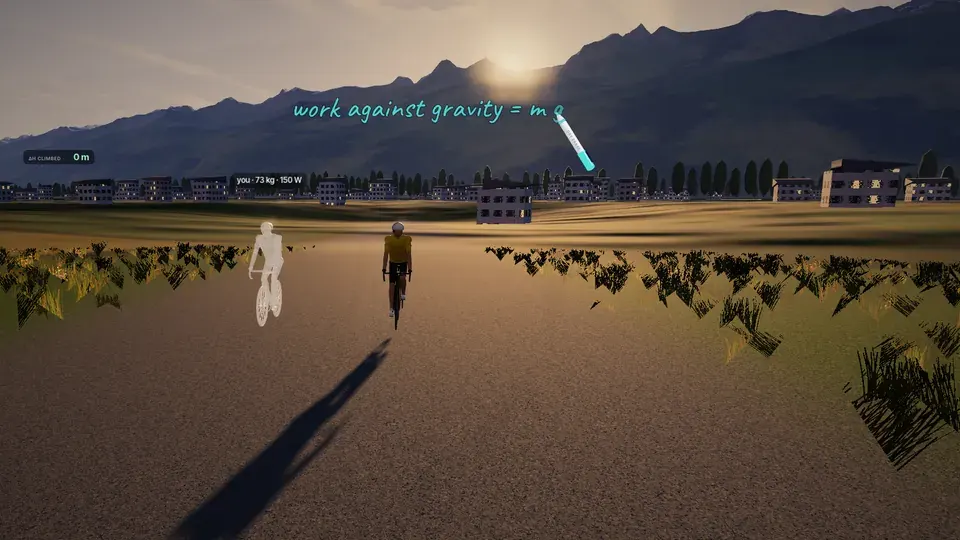
Okay, now it’s your turn. You and your bike have the same mass as him and his bike, so the mountain charges you the same eight hundred thousand joules. Say your legs make a steady hundred and fifty watts. Let’s pretend all of it goes into lifting you.
How many minutes would it take you to reach the top? Use the same equation we used for him, solved for the time.
You don’t need the Alps to measure your own power. A staircase does the same job, and designing that experiment is the kind of thing the exam asks. You measure your mass on a scale, the vertical height by measuring one step and counting them, and the time with a stopwatch, and your power is m g delta h over delta t.
People often measure one more thing that isn’t needed at all. Which one can you skip? Now leave the bike and run up four floors, timing yourself at every landing. Each three-meter floor stores about two thousand joules. Your energy against time falls close to a straight line, and its slope, in joules per second, is your average power.
To find the slope, use two points far apart on the line itself, not two of the dots. The line reads about a thousand joules at two seconds, and about seven thousand at fourteen. What’s your average power?
The sentence that earns the point
Let’s finish with the kind of power question the AP exam asks. A motor lifts a crate of mass M at constant speed through a height H in a time delta t. The crate’s speed doesn’t change, so the only energy that changes is gravitational, M g H, and the motor’s average power is M g H over delta t.
The exam asked a question like this in 2019, and the graders reported that one of the most frequent answers was M H over delta t, with the g missing. A quick units check catches it, because kilogram meters per second isn’t a watt, so that can’t be a power.
Then it asks what happens to the motor’s power if the same lift takes half the time. It also asks why. A full-credit answer sounds like this. The crate gains the same energy, M g H, either way, so to transfer that energy in half the time, the motor’s power must double, as shown by P equals delta E over delta t.
Compare that with this answer: “It needs more power because it’s going faster.” It’s true, but it never names the energy or an equation, and that loses the point. Here’s a slightly different version. The motor now lifts a crate with twice the mass through the same height in the same time. Which explanation would earn full credit?
Top of the Alpe
So let’s go back to the Alpe one last time. Now you know something his rivals would love to know. With a stopwatch, a scale and the height of a mountain, you worked out that he lifted himself at about three hundred eighty watts, and the model showed his legs made about four hundred thirty in all. And you? At a hundred fifty watts, that same mountain would take you at least eighty-nine minutes.
Power is how fast energy moves into, out of, or within a system. Average power is the energy that changed divided by the time, the slope of energy against time. The power of one force is F parallel times v, or F v cos theta. It’s zero when nothing moves, when nothing pushes, or when the push is sideways, and negative when the force opposes the motion.
The same energy in less time means more power. That wraps up energy for now. Next we start momentum, the quantity that decides what happens when things crash into each other.