
Topic 4.1 key terms
- momentum
- Linear momentum: an object's mass times its velocity, . A vector that points the same way as the velocity, measured in kilogram meters per second (kg·m/s).
- kg·m/s
- The unit of momentum: kilograms times meters per second. It has no special name (it is the same unit as the newton-second, N·s, used for impulse).
- linear momentum
- The momentum of an object moving from place to place (along any path), . In this course, "momentum" means linear momentum unless a problem says otherwise; rotating objects have angular momentum (Unit 6).
- momentum of a system
- The vector sum of the momenta of all the objects in the system, . It can be zero even when every part is moving.
- collision model
- A model for an interaction in which the forces between the objects are much larger than the net external force on them, so the external forces can be neglected during the interaction.
- object model
- Treating an object as a single point with a mass and a velocity. Because the collision model only analyzes the states just before and just after, each object can be treated this way.
- explosion model
- A model for an interaction in which forces internal to a system push objects within the system apart, like a gun firing a shell or two skaters pushing off each other.
- internal force
- A force that one part of a system exerts on another part of the same system. Which forces are internal depends on what you choose to include in the system.
- external force
- A force exerted on the system by something outside it, such as gravity from another body or friction from the ground.
Transcript
2,572 words · 8 parts
We moved a moon
This is the view from the camera on a NASA spacecraft called DART, on the twenty-sixth of September, 2022, eleven million kilometers from Earth and flying straight at a tiny moon. The bright dot is an asteroid called Didymos, and the speck beside it is its moon, Dimorphos, a pile of loose rock about a hundred and fifty meters wide. DART was doing about six kilometers every second and sending a picture home roughly once a second, so every frame you see is closer than the one before it.
And that last picture never finished, because the spacecraft hit the moon while its camera was still sending it. NASA did this on purpose, flying a spacecraft the size of a vending machine into a moon to find out whether we could push a rock like that off course before one ever comes for us. And there’s no bang at all. There’s no air out there to carry one.
For weeks afterward, telescopes on Earth timed the moon going around Didymos, and each trip around was taking thirty-three minutes less, when NASA’s bar for success had been a little over a minute. So how does something the size of a vending machine move a moon? By the end of this lesson, you’ll be able to work out how much momentum it carried and compare it with anything that moves, from a fastball to a battleship.
You’ll also see why the scientists needed only two snapshots of the crash, one just before and one just after. You’ve heard people say a team has momentum when it’s on a roll. In physics the word means something much more exact, a number with units and a direction that you can work out for a running back or a spacecraft.
Mass times velocity
Let’s start with something a lot slower than DART. Imagine a big truck and a skateboard rolling toward you at the same speed, and you have to stop one of them with your hands. You’d pick the skateboard, of course, because the truck has far more mass, and at the same speed all that mass is what makes it so much harder to stop. But now park the truck. It has all that mass and it’s not going anywhere, so there’s nothing to stop at all.
Now picture a skateboard flying at you really fast, and a truck barely creeping toward you. Which one do you think is harder to stop? A skateboard flying at you fast enough can beat a truck that’s barely creeping, or lose to it. The mass matters and the speed matters, and what counts is the two of them together.
That combination is what physicists call momentum. We write it with the letter p, and it’s the mass of an object multiplied by its velocity, so p with an arrow on top equals m times v with an arrow on top. Mass is in kilograms and velocity is in meters per second, so momentum comes out in kilogram meters per second.
The AP exam hands you an equation sheet with p equals m v printed right on it. What the sheet can’t do is remember for you what that little arrow means, and a lot of points ride on it.
So how big was DART’s momentum? We’ll round the numbers before we use NASA’s. Its mass was about six hundred kilograms, and it hit at about six thousand meters per second. Momentum is mass times velocity, so that’s six hundred times six thousand, which is three point six million kilogram meters per second. NASA’s measured values are on the board, and they give three point five six million, almost the same answer.
Now put that on the spacecraft itself. Here’s DART two seconds before impact, with its velocity drawn as an arrow pointing the way it’s flying. Here’s its momentum, a second arrow pointing the same way, because mass is never negative. The two arrows measure different things, so never compare their lengths.
Suppose NASA had built a spacecraft twice as heavy as DART. Set its speed so that it carries the same momentum DART did. The ghost arrow shows you the target.
Who has more?
Momentum is a product, so it can play tricks on your instincts. Here’s a comparison that sounds wrong at first. The fastest pitch ever tracked in Major League Baseball came from Aroldis Chapman in 2010, at forty-seven point three meters per second, and a baseball’s mass is a hundred and forty-five grams. Multiply them, and the fastest pitch ever tracked carries about six point nine kilogram meters per second.
Picture a student with a mass of sixty kilograms, walking to class at a normal pace, about one point four meters every second. She carries more than ten times as much momentum as the fastest pitch ever tracked.
Now you try one. Derrick Henry, one of the hardest running backs to bring down, has a mass of a hundred and twelve kilograms. On a long touchdown run in 2021, the league’s tracking clocked him at nine point seven five meters per second. What was Derrick Henry’s momentum at that top speed, in kilogram meters per second?
Here they all are on one ladder, where every step up means ten times more momentum. A highway SUV, fifteen hundred kilograms at thirty meters per second, sits here at forty-five thousand. DART carries about eighty times as much.
So when a question asks which object has more momentum, don’t let the heavier one win just because it’s heavier, or the faster one just because it’s faster. Multiply first, then compare.
The arrow points
So far we’ve only talked about how big a momentum is, but momentum is a vector, so it has a direction too, and DART’s direction was the whole point of the mission. Let’s put an axis along DART’s path through the impact point and make positive the direction Dimorphos is moving as it goes around Didymos, at about seventeen centimeters every second.
That’s slower than a slow walk. But the little moon has a mass of a few billion kilograms, so its momentum is more than a hundred times DART’s. We have to break its arrow just to fit it on the screen.
DART came in almost head-on, against the moonlet’s motion. On this axis, its velocity is negative. Momentum points wherever velocity points, so its momentum is negative too, about negative three and a half million kilogram meters per second.
That minus sign only tells you which way the arrow points on the axis we chose. DART didn’t have less momentum. There’s no such thing as a negative amount of motion.
If I flip the axis so positive points the other way, every sign flips, and DART’s momentum becomes positive. Nothing out there moved at all. The axis is a choice we make, and the spacecraft doesn’t care.
Now flip it back, so positive is the moonlet’s way again. NASA aimed DART against that motion on purpose, to slow the moonlet down. Slow a moon even for an instant, and it drops into a slightly tighter orbit and comes around sooner.
Now you aim it. Turn the dial so that DART’s momentum points the same way the moonlet is moving, and watch what would have happened to the orbit.
Momentum always points the same way as the velocity, because mass is never negative, so it can never turn the arrow around. In one dimension we write p sub x equals m times v sub x, so the sign of the velocity carries straight into the momentum.
That’s why a negative momentum is never a smaller momentum. An object with negative six kilogram meters per second carries as much as one with positive six, just in the opposite direction. For a whole system of objects, the momentum is the sum of all their momentum arrows. In one dimension, that just means adding them up with their signs.
Here are two identical carts rolling toward each other at the same speed. What is the total momentum of the system made of these two carts? I love this one, because it means a system can be full of motion and have no momentum at all. We’ll see that again with a battleship.
If the carts aren’t identical, the arrows stop canceling. A three-kilogram cart at two meters per second carries plus six kilogram meters per second. A two-kilogram cart coming the other way at two and a half meters per second carries negative five kilogram meters per second, so together they carry plus one kilogram meter per second.
The AP exam loves to hide the velocity inside a graph. Here’s the position of a two-kilogram block gliding along a smooth, level track, plotted against time. To find its momentum we need its velocity, and on a position graph the velocity is the slope, which is the same everywhere on a straight line like this one. Using the graph, what is the block’s momentum in kilogram meters per second, including its sign?
Two snapshots
Let’s go back to DART one more time and slow the crash itself down ten thousand times, so we can actually watch it happen. Before we watch it, I want you to predict it. Drag the dot to where you think DART’s own momentum ends up just after the crash, and then run the crash to test your guess.
During that millisecond, DART and the moon push on each other with an enormous force, billions of newtons. Now compare that with the biggest outside force on the moonlet. The Sun is far away but enormous, so its pull beats little Didymos’s, at about twenty million newtons. The crash beats it by hundreds of times.
That’s what a physicist means by a collision. It’s an interaction where the forces the objects exert on each other are much larger than the net external force on them. So during the crash, nothing outside can change the total momentum much, and we can skip the middle. We need just two snapshots, one just before and one just after. In each one, every object is a dot with a mass and a velocity.
That’s what happened with DART. The before came from DART’s own tracking and from years of timing the moonlet with telescopes. The camera went dark during the crash itself, and the after came from weeks more of that timing, so nobody ever needed to see the crush.
Write this one down, because the exam asks for it by name. When the forces between the objects are much larger than the net outside force, only the moments just before and just after matter.
Because only those two moments matter, we can treat each object as a single dot with a mass and a velocity. That’s the object model, the same one we’ve used since Unit 1. So how much larger is much larger? A golf club pushes on the ball about eighteen thousand times harder than the ball’s weight, and DART beat the Sun’s pull by hundreds of times.
The outside forces never disappear. Gravity and friction still act during these crashes. The model works because they’re tiny compared with the push between the objects, and only while that push lasts. Which of these interactions is the worst fit for the collision model?
Bursting apart
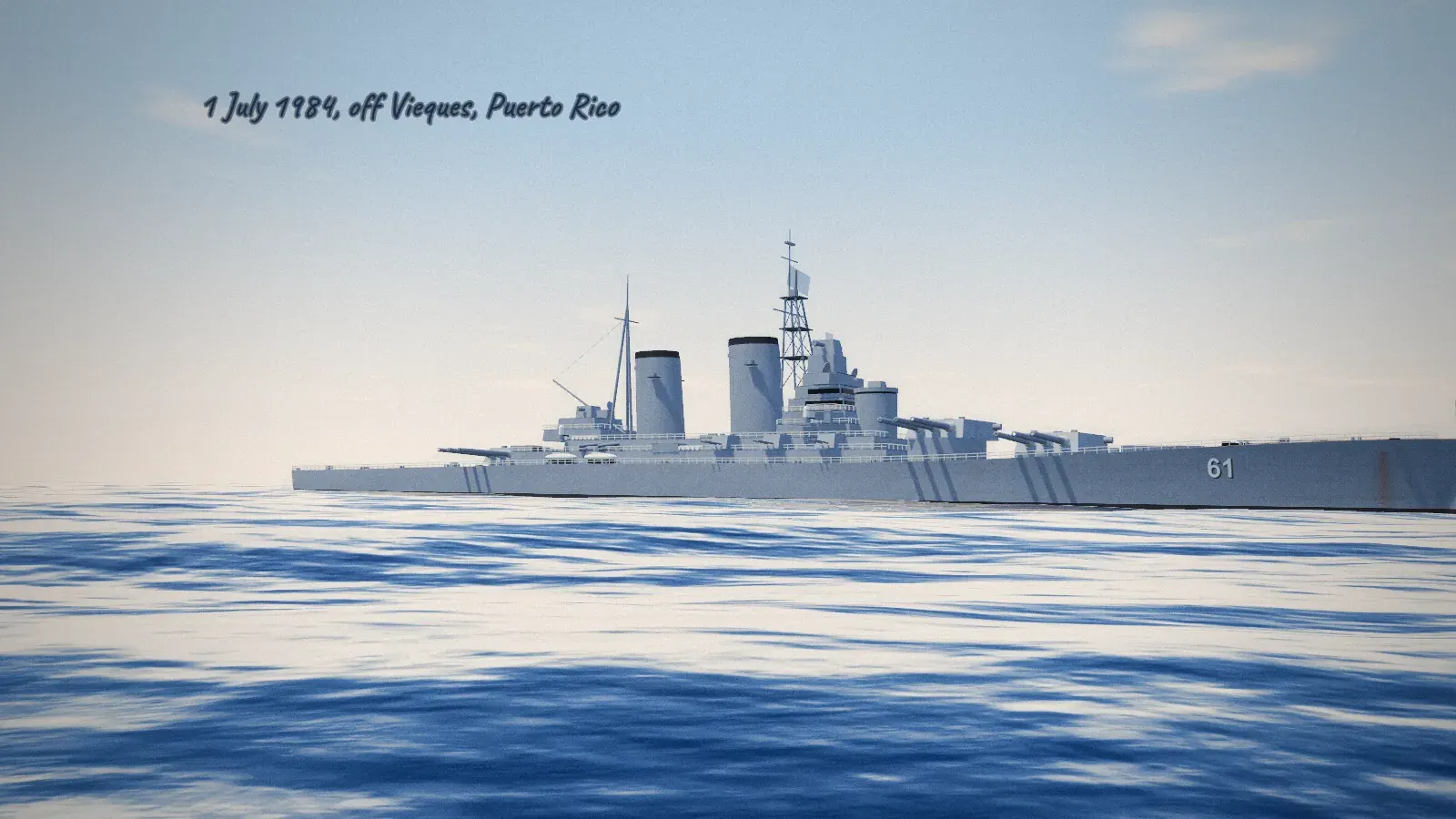
Now let’s run a collision backward. On the first of July, 1984, off the coast of Puerto Rico, the battleship USS Iowa fired all nine of its big guns at once, all to the same side.
Look at the water beside the ship, flattened into a huge ring. People online love to say that’s the recoil shoving the whole ship sideways through the sea. That ring is really the blast from the guns pressing down on the water. But the recoil question is a good one, so let’s answer it with momentum.
This is what physicists call an explosion. It’s an interaction where forces inside a system push the parts of that system apart, and here the system is the ship, its guns, the powder and the nine shells, all together. I’m putting the whole ship in the system on purpose, because each gun’s mount passes the push straight into the hull. That way, every shove in the firing is an inside force.
Call the direction the shells fly positive. Before the guns fire, nothing moves sideways, so the whole system’s momentum along that axis is zero. Together, the nine shells carry about eight point four million kilogram meters per second out to the side, more than twice what DART hit its moon with. The shells fly out to one side. Which way do you think the ship’s momentum points?
Here’s why. Each gun shoves its shell forward, and the shell shoves the gun back just as hard. Those pushes are inside the system, so they can’t change its total momentum. The total started at zero, so it stays zero. Lesson four point three proves it.
So the ship carries about eight point four million the other way. The ship’s mass is about fifty-eight million kilograms. How fast do you think it moves sideways when all nine shells leave?
Divide the ship’s eight point four million by its fifty-eight million kilograms. That’s about point one four meters per second the other way, fourteen centimeters a second. Then the water stops it. So the ring isn’t the recoil. The ship really does move, but barely, because fifty-eight million kilograms is an awful lot of mass to get going.
Justify it
On the exam, a classic question describes an interaction and asks whether the collision model applies. Then it asks you to justify your answer. Take a golf drive. The club touches the ball for about half a millisecond and pushes on it with about eight thousand newtons, and the ball’s weight is about half a newton. The tempting answer is “yes, because it’s a collision”, and that doesn’t earn the point, because it repeats the question without comparing any forces.
A full-credit answer sounds like this. Yes, the collision model applies, because the club’s force on the ball is about eighteen thousand times its weight. So during the contact we can ignore the weight and use only the ball’s momentum just before and just after. Now justify the crash this lesson started with. Which response would earn full credit for using the collision model on DART’s impact?
Two snapshots, one arrow
So you can do what I promised. DART carried about three and a half million kilogram meters per second, because momentum is mass times velocity. That’s about eighty highway SUVs. Multiply before you compare. That’s why a walker beats the fastest pitch, and the little moon crawling at seventeen centimeters a second beats DART.
Momentum points wherever the velocity points, so on an axis its sign is its direction. A system’s momentum is the sum of all its arrows, and it can be zero even when everything moves. When the push between objects dwarfs every outside force, two snapshots are enough, one just before and one just after. And when forces inside a system push its parts apart, like the Iowa’s broadside, that’s an explosion.
Out at Didymos, the little moon is still going around on its new, slightly tighter orbit, once every eleven hours and twenty-two minutes instead of eleven hours and fifty-five. In the next lesson, we’ll open up that tiny moment in the middle of a crash and see what it takes to change an object’s momentum.