
Topic 4.4 key terms
- system kinetic energy
- The sum of every object’s kinetic energy, . A scalar: it has no direction and is never negative, so nothing cancels.
- elastic collision
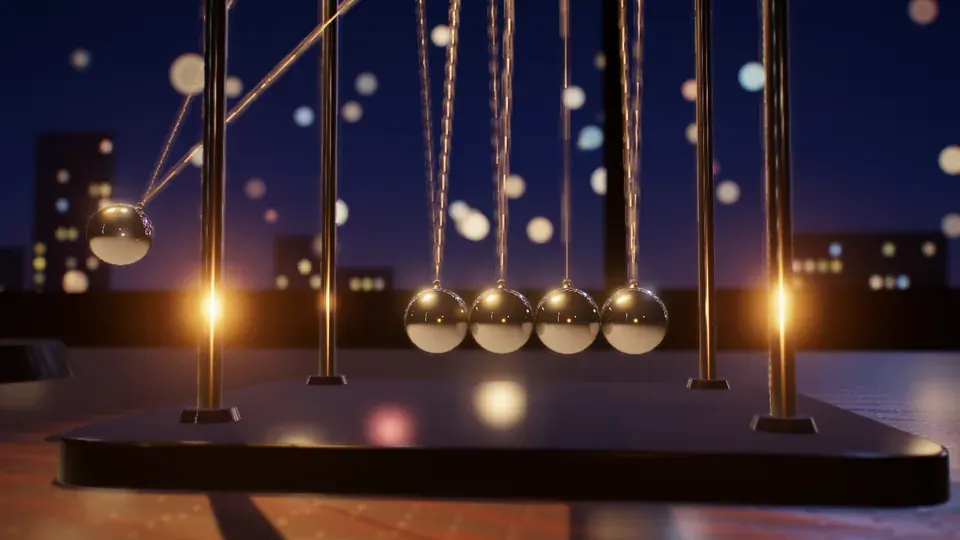
- A collision in which the system’s total kinetic energy after equals its total kinetic energy before. Each object’s own kinetic energy may still change (the first ball of a Newton’s cradle gives all of its kinetic energy to the last).
- inelastic collision
- A collision in which the system’s total kinetic energy decreases. Momentum is still conserved if no outside force acts during the collision.
- perfectly inelastic collision
- A collision in which the objects stick together and move with the same velocity afterward, . It loses the most kinetic energy possible, but all of it only if .
- nonconservative forces
- Forces such as crushing, rubbing and denting whose work is not stored as potential energy that can come back. In an inelastic collision they turn some kinetic energy into internal energy and sound.
- internal energy
- Energy inside the objects (the random motion of their particles, felt as warmth). Where most of the missing kinetic energy of an inelastic collision ends up.
- fraction of K kept when objects stick
- For an object of mass sticking to at rest: , the moving object’s share of the total mass (one half for equal masses).
Transcript
3,522 words · 9 parts
Higher than you dropped it
This is an ordinary tennis ball, and if you drop it from about seventy centimeters onto a hard floor, it bounces back up about forty centimeters. A basketball dropped from the same height comes back up about forty-two centimeters. So let’s balance the tennis ball on the basketball and drop them together, from the same height.
Where will the tennis ball peak? Drag the marker there. And look at that! The tennis ball rose one point seven two meters off the basketball, more than four times its own bounce, and the basketball barely left the floor. In slow motion the basketball squashes flat against the floor, and then the tennis ball leaves like it was fired out of a cannon.
A physicist named Rod Cross filmed and measured exactly this drop in 2007, and we’ll use his numbers all lesson. So where did the tennis ball get all that extra energy? It ended up more than twice as high as you dropped it from, which looks like energy out of nothing.
By the end of this lesson, you’ll be able to explain exactly where that energy came from, and look at any collision, a bounce, a pool shot, a crash, and say whether its kinetic energy survived, and if not, where it went. To do that, we’ll keep two ledgers on every collision, one for momentum and one for kinetic energy.
Two ledgers
Let’s start with a collision you’ve seen a hundred times, a Newton’s cradle. Pull one ball back and let it go, and one ball flies out the other side and back again, click after click, for a surprisingly long time. Now let’s build the same machine big enough to get your attention, five hollow steel balls almost a meter across and about nine hundred kilograms each, hanging from a gantry in a shipyard.
Pull back two and two swing out, and our first ledger, momentum, is one you already know. During the clang the balls push on each other far harder than anything outside pushes on them, so the system’s momentum just after equals the momentum just before.
So why two, and why doesn’t one ball fly out twice as fast instead? That’s a classic AP-style question, and momentum alone would be perfectly happy with either answer, because one ball moving at two v carries exactly the same momentum as two balls moving at v. That’s where the second ledger comes in. Kinetic energy, one half m v squared, has no direction, so it never cancels, and the system’s total is just every object’s kinetic energy added up.
So let’s play designer. Two balls are coming in at v, you choose how many balls leave and how fast, and see if you can find the outcome that balances both ledgers at once.
And that’s why the cradle does what it does. If every ball that leaves shares one speed, a collision that keeps its kinetic energy allows just one of those outcomes, two balls at v, and the cradle picks it every single time. A real cradle needs one more thing, though, because the squeeze has to travel cleanly down the row, ball to ball, and in slow motion you can watch it go.
Now watch each ball’s kinetic energy through a single clang. Before it, all of the kinetic energy belongs to the first ball, and after it, the first ball is hanging still and every joule belongs to the last one. So each ball’s kinetic energy changed completely while the system’s total didn’t change at all, and when a collision keeps the system’s kinetic energy the same after as before, we call it elastic.
Elastic, inelastic, and impossible
Let’s write the two ledgers down. The system’s momentum adds up each object’s mass times velocity, with a sign for direction, and its kinetic energy adds up each object’s one half m v squared, with no signs at all, because kinetic energy is never negative.
Now we can sort every collision there is. In an elastic collision the system’s kinetic energy is the same after as before, in an inelastic collision it goes down, and when the objects stick together and move off with one shared velocity, we call it perfectly inelastic. Momentum is conserved in all three as long as nothing outside is pushing, but kinetic energy can go missing, and treating those two conservation laws as if they were interchangeable is one of the most reliable ways to lose points on the AP exam.
And this is exactly how the exam likes to test it. On the 2026 AP exam, a disk bounced off another disk three times as heavy, and the question never said whether the collision was elastic, so you had to work out the kinetic energy from the momentum yourself, and we’ll do that exact collision later on.
Let’s test this on a two-kilogram ball moving at three meters per second that hits an identical ball sitting still. Here are four things that could happen next, and every one of them keeps the system’s six kilogram meters per second of momentum, so it’s up to the kinetic energy to decide. Before we work out any kinetic energy, one of these four outcomes can’t happen, so see if you can spot it.
The system starts with nine joules. If A stops dead and B leaves at three meters per second, it still has nine, which is elastic, the cradle’s outcome. If they stick and share one and a half meters per second, each ball has one half times two times one point five squared, two and a quarter joules, so the pair has four and a half joules, and half the kinetic energy is gone, and the split where A keeps half a meter per second and B takes two and a half lands in between, an ordinary inelastic collision.
But look at the last one. A bounces back at one meter per second and B shoots off at four meters per second, the momentum still works out, and the kinetic energy would be seventeen joules, which two balls bumping into each other can’t create out of nothing.
Where the energy goes
Back in the yard, there’s one thing about a Newton’s cradle the toy box never mentions, which is that it stops, mostly because every clang sends a little kinetic energy away as sound and leaves a little behind as heat, right where the steel got squeezed, and the air and the cables take a little more. So a steel cradle is close to elastic, but not quite, and on fast-forward you can watch the system’s kinetic energy leak away, clang by clang, into this bin of everything that stopped being kinetic energy.
In 2011, the MythBusters built a giant cradle like this one at an old navy shipyard in California, out of buoys filled with concrete and steel rebar, about nine hundred kilograms each, and its swinging died almost right away. Concrete doesn’t spring back the way hard steel does. Every hit crushes and cracks a little of it, and those crushing forces are nonconservative, so the kinetic energy they take never comes back as motion, and turns into internal energy and that thud instead.
Now we’ll put a thick pad of soft putty on every ball, so think about what happens when the first ball hits the row this time. And here it goes. The first ball just sticks to the row and the whole thing drifts off together like one big lump, which is a perfectly inelastic collision, the most kinetic energy these balls could possibly lose.
None of that energy vanished, though. The total energy is exactly what it was before the hit, and only the kinetic part went down, while the rest is sitting in the putty as heat.
Stuck together
Let’s work out exactly how much kinetic energy a sticky collision keeps, because the AP exam asks about it all the time. An object of mass m one moving at v one runs into an object of mass m two sitting still, and the two of them stick and move off with one shared velocity, v f.
During the hit, the only big forces are the ones they exert on each other, so the momentum before equals the momentum after, which means m one v one equals the combined mass, m one plus m two, times v f. Divide by the total mass and that’s v f, and it passes the sanity check, because if m two is tiny, like a bug a truck picks up on its windshield, v f is almost v one, and if m two is huge, like a parked truck the bug flies into, v f is almost zero.
Now let’s look at the kinetic energy. Before the hit it’s one half m one v one squared, and after it, it’s one half times the total mass times v f squared, so let’s put our v f in.
When v f goes in, the total mass ends up squared on the bottom, and one factor of it cancels the total mass out front, which leaves the kinetic energy we started with, times m one over m one plus m two. So the fraction of kinetic energy that survives a sticky collision is the moving object’s share of the total mass, which for two equal masses is exactly one half.
Now let’s do one together, shaped exactly like a question from the 2025 AP exam. A half-kilogram cart rolls along a track at point six meters per second, and a block of a tenth of a kilogram drops straight down onto it and sticks. The track pushes up to stop the falling block, so vertical momentum isn’t conserved, but nothing pushes sideways, so horizontal momentum is, and the block brings none of it, because it was falling straight down.
Now you take the next step. The cart brings point three kilogram meters per second of horizontal momentum, and after the block lands, the cart and block share it, so what is v f?
And measured from the moment the block is let go, when only the cart is moving, the kinetic energy goes from ninety millijoules to seventy-five millijoules, so the system lost fifteen millijoules, one sixth of what it had, and that checks out, because the moving cart is five sixths of the total mass. When the AP readers graded that question, they reported that some students tried to find the change in kinetic energy using conservation of energy, and that can’t work, because kinetic energy is exactly the thing that isn’t conserved here.
Now one on your own. A two-tenths-kilogram lump of clay flies at four meters per second into a six-tenths-kilogram cart sitting still and sticks, so what’s the change in the system’s kinetic energy? Give me after minus before, in joules, with its sign.
Three quarters is a lot, but it isn’t all of it, because sticking together doesn’t mean stopping. A perfectly inelastic collision only loses every last joule when the total momentum starts at zero, like two identical lumps of clay flying at each other at the same speed, which stick, stop dead, and turn everything into heat and a splat.
Let’s turn a sticky collision into graphs, because the 2025 exam asked for exactly this, the size of the system’s horizontal momentum against time, right through the collision, and I’ll put the kinetic energy right under it. To keep the graphs clean, let’s have the same cart hit the same block sitting still, so nothing is falling and all the momentum is sideways. Pick the right pair before I draw them.
Only one of these pairs gets both the momentum and the kinetic energy right. The readers said many students drew the momentum as two flat pieces with a drop at the collision, and that drop is the whole mistake, because in a sticky collision it’s the kinetic energy that goes missing, never the momentum.
Bounce beats stick
Back in the yard, here’s a question that fools most college physics students. A three-hundred-kilogram ball swings into a nine-hundred-kilogram ball hanging at rest, and we can give the small ball a different face for each try.
Decide which version of the small ball makes the big ball swing up the highest, and commit to it before we let go. Let’s let all three go at once. The putty pair creeps up to a sixteenth of the starting height, the concrete one does a bit better, and the steel ball bounces right back while its big ball swings four times higher than the putty one.
The momentum bar charts show why. When the small ball sticks, its m v gets shared by the pair, so the big ball ends up with only three quarters of it, because the small ball rides along and keeps the other quarter. But when it bounces, the small ball ends up with negative one half m v, so its momentum changed by one and a half m v, and the big ball gets every bit of that change, twice the three quarters it got when they stuck.
And you can feel why. To turn the small ball around, the big ball has to shove it backward, and the small ball shoves the big ball forward just as hard and for just as long.
That’s Newton’s third law, so turning around is exactly what hands the big ball the extra. Researchers asked over a thousand college students this same question, with a bullet and a block. Does the block move faster if the bullet bounces off, or if it sticks? Many said the bullet that sticks gives the bigger push. Only twenty-eight percent picked the bounce.
Now treat the steel as perfectly elastic. The small ball has negative one half m v, so it comes back at half its speed. The big ball is three times as heavy. Its one and a half m v is only half the speed. That’s the collision on the 2026 AP exam.
Is it elastic? Justify
On the exam it was two disks seen from above, with negligible friction. Disk R, mass m naught, slides at v naught into disk S, which is three times as heavy and sitting still, R moves back at half its original speed, and the question never says what kind of collision it was.
You’ve already watched this exact collision in the yard, so you probably have a hunch about what kind it was, but the exam never tells you the disks are steel, and a hunch doesn’t earn a point, so let’s make the two ledgers settle it. The scoring guide starts from momentum, so we will too. With right as positive, m naught v naught equals m naught times negative one half v naught, plus three m naught v S, the momentum before on the left and after on the right.
I’ve set up the momentum for you, so you take the last step. What is v S divided by v naught, as a decimal?
Now let’s check the kinetic-energy ledger. Before, it’s one half m naught v naught squared, and after, disk R has one eighth m naught v naught squared and disk S has three eighths, which add up to four eighths, one half, exactly what we started with. So the collision is elastic, even though nobody told us, and each disk’s share changed completely, because R kept only a quarter of its kinetic energy and S picked up the other three quarters.
And when a question asks whether a collision is elastic, this is the sentence that earns the point. The collision is elastic, because the total kinetic energy of the two-disk system after the collision equals the total before, both one half m naught v naught squared, so you make the claim, you give the evidence with the actual values, and you name the rule that connects them.
And here’s how people lose that point. Saying R bounced back doesn’t prove anything, because plenty of inelastic collisions bounce, and saying momentum was conserved doesn’t either, because momentum is conserved in every collision, so only the kinetic-energy totals can decide. Here’s a different collision, with numbers this time, so pick the answer that would earn full credit on a question that asks whether it’s elastic and wants you to justify it.
Back to the tennis ball
Now we can finally go back to the tennis ball. Physicists model the stacked drop as two quick collisions, the basketball bouncing off the floor and then, an instant later, running into the tennis ball, which is still on its way down.
Let’s ride along with the basketball. Both balls are falling at speed v. The basketball hits the floor and bounces straight back up at v. Seen from the basketball, the tennis ball rushes down at two v. That’s its own v, plus the basketball’s v coming up to meet it.
Now pretend the basketball is much heavier and perfectly bouncy, like a wall. The tennis ball bounces off it at the same two v, seen from the basketball. The basketball itself is rising at v. Back in the room, how fast does the tennis ball leave?
In the room, the basketball adds its own v. Two v plus v makes three v. The height a ball can climb goes with its kinetic energy. Kinetic energy goes with the speed squared. Three times the speed means nine times the height.
Nine times the seventy centimeters it fell is about six meters, so in a perfect world our tennis ball smashes into the ceiling. Six meters needs a very heavy, perfectly bouncy basketball. Cross used a small one, only a hundred and fifty grams. His tennis ball rose one point seven two meters.
Most of the gap between those heights comes from the light basketball. Did the collision also lose kinetic energy? How would you find out? You’d need both masses, and each ball’s speed just before and just after the bounce, because elastic is a statement about the system’s kinetic energy, and that’s exactly what Cross did, reading every position off the video frame by frame.
In his numbers, both balls were coming down at three point five three meters per second at the bounce. So just before the bounce, the basketball had about point nine three joules of kinetic energy and the tennis ball had point three six joules, one point two nine joules for the whole system.
Just after, the tennis ball flew up at five point eight meters per second with about point nine six joules, nearly three times as much, and the basketball kept about a hundredth of a joule. So the system arrived with one point two nine joules and left with about point nine seven joules, which means about a quarter of the kinetic energy is gone. The collision is inelastic, and that quarter went into squashing and warming the rubber and the felt, and into the thump you hear.
Let’s turn his numbers into a graph. Drag each bar to the right kinetic energy, using the table, and watch what the totals do. One warning before you use this on a test. You can’t use conservation of momentum on the two balls for the whole bounce, because the floor gives them a huge upward push from outside the system, which is exactly why their total momentum flips from pointing down to pointing up.
So now you can explain the tennis ball, and it didn’t get its energy from nowhere at all. The basketball lost about point nine two joules, and about point six joules of that showed up in the tennis ball, while the rest, about a quarter of what the pair arrived with, became heat and sound.
Build a better stack
Now that you know how the trick works, let’s beat it. There’s a ring two meters up, the drop is fixed at fifty centimeters, and you have a whole shelf of balls to build with. Build a stack that sends the top ball through the ring, and if your first try falls short, think about what made the tennis ball fly.
And there’s our tennis ball again, and this time you know exactly why it flies where it does, and it isn’t breaking any law of physics. The basketball hands it most of its kinetic energy, and about a quarter of the kinetic energy slips away as heat and sound on the way.
So here’s what to keep from today. In every collision, the system’s momentum is conserved as long as nothing outside pushes, and in an elastic collision the system’s kinetic energy is the same after as before, even though each object’s share can change completely. In an inelastic collision the system’s kinetic energy goes down, and the missing part becomes internal energy and sound, and when the objects stick together, they share one final velocity and lose as much kinetic energy as those objects possibly can, which usually still isn’t all of it.
And if you ever want to give something the hardest possible shove, bounce off it instead of sticking to it. That closes the book on momentum for now, and next, everything we’ve learned starts to spin.