
Topic 5.1 key terms
- rigid system
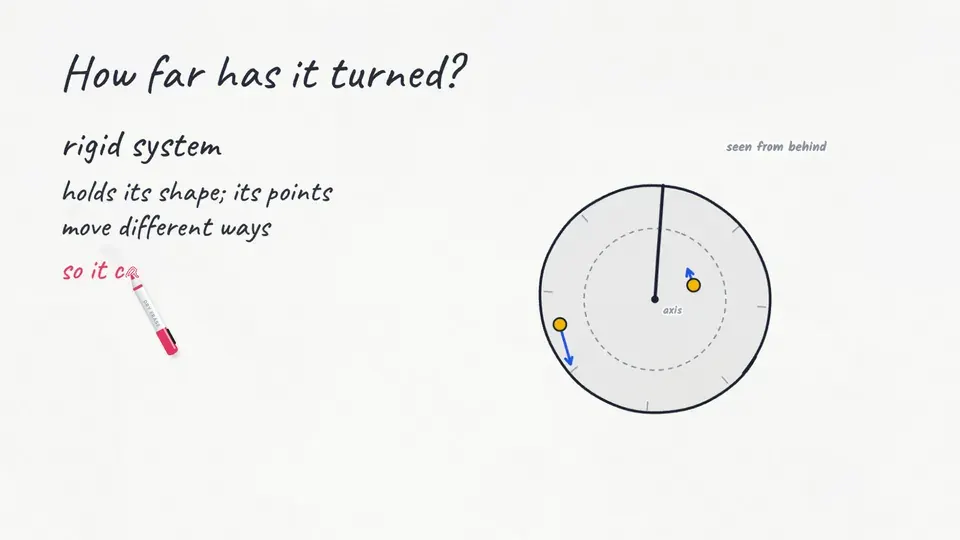
- A system that holds its shape while different points on it move in different directions as it rotates; it cannot be modeled as a single object for its rotation.
- angular position (θ)
- The angle from a chosen reference line to a line fixed on the rotating object, measured about the axis, in radians.
- radian
- The angle whose arc along a circle is one radius long, about 57°. One full turn is 2π radians.
- angular displacement (Δθ)
- The angle, in radians, through which a point on a rigid system rotates about an axis: Δθ = θ − θ₀. It keeps counting past 2π.
- average angular velocity
- The average rate at which angular position changes: ω_avg = Δθ/Δt, in rad/s. Its sign gives the direction of the net angular displacement over the interval (the direction of rotation, if the rotation never reverses).
- revolutions per minute (rpm)
- Turns per minute. Convert to rad/s before using any equation: multiply by 2π rad/rev and divide by 60 s/min.
- clockwise / counterclockwise
- The two directions of rotation about an axis, described from a stated viewpoint; one is chosen as positive (usually counterclockwise), the other is negative.
- average angular acceleration
- The average rate at which angular velocity changes: α_avg = Δω/Δt, in rad/s². Same sign as ω: speeding up; opposite sign: slowing down.
- constant-α equations
- ω = ω₀ + αt, θ = θ₀ + ω₀t + ½αt², ω² = ω₀² + 2α(θ − θ₀): the Unit 1 equations with the letters swapped, valid only for constant angular acceleration.
- slope and area on rotation graphs
- The slope of θ–t is ω, the slope of ω–t is α, the area under ω–t is Δθ and the area under α–t is Δω.
Transcript
2,466 words · 9 parts
Continuously increasing in a left roll
On the sixteenth of March, 1966, Neil Armstrong and David Scott flew their Gemini capsule up to an uncrewed rocket in orbit and docked with it, the first time two spacecraft had ever docked in space. About half an hour later, out of range of every tracking station on Earth, one small thruster on the capsule switched itself on, and it wouldn’t switch off.
The joined spacecraft started to roll, so they undocked, and the capsule on its own spun faster and faster, up to about three hundred degrees every second, most of a full turn every second. When they came back into radio contact, this is what Armstrong told the ground. Armstrong shut down the main thrusters, switched on a separate set in the nose, and fought the spin down, pulse by pulse, until it stopped.
It cost them three quarters of the fuel they needed to come home, so the mission ended that same night, and three years later, Neil Armstrong walked on the Moon. So how many more times did his capsule have to turn before it could stop? You’re going to work that out.
How far has it turned?
Here’s the capsule, seen from behind, looking straight along its nose. It has two dots painted on it, one near the edge, and one closer to the middle. As it turns, the two dots head in different directions at every instant. Physicists call this a rigid system. It holds its shape, but its points all move differently. So we can’t treat it as one dot.
For its trip around the Earth, though, the roll doesn’t matter, so there the whole capsule can be one dot. The Earth works the same way. For its yearly trip around the Sun, it’s one dot too.
But for the roll, the angle each dot sweeps out around the axis is the same for both. That shared angle is the one number that describes the whole spin. So we draw a reference line through the axis, and the capsule’s angular position, theta, is the angle from that line to a line painted on the capsule.
In physics we measure that angle in radians. To see one, take the radius and bend it around the edge. The angle it covers is one radian, a little less than sixty degrees. So one radian is the angle you get when the curved stretch of rim is as long as the radius, and that’s true on a coin, a wheel or a capsule.
It takes a little over six of them to get all the way around, two pi to be exact, so one full turn is two pi radians, which is three hundred sixty degrees. On the AP exam you get an equation sheet, but it doesn’t print two pi radians per turn. That one has to live in your head.
The angular displacement, delta theta, is the final angular position minus the starting one, and in physics we give it in radians. When something keeps spinning, the angle keeps counting. After three full turns, theta is six pi, about nineteen radians. It doesn’t reset to zero just because the dot is back where it started.
Skaters name their spins by angular displacement in degrees. When Tony Hawk landed the first nine hundred in 1999, he turned through nine hundred degrees in the air. How many radians is that?
Six and a half turns
Snowboarders have taken that much further, and in January 2025, at the X Games in Aspen, Hiroto Ogiwara of Japan landed the first twenty-three forty ever done in competition. This is our re-creation of a twenty-three forty. Keep your eye on the number in the corner, while he’s in the air.
Twenty-three hundred and forty degrees is six and a half full turns, and in radians that’s thirteen pi, about forty point eight radians, all in one jump. So how fast was he spinning? In our re-creation, he’s in the air for two point six seconds. Now look from above, with his board stamped every tenth of a second. Each stamp is the same quarter turn past the last one.
Now you make his angle-time graph. Choose how far each axis goes, then plot five stamps, one every half second, and run a straight line through them. The same angle every half second puts all five points on one straight line. The slope of that line is his average angular velocity, omega.
It’s the angular displacement divided by the time, just like average velocity in Unit One. For our jump that’s forty point eight radians over two point six seconds, about fifteen point seven radians per second, two and a half full turns every second. Armstrong’s three hundred degrees a second is about five point two radians per second, so our rider spins three times as fast as that runaway capsule.
Lots of machines give their speed in revolutions per minute. A record plays at thirty-three and a third rpm. Before rpm goes into any equation, turn it into radians per second, using two pi radians per turn and sixty seconds per minute. So what’s thirty-three and a third revolutions per minute in radians per second?
Which way is positive?
Let’s go back to Gemini, frozen in the middle of that spin, and look at it the way the crew did, from behind, looking forward along the nose. From here the left roll turns the capsule counterclockwise, and physicists usually call counterclockwise the positive direction, so its angular velocity is about positive five point two radians per second.
Now suppose you were floating out in front of the capsule, looking back at its nose, and tell me which way you’d see it turn. So the sign of a rotation depends on two choices you make, where you’re looking from and which way you call positive. It’s like choosing an axis in Unit One. Flip the axis, and every sign flips, but the motion stays the same.
With counterclockwise as positive, every clock on every wall turns in the negative direction. That’s a little funny, since clocks gave clockwise its name. That doesn’t mean clockwise is always negative. Seen from behind the wall, these same hands turn counterclockwise. The sign was never a fact about the clock.
Faster and faster
Here’s that spin-up again. The curved arrow is its angular velocity, and it grows as the roll speeds up. “Continuously increasing,” Armstrong said, so the angular velocity kept changing. How fast it changes is the angular acceleration, alpha. Here it points the same way as the spin. When Armstrong fired the nose thrusters, the angular acceleration flipped around to clockwise while the capsule was still turning counterclockwise, and that’s what slowed it down.
The average angular acceleration is the change in angular velocity divided by the time, so it comes in radians per second, per second, radians per second squared. DJs have played the Technics SL-1200 turntable in clubs since 1979. Its spec sheet even has a line of rotational kinematics, from standstill to thirty-three and a third rpm in point seven seconds.
The platter only turns one way here, so let’s call that way positive. It starts at omega naught equals zero. It ends at the three point four nine radians per second we just worked out, point seven seconds later. Divide the change by the time, and the platter’s average angular acceleration is about five radians per second squared.
The sign of alpha works the way acceleration’s sign worked in Unit One. When omega and alpha have the same sign, the spin speeds up. When they have opposite signs, it slows down.
Gemini did both, with omega and alpha both positive while the thruster was stuck, and opposite signs once the nose thrusters fired. A negative alpha doesn’t mean slowing down by itself. If the spin were already clockwise, a negative alpha would make it spin even faster.
This disk has an angular velocity of negative three point five radians per second, and an angular acceleration of positive two radians per second squared. With counterclockwise as positive, what is the disk doing?
The same mathematics
Every idea so far has a twin from Unit One. Rotation about one axis follows the same mathematics as motion along a line. Position turns into angular position, velocity into angular velocity, acceleration into angular acceleration, and every relationship between them carries straight over. Here are the three equations for constant acceleration from Unit One, the ones you used for drag racers and falling hammers.
Swap every letter for its rotational twin, and you get the three equations for constant angular acceleration. The AP equation sheet prints both sets. Just like before, they only work when alpha is constant. For anything messier, go back to the definitions or a graph.
The graphs carry over too. Let’s model the turntable’s start-up with a constant alpha. Its angular velocity climbs in a straight line from zero to three point four nine radians per second in point seven seconds, and then it stays flat. The slope of the angular velocity graph is the angular acceleration, five radians per second squared during the start-up, and zero once it’s up to speed.
The area under it is the angular displacement. While it gets up to speed, that’s the area of this triangle, one half times point seven seconds times three point four nine radians per second, about one point two radians. That’s only about seventy degrees. The record is at full speed before it has turned even a fifth of a turn.
Back in orbit, the thrusters can draw all three graphs at once. The capsule starts at rest. It gets four seconds of counterclockwise thrust, two seconds of coasting, and then four seconds of clockwise thrust.
Watch it again, and look only at the alpha graph. Four seconds at point two six radians per second squared adds about one radian per second to omega. So the area under alpha is the change in omega. The clockwise block has the same area. It takes all that spin back, and omega ends at zero.
Now the omega graph. Its ramps are straight because alpha is steady, and their slope is alpha. The area under omega is the angle the capsule turns. Omega is also the slope of the angle graph. So the angle graph bends up while omega grows, runs straight while omega holds, and levels off once omega is back to zero, after one turn.
In the demo, the capsule coasted for two seconds at about one radian per second. How many radians did it turn while it coasted? Now suppose we keep the clockwise thrust on after the spin is gone. Omega passes straight through zero, and the capsule starts rolling the other way.
Let’s run it again and freeze it at the instant omega is zero. You might guess alpha is zero there too, but it’s still negative point two six radians per second squared. Alpha is the slope of the omega graph, not its height. It’s like a ball at the very top of its toss.
How many more turns?
Let’s go back to the moment Armstrong started braking, with counterclockwise from behind as positive. The spin starts at about positive five point two radians per second, and it has to end at zero. Suppose he held both rings of nose thrusters on at full. In our model, that gives an angular acceleration of negative point two six radians per second squared. It’s negative because the thrusters push clockwise, against the spin.
First, you find the time. With that brake, how many seconds does it take to stop the spin? For the angle, the third equation is the quickest, because it doesn’t need the time. Theta minus theta naught is the angle turned, delta theta. On the 2026 AP exam, writing down a relevant rotational kinematics equation like this one was one way to earn a point.
Solve it for delta theta and put the numbers in. That’s zero minus five point two squared, over two times negative point two six. The minus signs cancel, so it’s positive fifty-two radians. Divide by two pi radians per turn, and that’s about eight more turns.
The graph agrees. Omega falls in a straight line from five point two to zero in twenty seconds. The triangle under it is one half times twenty seconds times five point two radians per second, fifty-two radians again.
Same brake, but suppose the capsule had been spinning twice as fast. How many times the angle would it turn before it stopped? Back in orbit, here are both rings at full, from five point two radians per second. The counter stops right on fifty-two radians, after twenty seconds. That’s the fastest stop our model allows, so even at full brake, the capsule had to turn about eight more times.
Armstrong started on both rings. Then, to save fuel for the trip home, he shut one of them down. Here he is on the radio. On one ring, pulsing gently, his real stop took minutes. A gentler brake stretches the triangle out, so his capsule turned even more than eight times before it stopped.
Justify it
AP questions often ask you to justify a claim in a few sentences. Let’s grade one. A student writes that the capsule is slowing down because its angular acceleration is negative. The claim is right, and alpha really is negative. But that isn’t a reason on its own.
A negative alpha with a clockwise spin would speed it up, so that answer wouldn’t earn the point. A full-credit answer starts with the claim. The capsule is slowing down. Then comes the evidence. Omega is positive, counterclockwise from behind, and alpha is negative.
Then the physics that connects them. Alpha is the rate of change of omega. When the two have opposite signs, the size of omega shrinks. That last sentence is the one that earns the point. It ties the claim to the definition of angular acceleration, not to a sign on its own.
This disk has an angular velocity of negative four radians per second, and an angular acceleration of negative one radian per second squared. Counterclockwise is positive. Which explanation would earn full credit?
Home safely
Gemini Eight came home safely that same night, to a splashdown in the western Pacific. So the angle, in radians, keeps counting as long as something turns. Angular velocity is how fast that angle changes. Angular acceleration is how fast the angular velocity changes, and it speeds the spin up when the two share a sign.
The signs only mean something once you’ve chosen which way is positive and where you’re looking from. Then every equation and graph from Unit One works with the letters swapped. Next time, we’ll find out why the edge of a spinning record moves so much faster than the middle, even though every point on it turns through the same angle.