
Topic 5.6 key terms
- net torque
- The sum of all the torques exerted on a system about one axis, counting clockwise and counterclockwise with opposite signs. A non-zero net torque changes the angular velocity; for a rigid object, a zero net torque leaves it unchanged.
- angular acceleration
- The rate at which an object's angular velocity changes, α (rad/s²). It is directly proportional to the net torque, in the same direction as the net torque, and inversely proportional to the rotational inertia.
- Newton's second law in rotational form
- α_sys = Στ/I_sys = τ_net/I_sys: the angular acceleration of a rigid system equals the net torque on it divided by its rotational inertia (both about the same axis).
- tangential acceleration
- The acceleration of a point along its circular path, a_T = rα. Every point of a rigid body shares one α, so points farther from the axis have larger tangential accelerations.
- force and torque analyses
- To fully describe a rotating rigid system, write Newton's second law for forces (ΣF = Ma_cm) and for torques (Στ = Iα) separately, and connect them with a constraint such as a = rα when a string or surface doesn't slip.
- inversely related vs inversely proportional
- α is inversely proportional to I (half the I, twice the α). After a fixed length of string pulled with a fixed force, ω = √(2F₀ℓ₀/I) is only inversely related to I (half the I, √2 times the ω).
Transcript
2,861 words · 11 parts
The chimney that snaps
In the north of England, a steeplejack from Bolton named Fred Dibnah spent years bringing down the tall chimneys of the old mill towns, ninety of them in all, and he usually did it with fire. His method sounds almost too simple. He’d knock a hole out of one side of the base, hold up the brickwork above it on wooden props, pile firewood around them, and set it all alight.
Then you wait while the fire eats into the props, so let’s watch one go, a chimney like the ones he brought down, sixty meters of brick that hasn’t moved an inch since Victorian times. When the props finally give way, it starts to lean so slowly that you’re not even sure it’s moving, and then a little faster, and then faster still.
And then, partway up, it snaps in two. That happens so often that physicists have written whole papers about it, because tall brick chimneys usually break in two like that, in mid-air, long before they reach the ground. So why would a chimney standing perfectly still a minute ago tear itself apart on the way down, when nothing hit it and gravity pulls on every brick the same way?
You’re going to find out why it snaps. On the way, you’ll prove something that sounds impossible. Part of a falling tower can speed up faster than anything in free fall. It all comes from one equation, the rotational version of Newton’s second law. Let’s rewind to before the fire, when the chimney stood perfectly still.
Until the torques stop cancelling
Here’s the chimney from the side, leaning a couple of degrees toward the opening. If it falls, it will turn about this edge of the base, which acts as a hinge. It would fall clockwise, so we’ll call clockwise positive.
Gravity pulls down at the center of mass, a little way out past the hinge. That makes a torque that tries to tip the stack forward. The props push up from out in the opening and make an equal torque the other way. The net torque is zero, and a chimney at rest stays at rest.
Now watch what the fire does. As the props burn, their push weakens, and they can’t balance gravity’s torque anymore. The angular velocity has been zero this whole time, and now it starts to change. An object’s angular velocity changes whenever the net torque on it isn’t zero. While the net torque stays zero, a rigid object keeps the angular velocity it has.
A chimney you can hold
Inside the old engine house there’s a workbench, and on it sits a chimney you can hold in your hands. It’s a one-meter board on a hinge, with a steel ball resting on a little golf tee near the free end. A paper cup sits just inside the tip. Physics teachers call it the falling chimney, because it’s a chimney lying on its side.
When I let go, the ball and the board both start falling from rest at the same instant. Predict what happens to the ball in the first moment after the release.
Look at that. The tip swings down so fast that the ball, falling with the full acceleration of gravity, gets left behind, and then the board slaps the bench and the ball drops right into the cup.
Here it is once more. This time, keep your eye on the gap between the tip and the ball. How can a falling board beat a falling ball? To find out, we need the rotational version of Newton’s second law.
Two second laws, one grammar
It works just like Newton’s second law for forces. A net force changes an object’s velocity, faster when the force is bigger and the mass is smaller. Rotation follows the same rule under new names. The net torque takes the place of the net force, and the rotational inertia takes the place of the mass.
The angular acceleration, how fast the angular velocity changes, takes the place of the ordinary acceleration. Your equation sheet prints the two laws side by side. Double the net torque, and you double the angular acceleration. It always points the same way as the net torque. Double the rotational inertia with the same torque, and you get half the angular acceleration. A more stubborn object changes its spin more slowly.
Let’s try a quick one. A constant net torque, the same size the whole time and not zero, acts on a wheel that’s free to turn. What happens to the wheel’s angular velocity while that torque keeps acting?
The stick that falls faster than gravity
Let’s work out how much faster than gravity the tip starts. Like on the exam, we start with a sketch and a sign convention. The board’s length L is one point zero meters, and its mass M is zero point four kilograms. Its weight M g acts at the center, half a length from the hinge. The board swings clockwise, so clockwise is positive.
Its rotational inertia about the hinge is one third M L squared, and an exam problem would give you that. For g, we’ll use ten meters per second squared, which the exam allows. The hinge pushes exactly at the axis, so its torque is zero. That leaves gravity, so the net torque is M g times L over two.
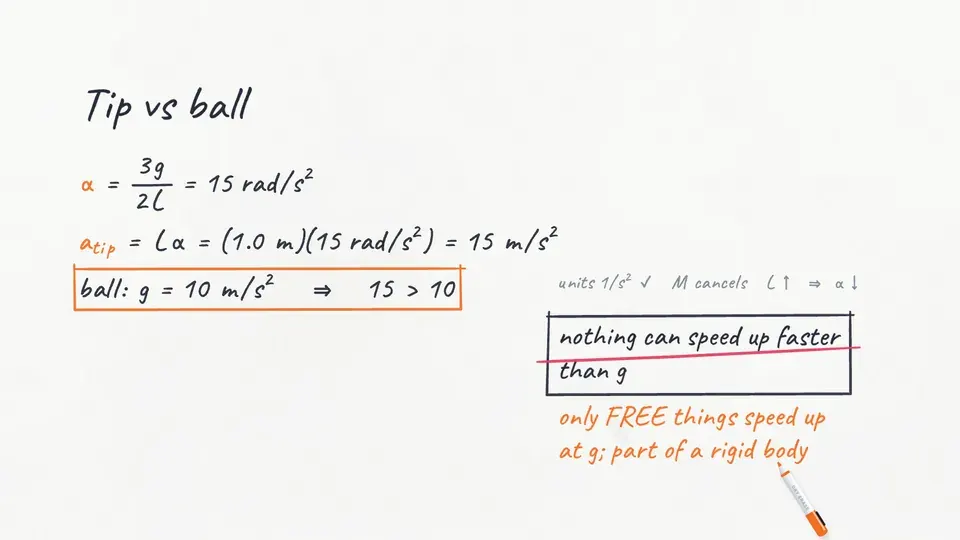
Alpha is the net torque over I. That’s M g L over two, divided by one third M L squared. Dividing by a third is multiplying by three. The mass cancels, one L cancels, and that leaves three g over two L.
Now put in the numbers. Three times ten, over two times one meter, is fifteen radians per second squared. The tip is a full meter out. Its acceleration along its path, the tangential acceleration, is L times alpha, fifteen meters per second squared.
The ball only speeds up at ten. The tip starts with one and a half times the acceleration of gravity. Falling things speed up at g only when they fall freely. A piece of a rigid object isn’t free. The rest of the object can push it along.
Every point on the board shares that alpha, so a point r from the hinge needs r times alpha to keep up. Gravity alone would give any free point ten. At the tip, the board needs fifteen against gravity’s ten, so it drags its tip down. That’s why the ball was left behind.
Two thirds of the way along, the board needs exactly ten, so a ball there would fall right along with it. At one third it needs only five, so the board holds that point back.
Now you try one. Take a longer board, one point five meters, on the same kind of hinge, let go from horizontal. Its mass doesn’t matter. What’s its angular acceleration at release, in radians per second squared?
Tape a weight to the end
Now let’s make the board heavier. Here’s a second board beside the first, exactly the same except for a lump of lead taped to its very tip. That lump has the same mass as the board itself, zero point four kilograms, so there’s more weight pulling the taped board down.
What do you think that does to how fast its tip starts to fall? Let’s let go of both boards at once. Watch the taped one fall behind. Adding weight to its end made it fall more slowly.
What does the lump add? Its weight acts a whole length from the hinge, so its torque is M g L, twice the board’s M g L over two. The torque triples. The lump also adds rotational inertia, a whole M L squared. The board had one third of that, so the total is four times the board’s.
Three times the torque over four times the rotational inertia gives three quarters of the angular acceleration, about eleven radians per second squared. More weight did add torque. It added even more rotational inertia.
One α for every brick
Now back outside. Treat the chimney as a much bigger board standing on its end. While it’s in one piece, it’s one rigid object with one angular acceleration. Call its lean angle theta. Gravity’s lever arm is now only L over two times sine theta, so alpha is the board’s three g over two L, times sine theta.
The bench board lay flat, a lean of ninety degrees, where sine theta is one. That’s why it had the full three g over two L. These orange bars show what each brick needs, r times alpha. The length cancels, just like on the longer board, so the top needs fifteen times sine theta, however tall the stack.
Gravity’s share shrinks too. Each brick moves at right angles to the stack, so when the stack leans by theta, its path tilts by theta, like a ramp. On a ramp, gravity gives g sine theta along the slope, the same for every brick. That’s this dashed line.
Try it at this lean, thirty degrees, where sine theta is one half. The top now needs fifteen times a half, seven and a half, and gravity gives five. Two thirds of the way up, it needs ten times a half, five, and gravity gives five. Both sides shrank by the same half, so they still match.
The gold is the gap between what a brick needs and what gravity gives. Up high, the chimney drags its bricks along, and low down, it holds them back. Now lean it further, to sixty degrees. Slide the ring up and down the chimney, and find the brick where gravity alone gives exactly the acceleration along the arc that it needs.
All that dragging and holding back bends the stack. The hinge can’t bend it, and the free top has nothing above it, so the bend peaks in between. The bend is worst about a third of the way up, lower than the two-thirds point where the push flips. Proving it takes math beyond this course.
Brick and mortar can take enormous squeezing, but a bend stretches one side of the wall. Mortar can hardly stretch at all. Watch the chimney snap near that one-third mark, where many real ones break.
Two tonnes on a string
A chimney turns about a hinge that stays put. A yo-yo falls and spins at the same time. In 2012, in Cincinnati, Beth Johnson dropped the world’s largest yo-yo from a crane. Its mass is about twenty-one hundred kilograms.
A rock dropped from up there lands in under three seconds. The yo-yo takes far longer, because the rope around its axle holds it back. Gravity pulls down at the center, and the rope pulls up at the edge of the axle. The tension has a lever arm, the axle’s radius r, and its torque spins the yo-yo up as it falls.
The yo-yo moves down and spins, so it needs a force sentence and a torque sentence, plus a link between them. Take down as positive. Then the force sentence is m g minus T equals m a. Take the spin direction as positive. The torque sentence is T r equals I alpha.
The rope doesn’t slip, so each radian of turn lets out r of rope. The center drops r per radian, and a equals r alpha. We want a by itself, so we’ll get rid of alpha and T. Let’s do it first with easy numbers.
Say the yo-yo’s rotational inertia is nine m r squared. In the torque sentence, alpha is a over r, so T r equals nine m r squared times a over r. That’s nine m r a. Divide both sides by r, and T is nine m a.
Put that T into the force sentence. m g minus nine m a equals m a. Move the nine m a across and pull out the a. m g equals a times m plus nine m. Divide by m, and g equals a times one plus nine. So a is g over ten, one meter per second squared.
Now the same steps, for any rotational inertia. Here are the three sentences again. Alpha is a over r again. So T r equals I a over r, and dividing by r, T is I a over r squared.
Put that T into the force sentence. It becomes m g minus I a over r squared equals m a. Move that term across and pull out the a. m g equals a times m plus I over r squared.
Divide by m, and g equals a times one plus I over m r squared. So a is g over one plus I over m r squared. Does that make sense? If I were zero, a would be g, like the rock. A fatter axle shrinks I over m r squared, so the yo-yo falls faster.
Now you try one. Say a yo-yo’s rotational inertia is four m r squared. What’s its acceleration, in meters per second squared? The force sentence alone tells you how hard the rope pulls. For that same yo-yo, falling at two meters per second squared, how does the rope’s pull compare with the yo-yo’s weight?
The way back up
Back to the record yo-yo, at the bottom of its drop. The rope runs out, and the yo-yo swings through underneath. Now the rope comes off the other side of the axle. The yo-yo keeps spinning the same way.
On the way back up, the yo-yo is still spinning the same way as before. Predict what happens to how fast it’s spinning while it climbs.
Watch the arcs. The spin arc points the same way all the way up, but the torque and alpha arcs point against it. That’s what braking looks like for something that spins. Alpha follows the net torque, not the spin. That’s how two tonnes of wood climbed back up its rope and into the record books.
The sentence that earns the point
Let’s finish with the exam. The 2026 AP Physics 1 exam asked a question just like this one. Two flywheels start from rest on fixed axles. Each has the same string wound on the same radius, and we pull each one with the same steady force until its string comes off. Flywheel B has half the rotational inertia of A, so which one spins faster at the end, and by how much?
The force and the radius are the same, so the torque on each flywheel is the same. B has half the rotational inertia, so it gets twice the angular acceleration. But B finishes only about one point four times as fast as A. It runs out of string sooner, so its bigger angular acceleration has less time to work. Once a string is off, there’s no torque on that flywheel, so it keeps the spin it has.
The exam asked for a derivation. We know how much string unwinds, but not how long it takes, so we use the equation that links angular speed to angle. The torque is F naught times r naught, so alpha is F naught r naught over I. The string unwinds through ell naught over r naught radians.
Both start from rest, so omega naught is zero. Put both into omega squared equals two alpha delta theta, and the r naught cancels. That leaves omega equals the square root of two F naught ell naught over I.
Cutting I in half doubles alpha. Alpha is inversely proportional to I. Omega grows by only the square root of two, because omega goes as one over the square root of I. We say omega is inversely related to I.
Before I show you a model answer, I’d like you to be the grader for a moment. Read these four responses and pick the one that would earn full credit.
A full-credit answer starts with the claim that B ends up spinning faster. The same force at the same radius gives both flywheels the same torque. That sentence earned a point in 2026. Angular acceleration is inversely proportional to rotational inertia, so B’s is twice A’s. Both strings unwind through the same angle, so B finishes faster by a factor of root two, not two. That earned the last point.
Back in the valley
For a rigid object, the angular velocity changes only when the net torque isn’t zero. The angular acceleration is the net torque over the rotational inertia, in the direction of the net torque.
When something moves and spins, write a force sentence and a torque sentence. Tie them together with the motion, like the yo-yo’s a equals r alpha. Cut I in half, and alpha doubles. After the same pull through the same string, omega grows only by root two.
Let’s go back to the valley. Now we know why it snapped. The props burned, and the net torque stopped being zero. The chimney began to turn. One rigid stack has one alpha, so every brick had to keep up.
The stack dragged its top bricks along and held its low ones back. That bent it most about a third of the way up. The mortar couldn’t hold the bend, and it snapped. Next time, we’ll ask where all that spinning energy comes from. Every bit of it, in the chimney and the yo-yo, came from the fall.