
Topic 6.1 key terms
- rotational kinetic energy
- The kinetic energy of a rigid system due to its rotation: K = ½Iω², where I is its rotational inertia about the axis and ω its angular speed (in rad/s). It is the ½mv² of every piece of the system, added up.
- rigid system
- A system whose parts keep the same distances from each other, so every part turns through the same angle in the same time: one ω for the whole system.
- rotational inertia
- I = Σmr²: a rigid system's resistance to changes in its rotation, set by its mass and by where that mass sits relative to the axis (topic 5.4). Units kg·m². For extended objects (rings, disks, flywheels, stars) it is given.
- angular speed ω
- How fast something turns, in radians per second. In K = ½Iω², ω must be in rad/s: convert rpm by × 2π/60.
- center of mass
- The point that moves as if all the system's mass were there. A system can have rotational kinetic energy while its center of mass is at rest.
- total kinetic energy
- For a rigid system that spins and travels: K = ½Mv_cm² + ½I_cmω², translation of the center of mass plus rotation about it. About a fixed axle, ½I_axleω² alone is the total (6.1.A.1.i).
- scalar
- A quantity with a size and no direction. Rotational kinetic energy is a scalar: it is the same for clockwise and counterclockwise spins, and the energies of opposite spins add.
- flywheel
- A heavy wheel spun up to store energy as rotational kinetic energy and give it back quickly. JET's two 775-tonne flywheels each stored 3,750 MJ at 225 rpm.
- pulsar
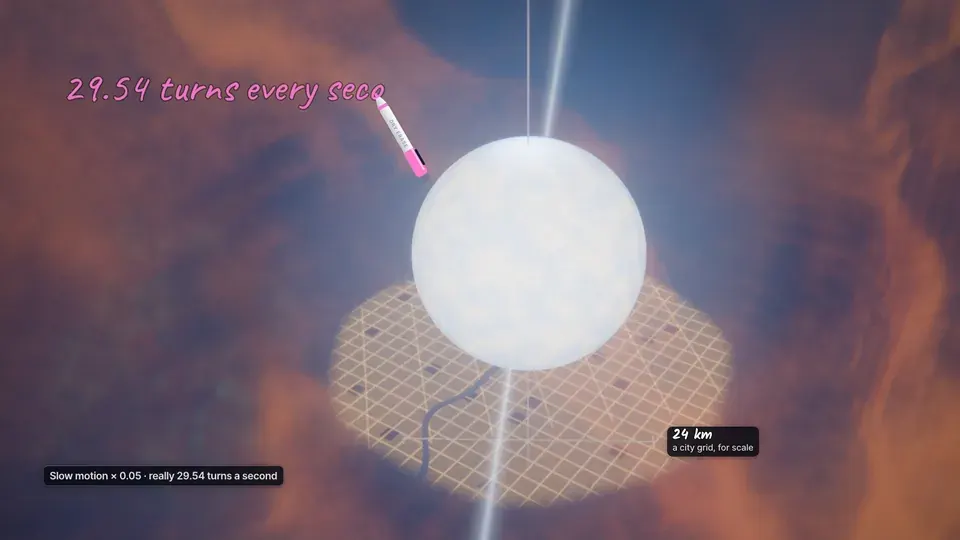
- A spinning neutron star whose beams sweep past Earth as it turns, so its pattern of pulses repeats once per turn. The Crab pulsar spins 29.54 times a second (July 2026) and is slowly spinning down.
Transcript
3,486 words · 9 parts
The guest star
In the summer of 1054, the astronomers who watched the sky for the Song emperor of China saw something new, rising in the east just before dawn. A new star had appeared among the stars of Taurus, as bright as Venus, and for twenty-three days it stayed bright enough to see in broad daylight. Then it faded away, and almost a thousand years later, in that exact spot, our telescopes see this, the Crab Nebula, the wreckage of an exploded star, sixty-five hundred light-years away.
And right in the middle of it, there’s something that flickers in a pattern that repeats about thirty times every second. That flicker is a dead star, a ball of neutrons about twenty-four kilometers across with more mass than the whole Sun, and it’s spinning twenty-nine and a half times every second, so that pattern of flashes repeats once for every turn.
Its center just sits there in the middle of the nebula it made, not going anywhere, and yet its spin holds more energy than the Sun gives off in a hundred million years. By the end of this lesson, you’ll be able to work out how much energy a star holds in its spin while it isn’t going anywhere. And you’ll be able to show that this star is lighting up the whole nebula, just by slowing down.
That should bother you a little. In Unit 3, kinetic energy was one half m v squared, and a star that stays in one place has no v to put into it. So here’s the question to keep in your head, and I want your guess before we work anything out.
If the star’s center isn’t moving, what is all that spin energy made of? So let’s find out where that energy is hiding, starting with something a lot smaller than a star.
Energy that goes nowhere
Here’s the simplest spinning thing I can draw, two one-kilogram balls on a light rod, each one half a meter from an axle in the middle, spinning at four radians per second. The axle runs right through the middle of the rod. That means its center of mass stays exactly where it is, the same as the star’s.
If we put the center’s speed into one half m v squared, we’d get zero. I’m crossing that out, because you wouldn’t want your hand anywhere near those balls. Each ball goes around a circle, so each one really is moving, and its speed is r times omega, so half a meter times four radians per second gives two meters per second.
That gives each ball one half times one kilogram times the square of two meters per second, two joules, so the pair has four joules of kinetic energy, while the center of the rod never moves at all. This is a classic AP setup, something spinning in place and a question about its kinetic energy, and the answer that earns the point doesn’t stop at yes, it says why, because every piece of it is moving.
Now let’s do the same thing for any spinning object by chopping it into pieces, where every piece has its own mass and its own distance from the axle, so every piece moves at its own speed, r times omega. When we add up one half m v squared for all the pieces, every piece has the same omega, because a rigid object turns all at once, so omega squared comes right out of the sum.
What’s left inside is the sum of m r squared, which is the rotational inertia I from the last unit, so the kinetic energy of a spinning object is one half I omega squared. I love this, because one half I omega squared turns out to be our old friend, one half m v squared, added up over pieces that move at different speeds.
The units work out too, because a kilogram meter squared times radians per second, squared, is a joule, since a radian is just a ratio of two lengths. And for our dumbbell, I is two times one kilogram times half a meter squared, which is half a kilogram meter squared, and one half times that times four radians per second, squared, gives the same four joules.
So let’s do that to the star. Slice it into five rings around its spin axis, and every ring is moving, the inner ones slowly and the outer ones fastest of all, because the equator of this star moves at about twenty-two hundred kilometers every second. Before we add them up, here’s a puzzle for you.
Which of the five rings do you think carries the most kinetic energy? Pick the ring you’d bet on. Each ring gets its own one half m v squared, and when we stack them up they make one bar, one half I omega squared, sitting right beside a center of mass that hasn’t moved at all.
Let’s try one before we go back to the star. Slide both balls out to one meter from the axle and keep the spin at four radians per second. How much kinetic energy does the dumbbell have now, in joules?
The square on omega
That check had a square hiding in it, and the star is the best place to feel how strong that square is, so here’s a dial for the star’s spin, set to today’s twenty-nine and a half turns a second, and here’s its energy bar. If I slow it to about half that, fifteen turns a second, watch the bar, because instead of dropping to half, it drops to about a quarter.
Now I’ll hand you the dial, and I want you to find the spin that gives this star four times the energy it has today. Let’s put that square on paper. It’s worth seeing written down.
It only took twice the spin, and that’s the square on omega doing its work, twice as fast means four times the energy, and three times as fast means nine times. The other knob is I, which is all about where the mass sits, so here are a ring and a solid disk with the same mass, two kilograms, the same radius, thirty centimeters, and the same spin, ten radians per second.
A lot of people say they must hold the same energy, since they have the same mass and the same spin. In one big study, more than a third of the students in regular intro physics courses picked exactly that answer. But every bit of the ring sits out at the rim, moving at full speed. Most of the disk is closer in, and moving slower. With the rotational inertias written in, the ring holds nine joules and the disk holds four and a half, exactly half as much.
So when you compare two spinning things, the safest move is to write the ratio, which is the ratio of the I’s times the ratio of the omegas, squared. Here’s one to try with that ratio. Wheel A has four times the rotational inertia of wheel B, but it spins half as fast. Which wheel stores more kinetic energy?
Three thousand seven hundred fifty megajoules
Now let’s watch that equation do a real job. This is JET, in Oxfordshire, England, the biggest fusion experiment in Europe until it shut down at the end of 2023, and its big plasma shots needed more than a thousand megawatts.
The power line could only give it about half of that, so the engineers built two of these, steel flywheels each seven hundred seventy-five tonnes and nine meters across, spun up between shots by a motor about as powerful as a whole high-speed train. At full speed the rim of each wheel moves at about three hundred eighty kilometers an hour, and on nights when a football final was on TV, the grid could hold JET’s shots back during the ad breaks, when the demand for power jumped.
The engineers published two numbers for each wheel, its rotational inertia, thirteen and a half million kilogram meters squared, and its top speed, two hundred twenty-five revolutions per minute, so let’s check how much energy that gives. The tempting move is to put the two twenty-five straight into the formula, and you’d get three point four times ten to the eleven joules, about ninety times too big, because omega has to be in radians per second, and revolutions per minute aren’t.
Each revolution is two pi radians and each minute is sixty seconds, so two hundred twenty-five revolutions a minute is about twenty-three and a half radians every second. Now you finish it. With I and omega on the board, how much energy does one of these wheels store at top speed, in megajoules?
Here’s what a shot does to the wheel. Think about it before we fire one. Suppose the wheel gives away energy until it’s turning at half its top speed. What fraction of its energy has it given away?
Here it is on the real wheel. At a hundred twelve and a half revolutions a minute, half its top speed, it’s holding only about nine hundred forty megajoules, a quarter of what it had. And here’s a real shot, which takes up to two thousand six hundred megajoules out of the wheel, almost seventy percent of everything it holds, so watch where the speed ends up.
The wheel is still turning at about a hundred twenty-five revolutions a minute, more than half its top speed, even though almost seventy percent of its energy is gone. That’s the square on omega again, in a machine that really used it. Here’s a question JET’s engineers could have asked.
If the wheel only had to hold one shot’s worth of energy, two thousand six hundred megajoules, how fast would it have to spin? Lock in your guess first, then spin it up and stop at two thousand six hundred.
Spin and travel
Everything so far has spun in one place, but plenty of things spin and travel at the same time, and the classic example is a yo-yo. Let’s catch one partway down, a fifty-gram yo-yo falling at forty centimeters per second while it spins at a hundred radians per second, with its rotational inertia given as two times ten to the minus five kilogram meters squared. Its center of mass really is moving now, so it has one half m v squared for the travel, and it’s spinning about its center, so it has one half I omega squared for the spin, and its total kinetic energy is the sum of the two.
The travel gives one half times point zero five kilograms times the square of point four meters per second, four thousandths of a joule. The spin gives one half times two times ten to the minus five kilogram meters squared, times a hundred radians per second, squared, which is a tenth of a joule.
So about ninety-six percent of this yo-yo’s kinetic energy is in its spin, which makes it a spinning thing that happens to fall, and that’s why a yo-yo falls so gently. And we can check it, because to reach that speed it fell about twenty-one centimeters, and m g h for that drop, with g as ten the way the AP exam does it, is about a tenth of a joule, the same total.
There’s one warning that goes with this. It’s about things that turn on a fixed axle, like a door on its hinges. For those, one half I omega squared about the axle is already all of the kinetic energy. You don’t add one half m v squared for the center on top.
Let’s check it with a real door, twelve kilograms and a meter wide, swinging at two radians per second. Its I about the hinge is four kilogram meters squared. One half I omega squared gives eight joules, the door’s whole kinetic energy. Now split the same swing in two. Its center sits half a meter from the hinge, so it moves at r omega, one meter per second. That’s six joules of travel.
About its own center, the door’s I is one kilogram meter squared, so the spin adds two joules. Six plus two is the same eight. The hinge’s I already holds the travel. What if you add one half m v squared on top? You’d count those six joules twice.
A rod swings on a hinge at one end. About the hinge, one half I omega squared is four joules. The travel of its center, one half m v squared, is three joules. What’s the rod’s whole kinetic energy?
No hinge this time, so it’s back to the sum. A solid ball rolls along the floor, and a block with the same mass slides beside it at the same speed. Which one has more kinetic energy?
I’ve been saying this star isn’t going anywhere, and that’s true from where we’ve been watching, riding right along with its center. Measured against the stars and gas around it, though, it drifts sideways at about a hundred eighteen kilometers every second.
That’s more than four hundred thousand kilometers an hour, and it gives the star a travel bar, one half m v squared for its center, that’s only about one percent as tall as the spin bar. So a star racing sideways that fast carries about a hundred times more energy in its spin than in the sideways motion we can measure.
Energy has no direction
There’s one more thing the star can show us, so let’s flip its spin, so it turns clockwise instead of counterclockwise, and omega changes sign, from positive one eighty-six to negative one eighty-six radians per second. Now look at the energy bar, because it hasn’t moved at all. Omega gets squared, and a negative number squared is positive, so a spin in either direction holds exactly the same energy.
That’s what it means for rotational kinetic energy to be a scalar, a number with a size and no direction at all, even though the spin it comes from has a direction. Now picture JET’s two flywheels side by side, both at full speed, but spinning in opposite directions. What’s their total kinetic energy?
The sentence that earns the point
This next setup comes straight from a question on the 2026 AP exam, and I’ve put our own numbers on it. Two tops, which the exam calls toys X and Y, turn on fixed axles with almost no friction, and top Y has half the rotational inertia of top X. Each top has a string wrapped around it, and we pull each string off with the same steady force, six newtons, over the same length, half a meter.
Before anyone pulls, make a prediction. After the strings come off, how fast is top Y spinning compared with top X? Now let’s test your prediction, and you’re the one doing the experiment, so pull both strings all the way off and read the two spins. So why does it come out that way? Let’s work it out.
The reasoning is all energy. Each force does work, force times distance, six newtons times half a meter, three joules, and the same work means the same change in kinetic energy for both tops. Each top starts at rest, so three joules equals one half I omega squared, and solving for omega gives the square root of two times the force times the length, over I, which is one of the two derivations the exam’s scoring guide accepted.
For X that’s one hundred seventy-three radians per second, and for Y, with half the I, it’s two hundred forty-five radians per second, the square root of two times faster. On the exam they’d ask you to justify which top spins faster. Before I show you the scoring guide’s own answer, pick the explanation you think earns full credit.
And this is the sentence that earns the point. Let’s read it slowly, one link at a time. The scoring guide’s model answer says, “The same force is exerted on both toys over the same distance, and so the work done is the same on both toys. This means that the change in kinetic energy of both toys is the same. So, Toy Y has a larger angular speed since it has a smaller rotational inertia with the same change in kinetic energy.”
Compare that with “Y spins faster because energy is conserved”, which names a law and stops, and the official course guide for this exam uses almost exactly that answer as its example of one that doesn’t earn credit, because it never connects the work, the energy and the rotational inertia. And if a question asks how omega depends on I, say it’s inversely related, through a square root, so half the I gives about one point four times the spin, and never twice.
Let’s put that square root to work. Back at the bench, top Y has half the rotational inertia of X, and it spins about one point four times as fast. Now it’s your design, and if your first try misses, you can re-wind and try again.
Choose a rim for top Y that makes it spin exactly twice as fast as X with the same pull, then pull both strings to test it. So to double a spin with the same energy, you need a quarter of the rotational inertia, and that square root turns up again and again on the exam.
The star that pays for a nebula
Now we can do what I promised at the start. Jodrell Bank Observatory in England times this star every month, and in July 2026 it was turning twenty-nine point five four times a second.
Nobody can weigh the inside of a neutron star, so astronomers use a standard estimate for its rotational inertia, about ten to the thirty-eight kilogram meters squared, and it could be twice that, so every answer we get for this star is an “about”. Each turn is two pi radians, so twenty-nine point five four turns a second is about a hundred eighty-six radians per second. So now you can do the calculation that sounded impossible at the start.
How much kinetic energy is in the Crab’s spin? Give your answer in units of ten to the forty-two joules. The Sun gives off about three point eight times ten to the twenty-six joules every second, so dividing tells us this spin holds about a hundred forty million years of sunshine.
And it’s spending that energy, because when astronomers discovered the pulsar in 1968, it turned about thirty point two times a second, which works out to about one point eight zero times ten to the forty-two joules. Subtract today’s one point seven two times ten to the forty-two, and the star has given away about eight times ten to the fortieth joules since 1968. Keep the extra digits until after you subtract, because the difference is tiny compared with the energies themselves. So the star has given away about eight times ten to the fortieth joules, and a watt is one joule every second.
Spread that over the fifty-eight years since 1968 and work out the power it’s been giving off, in units of ten to the thirty-one watts. That’s as much power as a hundred thousand Suns, coming out of a star that’s only slowing down.
That energy has to go somewhere, and it goes out into the nebula, into its magnetic field and its fast particles, and about a third of it comes out as radiation, the glow our telescopes see, so this star is lighting up the whole nebula just by slowing down. And you’re standing on a flywheel too, because the Earth’s spin holds about two times ten to the twenty-nine joules, and the Moon’s tides are slowly braking it, so every century the day gets about two milliseconds longer.
Spin is somewhere to keep energy
So here’s what to keep from today. The kinetic energy of a spinning thing is one half I omega squared, which is just one half m v squared added up over all its pieces, and it’s there even when the center of mass doesn’t move. Omega gets squared, so half the speed leaves a quarter of the energy, and I is about where the mass sits, so a ring stores more than a disk of the same mass and size.
When something spins and travels, you add the two, one half m v squared for the center plus one half I omega squared about the center, unless it turns about a fixed axle, where one half I omega squared is already everything. And kinetic energy is a scalar, so the energies of two spins in opposite directions still add up.
Next time we’ll see how a torque puts that energy into a spin in the first place, one turn at a time, and the Crab will still be out there, turning twenty-nine and a half times a second, a little slower every day.