
Topic 6.3 key terms
- angular momentum (rigid system)
- L = Iω: rotational inertia times angular velocity, about a chosen axis, in kg·m²/s. The spin twin of momentum p = mv. In AP Physics 1 it is a magnitude with a sign (counterclockwise positive, say); its direction in space is beyond the course.
- angular momentum of an object about a point
- L = rmv sin θ, where r is the distance from the point to the object and θ is the angle between r and the velocity. For straight-line motion r sin θ = r⊥, the closest distance from the point to the line, so L = r⊥mv: zero about a point on the line, and constant about any fixed point off it as long as the speed stays the same.
- angular impulse
- The torque exerted on an object times the time interval it acts, τΔt (N·m·s). It has the sign of the torque and equals the area under a torque–time graph.
- rotational impulse–momentum theorem
- The angular impulse delivered to an object or rigid system equals its change in angular momentum: τΔt = ΔL = L − L₀. For constant I it is the rotational second law, τ_net = ΔL/Δt = IΔω/Δt = Iα.
- net torque from an L–t graph
- The net torque on an object is the slope of its angular momentum–time graph: a straight ramp means a steady torque, a flat line means zero net torque (L constant, not zero), a falling line means a negative net torque (it slows a spin in the positive direction and speeds up one in the negative direction).
- choice of reference point
- Angular momentum is always about a point or axis you choose; the same moving object has different L about different points (zero about a point on its line of motion). Like position and the origin, the number depends on the choice but the motion does not.
Transcript
2,385 words · 10 parts
Nine thousandths of a second
On a June evening in nineteen ninety-seven, France played Brazil in a stadium in Lyon, and Brazil won a free kick thirty-odd meters from the French goal. Their left back, Roberto Carlos, put the ball down, and then he walked a long, long way back from it. He hit it with the outside of his left foot. On a hard kick, the boot and the ball touch for only about nine thousandths of a second.
It swung so far outside the wall that a ball boy well wide of the goal ducked, and then it bent back into the top corner. Nobody measured that kick. Physicists who study kicks estimate that the ball left his boot at about thirty meters per second, spinning about ten times every second. Those estimates are enough to answer a question no camera caught. How far from the center of the ball did his push really pass?
The answer? About the width of your thumbnail. That’s a strange thing to work out from a speed and a spin. Let’s start with a simpler question, where a ball’s spin comes from in the first place.
The same push, twice
Here are two balls. Each one gets the same push for the same nine thousandths of a second. Ball A’s push aims straight through its center. Ball B’s misses the center, just a little to one side.
Before we let them go, make a prediction. Once both pushes end, which ball is moving faster? One push can do two jobs at once. It always changes the ball’s momentum, and if its line misses the center, it changes the ball’s spin as well. Let’s keep the two in separate books.
You already know the first book from the momentum unit. The force times the time it acts is the impulse, and it equals the change in momentum. For the second book, think back to torque. A force whose line misses the center by a distance d twists the ball with a torque, F times d, for the same nine milliseconds.
Nine milliseconds, slowed down
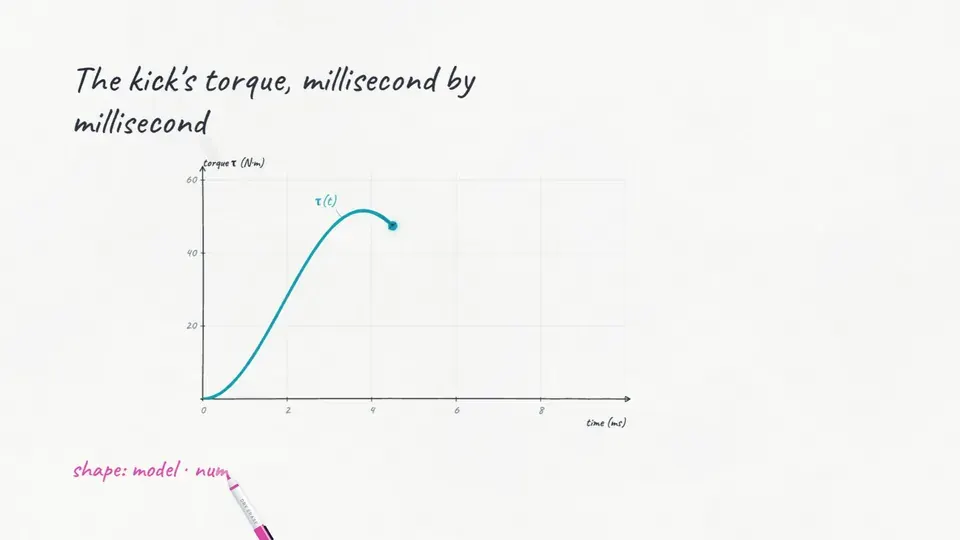
Let’s slow Carlos’s kick right down and watch that twist at work. While the boot pushes, the torque climbs and falls, the area under it fills, and the ball’s spin climbs with it.
The instant the ball leaves the boot, the climbing stops. The area reads zero point two two, and the spin chart reads zero point two two as well. Then, all the way to the goal, the spin stays at zero point two two. Once the boot is gone, nothing twists the ball, apart from a whisper of air.
That area, a torque times the time it acts, is the angular impulse, the spin version of an impulse. Its units are newton-meter-seconds. We call that stored spin the ball’s angular momentum. Momentum is mass times velocity. Swap in rotational inertia and angular velocity, and you get L equals I omega.
Try it on easy numbers. A wheel with an I of two kilogram meters squared spins at three radians per second. How much angular momentum does it carry, in kilogram meters squared per second? A newton-second is a kilogram meter per second, so a newton-meter-second is a kilogram meter squared per second. That’s why the two charts could match.
You’ve just seen the rule that links the two. The angular impulse equals the change in angular momentum, just as an impulse equals the change in momentum. Your equation sheet writes it as delta L equals tau delta t, where delta L is the final angular momentum minus the starting one. It’s Newton’s second law for rotation, tau equals I alpha, multiplied through by the time.
Now Carlos’s ball. It’s nearly a thin hollow shell, so its I is two thirds m r squared. Put in zero point four three kilograms and a radius of zero point one one meters. That gives about zero point zero zero three five kilogram meters squared.
Ten turns a second is ten times two pi, about sixty-three radians per second. Times the I, that’s about zero point two two, the same number the area reached in Lyon. His ball went from no spin to zero point two two in nine thousandths of a second. What average torque did his boot put on it, in newton-meters?
This is a classic exam question. It puts a push through the center next to a push at the edge, like our two balls. Full-credit answers say it plainly. A force aimed at the center produces no torque and no change in angular momentum.
The torque wasn’t steady, though. It climbed to a peak of about forty-eight newton-meters, twice the average, then fell away as the ball left the boot. The angular impulse is the area under that hump. A rectangle as tall as the average torque, twenty-four, covers the same area. That’s what the tau on your equation sheet means when the torque isn’t steady. It’s the average torque.
Tall or wide
Say you want to spin up a heavy wheel on a frictionless axle. You can give it a sharp tap with a hammer, or a long, gentle push with your hand. The hammer gives forty newton-meters of torque for five hundredths of a second. Your hand gives two newton-meters for two whole seconds. Which one leaves the wheel with more angular momentum?
The bottom graph shows angular momentum against time. Its slope at any moment is the net torque at that moment. Look at the push. Its line climbs four in two seconds, a slope of two, and the hand’s torque was two newton-meters.
A steady torque of four newton-meters doesn’t give a steady spin. It makes the angular momentum climb in a straight line, with a slope of four. Now the torque stops. What does the angular momentum line do?
In this course, angular momentum is a number with a sign. We call counterclockwise positive, the way Carlos’s ball spun seen from above. Friction in a bearing twists against that spin, so its torque is negative, and so is its angular impulse. Watch the line slope down.
Now say the wheel from the push has four kilogram meters squared per second. Its bearing isn’t frictionless after all, and it drags with a torque of negative zero point five newton-meters. How much angular momentum is left after three seconds?
The desert sling
A thing doesn’t have to spin about its own center to carry angular momentum. Out in the New Mexico desert, a company called SpinLaunch built this steel drum to fling rockets toward space. Inside it, an arm spins in a vacuum, faster and faster, and then flings a test vehicle toward the sky.
Its patent describes the full-size version, with every number we need. In that design, a two-thousand-kilogram vehicle rides the tip of an arm fifty meters long, and it lets go at two thousand eight hundred meters per second.
How much angular momentum is that? The vehicle is a point on the end of the arm, so its rotational inertia is m r squared, and its angular velocity is v over r. Multiplying them cancels one r, so L equals r times m v. That’s the other angular-momentum formula on your equation sheet, for a velocity at right angles to the arm.
Try it on easy numbers first. A two-kilogram puck on a half-meter string, moving at three meters per second, has half times two times three, or three. For the patent’s vehicle, multiply fifty meters, two thousand kilograms and two thousand eight hundred meters per second. That’s two point eight times ten to the eight, about a billion times the ball’s.
Flying straight, still carrying it
Now freeze it a thousandth of a second before it lets go. The vehicle is still going around the hub, carrying two point eight times ten to the eight about the hub. In a moment the arm will let go, and the vehicle will fly off in a perfectly straight line. What happens to its angular momentum about the hub when it does?
Two things change as it flies. Its distance from the hub keeps growing, but the angle between that distance and its velocity keeps shrinking. Angular momentum uses r times the sine of that angle. L equals r times m v times sine theta.
Like a torque’s lever arm, r times sine theta is this dashed line, the shortest distance from the hub to the vehicle’s path. The path is straight, so that distance stays fifty meters the whole way.
Here it is on the board. From the point you measure about, draw r out to the object. Theta is the angle between r and the velocity. It’s the same recipe as torque, with m v in place of the force. For torque, theta sat between r and the force.
That gives L equals r times m v sine theta, the mass times the speed times that perpendicular distance. Every time you give a number for it, say what point it’s about. The point is your choice. About a point right on the path, the perpendicular distance is zero, so L is zero. About a point twice as far from the line as the hub, it’s twice as big.
Measure from fifty meters on the other side of the line, and it comes out negative. From over there, the vehicle goes around clockwise. It’s like position in the very first lesson, where moving the origin changed every position but never the motion. The motion stays the same, and the number depends on where you stand.
Now you move the point. First, make the vehicle’s angular momentum zero. Then make it double the hub’s value. Last, match the hub’s value at least one hundred and fifty meters from the hub.
Read the torque off a graph
Labs measure torque like this, and the exam likes this setup. A flywheel with a rotational inertia of zero point two five kilogram meters squared has a string around a small hub.
You pull the string with a steady four newtons. A photogate times the spin. Every half second you get one angular velocity. Multiply each one by I, and you have the angular momentum at that moment.
Plot those five angular momentum values against time. Pick a scale that fits the data and put each point where it belongs. The best-fit line will tell you the net torque.
The string’s own torque is the hub radius times the pull, zero point zero five times four, or zero point two zero newton-meters. The line is less steep than the string alone would make it. The difference, about negative zero point zero four newton-meters, is friction in the bearing twisting against the spin. The slope only ever shows you the net torque.
What the exam wants to read
Here are two questions in the exam’s style. Two flywheels start from rest, and the graph shows each one’s angular momentum over six seconds. Flywheel B has three times the rotational inertia of flywheel A. Over the whole six seconds, how does the average net torque on flywheel B compare with the average net torque on flywheel A?
A disk and a hoop with the same mass and radius each get the same force on the rim for the same time, starting from rest. Which one ends up with more angular momentum?
The width of a thumbnail
You now have everything you need. Let’s keep the promise from the start. Let’s set it up the AP way, with a sketch from above. Counterclockwise is positive. The line of the push passes a distance d from the center, and d is what we want.
We know the ball’s mass, zero point four three kilograms, and its speed, about thirty meters per second. We also found its angular momentum, about zero point two two. Now write the kick in both books. The ball starts from rest. In the momentum book, the force times the time is the ball’s momentum, m v. In the spin book, the torque F d times the same time is the angular impulse, I omega.
We don’t know the force or the exact time, but watch what happens when we divide the second equation by the first. The force cancels, the time cancels, and d is I omega over m v. On top goes the angular momentum, zero point two two. On the bottom goes the momentum, zero point four three times thirty.
Go ahead and work it out. How far from the center did the line of his push pass, in centimeters? Does it make sense? It’s small next to the ball’s eleven-centimeter radius, which fits a kick that’s mostly power. The units come out in meters, and d equal to zero would mean no spin, like ball A.
Now test your number. Set the push to pass about one point seven centimeters to the right of center, strike it at thirty meters per second, and take the free kick.
To see what the spin did for him, watch the same kick with the push dead center. Keep an eye on the ball boy. That’s what bent one of the most famous free kicks ever. By our model, his push passed about one point seven centimeters off center, the width of your thumbnail. That tiny miss, held for nine milliseconds, gave the ball all ten turns a second.
The bend itself is a different piece of physics. The spin makes the air push the ball sideways. That’s how it curled back into the corner.
Where spin comes from
Let’s pull it all together. Angular momentum is I omega for something spinning, and r times m v sine theta about a point you choose, for something moving past it. A net torque acting for a time delivers an angular impulse, tau delta t. It’s the area under the torque–time graph, and it equals the change in angular momentum.
The slope of an angular momentum graph is the net torque. No net torque means a flat line, and flat isn’t the same as zero. Something coasting in a straight line at a steady speed keeps the same angular momentum about any point off its path, because r sine theta never changes.
A diver in midair has nothing to twist her, so her angular momentum can’t change. Yet she can spin faster by pulling in tight, and that’s the next lesson. All of it, every turn of that ball, came from a few thousandths of a second in Lyon.