
Topic 6.4 key terms
- total angular momentum of a system
- The sum of the angular momenta of all the parts of a system about one rotational axis (with clockwise and counterclockwise signs): a skater's body plus her arms, a stick plus the puck that hits it, Earth's spin plus the Moon's orbit.
- conservation of angular momentum
- Angular momentum is conserved in every interaction: it is transferred, never destroyed (6.4.B.1). A chosen system's total angular momentum is constant only when the net external torque on that system is zero (6.4.B.2); for one body that turns with a single ω, that constant total is I_i ω_i = I_f ω_f.
- external vs internal torque
- An external torque is exerted by something outside the chosen system and can change its angular momentum. Internal torques come in equal and opposite pairs (Newton's third law) and cancel in the system's total.
- angular impulse
- The torque times the time it acts, τΔt. It equals the change in a system's angular momentum, and the surroundings receive the equal and opposite change.
- nonrigid system
- A system that can change shape. By moving mass closer to or farther from the axis it changes its rotational inertia, so its angular speed changes while its angular momentum does not.
- conserved vs constant
- Angular momentum is conserved in every interaction: it never disappears, it moves. A particular system's angular momentum is constant only if no net external torque acts on that system.
- rotational inelastic collision
- Objects that stick together while rotating about an axis with no external torque: angular momentum about that axis is the same before and after, but kinetic energy is lost.
Transcript
4,148 words · 10 parts
Four and a half
This is Lake Placid, a small town in the mountains of upstate New York that has hosted the Winter Olympics twice, and in September of 2022 only a small crowd was there to see what happened inside its ice arena. A seventeen-year-old named Ilia Malinin skated out into that mostly empty arena, picked up speed going backward, and then turned forward to try a jump that nobody had ever landed in competition.
Here it is at full speed, and it’s over in under a second. That was a quadruple Axel. The Axel is the one jump you take off going forward, so a quad is four and a half full turns, and a jump like this does almost all of that turning in about three quarters of a second in the air, with nothing touching him.
Once his blade leaves the ice, there’s nothing to push against. So where did all that spin come from, and how did it get faster in the middle of the jump? By the end of this lesson, you’ll be able to work out how tightly a skater has to pull in. That’s what it takes to fit four and a half turns into one jump.
And you’ll check your answer against what sports scientists measured when they filmed the best skaters in the world in 3D. And all of it comes down to a quantity you already know, angular momentum, and one question we’re going to keep asking about it, which is what’s allowed to change it.
Nothing to push on
Before we look at any numbers, make a prediction. While he’s in the air, he pulls his arms in tight and spins faster, so what do you think happens to his angular momentum while he does that?
Let’s run the jump again. This time, we’ll graph his angular momentum while it happens. For the first split second his blade is still digging into the ice, and the ice pushes on it off to one side of his body, which twists him and builds up his angular momentum. That’s the angular impulse you already know, torque times time.
Now look at what his angular momentum does once he leaves the ice. The line goes completely flat, and it stays flat the whole time he’s in the air, even while his spin speeds up and his rotational inertia drops. Why flat? The only real force on him up there is gravity, and gravity pulls on him at his center of mass, which sits right on the axis he spins around, so it has no lever arm and it can’t twist him.
The air pushes on him a little, but over a split second that’s negligible. Then he lands, the ice grabs his blade again, and this time the twist goes the other way, so about half of his angular momentum drains out almost at once and the rest bleeds away as he glides out.
And you can put a number on that. In our model he loses about sixteen and a half kilogram meters squared per second in about a tenth of a second, so the ice twists him with an average torque of about one hundred sixty-five newton meters, and the ice, with the whole Earth under it, gets exactly the same angular impulse the other way.
So the only thing that ever changed his angular momentum was the ice, and the ice is outside him. That idea is what this whole topic rests on, and it’s exactly what AP questions on it test, so let’s write it down properly.
If the net external torque on a system is zero, the total angular momentum of that system stays constant. And if there is an outside torque, angular momentum moves between the system and its surroundings, and the amount that moves is the angular impulse, the average outside torque times the time, with the surroundings getting exactly the opposite.
For one spinning body, L is I times omega, so I initial omega initial equals I final omega final, and that one line is going to do most of the work from here on. Think of it as a product that’s locked. If he pulls his mass in and makes I three times smaller, omega has no choice but to get three times bigger, because the product can’t change. And this exact setup is a classic AP question, except instead of a skater it’s usually a kid on a playground merry-go-round.
A child walks from the edge of a spinning merry-go-round toward its center, and the merry-go-round turns freely on its axle. What happens to its angular speed, and why?
Pull in, spin up
Now let’s watch the same physics somewhere it lasts long enough to really see it, in a spin. Guinness lists the fastest spin on ice skates as Olivia Oliver’s, from Canada, and she was eleven years old when she spun at three hundred forty-two revolutions per minute, in Warsaw in 2015. That’s almost six turns every second, and she got there by pulling herself in, without pushing any harder on the ice.
Keep your eye on the angular momentum bar while she pulls in. The part that belongs to her arms and her free leg shrinks, the part that belongs to her body grows, and the total height never moves. That’s because her arms and her body are twisting each other, and by Newton’s third law those twists are equal and opposite, so her arms hand her body exactly as much angular momentum as they lose.
Pushes inside a system always come in pairs like that, and the pairs cancel, which is why nothing she does to herself can change her total. What she can change is her shape, which makes her what physicists call a nonrigid system, and that’s the only way she can change her spin without changing her angular momentum.
Now you pull her in. Drag her arms and her free leg in toward her body, and see if you can take her all the way up to the record while you keep an eye on that angular momentum bar.
So the idea that pulling in creates more angular momentum is the first thing we can cross out. Now let’s do the math on her record the way you’d do it on the exam, looking down from above with the axis straight through her. We know her record speed, three hundred forty-two revolutions per minute. Her rotational inertia isn’t in the record, but sports scientists who film elite jumps in 3D have measured skaters cutting theirs to about a third when they pull in for a triple Axel.
So let’s model her spin the same way, with I final equal to one third of I initial, and find the spin she started with. There’s no outside twist worth worrying about while she pulls in, so her angular momentum before equals her angular momentum after, I initial omega initial equals I final omega final. I want omega initial by itself, so I’ll divide both sides by I initial, and omega initial is omega final times I final over I initial.
Multiply three hundred forty-two revolutions per minute by one third, and in our model she started at one hundred fourteen revolutions per minute, a bit under two turns a second. And notice I never converted to radians per second, because the two rotational inertias cancel each other’s units. It makes sense, too, since before she pulled in she had three times the rotational inertia, so she had to spin three times slower to carry the same angular momentum.
Add up the parts
Now let’s put numbers on a classic lecture demo, and you might get to try this one in class. Someone sits on a stool that spins with almost no friction, holding a two-kilogram weight in each hand with their arms stretched out. We’ll model the person and the stool together as one point five kilogram meters squared. They start with each weight one meter from the axis and pull it in to twenty centimeters, and they start out turning at two radians per second.
The total rotational inertia is just the sum of the parts, the body plus each weight’s m r squared, so at the start each weight adds two kilogram meters squared, and the total is five point five kilogram meters squared. Let’s do the end together. At twenty centimeters, point two squared is point zero four, so the two weights add only point one six kilogram meters squared, and with the body’s one point five, I final is one point six six kilogram meters squared.
Now you finish it. Nothing outside twists the person and the stool, so their angular momentum stays the same. How fast are they spinning after the weights come in, in radians per second, to two significant figures?
This is the spot where a lot of people slip. The weights moved five times closer, so their m r squared dropped twenty-five times, and it’s tempting to say the spin goes up twenty-five times. But the person’s own one point five kilogram meters squared didn’t shrink at all, so the total only drops about three point three times, and that’s all the spin can go up.
And look at where the angular momentum went. The body starts with three kilogram meters squared per second and ends with about nine point nine, while the weights start with eight and end with only about one point one. So the weights handed about six point nine kilogram meters squared per second to the body, and the total stayed at eleven the whole time.
The energy doesn’t stay
Now let’s check the energy, using the rotational kinetic energy, one half I omega squared. Before the pull, that’s one half times five point five kilogram meters squared times the square of two radians per second, which is eleven joules, and after the pull, the same formula takes one point six six and six point six.
The angular momentum stayed at eleven kilogram meters squared per second, so what do you think the kinetic energy is after the weights come in? So the angular momentum stayed exactly the same, and the kinetic energy more than tripled. That extra twenty-five joules had to come from somewhere, and it came from the person’s arms.
A spinning weight would fly off in a straight line if you let go, so to drag it in you pull hard toward the axis, and pulling something through a distance is work. And since you’re pulling straight toward the axis, that force does work without making any torque, which is exactly how the energy can change while the angular momentum doesn’t.
You can see it on the skater too. Her energy bar climbs every time she pulls in, while her angular momentum bar sits perfectly still. So the idea that the energy stays the same whenever the angular momentum does is just wrong, and you can cross it out for good. The angular momentum holds steady, but the energy goes up, because her arms do the work.
It works the other way too. When she spreads her arms back out the energy drops again, and when two spinning things grab each other and stick, the angular momentum survives while some of the energy turns into heat, just like a sticky collision in a straight line.
Four and a half
Okay, now you’re ready for the question from the very beginning. How tightly does a skater have to pull in, to fit a quad Axel into one jump? We’re going to use measurements from 3D video of the world’s best skaters doing triple Axels and quads, so this is a model of what a skater like Malinin needs. The ice gives a skater like him about thirty-three kilogram meters squared per second, and a jump like this lasts about three quarters of a second in the air.
A little of the turning happens on the ice. So about four turns have to happen in the air. So in the air he has to average four turns in point seven five seconds, which is about five point three turns every second, and since each turn is two pi radians, that’s about thirty-three and a half radians per second.
Now it’s your turn to finish the promise. His angular momentum can’t change in the air, so suppose he could hold one fixed shape for the whole flight. What’s the largest rotational inertia that shape could have and still fit his four turns, in kilogram meters squared?
Now compare that with how he leaves the ice. In that 3D video data, skaters taking off for a triple Axel had rotational inertias between about two and three point seven kilogram meters squared, with their arms and free leg swinging wide. So he has to squeeze down to about a third of that. And he has to do it in the air.
And this is my favorite part. When those scientists measured elite skaters in the air, the triple Axels, which have a whole turn less to fit in, came in between about point seven and one point one, and the quads averaged about point seven kilogram meters squared, right under the ceiling you just calculated with one equation and three numbers.
But that number is a ceiling, because it assumes he holds one shape for the whole flight, and he can’t. Pulling in takes a moment, and so does opening up again for the landing, so let’s find out how tight he really has to be.
Now you’re the skater. Set how tight you pull in and how quickly you do it, then jump, and the judges will call your landing the way a technical panel does in competition. See if you can land a clean quad Axel. So the ice only gives a skater so much angular momentum, and everything after that comes down to how quickly he can get small and how long he can stay that way, which is almost exactly the advice those researchers wrote down for skaters.
Draw the box
Everything so far has been one body changing its shape. Now I want to show you two bodies passing angular momentum back and forth, the Earth and the Moon, and we can measure the handoff by timing a few particles of light. This is Apache Point Observatory, almost three kilometers up in the mountains of New Mexico, and on some clear nights it fires a green laser at the Moon.
The Apollo astronauts left mirrors up there. Only a handful of single particles of light make it all the way back, and timing them measures the distance to the Moon to within millimeters. And the measurement says the Moon is moving away from us, about three point eight centimeters every year, which is roughly as fast as your fingernails grow.
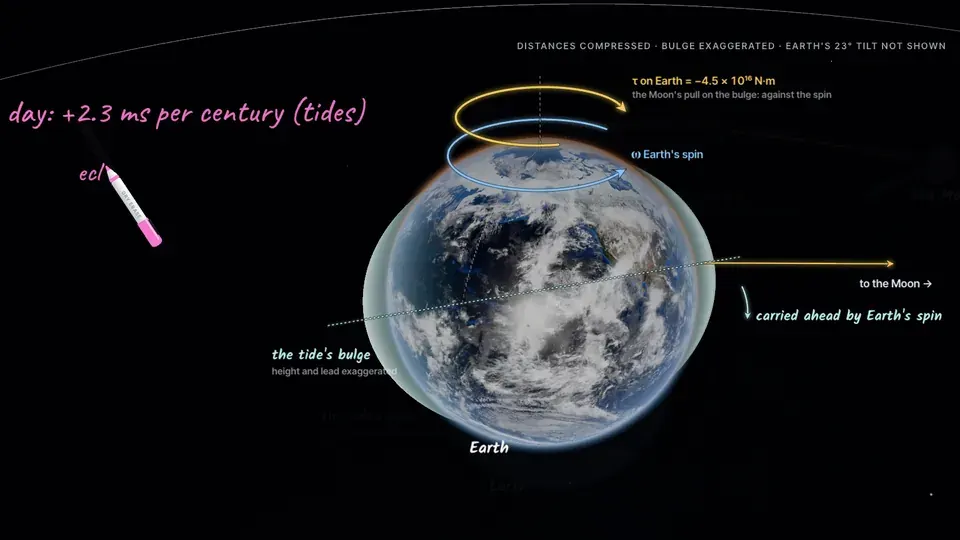
The reason is the tides. The Moon pulls the oceans into a bulge, and because the Earth spins much faster than the Moon goes around, the spin carries that bulge a little bit ahead of the Moon.
So the Moon pulls back on the bulge, and that twist works against the Earth’s spin and slows it down. The bulge pulls forward on the Moon, and that twist adds angular momentum to the Moon and lifts it into a wider orbit, and those two twists are equal and opposite, the same Newton’s third law pair as the skater’s arms and body.
On the Earth’s side, the tides make each day about two point three milliseconds longer every century, But records of eclipses going back almost three thousand years show the day growing by only about one point eight milliseconds a century, because the Earth is still getting rounder after the ice age, and that pulls its mass in toward the axis, like a skater pulling in her arms.
So let’s keep the books. Every century the Earth’s spin loses about one point six times ten to the twenty-sixth kilogram meters squared per second, and the Moon’s orbit gains about one point four times ten to the twenty-sixth. Whether that looks constant depends entirely on where you draw your box, so I want you to try it.
Now you draw the box. Put it around the Earth, around the Moon, or around both, and watch what happens to the angular momentum inside it over a century, and see if you can find a box where it stays constant.
This is the difference between conserved and constant, and the exam really cares about it. Angular momentum is conserved in every interaction, which means it never just disappears, but it’s only constant for a system that nothing outside is twisting. Almost all of the angular momentum the Earth loses goes into the Moon. It’s like cereal leaking out of a torn box onto the counter, because the cereal still exists, it just isn’t inside the box you’re counting anymore.
So let’s run the movie backward, six hundred twenty million years, to a time when the Moon was closer to us than it is now. How do you think a day back then compared with a day today?
And the rocks agree. Layers of sediment that the tides laid down six hundred twenty million years ago show a day of about twenty-one point nine hours, and about four hundred days in a year. And right now the Earth is also doing the opposite, because melting ice sends water from the poles toward the equator, farther from the axis, so the planet slows down a tiny bit extra, like a skater spreading her arms.
The puck and the stick
Let’s go back to the ice one last time, after everyone’s gone home, because an empty rink is the perfect place for a famous AP problem. A puck slides across the ice and hits a stick that’s pinned to the ice at one end, so the stick can only spin around the pin, and in this version the puck sticks to it and the two of them swing around together.
On the board, the AP routine starts with a picture. Here’s the stick from above, pinned at the left end. The puck comes in at six meters per second, one point two meters from the pin. The puck is point one seven kilograms, the problem gives us the stick’s rotational inertia about the pin, point four five kilogram meters squared, the way the exam would, and we want how fast the stick spins after the hit.
I’ll start by choosing the system, the puck and the stick together, and I’ll measure every angular momentum about the pin. The pin pushes on the stick during the hit, so the system’s linear momentum changes, and if you set p before equal to p after here, you lose the point. But the pin’s push goes right through the axis, so it has no lever arm and no torque, and that means the angular momentum about the pin stays constant.
Before the hit, the puck is moving in a straight line. But it still has angular momentum about the pin, m v x. You saw that in the last lesson. The distance x is the puck’s lever arm. It runs from the pin to the line the puck slides along, so the farther from the pin it hits, the more angular momentum it brings in.
After the hit, the puck rides along on the stick, so the total is I plus m x squared, times omega, and setting before equal to after and solving gives omega equals m v x over I plus m x squared. Putting in our numbers, the top comes to about one point two two and the bottom to about point six nine, so omega comes out to about one point eight radians per second.
And if you’d started from energy instead, setting one half m v squared equal to one half I omega squared, you’d get the wrong answer, because a sticky hit throws away most of the kinetic energy. Here it drops from about three joules to about one, while the angular momentum doesn’t change at all.
Now for the real AP twist, and it’s back on the ice. Suppose the puck bounces straight back off the stick instead of sticking to it. Which one leaves the stick spinning faster?
So let’s see the bounce. The puck comes back the way it came, and the stick spins away at about three point two radians per second, almost twice as fast as when the puck stuck.
Now try the first part of that exam question yourself. It asked where the puck should hit to make the stick spin fastest, so slide the hit point along the stick and find out.
On the real exam, students had to justify that answer in words, and an answer that just says the stick spins faster because angular momentum is conserved doesn’t earn the point, because conservation alone doesn’t say why bouncing gives the stick more spin than sticking. We have to follow what the puck loses and what the stick gains.
Here’s one that earns it. Take the puck and the stick as the system, and since the pin’s force passes through the axis, there’s no external torque about the pin, so the system’s angular momentum is the same before and after. When the puck bounces, its angular momentum reverses, from counterclockwise before the hit to clockwise after it.
So to keep the total the same, the stick has to end up with more counterclockwise angular momentum than the puck brought in, and that means a bigger omega. This is the sentence that earns the point, because it says which system, explains why the outside torque is zero, and then follows the angular momentum all the way to the answer, which is what a complete explanation of a no-outside-torque question looks like.
And there’s a second way to earn the same point. The bouncing puck changes its own angular momentum more than the sticking one, and the stick gets an equal and opposite change, so it has to spin faster.
Let’s try it on the merry-go-round from the start of the lesson. Which of these explanations would earn full credit for why it speeds up when the child walks in toward the center?
Your desk chair is a lab
You can test this tonight in an office chair. Sit in it holding a full water bottle in each hand with your arms out, and have a friend start you spinning. Put your phone on your lap running a free physics app that reads the phone’s gyroscope, and it gives you omega in radians per second many times every second. Then, during that same spin, move the bottles to a few different positions, in, out and in between, and since it’s all one spin, the only thing that changes from reading to reading is where the bottles are, so for each position estimate the rotational inertia the way we added up the stool.
Every one of your positions should obey L equals I omega, with the same L each time. If angular momentum really stays constant, which graph of your results should come out as a straight line through the origin?
Here’s what the stool from earlier predicts for four positions of the weights, and the line through them has a slope of eleven, which is the eleven kilogram meters squared per second we started with. When you actually do it, your points will droop a little the longer you spin, because the chair’s bearing has a bit of friction, a small outside torque that’s slowly handing your angular momentum to the floor, and through the floor to the whole Earth. Just sit low, keep your feet up, and have your friend spot you, because you will get dizzy.
Conserved, and constant in the right box
Let’s put everything from today on one board. The angular momentum of a system is the sum of the angular momenta of all its parts, about one axis. If nothing outside twists the system, that total stays constant, and when the parts turn together, that’s I initial omega initial equals I final omega final. Pull mass in and the spin speeds up by exactly the factor the rotational inertia drops, and the kinetic energy goes up, because muscles do the work.
An outside torque moves angular momentum across the boundary, and whatever the system loses, its surroundings gain. It’s conserved in every interaction, but it’s only constant in the right box, so always name the system and account for the outside torque on it, whether it’s zero or it moves angular momentum across your boundary.
And now when you watch him leave the ice, you know exactly what’s happening up there. The ice handed him all the angular momentum he was ever going to get, and the only thing he could do with it was get small, fast. Four and a half turns. And the ice paid for every one of them, before his blade ever left it.