
Topic 6.6 key terms
- satellite–central-body system
- A satellite and the much more massive body it orbits, treated as one system. The gravitational force between them is the only interaction, and it is internal to the system.
- conservation in orbits
- With only the internal gravitational force, the system's total mechanical energy is constant; because that force always points at the central body's center, it exerts no torque about it, so the satellite's angular momentum about that center is constant.
- negligible motion of the central body
- When the satellite's mass is negligible compared with the central body's, the central body's motion is negligible: equal forces, but a = F/M is tiny for the huge mass.
- elliptical orbit
- E and the satellite's angular momentum stay constant, but the system's potential energy and the satellite's kinetic energy trade: the satellite is fastest at its closest point. At the two ends, r_P v_P = r_A v_A.
- gravitational potential energy (two bodies)
- U_g = −Gm₁m₂/r for the system, with U = 0 when the two are infinitely far apart, so every finite separation has U < 0.
- circular orbit energies
- For a circular orbit of radius r: K = GMm/2r, U = −GMm/r = −2K and E = −GMm/2r = −K, all constant. A higher circle has less K and more (less negative) E.
- bound orbit
- An orbit whose total mechanical energy is negative: the satellite can never reach infinite separation, so it keeps coming back.
- escape velocity
- The speed that makes the system's total mechanical energy exactly zero: v_esc = √(2GM/r), independent of the satellite's mass and its direction. At exactly this speed the satellite slows forever and reaches zero speed only at infinite distance.
Transcript
2,962 words · 12 parts
The fastest thing we’ve ever built
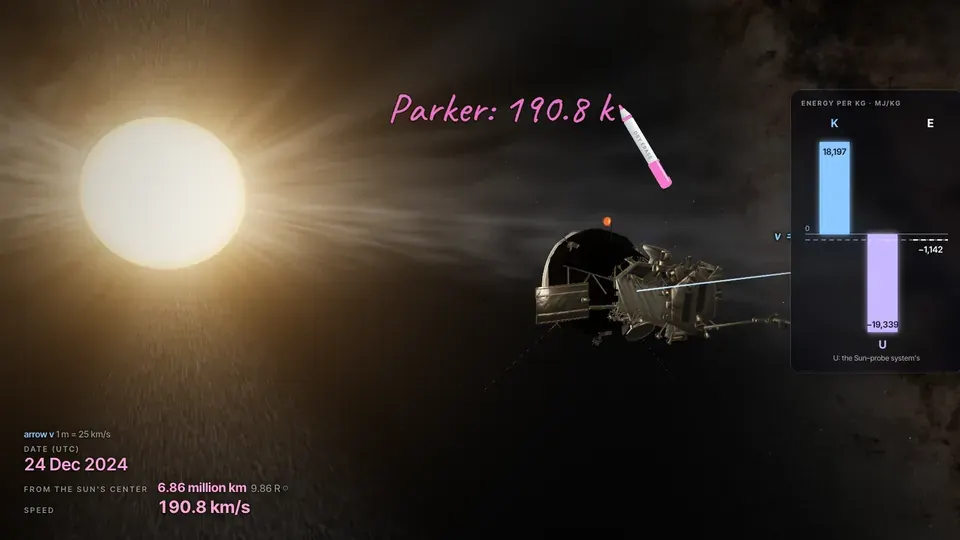
On Christmas Eve, 2024, a spacecraft called Parker Solar Probe flew closer to the Sun than anything people have ever built, so close that the Sun looked more than twenty times wider than it does from Earth. At its closest point, just under seven million kilometers from the Sun’s center, it was moving at about a hundred and ninety kilometers every second. That’s about four hundred and thirty thousand miles an hour, faster than any human-made object has ever moved.
Nobody could talk to it during the pass, so the team waited, and two days later a single beacon signal came home to say it had made it. Six weeks later, that same spacecraft was out by the orbit of Venus, crawling along at about twelve kilometers a second, and its engine had nothing to do with any of that change.
Those two distances and that one speed are all you need to predict that twelve kilometers a second, and by the end of this lesson you’ll do it yourself. Up close, it’s only three percent short of the speed that would fling it out of the solar system. You’ll also find out why it still comes back. So if nothing is pushing this spacecraft, where does all that speed come from?
One system, one force
Let’s freeze it on the way in, half a day before its closest pass, with its velocity arrow pointing along its path. There’s exactly one force on this probe, the gravitational force from the Sun. Which way do you think it points right now?
As the probe swings around, the arrow keeps turning to point at the Sun’s center. Look at the angle between the two arrows on the way in. The force leans forward, so part of it pulls along the motion. That forward part speeds the probe up. The part across the motion bends its path around the Sun.
On the way back out it leans backward, so that same part pulls against the motion and slows the probe down, all the way from a hundred and ninety back to twelve. So this spacecraft never needed an engine to keep it going, because the speeding up and the slowing down both come from one force that never switches off.
Let’s draw it as a system, the Sun and the probe together, with the gravitational force between them as the only interaction. That force acts inside the system, and nothing outside does any work on it. So the system’s total mechanical energy stays constant. Whatever kinetic energy the probe gains, the potential energy loses.
The force also points straight at the Sun’s center, so it has no lever arm about that center. It’s like pushing on a door straight toward its hinges, and the door doesn’t swing. With no torque, the probe’s angular momentum about the center stays constant too.
A classic AP question
Let’s put the whole orbit in one picture, with the closest point P and the farthest point A. I’ve drawn it a lot rounder than Parker’s real orbit so there’s room to see what’s going on.
This setup is a classic AP question. It asks you to compare the speed, the kinetic energy, the potential energy, the total energy and the angular momentum at the two points. Using the two facts we just found, which of these are exactly the same at P and at A? So let’s go and check that on the real spacecraft.
The bars show the energy for each kilogram of probe. At the closest point, the kinetic energy bar is huge, and the system’s potential energy hangs way down below zero. The orange readout is the probe’s angular momentum per kilogram. It’s the distance from the Sun’s center times the speed at right angles to that purple line. Up close, that’s a short distance times a big speed.
Out at the far end, the kinetic energy has shrunk to a sliver, and the potential energy has climbed most of the way up toward zero. The total hasn’t moved. The big orange number hasn’t changed either.
Out here, it’s a long distance times a small speed. The product comes out the same. That settles a very common wrong idea, that a satellite keeps one steady speed all the way round.
Closer means faster
Angular momentum lets us calculate something. For a small object moving past a point, it’s r times m times v times the sine of the angle between r and v. That one’s on your equation sheet. At the two ends of an ellipse, the velocity is perpendicular to the line from the Sun, so that angle is ninety degrees and the sine is one.
The angular momentum is the same at both ends, so m r v at P equals m r v at A. The mass cancels. That leaves the far speed equal to the near speed times the near distance over the far distance. One warning, though. This shortcut only works at those two ends, because anywhere else the velocity isn’t perpendicular to r, and you’d need the sine back.
Let’s try it with easy numbers first. Say the far end is four times as far from the Sun as the near end. Then out there, the speed is a quarter of the speed up close. So if it does forty kilometers a second up close, it does ten out there. Four times farther, four times slower.
Parker is frozen at its closest pass again. Up at the top are the three numbers you need, its distance and its speed here, and its distance at the far end. Now it’s your turn to keep the first half of the promise. Using those three numbers, how fast is it going at the far end, in kilometers per second?
This is the real spacecraft on the sixth of February 2025, out by Venus, doing eleven point nine seven kilometers a second. Two distances and one speed predicted a real spacecraft almost perfectly.
Zero at infinity
You probably noticed that the potential and total energies were negative, so let’s see where that minus sign comes from. The gravitational potential energy of the Sun–probe system is negative G times the two masses, divided by the distance between their centers. We put the zero at an infinite distance. Since the two pull each other together, every step closer lowers the potential energy, so at any real distance it’s already below zero.
So a negative potential energy isn’t a mistake. It just means we put zero out at infinity. This energy belongs to the Sun and the probe together, so we call it the system’s potential energy.
On a graph against distance, the potential energy dives way down close to the Sun and rises toward zero as you go out, without ever quite reaching it. The total energy is a flat line, because it never changes, and it sits below zero too. At any distance, the kinetic energy is the gap between that line and the curve, and close to the Sun the gap is enormous.
Zoom in on the far end, and you can see the total line sitting just below zero. The kinetic energy gap out here is small, about seventy-two megajoules per kilogram, but it’s still there. Think of the total as a budget that never changes. The potential energy rises and falls, and the kinetic energy is whatever’s left over.
Here are four sketches of one lap, starting from the far end, each with the kinetic energy, the potential energy and the total energy drawn against time. Which one gets all three right? To see it, we’ll ride one real lap of Parker’s orbit.
Watch the kinetic energy shoot up as it falls in, and the potential energy dive down to match. The total never moves. There’s sketch C, drawn from the real spacecraft’s numbers. Every joule of kinetic energy the probe gains, the potential energy loses, so the two curves mirror each other.
The probe pulls on the Sun just as hard as the Sun pulls on the probe. So why doesn’t the Sun get yanked around? The Sun has billions of billions of billions of times more mass, so the same force barely accelerates it. Its center sits only about two billionths of a billionth of a meter from the balance point. So when a satellite is tiny next to the body it orbits, we can treat the big body as sitting still.
Newton’s mountain
What does a satellite have in common with a thrown ball? Isaac Newton answered that with this drawing, published in 1728. Newton imagined firing a ball sideways from the top of a very high mountain, with the air taken away. Let’s build one four hundred and twenty kilometers tall, as high as the space station flies, on the real Earth.
If we fire the ball sideways at two kilometers a second, it curves down and lands, like any projectile you’ve ever thrown. Fire it at five, and it lands much farther away. Fire it at seven, and it lands a long way round. The Earth’s surface keeps curving away under the ball as it falls.
So how fast do you have to fire it so that it stays at the cannon’s height all the way round, in a perfect circle? Try a few speeds and find out.
Look at the readouts as it goes round. The distance and the speed never change, so neither do the potential and kinetic energy, and on a circle the total energy and the angular momentum are constant too.
That’s Parker’s force split again. On a circle, the force points straight across the motion, so it never speeds the ball up or slows it down. Fire it faster than that and it still doesn’t escape. It climbs into an ellipse with the cannon at the closest point, and the kinetic and potential energy start trading again, just like Parker’s.
Real satellites follow the same rule. The space station does about seven point seven kilometers a second, GPS satellites about four, the geostationary ones about three, and the Moon just one. So the higher the orbit, the slower it goes. That’s the opposite of what a lot of people guess, so let’s find out why.
The circle’s energy
To find the energy of a circular orbit, start from circular motion, where the net force points to the center and equals m v squared over r. Here the only force is the gravitational force, G M m over r squared, with M the Earth’s mass. So we set it equal to m v squared over r.
Multiply both sides by r, and m v squared equals G M m over r. Divide by m, and v squared equals G M over r. A bigger r means a smaller v. Half of m v squared is the kinetic energy, so K equals G M m over two r. It’s positive, like every kinetic energy.
The potential energy, negative G M m over r, is negative two times K. Add them, and the total energy is negative G M m over two r. That’s just the kinetic energy with a minus sign.
Per kilogram, the space station has about twenty-nine megajoules of kinetic energy, and a total of negative twenty-nine. A geostationary satellite, way higher, has just four point seven, and a total of negative four point seven. On the graph, the kinetic energy curve falls as the orbit gets higher, and the total energy curve rises toward zero. Negative four point seven is higher than negative twenty-nine.
Let me say that again, because it’s strange. A higher circular orbit has more total energy and less kinetic energy. To move a satellite up, you have to add energy, and then it ends up going slower. The idea that higher orbits go faster, because they have farther to travel, is backwards.
Suppose we move a satellite from the space station’s orbit up to a much higher GPS orbit. What happens to its kinetic energy, and to the total energy of the satellite–Earth system?
To catch up, slow down
That backwards fact caught out a real astronaut. On the third of June, 1965, on Gemini Four, Jim McDivitt tried to fly over to the spent rocket stage he could see out his window. He pointed at it and fired his thrusters, and it slid away from him. Every time he tried again it got farther away, until he’d burned almost half his fuel and they called off the chase.
You can see why now. His forward burn sped him up for a moment and raised his orbit’s energy. Then he climbed, and gravity pulled back against him the whole way up, like Parker on its way out. He slowed down and fell behind.
Here are two balls on the space station’s orbit. Yours is behind, and the target is about sixteen hundred kilometers ahead. Let’s see if you can do better than McDivitt did. Use your thrusters to catch the target, and pull up right beside it. Once you’re close underneath it, climb at your high point, the little triangle.
Escape
So how fast would you have to go to leave and never come back? Picture the slowest possible escape. The speed sinks toward zero as the distance grows without limit. Way out at infinity, the kinetic energy is zero, and so is the potential energy. The total never changes, so it’s zero the whole way out.
That’s our condition, the total energy is zero. So we set one half m v squared minus G M m over r equal to zero. The mass cancels again, so the escape speed doesn’t depend on how heavy the thing is. Move the G M over r across and double both sides, then take the square root, and that’s the escape speed.
For the Earth, we need G from the equation sheet and the Earth’s mass. We measure r from the Earth’s center, so from the ground it’s the radius, in meters. Put all three into the formula, and let a calculator do the arithmetic. It comes out at about eleven point two kilometers a second. That matches NASA’s number.
Up on our mountain the escape speed is a little less, ten point eight three kilometers a second, because the summit is farther from the Earth’s center. If we fire one ball straight up and one sideways, both at exactly that speed, which of them gets away? Watch their speedometers. They keep slowing down forever, closer and closer to zero, without ever getting there. Gravity reaches out forever, weaker and weaker, so there’s no place where it switches off.
So there are three kinds of energy line. Below zero, it’s bound and comes back. At exactly zero, it barely escapes. Above zero, it leaves with speed to spare, like the interstellar object Oumuamua in 2017.
Three percent short
Back to Parker at its closest point, for the second half of the promise. It’s doing a hundred and ninety point eight kilometers a second here. How much faster would it need to go to leave and never come back? Here’s a speed dial for Parker at its closest pass. Find the slowest speed that sends it out of the solar system for good.
Look how touchy it gets near the top. At a hundred and ninety-four kilometers a second, the far end is past Mars. At about a hundred and ninety-six, it’s past Jupiter. The last half a kilometer per second takes it past Neptune and out to infinity.
So why does Parker keep coming back, when it’s only three percent short? Its total energy is still below zero. At infinity, the potential energy is zero, so all of that negative total would have to be kinetic energy. Kinetic energy can’t be negative, so Parker can never get there, and it falls back in every eighty-eight days.
The sentence that earns the point
Let’s finish with the kind of question the AP exam loves. A spacecraft in a circular orbit fires its thrusters and moves out to a bigger circular orbit. Does its speed go up or down, and what about the system’s energy? Start with a clear claim, that the speed decreases and the system’s total energy increases.
Then give the physics that connects them. The gravitational force is the net force toward the center, so G M m over R squared equals m v squared over R, and v squared equals G M over R. Then apply it here. A larger R makes G M over R smaller, so the speed is smaller. Negative G M m over two R gets closer to zero, so the energy went up, even though the spacecraft slowed down.
Here’s an answer that loses it. “Because energy is conserved” names a law without connecting it to anything, and the thrusters had to add energy anyway. Let’s put a spacecraft with twice the mass into that same orbit. Which of these justifications would earn the point for its speed?
Coming back
A satellite and the body it orbits make one system, with one force inside it. So the total energy and the angular momentum both stay constant. On a circle, everything stays constant, and the total energy is minus the kinetic energy. So higher orbits are slower, but they have more energy. On an ellipse, the kinetic and potential energy trade, and closer means faster. A bound orbit has a total energy below zero, and the escape speed brings it up to zero.
Parker is still out there, swinging through its closest pass at about a hundred and ninety kilometers a second, every three months or so. It keeps falling in and climbing back out, and its total energy and angular momentum never change. So the next time you see the space station slide across the sky at dusk, you’ll know it’s falling the whole time, and it just keeps missing.