
Topic 7.1 key terms
- periodic motion
- Motion that repeats itself the same way in equal intervals of time. Every SHM is periodic; not every periodic motion is SHM.
- period
- The time for one complete repeat of a periodic motion, in seconds. The Taipei 101 damper’s period is about 7 s.
- equilibrium position
- A location at which the net force exerted on the object would be zero if it were at rest there. An oscillating object passes through it fastest, with zero restoring force; it is not the turning point, where the object stops for an instant.
- displacement from equilibrium (Δx)
- How far, and in which direction, the object is from its equilibrium position. For a hanging spring it is measured from the new (lower) equilibrium, not from the relaxed length.
- restoring force
- A force exerted in the direction opposite to the object’s displacement from equilibrium: it always points back toward equilibrium. In SHM it is also proportional to the displacement, so it is largest at the turning points.
- simple harmonic motion (SHM)
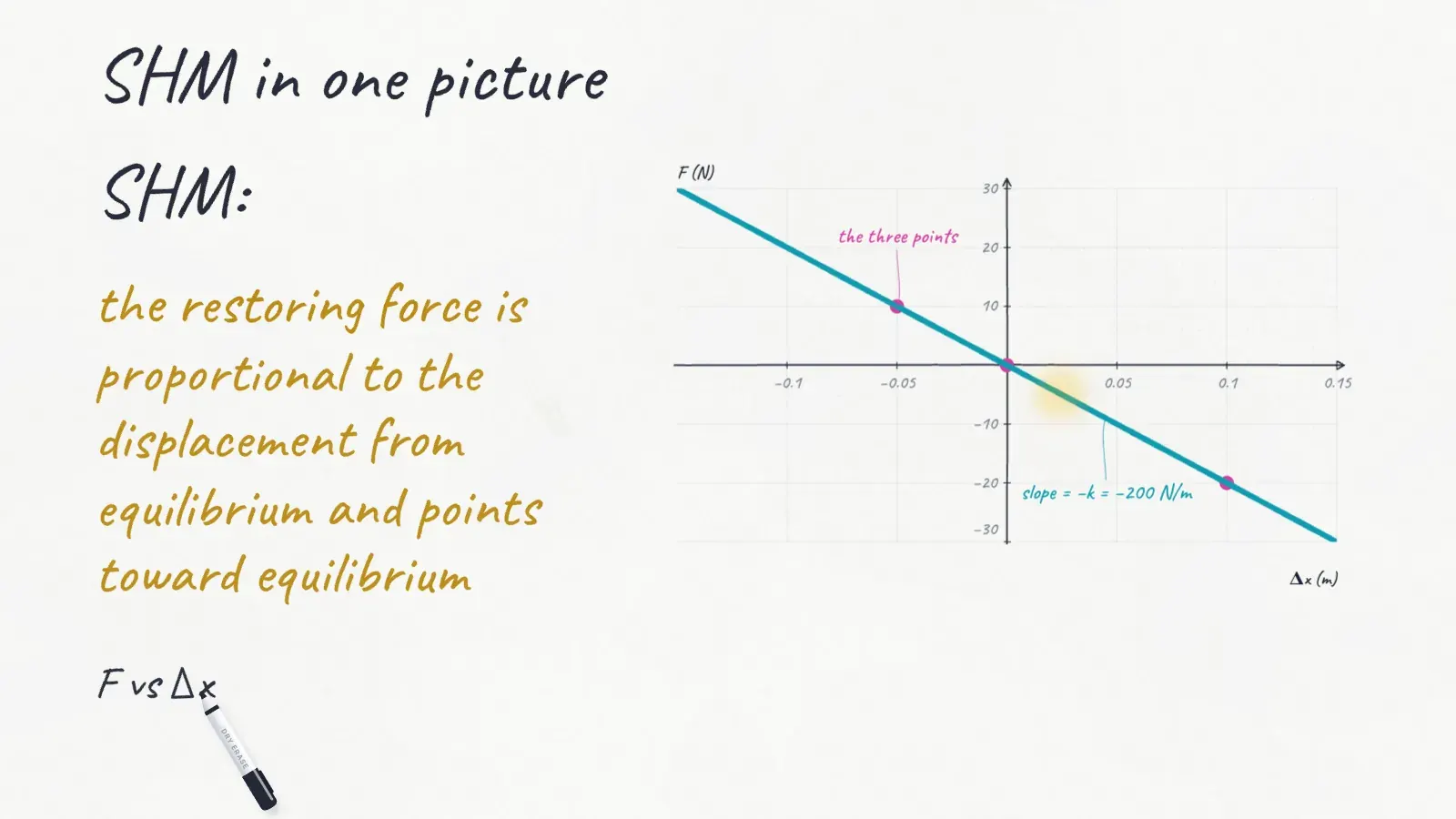
- Periodic motion produced by a restoring force whose magnitude is proportional to the displacement from equilibrium: . Its force-vs-displacement graph is a straight line through the origin with a negative slope.
- small-angle pendulum
- For small angles (radians), so a pendulum’s restoring torque is proportional to the angular displacement and the motion is (very nearly) SHM: within 1 % up to about .
Transcript
2,777 words · 11 parts
The ball at the top of the tower
Early in the morning on the eighth of August, 2015, Typhoon Soudelor was driving rain sideways across Taipei, and the five-hundred-meter tower in the middle of the city was swaying in the gusts. Almost four hundred meters up, in a room most people never guess is there, something moved farther that morning than it ever had before.
This is what moved. It’s a ball built from forty-one slabs of steel, five and a half meters across, hanging on eight cables. In the storm’s gusts, it swung a full meter out from the middle, the biggest swing anyone has ever recorded for it. Its mass is six hundred and sixty tonnes, one of the heaviest pendulums on Earth, and it’s up here on purpose. When the tower sways, the ball swings too and tugs back on the building.
Eight huge pistons underneath turn that motion into heat. The tower’s owners say that cuts the sway people feel by up to forty percent. By the end of this lesson, you’ll be able to prove that this ball moves in what physicists call simple harmonic motion. You’ll also work out how hard it gets pulled back toward the middle at the far end of its record swing. Let’s go and stand right next to it, and find out what’s doing all that pulling.
Home, and the pull back
Let’s stop the ball, take the storm away, and switch the pistons off. They’re there to kill the motion, and right now we want to watch it. When the ball hangs perfectly still, it hangs right here, straight under the point the cables hang from. Every force on it cancels out. We call that spot the equilibrium position, the place where the net force on the ball is zero.
That meaning earns points on the exam, too. In one of the AP’s own sample questions, the point goes to the student who says the net force there is zero. Now I’ll pull it a quarter of a meter to the right. The ruler on the floor shows its displacement, how far it is from equilibrium and which way.
This arrow points back toward the line. It’s the restoring force, the force pulling the ball back, and right now it’s about a hundred and thirty-five kilonewtons. Let’s pull it out to half a meter, twice as far, and watch the restoring force. The arrow is twice as long now, about two hundred and seventy kilonewtons. Twice the displacement gives twice the pull.
I’ll push it half a meter the other way, and both arrows flip. The displacement points left now, and the restoring force points right, still back toward equilibrium. A restoring force always points opposite the displacement.
You grab the ball this time, and pull it out until the restoring force is four hundred kilonewtons. Try to guess where that will be before you get there.
Look at the points you just made on this little graph of force against displacement. They sit on a straight line, and the line runs right through zero. That’s what it means for the restoring force to be proportional to the displacement.
So we have three words, each with an exact meaning. The equilibrium position is where the net force is zero. The displacement is how far the object is from there, and which way. The restoring force points back toward equilibrium, opposite the displacement. For this ball, twice as far out means twice the pull, every time.
Stopped is not balanced
Let’s release it from a full meter and watch it swing on its own. These faint copies show where the ball is at equal steps of time. Look how they bunch up at the ends and spread out in the middle.
It moves fastest through the middle, where the velocity arrow is longest, and slows to a stop at each end. The restoring force does the opposite. It vanishes in the middle and grows biggest at the ends, and the orange acceleration arrow follows it. I’m going to freeze it at the instant it stops at the far end. This moment is a classic AP question, and a lot of smart students get it wrong.
At this instant the ball isn’t moving at all. What do you think its acceleration is right now? Remember this frame. Zero velocity, but the biggest force and acceleration of the whole swing, both aimed back at equilibrium. Stopped doesn’t mean balanced.
The opposite mistake is just as common. People say the equilibrium position is where the ball stops. But when the ball crosses that line, it’s moving as fast as it ever goes, with no restoring force on it at all.
Things that come back
Before we write down a definition, let’s step back for a second. What do a child on a swing, a beating heart, a metronome and a perfectly bouncy ball all have in common? They all repeat. Each one does the same motion over and over, and every repeat takes the same time. We call any motion like that periodic motion.
The time for one repeat is the period. For the ball in Taipei, it’s about seven seconds. Simple harmonic motion is one special kind of periodic motion. Every simple harmonic motion repeats, but plenty of things repeat without being simple harmonic. What decides it is the force behind the motion.
The definition
Let’s use the simplest oscillator there is, a cart on a frictionless track, attached to a spring. We’ll put x equals zero at equilibrium, where the spring is relaxed, with positive to the right. That makes the displacement delta x just x. You already know the force a spring exerts. It’s Hooke’s law, right there on your equation sheet, and it says the spring force is negative k times delta x.
Newton’s second law says the net force along x equals m times a sub x. Along x, the spring is the only force on the cart, so m a sub x equals negative k delta x. That line isn’t on your equation sheet. On the exam, you build it yourself, the way we just did.
Divide both sides by m, and you get the acceleration. It’s proportional to the displacement, and the minus sign says it points the other way. The farther the cart gets from equilibrium, the harder the spring pulls it back.
Let’s try some easy numbers. A half-kilogram cart sits on a spring with k equal to two hundred newtons per meter. We pull it out to positive ten centimeters, which is zero point one meters.
The force is negative two hundred times zero point one, which is negative twenty newtons. It points left, back toward equilibrium. The acceleration is that force divided by the mass. Negative twenty newtons over half a kilogram is negative forty meters per second squared. It points back toward the middle too.
You take the next one. The cart is at negative five centimeters, five centimeters left of equilibrium. With right as positive, what’s the spring force on it, in newtons?
So the minus sign doesn’t mean the force is always negative. It means the force points opposite the displacement. That’s why it came out negative on the right and positive on the left. At x equals zero, the force and the acceleration are both zero, and that’s where the cart moves fastest.
Let’s put all three points on a graph of force against displacement. They land on a straight line through the origin with a negative slope. That slope is negative two hundred newtons per meter, which is just negative k.
An object moves in simple harmonic motion when the restoring force on it is proportional to its displacement from equilibrium, and points back toward equilibrium. On a graph, that’s a straight line through zero with a negative slope. It’s the same kind of line you made by hand in Taipei. A half-kilogram cart and a six-hundred-sixty-tonne ball obey the same rule.
Where is home?
What changes if we hang that spring straight down and hook a two-kilogram mass on it? Now the spring has to hold the mass up, so it stretches until the mass hangs still. This spring has k equal to four hundred newtons per meter. With g equal to ten, like on the AP exam, the mass weighs twenty newtons.
The mass hangs still when the spring pulls up as hard as gravity pulls down. Twenty divided by four hundred is zero point zero five meters of stretch. That’s the new equilibrium, where the net force is zero, five centimeters below the relaxed length. Let’s pull the mass three centimeters below equilibrium. Now the spring stretches five plus three, eight centimeters, which is zero point zero eight meters.
The spring pulls up with four hundred times zero point zero eight, which is thirty-two newtons. Gravity still pulls down with twenty. Thirty-two up and twenty down leaves a net force of twelve newtons up.
Here’s why it’s twelve. The first zero point zero five meters of stretch pull up twenty newtons, and that just holds up the weight. Only the extra zero point zero three meters pull the mass back, and four hundred times zero point zero three is twelve newtons. So the net force is proportional to the displacement from the new equilibrium, with the same k.
Gravity only moves where home is. It doesn’t change the spring. For the net force, measure the displacement from equilibrium, not from the relaxed length. On a real AP exam, lots of students measured from the wrong place.
You try the short way. Pull the mass two centimeters below equilibrium. With up as positive, what’s the net force on it, in newtons?
The test
Now we have a test for simple harmonic motion, and it’s a graph of force against displacement. Let’s try it first on something that repeats perfectly well. Here’s our ball again, but we swap its cables for a V-shaped trough. It rocks back and forth on two straight slopes, forever.
Before we let it go, sketch what you think its force graph will look like. Use the five handles on the card, then let it go and see how close you got. It repeats, so it’s periodic. But its force graph isn’t a straight line through zero, so it isn’t simple harmonic. Here are four force graphs for four different objects.
Which one of these could describe simple harmonic motion? Graph A is our cart on its spring. Graph B is a ball balanced on a hilltop, which never comes back. Graph C is the V-shaped trough you just sketched.
A bouncy ball repeats too. But in the air, the only force on it is its weight, the same at every height, so it fails the test. Repeating makes a motion periodic. It takes that straight line to make it simple harmonic.
A swing and a metronome come very close to simple harmonic motion when their swings are small. The bouncing ball doesn’t, and neither does a heartbeat. A heartbeat’s rhythm comes from its own electrical pacemaker, not from a restoring force. So what happens to a pendulum when the swing gets big? Let’s find out.
Why a pendulum is (almost) SHM
Back in the tower, here’s a blueprint ghost of the ball on the same cables. You can swing it much farther than the real ball could ever go without knocking out a few floors. Let’s swing it ten degrees. The card plots its pull against how far it has swung, next to the dashed straight line of simple harmonic motion, and the trace sits right on the line.
Now push it all the way out to sixty degrees, the way a kid really goes for it on a playground swing. The trace curls away from the line, seventeen percent below it. The swing still repeats, but it isn’t simple harmonic anymore. So where does small stop? Drag the ghost out until the real pull is one percent below the straight line, and see what angle that is.
Why does a big swing fail the test? Let’s draw the two forces on a pendulum. Its weight pulls straight down, and the tension pulls along the cable, toward the pivot. The tension can’t pull the ball back. It always points at the pivot, straight across the way the ball moves.
What pulls it back along its arc is a piece of its weight. Call the cable’s angle from straight down theta. Along the arc, the ball is like a block on a ramp tilted at theta, so the pull back is m g sine theta.
For simple harmonic motion, that pull has to grow in step with how far the ball has swung. The distance along the arc grows in step with theta, so the straight line that matches the real pull near the bottom is m g theta. So the real pull, m g sine theta, sits on that line only where sine theta matches theta.
Here’s theta, in radians, and sine theta on the same graph. Near zero they’re almost the same. As the angle grows, sine theta sags below the straight line. That sag is the curl you just saw at sixty degrees.
So for small angles, we can swap sine theta for theta. The pull becomes m g theta. It grows in step with the distance, and that’s simple harmonic motion. AP questions often say this with torque instead. Multiply the pull by the cable length L, and the restoring torque is m g L theta, proportional to the angle. It’s the same idea, measured around the pivot.
Here’s a quick one. Why does a five-degree swing count as simple harmonic motion, when a sixty-degree swing doesn’t? That’s why AP questions about pendulums say “small angle” right in the setup. Those two words are what make the swing simple harmonic.
The promise
Back in the tower, it’s time to keep the promise. Here’s the ball at the far end of its record swing, one meter out. First, let’s check that it really is simple harmonic. Out here, its cables lean only about four point seven degrees. At that angle, the real pull is a tenth of a percent off the straight line, so the swing is simple harmonic.
That makes a six-hundred-sixty-tonne ball at the top of a skyscraper a better simple harmonic oscillator than the swing in your local park. What matters is how little its cables tilt, not how heavy it is.
Now you finish it. At half a meter, the restoring force was two hundred and seventy kilonewtons. How hard is the ball pulled back at one meter, in kilonewtons? The readout in the tower agrees, about five hundred and forty kilonewtons. That’s the force dragging six hundred and sixty tonnes of steel back toward the middle.
The sentence that earns the point
An AP question would ask whether this motion is simple harmonic, and tell you to justify it using the data. Here’s the data you made with your own hands in Taipei. Right is positive, so every force on the right side comes out negative. Plot the points, and they sit on a straight line through zero with a negative slope.
Here’s the sentence that earns the point. The ball moves in simple harmonic motion. When the displacement doubles, from a quarter meter to a half, the force doubles, from a hundred and thirty-five to two hundred and seventy kilonewtons. The force always points opposite the displacement, too. So it’s a restoring force proportional to the displacement from equilibrium.
Two answers students write all the time lose that point. “It goes back and forth” only shows the motion is periodic. “Because F equals negative k x” names an equation without looking at the data. Here’s a cart pulled by a different device, with its own data. Which of these answers would earn full credit?
Back to the tower
A motion that repeats in equal times is periodic. Simple harmonic motion is the special case where the restoring force is proportional to the displacement from equilibrium. The equilibrium position is where the net force is zero, and it’s where an oscillator moves fastest. The restoring force always points back toward it, and it’s biggest at the turning points, where the object stops.
M a sub x equals negative k delta x says that whole idea in one line. The test is a graph of force against displacement, a straight line through zero with a negative slope. A pendulum passes that test only when its swing is small.
And somewhere above Taipei, every time the wind leans on that tower, a six-hundred-sixty-tonne ball swings out and gets pulled back home, harder the farther it goes, in simple harmonic motion. The ball and the tower share the same seven-second rhythm. Next time, we’ll find out what sets it.