
Topic 7.2 key terms
- period (T)
- The time for one complete cycle of a repeating motion: from one moment to the next moment when the object is at the same position moving in the same direction. Measured in seconds.
- frequency (f)
- The number of complete cycles per second, measured in hertz (1 Hz = 1 cycle per second = 1/s). f = cycles ÷ time.
- T = 1/f
- Period and frequency are reciprocals: seconds per cycle and cycles per second describe the same motion divided two ways.
- period of an object–spring oscillator
- For an object of mass m on an ideal spring of spring constant k: . More mass, longer period; stiffer spring, shorter period; no g and no amplitude in it.
- period of a simple pendulum
- For a simple pendulum of length ℓ (pivot to the bob's center) swinging through a small angle: . Longer, slower; stronger gravity, faster; no mass in it.
- small-angle condition
- The pendulum formula comes from approximating sin θ ≈ θ, so it is very close for small swings and less exact as the angle grows (the period gets longer at big angles).
- square-root dependence
- Because the period goes as a square root, multiplying m (or ℓ) by 4 multiplies T by 2; dividing g by 4 multiplies a pendulum's T by 2.
- linearizing period data
- Square the period: T² = (4π²/k)·m, so T² against the moving mass is a straight line through the origin with slope 4π²/k, and k = 4π²/slope. (The same move works for a pendulum: T² against ℓ has slope 4π²/g.)
- effective g in orbit
- In orbit a clock, its pendulum bob and the whole station fall together, so relative to the clock nothing pulls the bob back: the effective g is zero and the pendulum never swings back. A spring still pulls.
Transcript
2,591 words · 8 parts
The chair that “weighed” astronauts
In the summer of 1973, three astronauts were living up here on Skylab, America’s first space station. Every morning, the doctors back in Houston wanted to know how much each of them weighed. There was one problem, and you can see it floating right there. Up here the scale and whoever stands on it fall around the Earth together, so nothing presses on the scale, and its needle sits at zero.
A NASA doctor named William Thornton built them a chair on springs instead. Each astronaut folded up tight, held their breath and pulled a lever. A timer measured how long the seat took to rock back and forth three times. That time, about six seconds, went down to Houston by radio, and back came the astronaut’s mass, repeatable to within about the mass of an egg. The chair doesn’t need gravity at all, so it works where the scale fails.
How do you weigh someone when the scale reads zero? You’ll do it today, with a spring and a stopwatch. A pendulum clock up here would stop dead, and you’ll see why. Everything here runs on one number. It’s the time the seat takes to go back and forth, once.
There and back again
Here’s the chair from the side, with a ruler along the seat’s path. The mark in the middle is where the springs would leave it at rest. Right now the seat is passing that mark, moving forward. Before we watch, make a guess. If we start the clock right now, when has one full period gone by?
Let’s watch it go. It runs out to the far end and stops for an instant. That’s only a quarter of the trip. Now it’s back at the middle, where we started, but it’s heading the wrong way. That’s only half a trip.
It swings out to the other end, turns around, and comes through the middle moving forward again. Now everything matches, and it’s ready to repeat. That whole trip is one cycle. Its time is the period, and we call it capital T.
The chair’s timer counted three of those trips in about six seconds, five point nine six one. Divide by three, and one period is just under two seconds. NASA’s real chair took about two seconds too.
That’s a rule you can use in any lab. Time several cycles, then divide the time by the number of cycles. You get the seconds per cycle, the period. Divide the other way, cycles over time, and you get the frequency, f. It counts the cycles in each second, and its unit is the hertz, one cycle per second.
Our chair takes about two seconds for one cycle. So in one second it gets through only half a cycle, a frequency of about half a hertz. Two seconds and one half are flips of each other. Flip the frequency, and you get the period. T is one over f, and f is one over T.
On the 2024 AP exam, many students measured a spring’s period from the top of its bounce to the bottom. That’s only half a trip. A period always goes there and back. Now you try one. A block on a spring makes twenty complete oscillations in eight seconds. What’s its frequency, in hertz?
What the chair cares about
What sets that two seconds? Let’s find out the way a scientist would, by changing one thing at a time. First I’ll pull the seat back twice as far before I let go. It has twice as far to travel, yet the timer shows the same time, to the millisecond. We’ll see why next lesson.
Next, gravity, which you’d probably expect to matter. NASA kept a full-size copy of Skylab in Houston for training. Let’s put our astronaut in that chair, with all of Earth’s gravity pulling down. The timer shows the same six seconds it showed in orbit. Full Earth gravity changed nothing, so this chair works anywhere.
Back in orbit, let’s swap in a spring four times as stiff. The seat buzzes back and forth, and three periods take two point nine eight seconds, half as long as before. Last, the mass. With the normal spring back in, our astronaut floats out, and the springs move only the empty seat. One period drops to just under one second.
Now you’re NASA’s calibration technician. The empty seat is twenty-five kilograms, and so is each of these blocks. Run the chair with one, two and three blocks, and predict each new period before you pull the lever.
Look closely at your log. One block doubles the mass that moves, because the seat has the same mass as a block. The period grew one point four one times. Two blocks triple the mass, and the period grew one point seven three times. Three blocks make four times the mass, and the period doubled. Those are the square roots of two, three and four.
Reading the spring’s formula
That pattern is on your equation sheet. The period of a mass on a spring is two pi times the square root of m over k. Here m is all the mass that moves, and k is how stiff the spring is.
Let’s read it like a sentence. Mass is on top, so more mass means a longer period. Stiffness is on the bottom, so a stiffer spring pulls back harder and finishes each trip sooner.
Notice what isn’t in it. There’s no g, which is why NASA could use it in orbit. Even a spring hanging straight down keeps its timing. Gravity stretches it to a lower resting point, a new middle. Around that new middle, every centimeter of stretch still adds the same pull back, so each bounce takes the same time.
There’s no amplitude either, so pulling the seat farther changed nothing. Here are your runs again, from the empty seat up to four times its mass. Four times the mass didn’t make the period four times as long. It made it twice as long, because the mass sits under a square root.
Let’s try it with friendly numbers, on a lab cart. It’s half a kilogram on a spring of two hundred newtons per meter. How long does one bounce take? We know the mass and the spring, and we want the period. Half a kilogram goes on top, and two hundred newtons per meter goes underneath.
Half over two hundred is one over four hundred, and its square root is one over twenty, zero point zero five. Two pi times that is about zero point three one seconds. One over that is a frequency of about three point two hertz. That’s a little more than three bounces every second, which sounds right for a light cart on a stiff spring.
Time to put the two ideas together. If we load the cart until it has four times as much mass, what happens to its frequency?
The clock that never ticks
Time for the clock. No pendulum clock ever flew on Skylab, so ours is a thought experiment. Let’s take it down to the trainer in Houston, beside the chair. Listen to the two of them together. The clock’s pendulum swings there and back in two seconds. The chair takes just under two, so they rock almost in step.
Now let’s carry both of them up to the station and give the clock’s pendulum a little nudge. What do you think it does?
There it goes, turning round and round its pivot with the hands frozen, while the chair beside it keeps rocking every two seconds. On the ground, gravity swings a pendulum back. A spring pulls back on its own. What else sets a pendulum’s beat? Let’s go back to Earth and test one thing at a time again.
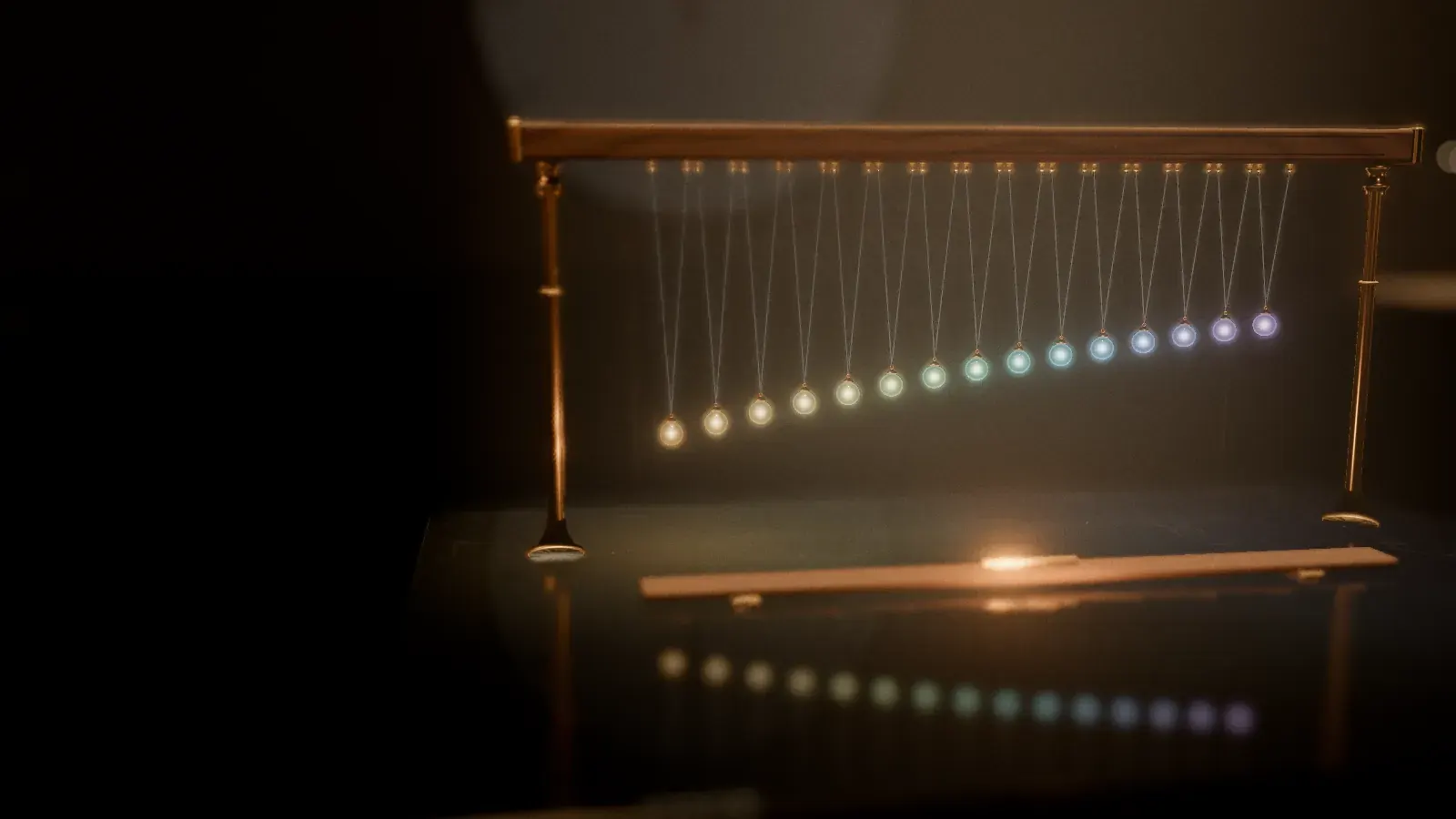
Here are fifteen pendulums hanging side by side, and nothing connects them. Each string is a little shorter than the one before it. Let’s let them all go together and see what happens. They start in a line, then peel apart into a wave that snakes along the row. Halfway through the minute, they split into two rows, every other bob swinging together.
Then, right at sixty seconds, every one of them lines up again. Harvard’s lecture demonstration team filmed a machine like this. The longest string makes fifty-one complete swings a minute. Each shorter one makes one more, up to sixty-five.
So the shorter the string, the faster it swings. Length sets a pendulum’s beat. What about the mass of the bob? Let’s hang a lead bob, four times as heavy, on string eight. At the end of the minute, it’s still right in line.
One thing does break the dance. Pull the whole row back four times as far, and the short strings swing out past thirty degrees. At angles that big their periods run long, and the minute ends in a smear.
Last, gravity. Let’s do something no museum can do, and move this whole gallery to the Moon, where gravity is about a sixth as strong. Everything slows down. The line doesn’t come back until about two and a half minutes.
Gravity sets the beat
Everything we just saw is in the other period formula on your equation sheet. A pendulum’s period is two pi times the square root of L over g. L is the length from the pivot to the center of the bob. Length is on top, so a longer pendulum swings more slowly, like the long strings in the gallery. Gravity is on the bottom, so weaker gravity, like the Moon’s, slows it down too.
There’s no mass in it, just as the lead bob showed. Gravity pulls a heavier bob harder, but that bob is harder to move by the same factor. It’s like a heavy ball and a light one falling side by side.
It only works for small swings, like the ones the gallery started with. As long as the swings stay small, how far you pull doesn’t change the time. The big pull made the timing drift.
Let’s put in friendly numbers. On the AP exam you can use ten meters per second squared for g, so I’ll use ten. The clock’s pendulum is about one meter long. One meter over ten is a tenth, and the square root of a tenth is about zero point three two. Two pi times that is about two seconds.
That’s the two seconds we heard in Houston, one tick each way. On the Moon, g is about one point six. Gravity sits under the square root, so the period grows by the square root of ten over one point six.
Ten over one point six is six and a quarter, and its square root is two and a half. Every period on the Moon is two and a half times as long. The one-minute line takes about two and a half minutes.
Here’s an AP-style question, a version of one of the exam’s own samples. A pendulum and a mass on a spring have the same period on Earth. On a planet with twice Earth’s gravity, what happens to each period?
Let’s take the trainer, chair, clock and all, to an imaginary planet with twice Earth’s gravity. The clock ticks faster, about one point four seconds a cycle, while the chair keeps its steady time, just under two. The g in the pendulum’s formula also explains the clock in orbit. Gravity up there is still almost as strong as on the ground. But the clock and its bob fall around the Earth together, just like the scale and the astronaut.
Nothing pulls the bob back, so the g it feels is zero. As g drops toward zero, the period grows longer and longer, without any limit. The pendulum never swings back, and the clock never ticks.
Find the astronaut’s mass
Let’s keep the promise and find our astronaut’s mass. First, NASA had to be sure of the spring’s k. On Earth you could hang a weight on the spring and measure the stretch. In orbit nothing hangs, so NASA timed known masses instead, just like your blocks.
Square both sides of the spring’s formula. T squared equals four pi squared over k, times the mass. So T squared grows in proportion to the mass. So if we plot your four runs against the moving mass, seat included, which graph comes out as a straight line through zero?
Read the slope as rise over run. The line climbs three point nine five seconds squared over a hundred kilograms, zero point zero three nine five seconds squared per kilogram. The boxed line says that slope is four pi squared over k. So k is four pi squared divided by the slope.
Four pi squared is about thirty-nine and a half. Divide by the slope, and k is a thousand newtons per meter, the number on the spring’s tag. Try one yourself. Timing the stiff spring the same way gives a line with a slope of zero point zero zero nine nine seconds squared per kilogram. What’s its k, in newtons per meter?
Next, the mass itself, the way the exam asks for it. The exam’s own sample question says, starting with the equation for the period of a mass on a spring, derive an expression for the mass. My first line is that equation, straight off the equation sheet. On that sample question, writing it down earns a point all by itself.
I want m by itself. Squaring both sides gives T squared equals four pi squared m over k, the same line as before. Then I multiply both sides by k and divide by four pi squared. The mass is k T squared over four pi squared.
Our astronaut’s three periods took five point nine six one seconds, so one period is one point nine eight seven. A thousand times that squared, over four pi squared, is a hundred kilograms. So is our astronaut a hundred kilograms? No, the spring moves the twenty-five kilogram seat too. Take that away, and the astronaut is seventy-five kilograms, an ordinary adult.
Now it’s your turn to do what they did. A new crewmate has just folded into the chair, and nobody has told us their mass. Pull the lever and read the timer. Then work out the crewmate’s mass in kilograms, and send it down to Houston.
Why the clock dies and the chair doesn’t
Let’s finish with the clock that would never tick. Suppose an AP question asks why the chair still works in orbit and the clock doesn’t. Full credit needs the claim and the physics reason behind it.
Which of these answers explains why the chair works in orbit while the clock stops? Pick the one that would earn full credit. Keep one picture from today, the seat going all the way there and back. That whole trip takes one period, and the frequency is one over it.
The spring’s period depends on mass and stiffness, with no g. The pendulum’s depends on length and gravity, with no mass, as long as the swings stay small. Both go as square roots, so four times the mass or four times the length gives twice the period. Graph the period squared against the mass, and the slope hands you k.
Every morning in 1973, the crews of Skylab found their mass with a spring and a timer. A pendulum clock beside them would have turned slowly round and round, waiting for a pull that never comes. Next time we’ll draw the motion itself, moment by moment. We’ll find out why pulling a spring farther never changes how long it takes to come back.