
Topic 7.4 key terms
- total mechanical energy
- For an oscillating system, the sum of its kinetic and potential energies, E = U + K. It stays constant as long as nothing outside the system does work on it and nothing (friction, air resistance, an inelastic collision) converts it into internal energy.
- kinetic energy
- The energy of motion, K = ½mv². In SHM it is largest at the equilibrium position and exactly zero at the turning points.
- gravitational potential energy
- Energy of an object–Earth system that depends on the object's height, U_g = mgh, measured from a zero you choose (here, the lowest point of the swing).
- spring potential energy
- Energy stored in a stretched or compressed spring, U_s = ½k(Δx)², where Δx is measured from the spring's relaxed length.
- turning point
- Where an oscillator momentarily stops and reverses: there K = 0 and all of the energy is potential energy.
- amplitude
- The greatest distance from the equilibrium position. For a spring–object system the total energy is E = ½kA², so the amplitude fixes the energy.
- equilibrium position
- Where the net force is zero; in SHM the object passes through it at its maximum speed, with the potential energy at its minimum.
- energy bar chart
- A chart with one bar per kind of energy in the system at one instant, all on the same scale; a zero is drawn as a distinct line on the zero line.
- internal energy
- Energy inside a system's parts, such as air warmed by drag. Energy that leaves an oscillation this way shrinks its amplitude.
Transcript
2,650 words · 10 parts
The fire that flies
In the cathedral of Santiago de Compostela, in the northwest corner of Spain, there’s an incense burner called the Botafumeiro. It stands about as tall as you do and weighs about sixty kilograms, and that’s before they pack it with burning coal. When the moment comes, the man in charge of it gives it a push, the way you’d push a kid on a swing. And eight men in red robes take hold of the other end of its rope.
Then every time it swings down through the bottom, all eight of them pull at once, and every swing comes back a little wider than the one before. After seventeen heaves on the rope, in about eighty seconds, it’s flying right across the church. It skims past just above the floor at sixty-eight kilometers an hour.
Then it soars up at each end to eighty-two degrees, almost touching the ceiling, and stops dead for an instant before it falls back. More than five hundred years ago, it flew off and crashed into one of the cathedral doors. In sixteen twenty-two, the rope simply snapped. That’s a lot of energy hanging over a lot of people.
Could you work out that speed just from how high it climbs? How do eight men on a rope make it swing higher every time? The answer is in what the energy does during a swing. Let’s slow one swing way down and follow the energy through it.
Follow the energy
To see it clearly, I’m going to cheat a little and switch off the air and the eight men. All that’s left is the Botafumeiro, the rope and the Earth, held at the top of its swing.
There are two kinds of energy to keep track of here, and the easy one is kinetic energy, the energy of motion. The other is gravitational potential energy, which belongs to the Botafumeiro and the Earth together and depends only on how high it is. I’m going to measure that height from the lowest point of the swing, so down at the bottom it’s zero.
Here it is at the very top of the swing, eighty-two degrees out. For this one instant it isn’t moving at all, so its kinetic energy is zero, and all of its energy is potential energy. Now let it go. As it falls, it loses height and picks up speed. The potential energy drains into kinetic energy, and I want you to watch the total while that happens.
The total doesn’t move by even a sliver. Every joule of potential energy it loses shows up as a joule of kinetic energy. At the bottom it’s all flipped. The potential energy is down to zero, and the kinetic energy is as big as it ever gets, so this is where it flies fastest. If an AP question asks where an oscillator moves fastest, this is the answer, wherever the potential energy is smallest.
Before I let it climb the other side, make a guess about how high it gets, with no air and nobody pulling on the rope. Let’s watch it climb the other side, trading it all back, until it stops at eighty-two degrees again, just as high as it started.
The total mechanical energy of the swing is the potential energy plus the kinetic energy. As long as nothing outside does work on it, and nothing turns it into internal energy, that total stays the same. The rope pulls on the Botafumeiro the whole time, but always at right angles to its motion, so it never adds or removes a joule. The eight men are going to change that.
Physicists draw this with bar charts, one chart for each snapshot, with a bar for each kind of energy and the same scale on every chart. At either end of the swing, the potential energy bar is four blocks tall and the kinetic energy is zero. Notice how I draw that zero, as a flat line sitting right on the zero line, never as an empty space.
This chart is a classic AP question. You earn the points by drawing every zero as a line and keeping the total the same in every snapshot. Now you finish it. In the middle snapshot, the bottom of the swing, drag the kinetic energy bar to the height it should be.
A lot of students read “energy is conserved” as “the kinetic and potential energy are equal.” AP readers flagged that on the 2023 exam. Those two are equal at only one height on the whole swing. What stays the same is their sum.
How fast at the bottom?
Now let’s put numbers on it. How fast is the Botafumeiro going when it passes through the bottom? I’ll start with a sketch, the way you always should. It starts from rest, a height h above the lowest point of the swing.
At the top it isn’t moving, so its kinetic energy is zero. Write that down. On the 2025 AP exam, a lot of students put kinetic energy into their equations where nothing was moving. At the bottom the potential energy is zero, because that’s where I put my zero. For g I’ll use ten meters per second squared, which the exam is happy with.
With no air and nobody pulling, the total at the top equals the total at the bottom. Up top that’s m g h plus zero, and at the bottom it’s zero plus one half m v squared.
The mass is on both sides, so it cancels. That leaves g h equals one half v squared, so v is the square root of two g h. Let’s try a friendly height first, one point eight meters. Two times ten times one point eight is thirty-six, and the square root of thirty-six is six meters per second.
Multiply by three point six, and that’s about twenty-two kilometers an hour, a fast bike ride. Since the mass cancelled, a marble on the same rope, let go from the same height, would pass the bottom just as fast. Now let’s turn that around. If the height decides the speed, you can pick a speed and work out the height that gives it.
You design the next one. Drag the Botafumeiro up its arc to the height that sends it through the bottom at ten meters per second, and then let it go. Sixty-eight kilometers an hour takes far more height, and far more energy. That’s what the eight men are for.
Where the energy comes from
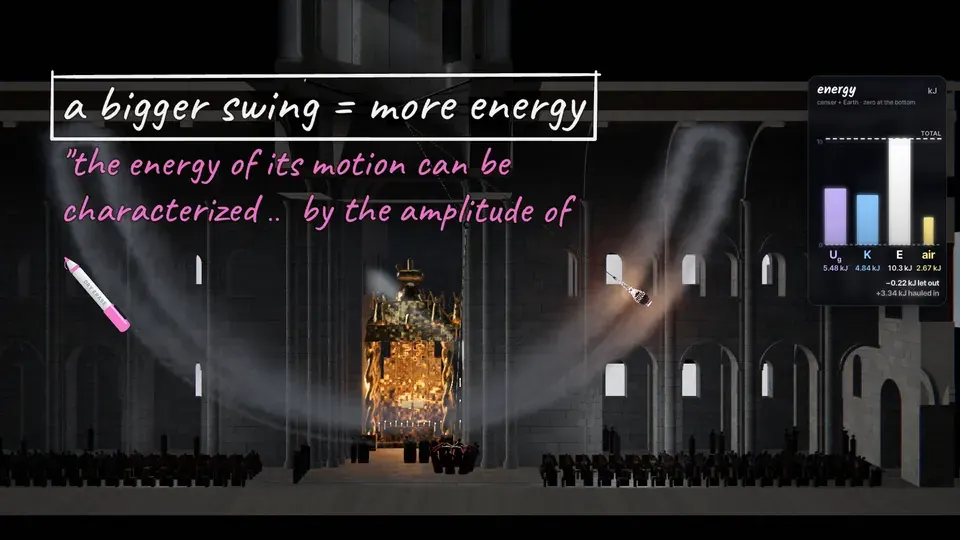
Let’s go back to the cathedral, switch the eight men back on, and the air too, and start again from the first gentle push. Watch the total. When the men haul the rope in, the burner moves along the rope, the way the rope pulls. Now the rope’s pull does work on it, and the total steps up.
When they let the rope back out near the top, it works the other way. On these small swings, most of that energy comes back out. But each haul puts in a little more than the let-out takes, so the total creeps up. Pull after pull, the total grows, even though the air takes a little out on every swing. So where does all that new energy go?
It goes into height. With every pull, the Botafumeiro stops a little higher at the end of its swing. Up there all of its energy is potential energy, so more energy means a higher place to stop.
A bigger swing means more energy. Look at how far out this swing goes, and you know how much energy it has. On its own, the swing can’t grow by one centimeter. To make it bigger, something outside the system has to do work on it.
Now you’re the crew. The Botafumeiro is swinging at thirteen degrees, and every time you hit pull, all eight men pull at once. See if you can pump it past sixty degrees, and watch what happens when your timing is off. A quick, honest note. A pendulum only moves in simple harmonic motion when its swings are small, and eighty-two degrees isn’t small.
Energy conservation still works at any angle. You can see a pendulum’s energy. It’s stored as height. A spring hides its energy in the stretched coil. In the next room, we’ll make that energy glow.
The spring keeps the books
This is the simplest oscillator there is, a glider on a spring, on a track with no friction. Unlike the big swing, it moves in simple harmonic motion however far you pull it. I’ll pull the glider out twenty centimeters. As the spring stretches, watch that column fill up. That’s the spring’s potential energy.
Now I’ll let go, in slow motion. The energy pours out of the spring into motion, and back into the spring on the other side. The total stays at four joules the whole time.
The glowing curve above the track is the spring’s potential energy at each spot. The flat line is the total. The glider turns around where the two of them meet. Those are the turning points, and the distance from the middle, the equilibrium position, out to either one is the amplitude.
The AP equation sheet gives you the spring’s potential energy, one half k times delta x squared. Delta x is how far you stretch or squeeze the spring from its relaxed length. At a turning point the glider stops, so the kinetic energy is zero and every joule is in the spring. The stretch there is the amplitude, A, so the total energy is one half k A squared.
That one isn’t on the equation sheet, but it’s one line away from it. Notice what’s missing. There’s no mass in it, only how stiff the spring is and how far you pull it.
Let’s try it with a lab glider, a two-hundred-newton-per-meter spring and a half-kilogram glider, pulled out twenty centimeters. I’ll square the point two zero first, which gives point zero four. Then multiply by two hundred and by one half, and the system has four point oh joules, the total we saw in the hall.
Can you find the glider’s top speed? All four joules are kinetic energy as it passes through the middle, and the glider’s mass is half a kilogram. Give it in meters per second.
Twice the pull
Back in the hall, the glider is still swinging with its four joules. What happens if I pull it out twice as far, to forty centimeters? Work it out before I pull. With the same spring pulled out forty centimeters, how much energy does the system have, in joules?
Here it is in the hall. Twice the pull, and four times as much light pours into the spring, sixteen joules sloshing back and forth. The square works the other way too. Let’s go back to twenty centimeters and four joules. Half-way out, the spring holds only a quarter of the energy.
At ten centimeters, the spring holds one joule of the four, and the glider still has the other three. So half-way out is not half and half.
Bars become graphs
A bar chart shows one moment at a time. Take a snapshot at every position along the track and line them up, and the tops of the bars trace out a graph. With x measured from the middle, the spring’s potential energy is one half k x squared, a parabola, zero in the middle and four joules at each end.
The total is the same at every position, so it’s a flat line at four joules. The kinetic energy is whatever’s left, the total minus the potential energy. That makes an upside-down parabola, biggest in the middle and zero at both ends. The turning points are where the parabola meets the flat line. The glider can’t go past them, because its kinetic energy would have to drop below zero.
Now let’s plot the same energies against time. The glider starts from rest at the end, so the potential energy starts at four joules and the kinetic energy at zero. In one period the glider rushes through the middle twice, once each way, so the kinetic energy peaks twice every period, and the potential energy does too.
It never goes below zero, because it’s built from the speed squared. Here are four graphs of energy against time for a glider released from rest at the end of its swing, so which one shows its kinetic energy?
Twice the mass
This next setup is a classic, with the same spring and the same twenty-centimeter pull, but on the second track the glider is twice as heavy, a full kilogram. Before I let them go, think about the heavy glider’s maximum kinetic energy, and decide how it compares with the light glider’s.
Let’s let them go. The heavy one lags behind and crosses the middle more slowly, but both columns hit the same four joules. The pull decided the energy before we let them go. The mass only decides how fast that energy makes the glider go.
On the AP exam, a question like this usually ends with one word, justify. Let’s write the answer that earns full credit. Start with a claim, a plain sentence that answers the question. Here, the maximum kinetic energies are equal.
Then name the physics that makes it true. The total energy of a spring–object system is one half k A squared, and that doesn’t depend on the mass. Then connect the physics to this situation. Both trials use the same spring and the same amplitude, so they have the same total energy, and at the equilibrium position all of it is kinetic.
That earns the point. Here are two answers that don’t. “Energy is conserved” is true, but it says nothing about these two gliders. “More mass means more kinetic energy” forgets that the heavy one is slower.
Now a new pair, two identical gliders on identical springs. We pull X out ten centimeters and Y out twenty centimeters. Which of these answers would earn full credit for comparing their maximum kinetic energies?
The promise
Now we can go back to Santiago and keep the promise. At full swing the Botafumeiro stops at eighty-two degrees, almost up at the vault. From the side, the ruler shows how high that is, seventeen point seven meters above the bottom of the swing.
You’ve done this once already, with a friendly height. It’s the same routine, just a much bigger swing. Over one half-swing, the crew and the air hardly change the energy. At the top the kinetic energy is zero, and at the bottom the potential energy is zero, so the speed at the bottom is the square root of two g h. So how fast is the Botafumeiro going as it passes through the bottom, in meters per second?
Multiply by three point six to get kilometers an hour, and you get about sixty-eight. That’s the number on the city’s own tourism website. You worked it out from nothing but a height and conservation of energy.
It stops growing at eighty-two degrees for a reason. Up there, the air takes out as much energy on every swing as the eight men put back in.
What to keep
An oscillator’s mechanical energy is its potential energy plus its kinetic energy, and it stays the same unless something outside does work on it, or turns some into internal energy. The amplitude tells you the energy. For a spring, the total is one half k A squared. Twice the amplitude means four times the energy, and the mass isn’t in it.
Against position, the potential energy is a bowl, the kinetic energy an arch, and the total a flat line. Against time, both peak twice per period and never go below zero.
Next time you see something swing, watch how far out it goes. A wider swing means more energy, and only work from outside, like eight men on a rope, can make it wider.