
Topic 8.1 key terms
- solid
- Matter whose particles are held in fixed positions by their neighbors and only vibrate there, so it has a fixed shape and a fixed volume.
- liquid
- Matter whose molecules touch and attract each other but can slide past one another: no fixed shape, nearly fixed volume.
- gas
- Matter whose molecules are far apart and barely interact except in collisions: no fixed shape and no fixed volume; it fills its container.
- fluid
- A substance that has no fixed shape: every liquid and every gas. Fluids flow and take the shape of whatever holds them.
- density
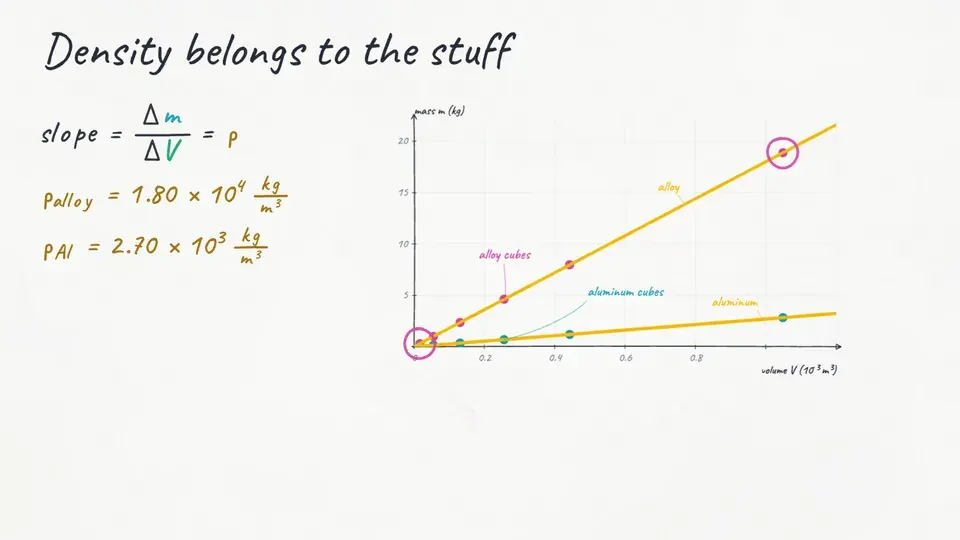
- Mass per unit volume, , in kg/m³: how many kilograms of the stuff fill a box one meter on every side. A property of the material, not of the size of the object; the slope of a mass–volume graph.
- incompressible
- A fluid whose volume, and so density, does not change when it is squeezed. A very good model for liquids (water: less than 0.01 % per extra atmosphere), a poor one for gases.
- viscosity
- A fluid's internal friction, the molecules dragging on each other as layers slide past one another; it decides how thick the fluid is and how slowly it pours. Separate from density.
- ideal fluid
- A model fluid that is incompressible and has no viscosity. AP problems assume fluids are ideal unless they say otherwise.
Transcript
2,267 words · 9 parts
Commercial Street, just after noon
In January of nineteen nineteen, Boston had been freezing for days, and then on the fifteenth the weather suddenly broke, and by lunchtime the air on the waterfront had climbed to about forty degrees Fahrenheit. Down on Commercial Street, right beside the harbor, stood a steel tank fifty feet tall and ninety feet across, and it was almost full of molasses, more than eight million liters of it.
That tank leaked, maybe from the very first day they filled it, so badly that the company painted it brown to hide the streaks, and people nearby heard it groan every time they filled it. Just after noon the rivets started to go, one after another, so fast that people said it sounded like a machine gun, and then the whole wall of the tank split open.
What came out was a wave of molasses that people at the time put at about twenty-five feet high, as tall as a two-story house, and it came down the street faster than anyone could run. It swept buildings off their foundations and slammed pieces of the tank into the girders of the elevated railway, and it killed twenty-one people and hurt about a hundred and fifty more.
By the end of this lesson, you’ll be able to weigh that wave with a tape measure and one number about molasses. You’ll also find the one property that made it so deadly. Physicists throw that property away when they talk about an ideal fluid. The steel tank and the molasses inside it are both made of tiny particles. So why does the steel hold its shape while the molasses pours down the street?
Why steel stands and molasses pours
I’ve frozen the flood at the moment the wave hits one of the railway’s steel columns, because in this one picture we’ve got a solid, a liquid and a gas, all side by side. This lens shows the steel about a hundred million times bigger. The iron atoms sit in neat rows. Each atom’s neighbors keep pulling it back to its own spot, so all it can do is jiggle there.
That’s why a steel column keeps its shape. Bend it a little and let go, and those same neighbors pull it right back. Now slide over to the molasses. The molecules are just as crowded, still touching, but they tumble and slide past each other. That’s why molasses can flow into any shape.
Up in the cold air above the street, there’s hardly anything in the lens at all. A few molecules fly around far apart, bouncing off whatever they hit. Richard Feynman once asked which single sentence he’d pass on if all of science were about to be lost. He chose this one, that all things are made of atoms, little particles that move around in perpetual motion, attracting each other when they are a little distance apart, but repelling upon being squeezed into one another.
Now you take the lens. Find the solid, the liquid and the gas in this frozen frame. In each one, pull the particle with the gold ring to feel how hard its neighbors hold on, and note the number the lens shows.
Let’s put that into the words an AP answer would use. In a solid, the particles hold each other in fixed places, so a solid keeps its own shape and its own volume. In a liquid, the molecules still touch and still pull on each other, so a liter stays about a liter. But they can slide, so a liquid takes the shape of whatever holds it, a tank one minute and a street the next.
In a gas, the molecules are so far apart that they hardly pull on each other. A gas spreads out to fill any container, so it has no fixed shape and no fixed volume. A fluid is anything with no fixed shape, so liquids and gases are both fluids. Fluid doesn’t just mean liquid. The air around you is a fluid too.
This word matters on the AP exam. Your equation sheet says fluids are assumed to be ideal, unless a question says otherwise. By the end of today, you’ll know what ideal means.
A strange test
Let’s test that definition on something strange. This is pitch, a black, tarry stuff. Hit a lump of it with a hammer and it shatters into sharp pieces, just like glass. Given what we just said about shapes, what do you think pitch really is? So pitch is a fluid, just an extremely thick one.
Density
Remember the numbers the lens showed you? Steel was about seven thousand nine hundred, molasses about fourteen hundred, and air just one point two. Each one is how many kilograms of the stuff would fill a box one meter on every side.
Notice the drop from molasses to air, more than a thousand times. A gas’s molecules are far apart, so a box of it holds hardly any mass. That number has a name, density. We write it with the Greek letter rho. On this board it gets a curly tail, so it never looks like a p.
Density is the mass of something divided by the volume it takes up. Kilograms over cubic meters gives kilograms per cubic meter. Let’s try it with friendly numbers. Two cubic meters of molasses have a mass of twenty-eight hundred kilograms. Twenty-eight hundred over two is fourteen hundred kilograms per cubic meter, the number from the lens.
Try one with steel. A girder from the elevated railway takes up three cubic meters and has a mass of twenty-four thousand kilograms. What’s its density?
One warning about that letter, because it costs people real points. On the 2025 AP exam, many students read rho as the letter p, and took it for pressure or momentum. Keep them apart for good. Rho is density, a small p is momentum, and a capital P is pressure.
Picture a box one meter on each side, full of ordinary air, next to a one-liter bottle of water. Which one has more mass? Most people get this one wrong.
Weighing the wave
Mass equals density times volume, and that’s all we need to weigh the wave. Here’s the tank before it burst. All we know about it is its size, fifty feet tall and ninety feet across.
Let’s do it the way you would on the exam, starting with a sketch. Fifty feet is about fifteen meters, so that’s the height. Ninety feet is about twenty-seven meters across, so the radius is about fourteen. The one number about molasses is its density, fourteen hundred kilograms per cubic meter, the number from the lens. We’re hunting for the mass.
Let me think out loud. I want a mass, and I know a density. Density is mass over volume, so mass is density times volume. The only thing I’m missing is the volume. The volume of a cylinder is on the equation sheet, pi r squared h. That’s the area of the circle on the bottom, times the height.
Pi times fourteen squared times fifteen comes out to about nine thousand cubic meters. That’s nine thousand of those one-meter boxes. Every one of those boxes holds fourteen hundred kilograms, so the mass is fourteen hundred times nine thousand. The cubic meters cancel and leave kilograms.
That’s twelve point six million kilograms, about thirteen million. That’s for a tank full to the brim, and that day it nearly was. Its weight is gravity’s pull on all that mass, m times g. Take g as ten meters per second squared. Thirteen million kilograms times ten gives about a hundred and thirty million newtons.
Exam questions often start this way, by turning a volume into a mass. Now fill that same tank with water instead, at a thousand kilograms per cubic meter. The molasses had how many times the water’s mass?
Density belongs to the stuff
Does density belong to the molasses itself, or to how much of it you have? To find out, let’s fill the empty tank two thousand cubic meters at a time. Every time we add two thousand cubic meters, the mass goes up by two point eight million kilograms. Let’s plot each step as a point, mass up the side and volume along the bottom. Both axes get their units, the way the exam wants a graph drawn.
The points fall on one straight line, and it runs back through the origin. An empty tank has no volume and no mass. The slope is the rise in mass over the run in volume. Mass over volume is density, so the slope of this line is the density.
Each step rises two point eight million kilograms over a run of two thousand cubic meters. That’s fourteen hundred kilograms per cubic meter, the molasses number again. The full tank from before, nine thousand cubic meters and twelve point six million kilograms, lands on this same line. Now drain half the molasses out of that full tank. What happens to the density of what’s left?
Fill the same tank with water instead, and you get a second line, a shallower one. Its slope is a thousand kilograms per cubic meter, the density of water. Try one. A third liquid puts four million six hundred thousand kilograms into five thousand cubic meters of the tank. What’s its density?
A bucket or a tankful, each liquid stays on its own line. So density belongs to the material, not to how much of it you have. Heavier doesn’t mean denser, either. A full tank of water is far heavier than a bucket of molasses, but the molasses is the denser one.
The ideal fluid
Now let’s find out what ideal means. Start with two sealed syringes, one full of air and one full of water, with the tips plugged so nothing can get out. Suppose I push on both plungers equally hard, hard enough to double the pressure inside. What do you think happens?
Push slowly. The air’s molecules have empty space between them, so they crowd into half the room. The water’s molecules already touch, and they push back. Its volume shrinks by less than a hundredth of a percent.
Physicists call a fluid like that incompressible. Squeezing it doesn’t change its volume, so its density stays the same, however hard you push. Even at the bottom of the deepest ocean, water is only about five percent denser. For liquids, incompressible is a great approximation. For a gas you squeeze, it’s wrong.
Now picture molasses and water pouring side by side. The molasses drags on itself as it flows. Physicists call that viscosity, a kind of internal friction between the layers of a fluid. Pitch is hundreds of billions of times thicker than water. Molasses is about four thousand times thicker, and air is thinner still.
At the bottom of the table, with zero viscosity, sits the ideal fluid. It slides past itself with no friction at all. Mercury is more than thirteen times denser than water. How do you think it pours?
Put the two halves together, and an ideal fluid is one you can’t squeeze, with no viscosity at all. That’s what’s behind the line on your equation sheet that says fluids are assumed to be ideal.
Let’s use it. Which of these is closest to an ideal fluid? For water, the ideal model works well. For molasses, it leaves out the most important thing of all.
Back to Boston
So let’s go back to Commercial Street and burst that tank twice, side by side, once full of an ideal fluid and once full of real molasses on a forty-degree afternoon. For the first few seconds, the two walls look almost the same. The wave is so tall and fast that viscosity hardly gets a say. That’s why even molasses came down that street like a wall.
But then they part ways. The ideal fluid keeps racing outward, thinner and thinner, and runs off into the harbor, while the molasses slows down, piles up and stops, two to three feet deep in the streets. As the afternoon turned to evening, the molasses cooled. Cold molasses is far thicker than warm, so it held on to the people caught in it, and the rescue was slow and desperate.
Now you run the experiment. Race the ideal fluid against cold molasses, then warm the molasses up and run it again. Watch how viscosity changes where the flood stops.
Now we can keep both halves of that promise. Density gave that wave thirteen million kilograms, about a hundred and thirty million newtons of weight. Viscosity, the thing an ideal fluid throws away, made it deadly once it stopped.
What to keep
What should you take from today? Atoms and molecules pull on each other when they’re a little apart, and push back when they’re squeezed. How tightly they hold on decides whether you get a solid, a liquid or a gas. A fluid is anything without a fixed shape, which means liquids and gases both, and even pitch, if you’re willing to wait.
Density is mass divided by volume, so it belongs to the material and not to the size of the piece, and it’s the slope of a mass–volume graph. An ideal fluid is a model fluid that you can’t squeeze and that has no viscosity. It works well for water, and even for the first seconds of that wave, but it fails once the molasses slows down and cools.
Next time you pour a glass of water or feel the wind on your face, you’ll know that’s a fluid with a density you could work out. And it’s just a little bit less than ideal.