
Topic 8.2 key terms
- pressure (P)
- The magnitude of the perpendicular component of a force exerted on a surface, per unit area: . Measured in pascals.
- pascal (Pa)
- The SI unit of pressure: 1 Pa = 1 N/m². A sheet of paper on a desk presses with about 1 Pa; the atmosphere at sea level is about 1.0 × 10⁵ Pa.
- perpendicular force component (F⊥)
- Only the part of a force that pushes straight into a surface makes pressure; the part along the surface does not.
- pressure is a scalar
- Pressure at a point has a size but no direction: a sensor reads the same whichever way it faces. The force a pressure exerts on a surface is perpendicular to that surface.
- fluid pressure and particles
- The pressure a fluid exerts is the combined effect of its particles colliding with (or pressing on) a surface, from every direction.
- atmospheric pressure (P₀, P_atm)
- The pressure of the air around us, about 1.0 × 10⁵ Pa (1 atm) at sea level: the column of air above each square meter (about ten tonnes) weighs about 1.0 × 10⁵ N, spread over that square meter.
- absolute pressure
- The total pressure at a point, counting the atmosphere: .
- gauge pressure
- The difference between the pressure at a point and a reference pressure (usually the atmosphere): what most gauges read. It can be negative (a vacuum).
- gauge pressure of a fluid column
- For a liquid of density ρ at depth h: , and . It depends only on the density, g and the depth, not on the amount or shape of the liquid.
- incompressible fluid
- A fluid whose volume and density don't change with pressure. Water is very nearly incompressible, so ρ is the same at every depth and P grows linearly with depth.
- net force from a pressure difference
- The net force on a panel with different pressures on its two sides: , perpendicular to the panel, toward the lower-pressure side.
Transcript
2,538 words · 9 parts
The air that folds steel
This is an ordinary railroad tank car, with solid steel walls all the way around. When the MythBusters pumped the air out of cars like this one, the steel held. Then they dented the top of one with a concrete block. That’s the car we’re going to try tonight.
The pump is pulling the air out of the tank. This gauge measures the vacuum in inches of mercury, an old unit, and fifteen inches means about half the air is gone.
The needle climbs past twenty inches, then twenty-two. You can hear the steel creak, but it’s holding, and for a long time it looks like nothing will happen at all. Let’s watch that again, slowly, from the end. The round end of the tank dishes in, and then the whole top caves down.
Now look from underneath. The bottom of the tank folds upward, against gravity, as if something down there were pushing it up. Apart from that dent, nobody touched this tank. The pump only took air out of the inside. The ordinary air outside did all of this.
Soon you’ll work out how hard the air pushed on each square meter of that steel. The same air is pressing on you right now, so why don’t you feel a thing? To get there we need one idea, pressure, and the best way into it is with something sharp.
Force on an area
Here’s a demonstration physics teachers love. Lie down on one nail, and it goes straight into your back. Lie down on a bed of a thousand nails, and you can relax. Your weight didn’t change at all. On a bed of a thousand nails, each nail only holds up about a thousandth of it.
That’s what pressure measures. Pressure is the force pushing straight into a surface, divided by the area it pushes on, so P equals F over A. A newton on every square meter has its own name, one pascal, after Blaise Pascal.
One pascal is tiny. A sheet of paper lying on your desk presses on it with about one pascal. The air around you pushes on everything with about a hundred thousand. On the 2025 AP exam, the graders saw students treat pressure as if it were a force. A pressure becomes a force only when you multiply it by an area.
Notice I said straight into. Push on a wall at a slant, and only the part of your push going straight in makes pressure. That’s why the F here is F perpendicular.
Push with fifty newtons, thirty degrees off the wall. The straight-in part sits opposite that angle. Fifty times sine thirty gives twenty-five newtons. Spread that over a hundredth of a square meter, and you get twenty-five hundred pascals.
A woman in stiletto heels stands next to an elephant. The board gives each one’s weight and the area it stands on. She rocks back onto one heel, and the elephant stands on all four feet. Which one puts more pressure on the floor?
Pressure has no direction
Let’s go back to the tank before the pump started. The air outside pushes on every square meter of the steel. The air inside pushes back just as hard, so every pair of arrows cancels.
Now the pump pulls air out. The inside arrows shrink, and the outside push is left over, with nothing to balance it. Look at which way the leftover arrows point. On top of the tank they point down.
On the round ends they point sideways. Underneath, they point up. The air doesn’t only push down. It pushes on every surface, from every side, and its force always points straight into the surface, whichever way the surface faces.
A push that goes every way at once is strange, so let’s test it. This sensor sits in the open air. It reads a hundred and one kilopascals, the hundred thousand pascals from before, measured more precisely.
I can turn this sensor any way I like. Which way will it read the most? Facing up, it reads a hundred and one kilopascals. Facing down, the same. Sideways, or at any angle in between, it doesn’t budge.
Pressure is a scalar, a size with no direction. Only the force it makes has a direction, and the surface you put there decides which way that force points. Where does a push that goes every way at once come from? Let’s put a lens on the steel, strong enough to see the air itself.
Air molecules race around at about five hundred meters per second, striking the steel from every direction. Each hit gives a tiny push. Add up the pushes on a patch of wall, divide by its area, and you have the pressure. Now let the pump run, and watch the inside. Every stroke takes molecules away, so fewer of them hit the inside of the wall.
Outside, nothing changes. People say the vacuum sucked the tank in, but that’s backwards. Empty space has nothing to pull with. Fewer molecules pushed back from inside, so the air outside shoved the steel in.
The ocean of air
So how hard does the outside air push? Picture one square meter of ground and all the air standing on top of it, straight up to the edge of space. All the air in that column has a mass of about ten tonnes. Using g as ten meters per second squared, which the AP exam accepts, it weighs about a hundred thousand newtons.
Spread over one square meter, that’s a hundred thousand pascals. We call it one atmosphere, and we write it P zero. Evangelista Torricelli worked this out in 1644. He wrote to a friend, “We live submerged at the bottom of an ocean of air.”
Most gauges ignore that ocean of air. They read only the difference from the air around them. To get the absolute pressure, add the atmosphere back on, so P equals P zero plus P gauge.
Say a tire gauge reads two hundred kilopascals. The air inside is really at three hundred, because the gauge never counts the hundred that the atmosphere adds. Now the tire goes flat, and its gauge reads zero. How much air pressure is left inside?
Your turn with the tank
Back to the desert, at the instant before the tank folded. Outside, the air pushes with a hundred and one kilopascals. Inside, it’s down to twenty-three. The inside air still pushes back, so only the difference counts. Multiply that difference by the area, and you have the net force.
What’s the net force of the air on one square meter of the steel, in newtons? This round end of the tank is about seven square meters. With the same difference, what’s the net force on the whole end, in newtons? Now let it go, and watch from the side, ten times slower. You can see the outside air pushing the steel in all along its length.
Now take a tank that hasn’t folded, pump some of the air out, and then open the valve. Listen to the outside air pushing its way back in. The inside arrows grow back until every pair cancels again. The net force drops to zero, and the reading outside never changed.
That’s you. Your body is like that tank with its valve open. The fluids inside you push out as hard as the air pushes in, so the net force on your skin is about zero. You only ever feel a difference, like your ears popping on a plane.
Deeper means more
The air’s pressure comes from the weight of the air above you. Water works the same way, but water is about eight hundred times denser, so its pressure piles up fast. Picture a column of water one square meter across and ten meters tall. That’s ten cubic meters, and each cubic meter of water has a mass of a thousand kilograms.
With g as ten, ten thousand kilograms weighs a hundred thousand newtons. Spread over one square meter, that’s a hundred thousand pascals, one whole atmosphere. Every ten meters you dive adds another atmosphere. It’s the same ten tonnes on each square meter as all the air above you.
Now make the column twice as wide. It weighs twice as much, but it presses on twice the area, so the pressure stays the same. Only the height counts. So the pressure under a liquid comes from its density, rho, times g, times the depth, h. That’s P gauge equals rho g h.
Check it on our column. A thousand times ten times ten is a hundred thousand pascals, the same as before. Careful with that first letter. It’s rho, the Greek letter for density, not a P. The 2025 graders saw that mix-up in a lot of answers.
Rho g h is only the water’s part. The air still sits on top, so the absolute pressure at depth h is P zero plus rho g h. This assumes rho is the same all the way down. For water that’s very nearly true, because water barely squeezes. We call it incompressible.
Push equally hard on a sealed syringe of air and one of water, enough to double the pressure. The air squeezes to half its volume. The water keeps its volume, and its density. When Lake Mead is full, the water at the base of Hoover Dam is about two hundred twenty meters deep. What’s the gauge pressure there, in pascals?
The lake doesn’t matter
This is Hoover Dam at blue hour, holding back Lake Mead. When it’s full, the lake runs about a hundred and ten miles up the canyon. Let’s fill it back up to its high-water line, and drop a pressure probe from the top. We’ll ride it all the way down the face.
At fifty meters down, its gauge pressure is about half a million pascals. At a hundred meters, about a million. It climbs the same amount every meter, and at the very bottom it reads about two point two million.
That’s your answer. The Bureau of Reclamation, which runs the dam, lists about the same pressure at its base. Now let’s cut the dam in half, like a museum exhibit. The pressure starts at zero at the surface and climbs in a straight line to the base.
Those arrows make a triangle, the graph of rho g h drawn on the concrete. That’s why the dam is two hundred meters thick at the bottom, and only fourteen at the top. Lake Mead is huge, though, a hundred and ten miles of water. Imagine we pull the far shore in until only a slab of water one meter thick is left, just as deep as before. With only that slab left, what happens to the pressure down at the base?
Watch the far shore slide in from a hundred and ten miles. Keep your eye on the probe at the bottom, all the way down to a slab one meter thick. The probe never moved. A hundred and ten miles of lake or a one-meter slab, the water adds the same pressure. Depth, density and g set it.
It’s the column idea again. Each square meter at the base holds up only the water right above it. A longer lake just adds more columns side by side, pressing on more floor.
Measure it like the AP
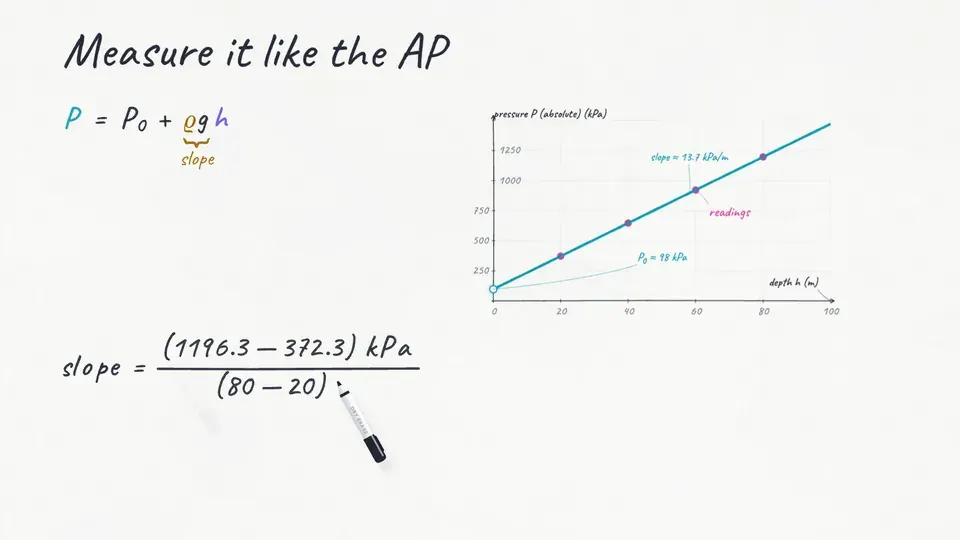
Lake Mead is now full of liquid X, and nobody has told us anything about it. You have a pressure sensor on a cable and a depth readout, but no scale. Lower the probe and record the pressure in liquid X at four depths, at least ten meters apart.
Here are four readings like yours, at twenty, forty, sixty and eighty meters. Watch them land on one straight line. This sensor reads absolute pressure, so at the surface the line starts at the air’s pressure, a hundred kilopascals. That’s where the line meets the axis. The intercept is P zero.
P zero plus rho g h is a straight line in h. Its slope is rho g, the density times g. At twenty meters it reads three hundred eighty kilopascals. At eighty meters, twelve hundred twenty. That’s eight hundred forty over sixty meters, fourteen kilopascals per meter.
Divide the slope by g. Fourteen thousand pascals per meter, divided by ten, is fourteen hundred kilograms per cubic meter. Water would make a gentler line, only ten kilopascals per meter, because water is less dense. The denser the liquid, the steeper the line.
Fourteen hundred kilograms per cubic meter is the density of molasses. Liquid X is molasses, the stuff that flooded Boston in 1919. You measured it with a sensor and a ruler. Liquid Y’s line climbs eight kilopascals per meter. What’s its density, in kilograms per cubic meter?
The College Board has a sample question just like this one. You earn the credit by graphing pressure against depth and saying the slope is rho g. Don’t divide one reading by g and h. Every reading still has the hundred kilopascals of air in it. The slope subtracts two readings, so the air drops out.
The exam also asks you to explain in words. A student claims the pressure at the base of Hoover Dam is huge because Lake Mead holds so much water. Which response earns full credit, with a claim, the right reason and evidence?
Sink it
Let’s finish where we started, with the tank car and one change. We seal it with ordinary air inside, no pump at all, and weigh it down so it sinks. Then we hang it from a crane over a flooded quarry.
Inside, the air stays at one atmosphere. Outside, it’s one atmosphere plus rho g h, so the difference is just rho g h. The car folds when that difference reaches seventy-eight kilopascals. How deep does it go before it folds, in meters?
Down it goes. Keep your eye on the ruler on the cable. Every meter deeper, the water pushes a little harder, and you can hear the steel groan. Just before eight meters, it folds, with no pump anywhere.
Your turn at the controls. Another tank with the same dent hangs on the crane. Lower it yourself, and stop at the deepest depth where it survives.
Now you can answer the question from the start. In the desert, the outside air out-pushed the inside by seventy-eight thousand newtons on every square meter. Right now, the air pushes on every square meter of you with about a hundred thousand newtons. You never feel it, because you push back just as hard.
Pressure is the perpendicular force on a surface, divided by its area. To turn a pressure into a force, multiply by the area. Pressure has no direction of its own. The force it makes points straight into any surface.
That push comes from countless particles hitting the surface from every side. Absolute pressure is the atmosphere plus the gauge pressure. A gauge reads only the difference from the air around it. In a liquid, the gauge pressure is rho g h. Depth, density and g set it, never the amount of liquid.
Next time, we’ll put something in a fluid. The pressure on its bottom is bigger than on its top, and that difference, times the area, pushes it up. It’s the reason ships float.