
Topic 8.3 key terms
- buoyant force
- The net upward force a fluid exerts on an object in it, F_b. It is the sum of all the fluid's pushes on the object's surface: the fluid underneath pushes harder than the fluid on top, because it is deeper.
- Archimedes' principle
- The buoyant force on an object equals the weight of the fluid the object displaces (pushes aside): F_b = ρVg, with ρ the density of the fluid and V the displaced volume.
- displaced fluid
- The fluid an object pushes out of the way: for an object completely under the surface, a volume equal to the object's own volume; for a floating object, the volume of the part below the surface.
- neutral depth (neutral buoyancy)
- The depth where the buoyant force equals the weight (ρV = m), so the two forces cancel and an object at rest stays at rest, neither rising nor sinking. For a freediver it exists because the water squeezes his lungs, so his V shrinks with depth.
- free-body diagram
- A diagram of one object as a dot with an arrow for every force on it. For a submerged object: the weight mg down and the buoyant force up, plus any tension, normal force or drag.
Transcript
2,803 words · 9 parts
One breath, a hundred meters down
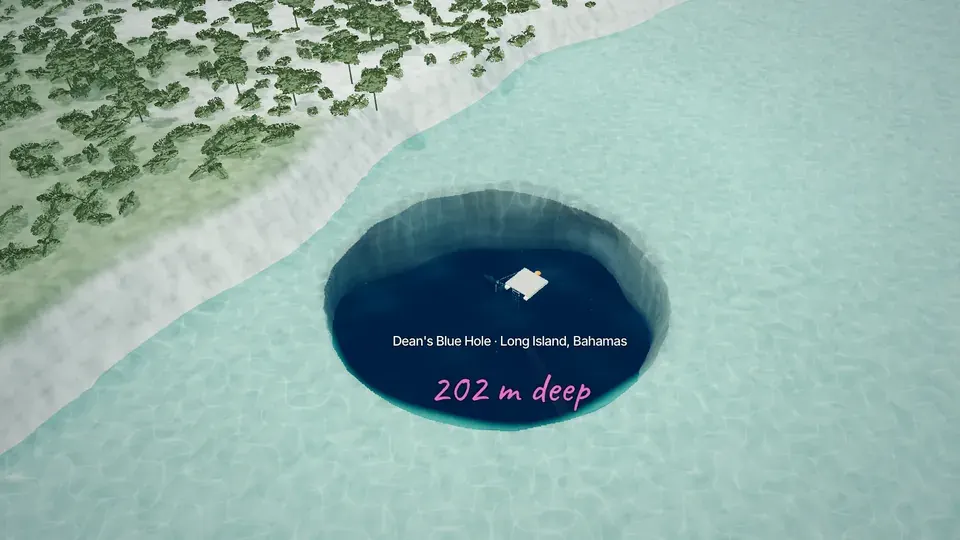
This is Dean’s Blue Hole in the Bahamas. It’s a round hole in a shallow lagoon, and it drops straight down for two hundred and two meters. The best freedivers in the world come here to find out how deep they can go on one breath.
In July of twenty twenty-three, right here, Alexey Molchanov swam down this line to a hundred and thirty-three meters and back up, all on one breath. For the first twenty-odd meters, a diver going that deep has to kick hard the whole way. Near the top, the sea keeps pushing him back up.
Then he stops kicking, puts his arms by his sides, and sinks for the next hundred meters without moving a muscle. Divers call it the freefall, though the water still pushes on him the whole way. He didn’t get any heavier on the way down, and nobody pushed him. What changed is the water’s upward push on him. It gets weaker the deeper he goes.
That’s strange, because the deeper water squeezes him harder and harder. Near the surface, the sea fights him. Deeper down, it lets him fall. By the end of this lesson, you’ll be able to explain why.
You’ll also write the one equation the 2025 AP exam asked for, about a swimmer in a tank of water. Start where he starts, floating at the surface. Why does water push up on anything at all?
Why the water pushes up
Before the dive, he floats on the surface, perfectly still. He’s at rest, so Newton’s first law says the forces on him balance. Gravity pulls him down with his weight, m g. The water has to push him up just as hard. We call that upward push from a fluid the buoyant force, F sub b.
But water doesn’t have hands. So where does that push come from? Let’s look at him from underneath. The water presses straight in on every patch of his skin below the waterline. The deeper the patch, the harder it presses, because more water sits on top of it.
The pushes on his two sides point opposite ways, so they cancel. The push from below beats the push from above. Add them all up, and what’s left points straight up. Zoom in a hundred million times, and each push turns out to be water molecules bumping into his skin. The ones underneath hit a little harder than the ones above.
A block shows the same idea more simply. The water pushes on every face of it, and the pushes on the left and the right are equal, so they cancel. The bottom of the block is deeper than the top. So the water pushes up on the bottom harder than it pushes down on the top.
That leftover push is the buoyant force, and in still water it always points up. On a free-body diagram, the floating diver is a dot with two arrows. His weight points down and the buoyant force points up. At rest, the two arrows are the same length.
The AP exam asked about this in twenty twenty-five. A swimmer held a block under water and let it go. Many students got the forces on that block wrong. The swimmer lets go, and the block starts to rise. Leaving out drag, as the exam did, which forces act on the block right after it’s released?
The ghost of water
So how big is that push? We can find it with one thought experiment, and no math at all. Picture a piece of the sea shaped exactly like our diver, thirty meters down. It’s just seawater, so it doesn’t sink and it doesn’t rise. It stays where it is.
It’s at rest, so the forces on it balance. Its weight pulls it down, so the water around it must push it up with a force equal to its weight. Now swap that piece of water for the diver. The water outside presses on the same shape at the same depth, so it pushes up just as hard as before.
So the buoyant force on anything equals the weight of the fluid it pushes aside. We call that Archimedes’ principle. Look at the readout on the right. At this depth, his weight beats the water’s push by about four newtons. That’s roughly the weight of a big glass of water, and we’ll see why soon.
On the board, the buoyant force equals the weight of the fluid pushed aside, and that weight is the fluid’s mass times g. The fluid’s mass is its density times its volume, rho times V. That makes the buoyant force rho V g, the equation on your AP equation sheet.
Watch the two middle letters. Rho is the density of the fluid, never the object. V is the volume of fluid pushed aside. For something fully under water, that’s its whole volume. That curly letter is rho, the Greek r, not a p. On the real exam, some students read it as a p and called it pressure.
A rock sits on the bottom of a cup of water. The water pushes up on it with eight newtons. Swap the water for an oil that’s three-quarters as dense. How hard does the oil push up, in newtons?
The swimmer and the block
Engineers test ship hulls here, in a long basin of still water. It’s called a ship-model basin, and it’s a good place to put our equation to work. We’ve built the 2025 AP question here, for real. One tank holds fresh water. The other holds salt water, about two and a half percent denser. In each tank, a swimmer holds the same wooden block perfectly still.
They’ll let go at the same instant. Which block will have the bigger acceleration the moment it’s released? There they go. Both blocks have the same weight arrow. The salt water pushes a little harder, and its block pulls ahead from the start.
The exam said to start from Newton’s second law, and find the block’s acceleration the instant the swimmer lets go. We’ll take up as positive. The net force on the block equals its mass times its acceleration.
Two forces act on it. The buoyant force points up, so it’s positive. The weight points down, so it’s negative. The buoyant force is rho V g, so we put that in its place. Divide everything by m, and you get a equals rho V g over m, minus g.
Suppose the block had the same density as water. Then the water it pushes aside has the same mass as the block, so rho V equals m. The first term becomes g, and g minus g is zero. The block would just hover, like the ghost of water.
Now the fresh-water numbers. The block’s mass is zero point eight kilograms. Its volume is one liter, a thousandth of a cubic meter. We’ll use g equals ten, which the exam allows.
First, the buoyant force. A thousand, times a thousandth, times ten, is ten newtons. The weight is zero point eight times ten, eight newtons. The net force is ten minus eight, two newtons up. Two newtons on zero point eight kilograms gives two point five meters per second squared, upward.
Now you do the salt water. It’s the same block, but the water’s density is one thousand twenty-five kilograms per cubic meter. What’s the block’s acceleration the instant it’s released, in meters per second squared?
Look where rho sits, on top of the first term. A denser fluid means a bigger acceleration. That’s the reasoning the exam wanted in its last part.
The freefall, explained
Back to the diver. Watch the green number by his chest as he kicks down. That’s V, the water he pushes aside. The water squeezes his lungs, so V shrinks, and so does his buoyant force. His weight arrow stays the same the whole way.
Now we can explain that four-newton gap at thirty meters. The diver obeys the same equation as the block. His mass, the seawater’s density and g all stay the same. Only one letter can change, V.
And V does change. The deeper he goes, the harder the water squeezes him. The air in his lungs gets pressed smaller, so he pushes aside less water. Less water pushed aside means a smaller buoyant force.
At some depth, rho V shrinks to equal his mass, just like the hovering block. Then the buoyant force equals his weight. If he stopped right there, he’d hang in the water like the ghost, neither rising nor sinking. Divers call it the neutral depth. Thirty meters is below it, which is why his weight won there.
Now take something the water can’t squeeze. A solid steel ball rides down the line from ten meters to a hundred meters. What happens to the buoyant force on it?
Here’s the steel ball riding down beside him. Its buoyant force stays the same all the way down, while his keeps shrinking. That settles a classic mistake, the idea that deeper water pushes up harder. For something rigid and fully under water, there’s no depth in rho V g.
Now you find the freefall. Drag the marker to where he should stop kicking, then press dive. Stop too soon, and the sea carries him back up. Try a few depths, and find where he starts to fall on his own.
Here’s what happened on your dive. Floating at the surface, he sinks only until the water he pushes aside weighs as much as he does. That takes only part of his body. Once he’s fully under with full lungs, he pushes aside more water. The sea pushes him up about fifty newtons harder than gravity pulls him down.
As he kicks deeper, that extra push shrinks. By about twenty-three meters, in our model, the two forces match. Below that depth, his weight is bigger than the buoyant force, so from rest he starts to sink. The deeper he goes, the bigger that gap gets. The water’s drag soon holds him to a steady glide of about a meter a second, and he never has to kick.
Weighing in water
Back in the hall, there’s an experiment from the AP course guide. A crane and a graph will show you what’s hiding in murky water. This murky pool is three meters deep. A hidden object, two meters tall, sits on the bottom. A crane holds it by a cable with a sensor that reads the tension.
The crane lifts it slowly, and a graph plots the tension against the height of the object’s bottom, from zero up to four meters. Look at the first meter. The object rises, but the tension doesn’t change at all. Like the steel ball, the water can’t squeeze it, so its buoyant force stays the same.
From one meter to three, the object slides up through the surface, and the tension climbs. Less of it is under water, so the water holds up less, and the cable takes the rest. After three meters, it’s out of the water, and the cable holds its full weight.
Now read it like an AP problem. Under water and rising at a steady speed, the object has zero net force. So the tension plus the buoyant force equals its weight. Rearrange it, and the buoyant force is the weight minus the tension. On the graph, that’s the gap between the two flat parts.
In air, the cable holds about two hundred thousand newtons. Under water, it holds about a hundred and twenty thousand. The gap, eighty thousand newtons, is the buoyant force. Now find the object’s size without ever seeing it. Using that buoyant force, what is the object’s volume, in cubic meters?
With the water cleared, there it is, a two-meter cube. On the bench, a beaker of water sits on a scale. A steel ball hangs above it from a force gauge.
We’ll lower the ball until it’s fully under, touching neither the bottom nor the sides. What happens to the reading on the scale? Watch both readings as the ball goes in. The scale goes up by a hundred grams, about one newton. The gauge drops by the same one newton.
The water pushes the ball up, so the ball pushes down on the water just as hard. The diver does the same in the Blue Hole. The sea pushes him up, and he pushes down on the sea.
The water obeys Newton too
Around the diver, the water sat still. What happens when the water itself has to speed up? The towing carriage carries two things. An open tank of water holds a cork float tied to the bottom and a steel ball on a thread. A sealed glass box of air holds a helium balloon tied to the floor and a weight hanging from the roof.
When the carriage launches, the steel ball will swing back, the way you get pressed into your seat. What do you think the cork float will do?
Watch all four at once. The steel ball and the weight swing back. The float and the balloon lean forward. The water’s surface tilts up toward the back. Once the carriage reaches a steady speed, everything hangs straight again, and the surface goes flat.
Picture the ghost of water again, this time a ball of the tank’s water the size of the float. When the tank speeds up, this ball of water speeds up with it. By Newton’s second law, a net force on it must point forward.
Only the water around it can push it. So the water behind must push harder than the water in front. The pressure is higher at the back, and you can see it, because the surface piles up there. Now put the float where the ghost was. The water gives it the same forward push.
That push could speed up a whole ball of water. The float is far lighter, so it gets ahead of the tank and leans forward. The steel ball has far more mass than its ghost. The same push can’t keep it up to speed, so it lags behind.
At a steady speed, the water’s velocity isn’t changing. There’s no net force on it, and no extra push from the back. A fluid’s velocity changes only when the net force on it isn’t zero, just like anything else.
Air is a fluid too. In a car, a helium balloon leans forward when the driver speeds up. Which way does it lean when the driver brakes?
The sentence that earns the point
Back down the line, one last time. At the bottom, the diver grabs a tag from the plate to prove he made it, and turns for home. Now the freefall works against him. Down here, his weight still beats the buoyant force, so he has to kick hard all the way back up to the neutral depth.
Above it, the air in his lungs expands again, and the buoyant force grows past his weight. For the last twenty-odd meters, the sea carries him up to the light. An AP question asks why the diver, stopped at rest below the neutral depth, starts to sink, in terms of the forces on him. Which explanation earns full credit?
On the 2025 exam, only about a third of students wrote that the block’s weight stays the same in both tanks. That one fact was worth a whole point. When you explain anything that floats, sinks or hovers, start with the weight, and say it doesn’t change. Then say what the buoyant force does, and why. Finish with the direction of the net force.
The whole dive fits in rho V g minus m g. On the way down, only V changes. Once V shrinks enough, the sea that fought him at the surface lets him fall.
What to keep
The buoyant force is the fluid’s net push on an object. It points up because the fluid underneath pushes harder. Its size is the weight of the fluid pushed aside, rho V g, with rho the fluid’s density and V the volume pushed aside.
There’s no depth in it, so a rigid object fully under water feels the same push at any depth. Newton’s second law decides what happens next. With drag left out, the buoyant force minus the weight equals m a. Its sign tells you whether it rises, hovers or sinks.
A fluid obeys the same laws. Its velocity changes only when the net force on it isn’t zero, like the air around a balloon in a car. Every push from a fluid has a partner. The object pushes back on the fluid just as hard, which is why the scale under the beaker went up.
Next time you’re floating in a pool, take a deep breath and let it out slowly. You’ll settle a little lower in the water, because you just made your V smaller.