
Topic 8.4 key terms
- pressure difference (cause of flow)
- A difference in pressure between two places in a fluid makes it flow: the fluid is pushed from where the pressure is higher toward where it is lower, and in a level pipe it speeds up only where the push from behind is bigger than the push from ahead.
- volume flow rate
- The volume of fluid that passes a cross-section each second, V/t = Av (m³/s): the cross-sectional area times the speed. A derived equation, not on the equation sheet.
- continuity equation
- A₁v₁ = A₂v₂: in a completely filled pipe of incompressible fluid, the same volume (and so the same mass) passes every cross-section each second. Narrow means fast.
- Bernoulli's equation
- P₁ + ρgy₁ + ½ρv₁² = P₂ + ρgy₂ + ½ρv₂² between two places along one steady flow of an ideal fluid: the energy bar chart per cubic meter, so conservation of mechanical energy (½ρv² is K per m³, ρgy is U_g per m³, P is the work per m³ the push from behind can do). On the equation sheet.
- Torricelli's theorem
- v = √(2gΔy): the speed of a fluid leaving an opening a depth Δy below the top surface (Δy runs from the hole UP to the surface, never to the floor). From Bernoulli: the height bar at the surface becomes the speed bar at the hole. Not on the equation sheet; no density and no area in it.
- ideal fluid
- A fluid that is incompressible and has no viscosity; on the AP exam fluids are ideal and pipes are completely filled unless a problem says otherwise.
Transcript
2,498 words · 8 parts
Half a tonne a second
This is Lake Geneva at dawn. Out at the end of that long stone jetty, a pipe points straight up at the sky, and nothing is coming out of it yet. Every morning, someone presses the button that starts the pumps under the jetty. Then this happens.
Every second, that pipe throws five hundred liters of water into the air at two hundred kilometers an hour. The water climbs a hundred and forty meters, about as high as a forty-story building, and then it falls back into the lake. My favorite part is how it got started, because nobody meant to build it. In 1886, Geneva pumped water at high pressure through pipes under its streets, and craftsmen ran their machines on it. Every evening, when the workshops shut down, all that pressure had nowhere to go.
The engineers fitted a valve to let it out, and every evening a jet of water stood straight up out of the river. In 1891 the city made it an attraction and moved it out here, into the harbor. Geneva publishes just three numbers about this fountain. From those three alone, you can work out what Geneva never tells you.
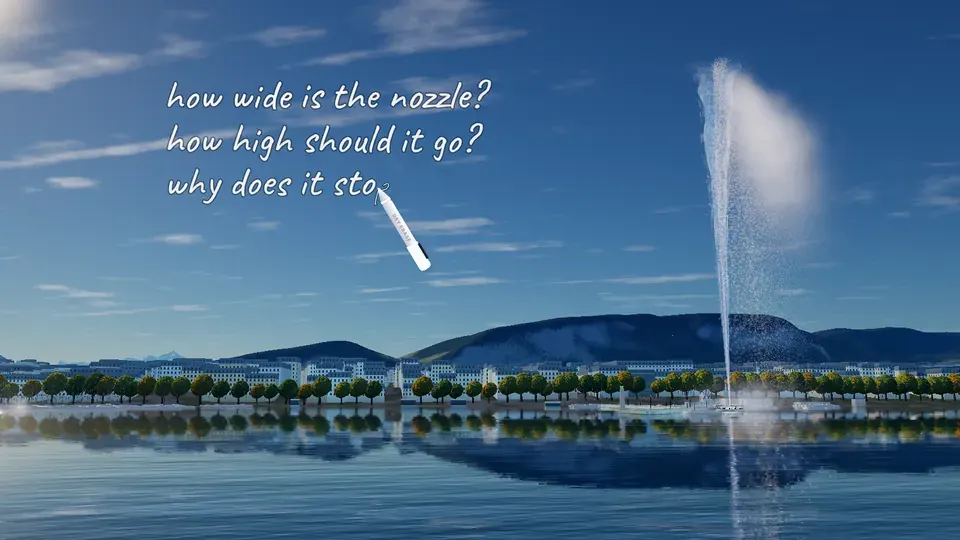
How wide is the nozzle? How high should the water go? And why does the real jet stop about seventeen meters short? It all starts with what those engineers saw in 1886. Water flows from where the pressure is high to where it’s low.
What goes in must come out
Let’s look under the jetty. Two big pumps drive lake water up a pipe toward the nozzle. They keep the water in that pipe at a far higher pressure than the air outside.
The water in the pipe pushes forward much harder than the air can push back, so it speeds up and shoots out. A difference in pressure is all it takes to make a fluid flow. Watch the specks in the water. They crawl along the wide pipe, then race out through the narrow nozzle.
How much water leaves every second? Let’s paint everything that leaves the nozzle in one second. It makes a glowing cylinder, as wide as the nozzle. Its length is how far the water travels in one second.
The water leaves at two hundred kilometers an hour, which is about fifty-six meters every second. That makes the cylinder about fifty-six meters long. The same picture works for any opening. The end of the cylinder is the opening’s area, A. Its length is the speed times the time, v t.
Its volume is the area times the length. Divide by the time, and you get the volume that passes each second. V over t equals A v. Say an opening is two square meters, and the water moves through it at three meters per second. Then six cubic meters pass every second.
We call V over t the volume flow rate. Careful with the letters. Capital V is a volume, and little v is a speed. This showed up on the 2026 AP exam, in a question about a fountain. One point went to students who wrote the flow rate as area times speed.
Think about the pipe under the jetty again. It’s full, and water doesn’t squeeze, so whatever goes in one end each second has to come out the other. The wide pipe and the narrow nozzle pass the same volume every second. A one v one equals A two v two.
That’s the continuity equation, and it’s on your equation sheet. The same volume each second is also the same mass, so it’s really conservation of mass. Where the area is small, the speed is big. That’s why the specks raced through Geneva’s nozzle.
Try one. A garden hose carries water at two meters per second through three square centimeters. Its nozzle is half a square centimeter. How fast does the water leave the nozzle, in meters per second?
Now we can answer the first question. A cubic meter holds a thousand liters, so Geneva’s five hundred liters is half a cubic meter. That’s a flow rate of half a cubic meter every second, leaving at about fifty-six meters per second.
We want the area, so we divide the flow rate by the speed. A half, divided by fifty-six, is about nine thousandths of a square meter. A square meter is a hundred centimeters by a hundred centimeters, so it holds ten thousand square centimeters. Nine thousandths of that is about ninety square centimeters.
Here’s ninety square centimeters at full size, a ring around the nozzle. Against the ten-centimeter scale bar, it’s just under eleven centimeters across. That’s about the size of a grapefruit. Think about that. Five hundred liters of water come out of a hole that small, every second.
Narrow means fast, and fast means…
To see what happens inside a pipe, we need a pipe we can see through. This old glasshouse has a whole bench of them. This glass pipe is full of water with tiny specks in it, so you can watch the water move. In the middle it narrows to a throat with half the radius.
When the water flows, how fast do you think it moves through the throat, compared with the wide part? Let’s open the valve and see. The specks drift through the wide part at thirty centimeters a second. In the throat they race through at a hundred and twenty, four times as fast.
Area goes with the radius squared. Half the radius gives a quarter of the area, so the water needs four times the speed to get the same volume through. AP questions put twice as fast among the choices to catch you. Square the radius before you compare speeds.
Next, we can ask the pipe about pressure. Three glass tubes stand on it, one before the throat, one over it, and one after it. The harder the water pushes, the higher it climbs up a tube.
When we open the taps, which tube do you think the water will stand lowest in? Look at that. The water over the throat stands about seven centimeters lower. The fastest water in the pipe is at the lowest pressure.
It has to be this way. Water entering the throat speeds up, and something has to push it forward. The only thing touching it is more water. So the water behind must push harder than the water ahead.
Most people expect the narrow part to squeeze the water to a high pressure. It’s the other way round. In a level pipe, fast water is at low pressure, because that drop in pressure is what sped it up.
Bernoulli is an energy bar chart
You’ve seen trades like this before, in the energy bar charts from Unit 3. Here’s one beside each tube, for each cubic meter of water. Each chart has a pressure bar, a height bar and a speed bar. The dashed line is their total. Watch as I make the throat even narrower. The speed bar grows, the pressure bar shrinks by the same amount, and the dashed line, the total, stays put.
That bar chart has a name. It’s Bernoulli’s equation, and it’s on your equation sheet. Each bar is for one cubic meter of water. Rho is the density, the mass of each cubic meter. For water, that’s a thousand kilograms.
Pick one spot in the flow. The pressure bar is P. The height bar is rho g y. The speed bar is one half rho v squared, and we add all three. At any other place along the same flow, the three add up to the same total.
One half rho v squared is that cubic meter’s kinetic energy. Rho g y is its gravitational potential energy. The pressure is the work the water behind can do on that cubic meter. A pascal is a newton per square meter, which is the same as a joule per cubic meter.
Bernoulli’s equation is conservation of energy, one cubic meter at a time. That’s why the tube over the throat stood lower. The speed bar grew and the height bar stayed put, so the pressure bar had to shrink.
Put some numbers on that trade. Water in a level pipe speeds up from one meter per second to three. The heights match, so the height terms cancel. The pressure drop is one half rho, times v two squared minus v one squared. That’s five hundred, times nine minus one, which is four thousand pascals.
This time the water in a level pipe speeds up from two meters per second to four. How much does its pressure drop, in pascals?
This pipe is the same width all the way, and it climbs two meters up the glasshouse wall. Look at the top of the climb. What do you think has changed about the water there?
The specks move at the same speed at the bottom and the top. The water in the two tubes tops out on one level line, so the top tube stands two meters shorter. In bars, the height bar grows by rho g times two meters. The speed bar stays the same, so the pressure bar shrinks by that same amount.
From here on I’ll use g equals ten, which the AP exam allows. A thousand, times ten, times two, is twenty thousand pascals. Water doesn’t slow down going uphill in a full pipe of one width. Its pressure pays for the climb.
How fast out of a hole?
One more place on the bench. This tall glass tank stays full to the same level, and it has corks in its side. Let’s pull the middle cork. How fast does the water come out? The energy bars can tell us.
Compare the water at the top surface with the water leaving the hole. Both are open to the air, so their pressure bars match. At the surface the water is high up and almost still. At the hole it has dropped a height delta y, and it’s moving fast.
The height bar at the top becomes the speed bar at the hole. Height turns into speed. The rho cancels, and doubling both sides gives v squared equals two g delta y. Take the square root, and that’s the speed.
That’s Torricelli’s theorem. It isn’t on your equation sheet, but Bernoulli is, and you just got one from the other. Picture a stone dropped from the surface down to the hole. It reaches the same speed.
Be careful with delta y. It runs from the hole up to the top surface of the water. It never runs down to the floor. This hole is twenty centimeters down. Two times ten times point two is four, and the square root of four is two meters per second.
Your turn to try one. A wide tank has a small hole eighty centimeters above the floor and forty-five centimeters below the water’s surface. How fast does the water leave the hole, in meters per second?
How high should it go?
Back to Geneva, for the second question. Torricelli noticed something about jets in 1644. Turn one straight up, and it should climb back to the level of the water feeding it. The speed turns back into height. We can run his equation backward.
Here’s Torricelli’s equation again. Square both sides and solve for the height. Now delta y is how high the jet climbs, v squared over two g. Geneva’s water leaves at about fifty-six meters per second. Fifty-six squared, over two times ten, comes out at about a hundred and fifty-seven meters.
But the real jet stops at a hundred and forty. About seventeen meters have gone missing. Suppose the water left the nozzle at half the speed. How high do you think the jet would go?
Let’s switch off the air. Now the column climbs all the way to a hundred and fifty-seven meters. Turn the air back on, and the spray has to shove air aside the whole way up. It tops out about seventeen meters lower.
Our equation left out the air. It also treats water as never squeezing and never rubbing on itself. Even so, we missed the real jet by only seventeen meters. Here are the bars at the nozzle and at the top. At the nozzle it’s nearly all speed, and at the top it’s nearly all height.
The pressure is the air’s at both ends. On the 2026 exam, saying so earned a point. What pushes the water up to that speed? The pumps push the pipe water as hard as a column of still water a hundred and fifty-seven meters deep.
The pressure in the pipe becomes speed at the nozzle, and the speed becomes height. In 1886 that pressure had nowhere to go. Now it goes a hundred and forty meters up.
The sentence that earns the point
The 2026 AP exam ended its fountain question with a twist. It swapped the nozzle for a smaller one and kept the flow rate the same. Then it asked what happens to the height.
Here’s Geneva’s nozzle on a dial, and the pumps hold the flow at half a cubic meter a second. Set the nozzle so the jet, with no air, climbs to two hundred meters. Six millimeters narrower adds about forty meters of height.
On the exam you’d have to justify that in words. Here are three explanations. Which one would earn full credit? Here’s the answer the 2026 scoring guide rewarded. The claim, h two is greater than h one, is one point.
The second point goes to the link. Same flow through a smaller hole, so the water moves faster. The third point says faster water climbs higher. “It’s squeezed, so it goes higher” names the wrong cause. “Same water, same height” forgets that the speed changed.
The exam had to promise the same flow. The speed is the flow divided by the area, so without that promise, you couldn’t say what a smaller nozzle does.
What to keep
Geneva gave you three numbers, and you turned them into three answers. The nozzle is just under eleven centimeters across. The water should climb a hundred and fifty-seven meters, and the air takes about seventeen of them.
A difference in pressure makes a fluid flow. In a level pipe, fast water is at low pressure. In a full pipe, the volume flow rate, A times v, is the same everywhere, so narrow means fast. Square the radius first. Bernoulli’s equation is the energy bar chart, per cubic meter, and its total stays the same along one flow.
Torricelli gives the speed out of a hole, the square root of two g delta y, with delta y measured up to the top surface. This is the last topic in AP Physics 1, and it needs no new laws. Continuity is conservation of mass. Bernoulli is conservation of energy, the bar chart you’ve drawn since Unit 3.
At night Geneva lights its fountain from below. Millions of tiny air bubbles make it glow like a column of snow, five hundred liters every second, a hundred and forty meters into the dark.