
Topic 6.5 key terms
- rolling without slipping
- Rolling in which the point of the object touching the surface does not slide over it. Then the center's motion and the rotation are locked: = rω, = rΔθ and = rα.
- contact point
- The point of a rolling object touching the surface. While rolling without slipping it is momentarily at rest relative to the surface, while the top moves at twice the speed of the center.
- = rω
- For rolling without slipping, the speed of the center of mass equals the radius times the angular speed (on the equation sheet as v = rω).
- = rΔθ
- For rolling without slipping, the distance the center of mass moves equals the radius times the angle turned (in radians): one turn moves it one circumference.
- total kinetic energy
- = + = ½Mv² + ½Iω²: the kinetic energy of the center's motion plus that of the rotation about the center of mass. For a rolling solid cylinder it is ¾Mv², one third of it rotational.
- static friction on a rolling object
- The friction at the contact point of a rolling object. On a slope it supplies the torque that changes the spin; while the object rolls without slipping it acts on a point at rest, so it does no work and dissipates no energy.
- rolling while slipping (skidding)
- Rolling in which the contact point slides over the surface. Then and ω cannot be related by v = rω, and kinetic friction, whose point of application moves over the surface, dissipates energy until the object rolls.
Transcript
2,879 words · 11 parts
Nobody catches the cheese
At the end of every May, a crowd packs the edges of a hill in the west of England. They come to watch something people there have done since at least eighteen thirty-six. At the top of Cooper’s Hill, a line of runners crouches at the edge of a slope that drops a meter for every two meters forward. They’re about to throw themselves down it.
Beside them, someone holds up a wheel of Double Gloucester cheese, about three and a half kilos of it, and for a second the whole hill holds its breath. There it goes, with the runners right behind it, and within a few strides most of them are tumbling. The first person over the line wins the cheese, but nobody ever catches it. It gets to the bottom far ahead of everyone chasing it.
So how fast is that cheese going? The BBC says up to seventy miles an hour, the local paper says eighty, and as far as anyone can tell, nobody has ever measured it. By the end of this lesson, you’ll be able to work out the fastest a rolling cheese could possibly be going at the bottom of this hill, and decide for yourself whether seventy is even possible.
You’ll also see why a block of ice would beat it to the bottom. And it’s a classic AP setup, a disk rolling without slipping down a ramp, so you’ll solve it the way the exam does.
Two motions at once
Let’s freeze the cheese halfway down and look at it from the side. Its center is moving down the slope, so I’ll put a velocity arrow on the axle and call that speed v. Now look at the very bottom. It’s pressed against the grass.
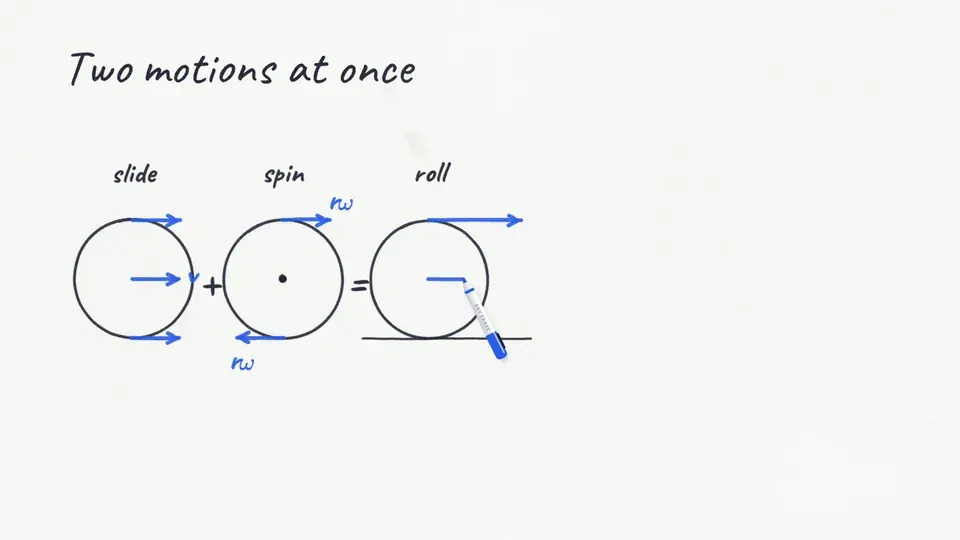
Make a prediction for me. Relative to the grass, how fast is that bottom strip moving at this exact instant? To see why, let’s pull the motion apart into two pieces. One copy of the cheese slides down the hill without turning, so every point on it moves forward at v. The other copy just spins in place, and a point on its rim moves at r times omega.
Now let’s put them back together and add the arrows. At the top, the sliding and the spinning both point forward, so they add. At the bottom they point opposite ways, and for a cheese that rolls without slipping, they cancel exactly.
That’s rolling without slipping. The bottom isn’t skidding, so right now it’s standing still. Its speed, v minus r omega, is zero, so v equals r omega. And the top moves at twice the center’s speed.
Paint a spot on the rim, and you can watch it happen. The spot swoops up and over at full speed. Every time it comes down, it touches the grass, stops for an instant, and lifts off again. There’s another way to see it. In one turn without slipping, every bit of the rim gets laid on the grass once, like tape coming off a roll, so the center moves forward one circumference.
On the board, sliding plus spinning gives rolling. The bottom’s velocity, v minus r omega, has to be zero. That gives v equals r omega, where v is the speed of the center of mass. I’ll call it the rolling lock.
The tape gives the rolling lock for distance too. Turn through an angle delta theta, and the center moves r delta theta.
Two kinds of kinetic energy
Now we can ask where the cheese’s energy goes. Its center is moving, so it has translational kinetic energy, one half M v squared. It’s also spinning, so it has rotational kinetic energy, one half I omega squared. The total is the sum.
A solid cylinder like the cheese has a rotational inertia of one half M R squared, which the exam gives you in the question. And since it rolls without slipping, omega is v over R, so let’s put both of those in. The R squared on top cancels the one underneath, so the spin part comes out to a quarter M v squared, and the total is three quarters M v squared. Before I say it, try this one. What fraction of the cheese’s kinetic energy is in its spin?
The other two thirds moves the cheese down the hill. Now look at what’s gone. There’s no M and no R, so a huge cheese or a tiny one, heavy or light, always spins a third. That third comes from the shape alone, and in a minute you’ll watch it decide a race.
The race down Cooper’s Hill
So let’s race. Here’s our three-and-a-half-kilogram cheese next to a little one with a mass of about one kilogram. Make a call for me. When we let them both go at the same moment, which one gets to the bottom first?
They’re dead level the whole way down, and their energy bars stay in exactly the same proportions, two thirds translational and one third spin, at every moment. Now let’s try some different shapes. Next to the cheese I’ll put a solid ball, a hollow ball, a bike tire, and a block of ice that slides without friction, so it never turns. And off they go. The ice pulls away first, the solid ball and the cheese are right behind it, and the hollow ball and the tire fall back.
Look at the bars at the finish. The ice spins nothing, and the tire spins half. In between are the ball, at two sevenths, the cheese, at a third, and the hollow ball, at two fifths. That’s the finishing order. Less spin leaves more for speed.
Now you build one. Slide where your racer’s mass sits, put a pin where you think it will finish, and see if you can build a racer that beats the solid ball.
Where do those shares come from? The same steps as the cheese. A solid ball has a rotational inertia of two fifths M R squared, so its spin energy is one fifth M v squared. Its total is seven tenths M v squared, and one fifth out of seven tenths is two sevenths.
Every racer works the same way. The ice never turns, so it spins nothing. Two fifths in front of M R squared gives two sevenths, a half gives a third, two thirds gives two fifths, and the tire’s one gives a half.
The further out the mass sits, the bigger the number in front of M R squared, and the bigger the share of spin. You saw that with your own racer. M and R cancel every time, so the heavier cheese doesn’t win, and neither does the bigger one.
How fast could it possibly go?
So, how fast could the cheese possibly be going at the bottom of Cooper’s Hill? Let’s do this one start to finish. I’ll write it up the way you would on the exam.
First, let’s sketch it. The cheese starts at rest, and we want its speed at the bottom. Nobody has published how far the hill drops, so we read it off elevation maps, and they give about sixty meters. The cheese is about three and a half kilograms, and it starts from rest. We’ll use g equals ten meters per second squared, which the exam allows.
The hill is steep in the middle and gentle at the ends, so forces would be miserable here. Energy only cares about the drop. With the cheese and the Earth as our system, the potential energy it loses becomes the cheese’s three quarters M v squared.
The mass cancels, so v is the square root of four g h over three, which is the square root of eight hundred, about twenty-eight meters per second. That’s about sixty-three miles an hour. Does that make sense? A block of ice would get the square root of two g h, about thirty-five, so the cheese is slower, as it should be with a third of its energy spinning.
So a perfect roll down this hill tops out at about sixty-three miles an hour. Even if the hill dropped ten meters more, it would only reach about sixty-eight. So the BBC’s seventy is out of reach for a rolling cheese. Eighty is even further away, so whoever wrote eighty was, let’s say, rounding up.
The bike tire
Now you try one. A bike tire on its own is basically a hoop, with all of its mass out at the rim, so its rotational inertia is the whole M R squared. If the tire rolls without slipping down the same sixty-meter drop, how fast is it going at the bottom? Use g equals ten.
On the same drop, the ice gets thirty-five meters per second, the cheese twenty-eight and the tire about twenty-four and a half. The only thing that changed was the shape.
Which way does friction push?
The exam also asks this with forces, and forces show what actually makes the cheese spin. Here’s a disk on a ramp at an angle theta, with gravity and the normal force drawn on it.
To finish this free-body diagram for a disk rolling down the ramp without slipping, where does friction go, and which way does it point? Friction points up the slope, even though the disk is rolling down it. Now take torques about the center. Gravity acts at the center and the normal force points straight through it, so only friction, pushing at the rim, can twist the disk.
Forces give us two unknowns, the friction and the acceleration, so we need two equations. The first one is about spin. Friction’s torque is F sub f times R, and that equals I alpha.
The disk speeds up without slipping, so its spin has to keep pace. That’s the rolling lock again, for accelerations, so alpha is a over R. Writing that line earns an exam point on its own.
Now put one half M R squared in for I, and a over R in for alpha. The R’s cancel, and friction is one half M a. The second equation is Newton’s law along the slope. M g sine theta minus that friction equals M a.
Put one half M a in for the friction, and move it across. M g sine theta equals three halves M a. So a equals two thirds g sine theta. A block of ice with no friction gets the full g sine theta. Two thirds again, the same share of the energy that goes into moving.
Let’s put numbers in. On a steeper stretch of Cooper’s Hill, at thirty degrees, how fast does a rolling cheese speed up? Use g equals ten.
The friction that does no work
Something should bother you now. Friction pushes on this cheese the whole way down, so shouldn’t it steal some of its energy and turn it into heat? It doesn’t, because of that still point at the bottom. A force does work only if the point it pushes on moves. That’s why you can lean on a wall all day without doing any work on it.
Friction pushes on the bit of cheese touching the grass, and that bit isn’t moving. So friction does zero work, and the heat bar stays empty. In a 2005 study, fewer than one in five intro physics students got this right. Static friction spins the cheese up without taking a single joule. It only changes where the energy goes, steering a third of it into spin.
So when does friction start costing energy? Let’s make it rain, and turn the grass’s grip down until the cheese can’t roll properly anymore, keeping an eye on the heat bar.
Here are three cheeses, on dry grass, on wet grass, and with no friction at all. The dry one rolls and loses no energy at all. The wet one is still skidding when it crosses the line, and its heat bar climbs.
The last one never spins. Nothing can twist it, so it slides down like the ice. Notice the wet one beat the dry one down. While it skids, less of its energy goes into spin, so more of it goes into speed, even with some lost as heat.
Here’s where each cheese’s energy goes. Left of each dashed line is the top of the hill, and right of it is the bottom. The dry cheese and the frictionless one keep all of it. Only the wet one loses some as heat.
Compare the wet cheese with the dry one. Its spin bar is only a sliver. That leaves more energy for speed. Its speed bar stands taller than the dry one’s, even after the heat.
Static friction pushes on a point that’s standing still, so it does no work. Kinetic friction rubs a point that slides over the grass, and that rubbing makes the heat.
Skid, then roll
The best place to watch something slip and then roll is a bowling lane, because a bowling ball does both on almost every throw. To test balls, the United States Bowling Congress built a robot that throws like a good bowler. Watch the stripe. It’s turning far too lazily for how fast the ball is moving.
Freeze it, and the bottom arrow isn’t zero anymore. The spin can’t keep up with the speed. So the bottom slides forward along the oil, and this ball is skidding. So while it skids down the lane, what happens to its speed, and what happens to its spin?
Let’s run it again with the friction showing. Kinetic friction points backward at the bottom. The speed bar falls, the r omega bar rises, and the heat bar keeps climbing, until the v and r omega bars meet.
The moment v equals r omega, the bottom stops sliding. The friction disappears and the heat bar freezes. You can hear the hiss of the skid turn into the rumble of a roll.
On a graph against time, v comes down and r omega comes up, and the ball starts rolling where the lines meet. Both lines bend where the oil ends and the dry wood grips harder. While it skids, v doesn’t equal r omega, so the exam asks you to explain why one rises and the other falls.
Now you’re the bowler. You throw at five point four meters per second, and the ball’s radius is point one zero eight meters. What angular speed, in radians per second, makes it leave your hand already rolling?
Throw it with that spin, and the bottom never slides. The v and r omega bars match from the start, and the heat bar never moves.
The sentence that earns the point
Now for the AP question I promised you. A disk and a block of ice with the same mass start from rest at the same height on identical ramps. The disk rolls without slipping, the block slides without friction, and you have to say which one takes longer, and why. A lot of students write that the block is faster because of conservation of energy. That sounds smart and earns nothing, because it names a law without saying how the law leads to the answer.
A full-credit answer starts with the claim, that the disk takes longer. Then comes the physics, that friction pulls back up the ramp on the disk, so its net force and its acceleration are smaller. Then it ties that to this situation, where both start from rest and cover the same distance, so the smaller acceleration needs more time. That last link, from the smaller acceleration to the longer time, is the sentence that earns the point. It’s also the easiest one to leave out.
You can argue it with energy too, as long as you finish the chain. Both lose the same potential energy, but part of the disk’s goes into spin. So it’s slower at every point along the ramp, and it takes longer. A cheese and a bike tire with the same mass roll down the hill from rest, and the cheese wins. Which explanation would earn full credit?
The real cheese
Let’s finish on Cooper’s Hill with two cheeses, a glass one that rolls perfectly, never bouncing and never feeling the air, and the real one. Every time the real cheese lands from a bounce, its spin doesn’t match its speed, so it skids and the heat flickers. The air pushes back on it too, so the perfect cheese pulls ahead.
On this hill, a cheese that’s rolling at the bottom can be going at most about sixty-three miles an hour. The real one loses energy at every bounce, so it comes in behind. Seventy is out of reach for a rolling cheese, and eighty is further still. A block of ice would beat it, because the ice puts none of its energy into spin.
If you remember one thing, make it that still point at the bottom. Rolling is sliding and spinning, locked together by v equals r omega. The shape alone decides how the kinetic energy splits between them, and that decides every rolling race down the same slope.
While it rolls, static friction takes none of its energy. Anything that slips, like a skidding bowling ball, turns energy into heat until v and r omega meet. Next time we’ll head into orbit, where energy and angular momentum decide how a satellite moves when the only thing holding on to it is gravity.