
Topic 6.2 key terms
- work done by a torque
- The energy a torque transfers into or out of a rigid system while the system turns through an angle. If the system doesn’t turn (Δθ = 0), the torque does no work, however large it is.
- W = τΔθ
- Work done by a constant torque τ while the system turns through an angular displacement Δθ (in radians). It comes from with the arc and .
- radian
- The angle whose arc equals the radius: Δθ = arc length ÷ radius. A ratio of two lengths, so N·m × rad = J. One turn is 2π rad; degrees never go into W = τΔθ.
- torque vs work
- Torque (N·m) is how hard something twists about an axis at one instant; work (J) is energy that has moved. They share base units on paper but are different quantities.
- area under τ–θ
- When the torque changes, the work it does is the area under the graph of torque against angular position (radians on the axis). Area below the axis is negative work.
- positive and negative work by a torque
- A torque in the same sense as the rotation transfers energy into the system (positive work); a torque opposite to the rotation transfers energy out (negative work), even while the system keeps turning.
- collection of torques
- Several torques on one rigid system all act through the same Δθ, so their works add: . For constant torques that is ; for changing torques, add their signed areas under τ–θ.
- rotational work–energy
- The net work done by all the torques on a rigid system equals the change in its rotational kinetic energy: .
Transcript
2,587 words · 10 parts
Not until it’s struck
On a July evening in thirteen oh four, the long northern dusk lingered for hours over Stirling Castle, high on its rock above the River Forth, and camped below it was the army of the English king, Edward the First. His army had thirteen great siege engines at work on the castle, and the most famous of them was a giant new trebuchet that the king’s own accounts call the War Wolf.
Then, on the twentieth of July, the Scots inside the castle surrendered without conditions, and Edward told his army to wait. A letter written at the siege that very day still survives. It says the king would let none of his people go in until the Warwolf had struck the castle. So the castle had already given up. And still, he wanted to try out his new machine on it first.
And so, on the king’s order, they pulled the pin. Now let’s go back to a moment before the shot. Here’s the machine, cocked and waiting on its pin. That huge box of stones twists the arm with an enormous torque, about sixty-four thousand newton-meters if we build it like the modern replica at Warwick Castle. Yet it’s doing no work on the arm at all, because nothing is turning yet.
Here’s that twist on a graph, from the moment they pull the pin to the moment the stone leaves. How much energy does gravity pour into the swinging arm? By the end of this lesson, you’ll read it straight off this graph. And you’ll find out why the answer isn’t the peak of that graph, even though the peak is where it twists hardest. So let’s start with the part that sounds completely wrong, a giant torque that does no work at all.
A torque that does nothing
Here’s the Warwolf cocked for the night, held by its trigger while the hours go by. The counterweight never stops pulling, so its torque stays at about sixty-four thousand newton-meters, hour after hour. So here’s a question for you. After a whole hour on the trigger, how much work has the counterweight’s torque done on the arm?
The counterweight never stops pulling, but pulling alone moves no energy. A torque moves energy into or out of a system only while the system turns through an angle. No angle, no work, and it doesn’t matter one bit how hard the torque is twisting.
You’ve felt this yourself with the stuck wheel nut from the torque lesson. Hang your whole weight on the wrench, and if the nut doesn’t budge, you’ve done zero work on it, however big your torque. Torque and work both come out as a newton times a meter, but they aren’t the same thing.
Torque is how hard something twists right now. Work is energy that has actually moved, so we give torque in newton-meters and work in joules. This matters on the exam. In 2023, the AP exam had gravity swing a rod down from straight up, like a trebuchet arm on paper. Students averaged about one and a half points out of seven, and by the end of today, you’ll beat that.
Work is a torque times an angle
How much work does a torque do once things turn? We can work it out with a mill horse, the animal that gave us the word horsepower. The horse walks round and round a post, pulling a long beam that turns a millstone, and it always pulls straight along its path.
From Unit 3, the work a force does is the force along the motion times the distance, W equals F d. But the horse walks along an arc of a circle. An arc is the radius times the angle, so d equals r delta theta. That only works with the angle in radians. A radian is defined as the length of the arc divided by the radius.
That makes the work F times r times delta theta. The horse pulls square to the beam, so F times r is its torque about the post. Swap in tau for F times r, and you get W equals tau delta theta. For a constant torque, the work is the torque times the angle it turns through, and it’s on your equation sheet.
Here’s a quick one before we put numbers in. Suppose the beam were twice as long and the horse pulled just as hard. How much work would it do in one lap?
Say the horse pulls with eight hundred newtons on a beam four meters long. Its torque is three thousand two hundred newton-meters. One lap is a full circle, two pi radians, so each lap the horse does about twenty thousand joules of work. Check it with Unit 3. One lap is about twenty-five meters of walking, and eight hundred newtons times twenty-five meters is twenty thousand joules again.
Now put the horse on the eight-meter beam, and let it walk the same twenty-five meters. Compared with the twenty thousand joules from before, how much work does it do?
Newton-meters times radians comes out in joules, because a radian is a ratio of two lengths and carries no unit of its own. Plug in three hundred sixty degrees instead, and you get over a million joules. A radian is about fifty-seven degrees, so that’s fifty-seven times too much, and degrees never go in.
Your turn, with a door like the one from the torque lesson. A push square to the door at its handle makes twenty newton-meters of torque about the hinges, and you keep it up while the door swings open a quarter turn. How much work does that torque do on the door, in joules?
Pull the pin
Back to Stirling, where the Warwolf’s torque changes as the arm swings. This dashed line is the counterweight’s lever arm, the sideways distance from the axle to the line its weight pulls along. The graph beside it plots the torque against the angle the arm has turned.
Before we pull the pin, make a prediction. As the arm swings from cocked all the way to straight up, what does the counterweight’s torque do?
Let’s pull the pin and slow it right down. Watch the torque climb as the lever arm stretches out, peak when the arm is level, and fall back to zero as the counterweight swings under the axle, while the area underneath fills in. That filling area is the work. For every tiny angle the arm turns, the torque hands it a tiny bit of energy, torque times that little angle. Add up all those thin slices and you get the area under the curve.
Now you find them on the machine. Drag the arm and plant two flags, one where the counterweight twists hardest, and one where gravity has handed the swinging arm and counterweight the most energy so far. Plant the two flags where you think they belong.
On the board, I’ve chopped the same graph into thin strips. Each strip’s height is the torque and its width is a little angle, in radians, so its area is the work done in that slice. When the torque changes, the work it does is the area under the graph of torque against angle.
A common mistake is to take the biggest torque times the whole angle. That’s this rectangle, and it’s far bigger than the area, because the torque was only that big for an instant. The height of the graph tells you how hard the counterweight is twisting right now, and the area tells you how much energy it has handed over so far.
At the peak, the arm is twisting as hard as it ever will, and yet less than half the energy has gone in. By the end, the torque has fallen to zero, and the arm has collected every joule. For the Warwolf, all those strips add up to about a hundred fifty thousand joules.
Here’s a second way to get that number. Watch the counterweight’s height as the arm swings up to upright. It drops about three point four meters. The counterweight is four and a half tonnes, that’s four thousand five hundred kilograms. With g as ten, which the exam allows, it weighs forty-five thousand newtons.
Gravity’s work on it is its weight times its drop, so forty-five thousand newtons times three point four meters gives about a hundred fifty thousand joules, the same as the area. Now you get the controls. You can change the counterweight’s mass and the length of its short arm, from the axle to the counterweight, and the graph will redraw when you fire. Change one thing so that the counterweight’s torque does twice as much work, and then fire it.
Into or out of
Let’s do something the crew never would. Suppose the stone doesn’t let go and nothing stops the arm, so it swings right on past straight up. Over the next quarter turn, what’s the sign of the work the counterweight’s torque does on the arm?
Watch the curve dip below the axis. Area below the axis is negative work, energy flowing back out of the arm, so the arm slows down. It stops right there, when the area below has cancelled the area above.
The sign of the work tells you which way energy flows. Twist with the turn, and the work is positive, so energy goes in. Twist against the turn, and the work is negative, so energy comes out. The arm is still turning, but that doesn’t make the work positive. Brakes and generators take energy out of things that are still turning, too.
The exam’s trebuchet
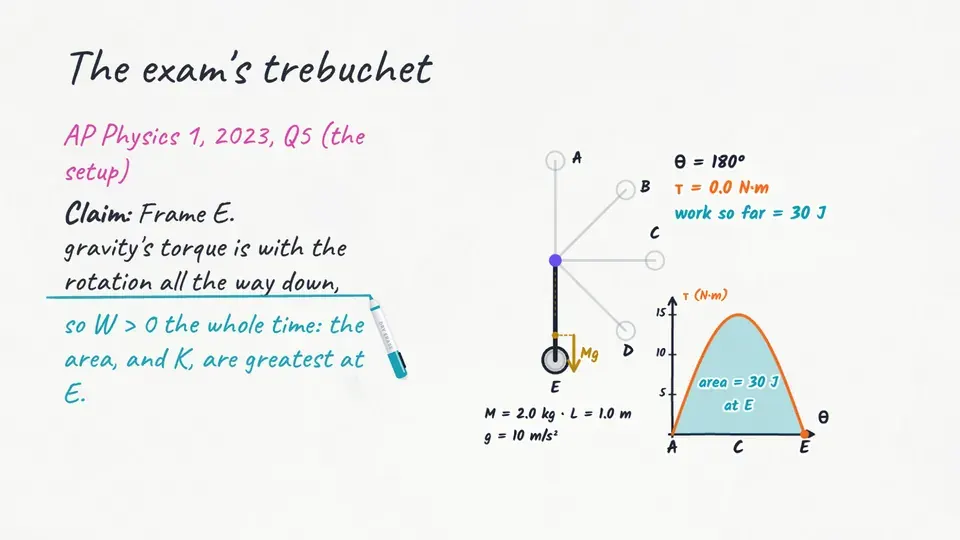
The 2023 exam drew the same thing on paper. A rod with a sphere on its end balances straight up on an axle, gets a tiny tap, and swings down. It showed five frames, A at the top, C with the rod level, and E at the bottom. Gravity’s torque on the rod behaves just like the counterweight’s. It’s zero at the top, it peaks when the rod is level, and it’s back to zero at the bottom, one smooth hump.
So in which frame is the rod’s rotational kinetic energy the greatest? To earn the point, write it as a claim and a reason. The claim is Frame E. Gravity’s torque points the same way as the rotation the whole way down. So gravity does positive work the entire time, and the total work, the area, is greatest at E. That’s where the kinetic energy is greatest.
Compare that with “because energy is conserved.” It names a principle but never connects it to frame E, and on a question like this, that loses the point. Say the rod and sphere together have a mass of two kilograms, and their center of mass sits three quarters of a meter from the axle.
From top to bottom, the center of mass drops from three quarters of a meter above the axle to three quarters below it. That’s a drop of one and a half meters, so gravity does about thirty joules of work, and that’s the kinetic energy at E.
The exam’s last part is the one most students missed. If our system is just the rod and its sphere, with Earth left out, where do those thirty joules of kinetic energy come from? Gravity’s torque did the work, and that work became the rod’s kinetic energy. You’ll write that sentence on a lot of rotation questions.
The turbine that couldn’t stop
Real machines usually feel several torques at once. This wind turbine stood near Hornslet, in Denmark, and on a stormy afternoon in February two thousand eight, it made the news. Two torques act on its rotor. The wind twists the blades the way they turn, so its work is positive and puts energy in. The generator twists against the turn and takes energy out, as electricity.
Watch this strip. Every turn, each torque adds a rectangle, as tall as the torque and two pi radians wide. The wind’s rectangles sit above the axis, and the generator’s sit below it. The rotor is one rigid piece, so every torque on it turns through the same angle, and their works simply add.
When the two rectangles match, the net work is zero, the rotor’s kinetic energy doesn’t change, and it turns at a steady speed, even with enormous torques acting on it. Now you run the generator. The gusts are coming in, and this lever sets how hard the generator pulls back on the rotor. Hold the rotor at a steady speed through the gusts for eight turns.
With the brake on in a gale, the wind twists the blades hard, but the rotor doesn’t turn, so the wind does no work at all, just like the Warwolf on its trigger. That February afternoon, technicians restarted it in a strong wind. Then its gearbox failed with a bang, and the brakes in its blade tips broke off.
With the gearbox broken, the generator can’t reach the rotor, and the tip brakes are gone. Every turn, the wind’s work goes in and almost nothing comes out, so the rotor’s kinetic energy climbs, and it races far past its design speed. Let’s stop the clock one heartbeat before the end. At about twenty past three, the blades broke apart and struck the tower, and the whole top of the turbine came down. Nobody was hurt.
You do: one turn
Let’s put numbers on a turbine like that one. We’ll call the way it spins positive. In a gust, the wind’s torque is plus two hundred thousand newton-meters, and the generator’s is negative a hundred eighty thousand. Both hold steady for one full turn. Now find the net work on the rotor in that one turn. Keep track of the signs.
What’s the net work done on the rotor in that one turn, in joules? That gain is the change in one-half I omega squared from last lesson, so positive net work means a faster rotor.
Measure it yourself
You can measure all of this in a school lab. How would you find the work a mousetrap’s spring does on its arm as it snaps shut? Which plan would actually measure the work the spring does on the arm?
An engineering professor, Autar Kaw, did this with a real mousetrap. He measured the torque at five angles with a spring scale and a protractor, and he wrote the angles in degrees. Pick the right unit for the angle axis, and then drag the five points onto the graph.
What to keep
A torque only moves energy while the system turns, so no angle means no work. For a constant torque, the work is tau delta theta, with the angle in radians. When the torque changes, the work is the area under torque against angle, and never the peak times the angle. A torque that twists with the turn puts energy in, and one that twists against it takes energy out. Several torques on one rigid system all turn through the same angle, so their works add, and the net work is the change in kinetic energy.
Back at Stirling, the chroniclers say the king got his wish, and after the surrender his crew fired the Warwolf at the walls. On a machine the size of Warwick’s, gravity does about a hundred fifty thousand joules of work on the swinging arm and its counterweight with every shot. Now you can read that number yourself, straight off the area under the graph we started with. And four days after that letter, on the twenty-fourth of July, the governor and his garrison formally handed the castle over.