
Topic 5.3 key terms
- axis of rotation
- The line an object turns around, like a door's hinge line or a clock's arbor. A torque is always measured about a particular axis, so name it first ("about the hinge").
- torque
- How strongly a force turns an object about an axis: , in newton-meters (N·m). AP Physics 1 uses its magnitude and its sense (clockwise or counterclockwise), never a torque direction vector.
- position vector r
- The vector from the axis of rotation to the point where the force is exerted (the point of application). θ in τ = rF sin θ is the angle between r and F, measured tail to tail.
- line of action
- The straight line through a force, extended in both directions. Sliding a force along its own line of action does not change its torque.
- lever arm
- The perpendicular distance from the axis of rotation to the line of action of the force, . A force whose line of action passes through the axis has zero lever arm and exerts zero torque.
- force diagram
- Like a free-body diagram, it shows the relative magnitudes and directions of the forces on a system, but each force is drawn where it is exerted on the object, so its position relative to the axis (and its torque) can be analyzed.
Transcript
3,417 words · 9 parts
Four minutes slow
On the night of the twelfth of August, 1949, people all over Britain tuned in to the BBC’s nine o’clock news, which normally began with the familiar chimes of Big Ben. That night the hour came and the bell stayed silent, because high up on the tower, the most famous clock in the world had fallen behind.
Later the BBC explained what had gone wrong, in one of my favorite sentences in the history of news: swarms of starlings are sitting on the hands holding them back. The clock was running about four minutes slow. Its minute hand is a sheet of copper four point two meters long, more than twice as tall as a person, and every one of those starlings weighs less than your phone.
By the end of this lesson, you’ll be able to explain how birds that small could hold back a hand that big. You’ll even be able to point to the exact minute on the dial where they were holding it back the hardest. To do that, we need a way to measure how well a force turns something, and the good news is that your hands already know a lot about it, because you open doors all day long.
Where you push
Here’s an ordinary door, seen from straight above. The glowing dot is its hinge, the axis the door turns around, which we’re seeing end-on, straight down its length, and the handle sits eighty centimeters away from it. If you push on the handle, square to the door, it only takes about twenty-two newtons to swing it open, which is roughly the most force that US accessibility rules allow for opening an interior door.
Push halfway between the handle and the hinge, and you need twice as much force. Ten centimeters from the hinge, it takes about a hundred and eighty newtons, eight times as much, like holding up an eighteen-kilogram suitcase. So the distance from the hinge matters a lot, and so does the direction you push. That brings me to a question.
Suppose you push on the handle as hard as you like, but you aim the push straight at the hinge. What does the door do?
Here’s three hundred newtons, aimed at the hinge, and all it does is squash the door into its hinges. So a force can be huge and still do nothing to turn something. What measures how well a force turns an object about an axis is torque, written with the Greek letter tau, and it depends on how hard you push, how far from the axis, and which way the push points.
That’s why torque isn’t simply another word for force, even though people use it that way all the time. The same push on the same door can make a big torque or no torque at all. This matters on the AP exam more than you might think. In 2025 one free-response question was a lab with a meterstick on a pivot, and the graders called out students treating a force as if it didn’t matter where on the stick it acted.
Now you try it. Twenty-two newtons at the handle opens this door, so see if you can open it with less, by changing where you push and which way, and find the smallest push that still works.
Only the square part turns
Real pushes are rarely square to the door, so let’s slant one. Any slanted push splits into two pieces, one square to the door and one along it. The piece along the door just tugs on the hinges, so only the perpendicular piece turns the door. That’s why these thirty newtons can’t open a door that twenty-two newtons opened a minute ago, because only fifteen newtons of that push are square to it.
Let’s draw this properly. The arrow from the axis to the point where the force acts is what we call the position vector r, and theta is the angle between r and the force, measured tail to tail.
The perpendicular piece of the force is F times the sine of theta, so we call it F perpendicular, and it’s the only piece that turns anything. That gives us the torque, tau equals r times F perpendicular, which is r F sine theta, and every torque in this lesson comes out of that one equation.
Let’s test it. A square push has theta equal to ninety degrees, the sine is one, and all of the force counts. A push aimed at the hinge points exactly opposite to r, so theta is a hundred eighty degrees and the torque is zero, just like the door showed us.
Torque comes out in newton-meters, and we never call a torque joules, because a torque isn’t an amount of energy. Let’s try one together. Push the handle, eighty centimeters from the hinge, with thirty newtons at thirty degrees to the door. The sine of thirty is one half, so the torque is zero point eight meters times thirty newtons times a half, which is twelve newton-meters.
Now you do one with the same handle and the same thirty newtons, but this time the push makes sixty degrees with the door. What’s the torque about the hinge, in newton-meters?
The lever arm
There’s a second way to get the same number, the one printed on the AP equation sheet. Take the force and stretch it into a long dashed line in both directions, which we call its line of action.
Before I measure how far this line is from the hinge, I want you to find out yourself, so drag the free end of the ruler onto the dashed line and look for the shortest way to reach it. The shortest distance from the axis to the line of action always meets the line at a right angle. We call that distance the lever arm, and we write it r perpendicular.
In our sketch the lever arm is r times the sine of theta, zero point four meters, and if you multiply it by the whole force, thirty newtons, you get twelve newton-meters again. You’ll see torque written as r times F perpendicular, and the AP equation sheet writes it as r perpendicular times F. They always give the same number, because the sine of theta can ride along with the force or with the distance.
The lever arm is so useful because you could slide the push anywhere along its own line of action and the torque wouldn’t change. A rope pulling along that line works the same however long it is, because the line and its distance from the axis stay put. So the lever arm isn’t the distance to where the force acts. It’s the distance to the line the force acts along, and the two only match when the push is square.
And if the line of action runs straight through the axis, the lever arm is zero, and so is the torque, however big the force is. Hold on to that one, because it explains the whole clock.
A kilogram of birds
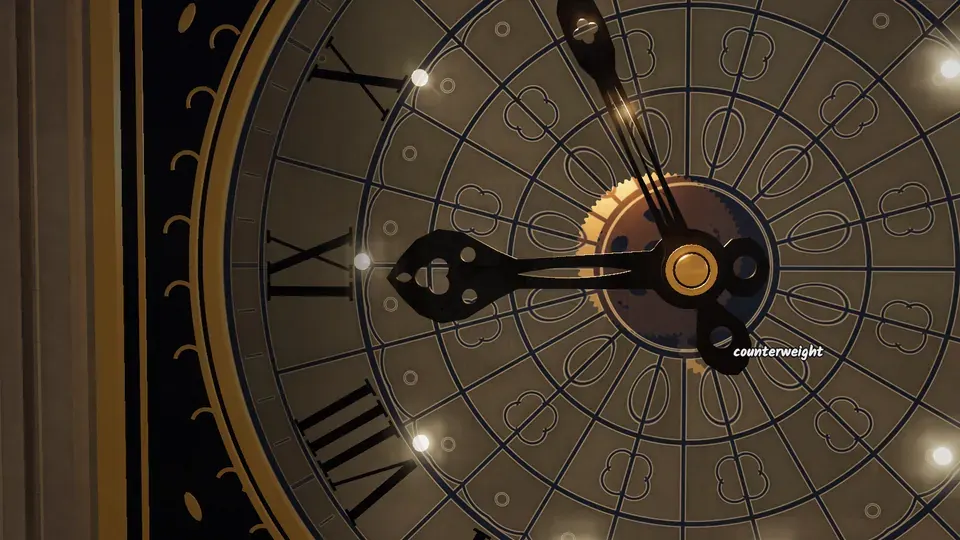
Back to the Great Clock. The minute hand carries a counterweight on the short side of the arbor, the axle the hands turn on, so the whole hand balances on it. At every angle the two ends make torques of the same size that try to turn the hand opposite ways, so the gears only fight friction and wind, until something lands on the hand.
So let’s land about a dozen starlings on it, three meters out from the arbor. That’s about a kilogram, and using ten meters per second squared for g, the number the AP exam lets us use, their weight is about ten newtons, so they press down on the hand with ten newtons, straight down whatever the hand is doing. So as the hand goes around the dial, where do you think this kilogram of birds makes the biggest torque about the arbor?
Here’s the top of the hour. The hand points straight up, and the birds’ line of action runs straight down through the arbor, so the lever arm is zero, and so is the torque. They’re as high as they can be, and they’re doing nothing at all to turn it. At quarter past the hand is level, the lever arm is the full three meters, and the torque is three meters times ten newtons, thirty newton-meters, the most these birds can ever make.
Now let’s do ten past together, because this is where it gets interesting. The hand is sixty degrees from straight up, and the lever arm is the horizontal distance from the arbor to the birds’ vertical line, three meters times the sine of sixty, about two point six meters. Multiply by the ten newtons and the torque is about twenty-six newton-meters, a little less than at quarter past.
Before we go on, here’s the question that trips up almost everyone. To get that same twenty-six newton-meters from r F sine theta, which angle goes in for theta? Tap an angle on the dial to test it.
Be careful with the angle here, because this is exactly where torque problems go wrong. The hand makes thirty degrees with the horizontal, and if you put thirty degrees into the sine, you get fifteen newton-meters, which is wrong.
Theta is the angle between r and the force, tail to tail. r points up along the hand and the force points straight down, so theta is a hundred twenty degrees, and the sine of a hundred twenty equals the sine of sixty, which gives the same twenty-six newton-meters. Now try twenty-five past on your own, with the same kilogram of birds three meters from the arbor. What torque do they make, in newton-meters?
If we work out the torque for every minute and plot it, it starts at zero at the top of the hour, rises to thirty newton-meters at quarter past, falls back to zero at half past, and makes the same hump again on the way back up. It’s the sine from our equation, drawn out in time.
For the clock, though, those two humps aren’t the same at all. From the top of the hour to half past, the hand swings down the right side, and the birds’ torque turns it the way it’s already going.
From half past back to the top, the hand has to climb the left side of the dial. Now the birds’ torque tries to turn it backward, against the gears that are driving it up. Now it’s your turn to find it, so drag the clock to the minute where these birds hold the hand back the hardest.
The wheel nut
Let’s put the equation to work on something you’ll actually do one day, changing a car’s wheel. The manual for a Toyota Camry says each wheel nut gets tightened to a hundred and three newton-meters. The wheel brace is forty centimeters long, so how hard do you have to push square to its end to reach that hundred and three newton-meters?
Here’s the routine for every torque problem. First a sketch, and at the top I write which axis we’re taking torques about, here the nut, because a torque only means something about a particular axis. Next, we list what we know, which is the torque, a hundred and three newton-meters, the distance from the nut to where we push, forty centimeters, and the angle, ninety degrees. The force is what we want.
Our equation is the one with torque in it. Before putting in any numbers, I’ll solve it for the force, which means dividing both sides by r sine theta. Putting in the numbers, a hundred and three newton-meters divided by zero point four meters gives about two hundred sixty newtons, and the units come out as newtons, as a force should.
Does that make sense? Two hundred sixty newtons is about the weight of a twenty-six-kilogram suitcase, a firm push most people can manage, so it passes. Now slant your push to thirty degrees from the handle. The sine of thirty is a half, so you need twice the force, about five hundred twenty newtons, for the same job.
Mechanics have a trick for stuck nuts. They slide a pipe over the handle, so the push lands eighty centimeters from the nut instead of forty. Pushing square to it again, how hard do you need to push now to reach one hundred and three newton-meters, in newtons?
People say a long wrench works because it gives your hands more to grab. But the grip has nothing to do with it, and the whole effect comes from the extra distance from the axis. Here’s that wheel nut again, with the pipe already on the brace and the torque gauge ready.
Now you tighten one. Push anywhere on the brace or the pipe, at any angle you like, and bring this nut to one hundred and three newton-meters. The wrench will click when you get there.
The other trick for a really stuck nut is to stand on the handle. If your mass is sixty kilograms, you weigh about six hundred newtons, and your feet press that whole force square onto a level handle, so the torque is zero point four meters times six hundred newtons, two hundred forty newton-meters, more than twice the spec.
Let’s do the next one together. If the handle points thirty degrees above level, your foot still pushes straight down, so its line moves closer to the nut, and the lever arm is zero point four meters times the cosine of thirty, about thirty-five centimeters. Times six hundred newtons, that’s about two hundred ten newton-meters, and r F sine theta, with a hundred twenty degrees between the handle and your push, gives the same answer.
Now you do one with the same six hundred newtons on the same forty-centimeter handle, but now it points sixty degrees above level. What torque does your foot’s push make about the nut, in newton-meters?
And if the handle points straight up and you balance on top, your push goes straight down through the nut and the torque is zero, just like the birds at the top of the hour. This is the kind of question the AP exam loves. A square push on the end of the brace makes a torque tau. Now you push twice as hard at the same spot, but at thirty degrees to the handle. What’s the new torque?
Draw where it acts
Every torque so far depended on where a force acts, so our diagram has to show that. A free-body diagram, the kind you drew in Unit 2, squashes the whole object down to one dot. And on a dot, there’s nowhere to put a lever arm. So it can’t show you which force turns the object, and which doesn’t.
So for torques we draw a force diagram. It’s like a free-body diagram, but each arrow starts where its force acts, and the lengths still show which forces are bigger. This is the same apparatus as the first part of that 2025 AP lab question, with our own numbers: a uniform meterstick on a pivot at its middle, a block hanging from it, and a spring scale holding one end.
Now you build the force diagram. Drag each of the four forces onto the stick, at the point where it actually acts. Now we list the torques about the pivot. The pivot’s push and the stick’s weight both act right at the axis, so their distance from it is zero, and so are their torques.
The two-newton block pulls thirty centimeters from the pivot, so its torque is zero point six newton-meters, and the scale, fifty centimeters out, makes half a meter times whatever it reads. Now let’s slide the block in to the sixty-centimeter mark. Same block, same weight, but only ten centimeters from the pivot, so its torque drops to zero point two newton-meters.
When the stick hangs level and still, the scale’s torque has to match the block’s, and in two lessons, when we get to balance, you’ll work out exactly what this scale reads. But you can already see the mistake that cost people points on the exam. The scale can’t read the same force wherever the block hangs, because the block’s torque changes when it moves.
Justify it
Let’s finish the way the exam often does, with a claim to agree or disagree with. An eighty-gram starling, which presses down with about zero point eight newtons, sits three meters from the arbor, and a student says it makes the same torque at noon as at quarter past, because the force and the distance are the same.
Here’s an answer that loses the point. It says the bird is farther out at quarter past, but the bird is three meters from the arbor both times, so ‘farther out’ never says what actually changed, and it never names a relationship.
Now here’s an answer that earns full credit, so listen to how it reasons. I disagree, because the torque is bigger at quarter past. Torque is r F sine theta, with theta the angle between r and the force, and for this bird r and F never change, so only the angle can make a difference. At noon r points straight up and the weight points straight down, so theta is a hundred eighty degrees and the torque is zero, and at quarter past theta is ninety degrees, so the torque is three meters times zero point eight newtons, two point four newton-meters.
And this is the sentence that earns the point, the one that ties the equation to this bird, because it says the force and the distance stayed the same and only the angle changed. Readers look for exactly that link between the equation and the situation.
Now try one on your own. A student pulls on a door handle eighty centimeters from the hinge with forty newtons, once perpendicular to the door and once at thirty degrees to it. Pick the response that would earn full credit for which pull makes more torque about the hinge.
Nine o’clock
So let’s go back to that night in 1949 and watch the last half hour before nine with everything we know now. And it’s no accident that the trouble came in this half hour. The papers called them roosting starlings, and starlings settle in to roost at dusk, and that evening the sun set over London at about half past eight, just as the minute hand began to climb.
At half past eight the minute hand starts climbing the left side of the dial, and the birds’ torque holds it back a little harder every minute, until quarter to nine, when the hand is level and their lever arm is longest. And the hour hand was on the same side, close to level and climbing too, so the birds on it were working against its climb too, at nearly their biggest lever arm.
So when nine o’clock came, the minute hand hadn’t reached twelve yet, and Big Ben stayed silent. Nobody measured any of this that night, so this is our model, and it fits the record. The birds were pushing hardest against the hands in the half hour before nine. In our model, that’s exactly when the clock lost its four minutes.
And the clock has been held back at least once since. On New Year’s Eve in 1962, snow piled up on the hands, and London rang in the New Year ten minutes late. So now you can do what I promised at the start. You can explain how birds that light could hold back a hand that big, and point to the exact minute on the dial where they held it back the hardest, quarter to nine.
Here’s what to take with you. Torque is r F sine theta, r times the perpendicular part of the force, or the lever arm times the whole force. Only the part of a force perpendicular to r turns anything, and the lever arm runs from the axis to the line of action.
A force whose line runs through the axis makes no torque at all, however big it is, and that’s why every force diagram has to show where each force acts. Next time, we’ll meet a man who walked a wire between two skyscrapers carrying a pole of about twenty-five kilograms on purpose, and we’ll find out why some objects are so much harder to start turning than others.