
Topic 5.4 key terms
- rotational inertia
- A measure of a rigid system's resistance to changes in its rotation. It depends on the system's mass and on how that mass is distributed relative to the axis of rotation. Units: kg·m².
- axis of rotation
- The line a rigid system rotates about. Every rotational inertia is measured about a particular axis; change the axis and the rotational inertia changes.
- I = mr²
- The rotational inertia of a small object of mass m a perpendicular distance r from the axis. The distance is squared: twice as far out is four times the rotational inertia.
- total rotational inertia
- For a collection of objects about one axis, the sum of each object's rotational inertia about that axis: I_tot = Σmᵢrᵢ².
- center of mass (and the minimum I)
- A rigid system's rotational inertia in a given plane is smallest when the axis passes through its center of mass.
- parallel axis theorem
- I′ = I_cm + Md²: the rotational inertia about any axis parallel to one through the center of mass, where M is the total mass and d the distance between the two axes.
- swing weight
- Sports equipment makers' name for the rotational inertia of a bat or racket about an axis near the hands (for bats, 6 inches from the knob).
Transcript
3,723 words · 10 parts
Twenty-five extra kilograms
On the seventh of August, 1974, early in the morning, a twenty-four-year-old French wire walker named Philippe Petit stepped off the roof of one of the Twin Towers in New York, onto a steel cable stretched across the gap to the other tower. He was about thirteen hundred and fifty feet above the street, with no net beneath him, and he walked back and forth across that gap eight times, for more than forty-five minutes.
And look at what he’s holding. That pole was about eight meters long and weighed about twenty-five kilograms, so up there, where falling is the only thing that can go wrong, he chose to make himself heavier. Why would anybody do that?
By the end of this lesson, you’ll be able to explain why the great wire walkers carry a long, heavy pole, and calculate how much harder it makes him to start tipping over, compared with the very same mass bundled up in his hands, which turns out to give him only a small fraction of that help. The answer has a name, rotational inertia, so let’s start with a question that sounds almost too simple, which is what it actually means for something to be hard to turn.
Hard to turn
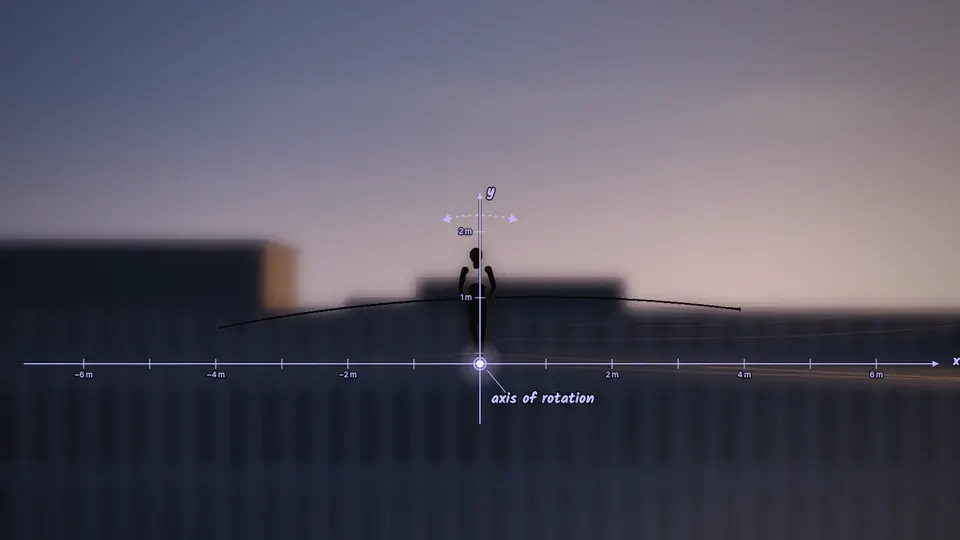
When we studied forces, inertia meant mass, because a bowling ball resists getting moving, and resists stopping, far more than a tennis ball does. Turning has its own version of inertia, and to see it, let’s look at Petit from a new angle, straight down the wire, so the whole cable shrinks to a single dot.
From here you can see what tipping over really is. If he starts to fall, his whole body swings around that dot, so the wire is the axis he’d rotate about, and staying up means catching that rotation before it carries him too far.
A 2020 study in a Royal Society journal built a model of exactly this, a seventy-eight-kilogram walker with a twelve-meter pole of thirteen kilograms, a little longer and lighter than the pole Petit carried, but based on what walkers like him really use. We’ll split that pole’s mass into four beads, so we can see where every kilogram sits.
Okay, I want you to make a prediction. Imagine two walkers who are exactly alike, carrying these same thirteen kilograms, but one has them folded up in his hands and the other has them spread out along the pole. When the same gust of wind hits them both, which one starts tipping over faster?
Here’s the same gust hitting both of them at the same instant. The walker with the mass in his hands is over in a blink, and he has to drop down onto the wire, while the one with the long pole just leans, slowly, and he has time to catch himself.
These curves show how far each one tilted, second by second. The folded one shoots up past the line where he can’t catch himself anymore, the spread-out one rises only about a third as far, more slowly, and comes back down, and the only difference between them is how far the same thirteen kilograms sit from the wire.
You’ll sometimes hear that the pole works by lowering his center of mass, but look at where he holds it, at about the height of his own center of mass, so it barely changes how low his mass is. What it really changes is how far that mass sits from the axis.
So in physics words, mass resists changes in velocity, and rotational inertia, a capital I, measures how much a rigid system, like a walker and his pole moving as one piece, resists changes in its rotation. And it depends on two things, how much mass the system has and how that mass is spread out relative to the axis. Our two walkers just showed you that the second one can matter far more than the first. This exact comparison, two objects with the same mass arranged in different ways, is a classic AP question, and the students who lose the point are the ones who stop at “same mass, so the same.”
Why r is squared
So how exactly does the distance from the axis count? Let’s take one small mass on a light rod, a distance r from the axis, and spin it. Before I show you why, I’d like your guess. If I slide this same mass out to twice the distance, how much harder is the rod to spin up in the same time?
If I move the mass twice as far out, then every time the rod goes around, the mass has to travel a circle twice as big. So it has to move twice as fast, and getting it up to that speed in the same time takes twice the push. And there’s a second effect stacked on top of that. We’re turning this from the axis, and for the rod to deliver a push twice as far out, we have to twist twice as hard. That twist is the torque we met in the last lesson.
So you need twice the push, and every bit of that push costs twice the twist, which makes four times the twist in all, and that’s why the distance shows up squared. The rotational inertia of one small mass is I equals m r squared. Here m is the mass, r is its perpendicular distance from the axis, and since we’re multiplying kilograms by meters squared, rotational inertia comes in kilogram meters squared.
For a collection of small masses, we work out m r squared for every one of them and add them all up. That sum is on your exam’s equation sheet, so your job is knowing what every letter means.
Let’s test that. A bead sits on a light rod a meter and a half from the axis, and you slide it out to four and a half meters, so what happens to its rotational inertia?
So whenever a mass moves twice as far from the axis, its rotational inertia goes up four times, and if you count the distance only once, you’d predict twice, which is exactly the answer that little squared sign is there to stop. And r is always the distance straight from the axis to the mass, so when a mass sits off to the side and also above the axis, r squared is x squared plus y squared, which is going to matter in a minute.
Five objects on a wire
Now let’s work out the rotational inertia of our walker model. Here he is from straight down the wire again, and the world is drawing a line from the axis to every piece of mass, his center of mass a meter above the wire, and each of the four beads.
Let’s put that on the board the way you’d set up an AP problem. I’ll start with a sketch, with the wire at the origin, x pointing to the right and y pointing up, so we can place all five masses.
Next come the knowns, with their units. The walker is seventy-eight kilograms, one meter right above the wire, and the beads are three and a quarter kilograms each, two of them a meter and a half to either side and two of them four and a half meters out, all one meter up. We have five small masses and one axis, so the equation that fits is the sum of m r squared, and for each r squared, we add x squared and y squared.
The walker is the easy one, if we treat him as one point at his center of mass the way an exam problem would, seventy-eight kilograms times one meter squared, so seventy-eight kilogram meters squared. For the inner beads, one and a half squared plus one squared is three and a quarter square meters, which just happens to match the bead’s mass, so three and a quarter kilograms times that, times two beads, gives about twenty-one kilogram meters squared.
And for the outer beads, four and a half squared is twenty and a quarter, plus one is twenty-one and a quarter square meters, and three and a quarter kilograms times that, times two, comes to about a hundred thirty-eight kilogram meters squared. Add them up, and the walker with his pole has a rotational inertia of about two hundred thirty-seven kilogram meters squared about the wire.
Does that make sense? The units are right, it’s about three times what he’d have on his own, which is what the 2020 study found too, and look at the two outer beads, only six and a half of the ninety-one kilograms, carrying more than half of all the rotational inertia.
Same mass, folded
Now let’s take that exact same thirteen kilograms and fold the pole up into his hands, so he’s holding two bundles of six and a half kilograms each, about thirty centimeters out from his middle and still a meter above the wire. I’d like you to work this one out yourself with the same steps, so find the rotational inertia of just the two folded bundles about the wire.
So with the pole folded up, the walker and his thirteen kilograms come to about ninety-two kilogram meters squared, and with the pole spread out, the very same mass gives two hundred thirty-seven kilogram meters squared, about two and a half times the rotational inertia, and he isn’t carrying a single extra gram. That’s why rotational inertia is never just how heavy something is. The mass counts, where you put it counts too, and out at the end of a pole, every kilogram counts a lot more than it does in your hands.
Let’s go back up to the wire with the pole folded. The bars show where the rotational inertia lives, ninety-two kilogram meters squared in all, and here comes a gust that this design just can’t handle.
So now you’re the pole maker. You’ve got the same thirteen kilograms in four beads, so slide them wherever you like, send the gust again, and keep going until he rides it out without crouching. Each try stays on the screen, so you can see exactly what your last change bought you.
Same weight, different swing
So rotational inertia depends on where the mass is, and the best place to feel that with your own hands is a lot closer to the ground than a wire, in a batting cage at night. These are two real softball bats from a 2010 paper by Dan Russell in The Physics Teacher, both thirty-four inches long, and on a scale they weigh exactly the same, thirty point two ounces, about eight hundred fifty-six grams each.
Now let’s swing them both with exactly the same twist and watch closely. One of them comes around clean, and the other one lags behind like it’s dragging through water. Russell measured each bat’s rotational inertia about the spot where your hands go, six inches up from the knob, a number bat makers call the swing weight, and the end-loaded bat came out forty-four percent higher than its twin.
The difference is where the mass sits. The balance point, which is the bat’s center of mass, sits almost five inches farther from the hands on the harder bat, so more of its mass is out in the barrel, far from the axis. So a scale can never tell you how a bat is going to feel in your hands. The scale only sees the mass, and your wrists feel where that mass sits.
Tape an eight-ounce weight to the knob, right by your hands, and the swing weight barely moves, a couple of percent, but tape the same weight on the end cap and it jumps by about half, and when Russell measured the knob version on a real bat, m r squared got it right to within half a percent. But a hitter can do something about it. When you choke up, sliding your hands about four inches up the handle, the axis moves closer to the bat’s center of mass, and the rotational inertia about your hands drops to about point one five kilogram meters squared, almost exactly what the easier bat felt like.
Now you take the pivot. Slide it anywhere along this bat, keep an eye on the reading, and find the one place where the bat is easiest to rotate. Every time you let go, your reading stays on the graph.
Here’s every position at once. As the pivot slides along the bat, the rotational inertia traces out a bowl, right through any readings you took, and the bottom of the bowl sits exactly at the balance point.
Now put the pivot the same distance on the other side. Same reading, because only the distance from the center of mass counts. So an object doesn’t carry one rotational inertia around the way it carries one mass. Rotational inertia is always measured about some axis, and as you slide that axis across any object, it’s smallest when the axis goes right through the center of mass.
The parallel axis theorem
Let’s put that bowl on the board, with the balance point at zero. Its equation is on your equation sheet. The bottom of the bowl is I sub c m, the rotational inertia about the center of mass. Move the axis a distance d away, and the bowl rises by M d squared, the mass times d squared. Add the two, and you get I prime, the rotational inertia about the new axis.
Where does that shape come from? Picture two motions at once. First, the bat spins about its own center. That’s I sub c m. Second, its center of mass swings in a circle around the new axis.
For that part, the bat acts as if all its mass sat at one point, d away. That’s M d squared. M d squared is never negative. Any other parallel axis adds something, so its rotational inertia is bigger. That’s why the bowl bottoms out at the balance point.
Try the theorem on this bat. Its mass is zero point eight six kilograms, and its I sub c m is zero point zero five seven kilogram meters squared. What’s its rotational inertia about an axis twenty centimeters from the balance point?
Let’s test the theorem the way a lab would. Line it up with the equation of a straight line, y equals b plus m x. I prime takes the place of y, and d squared takes the place of x. These are five model readings for the same bat, at five distances d from the balance point. If the theorem is right, I against d squared comes out straight.
There it is, a straight line, just as the theorem predicts. It crosses the vertical axis at about zero point zero five seven. That’s I sub c m, the b of this line, because there d is zero.
So what about the slope of this line? Think about what the equation says it has to be. The slope comes out to about zero point eight five kilograms, and the scale said zero point eight five six, so the slope hands back the bat’s mass, which means a lab can weigh a bat just by spinning it. Picking what to plot so that a graph comes out straight is a favorite move on the AP lab questions, so it’s worth remembering how we did it.
Let’s use the theorem on something you can try at your desk, a hundred-fifty-gram meterstick, and the exam would hand you its rotational inertia about its middle, zero point zero one two five kilogram meters squared. About one end, the axis is half a meter from the center, so M d squared is zero point one five kilograms times a quarter of a square meter, and adding that to the middle’s value gives zero point zero five zero kilogram meters squared, four times as much, so grab a ruler, twirl it by the middle and then by the end, and feel it in your fingers.
Now take it back up to the wire. Our model’s twelve-meter, thirteen-kilogram pole has a rotational inertia of one hundred fifty-six kilogram meters squared about its own center, and he holds it so that its center is one meter above the wire, so what’s its rotational inertia about the wire?
Back on the wire, the beads become a smooth rod, and with the walker that’s about two hundred forty-seven kilogram meters squared, a little more than our beads gave, because each bead squeezed three meters of pole into one point, and spreading that mass back out adds a little. And here’s my favorite way to see it. To match just the pole’s share, that hundred sixty-nine, with a lump held in his hands, the lump would have to weigh about a hundred fifty-five kilograms, twice as much as he does, and the pole does it with thirteen kilograms.
Hoops, disks and a fair test
Physics teachers have a classic lab machine for this, a turntable with four sliding masses and a string wrapped around its axle, with a small weight hanging off the end. When you let go, the falling weight spins the turntable up. We time how long that weight takes to reach the floor. Say you want to show that where the masses sit really matters, and that it isn’t only how much mass there is, so which pair of runs would you compare?
So let’s run it. With the masses close in, the weight hits the floor in about three seconds, and with the same masses slid out to the edge, the very same weight takes about ten seconds. The exam’s favorite version is a hoop and a solid disk with the same mass and the same radius, each on a turntable with the same hanging weight. So with the same weight pulling on each of them, which one do you think spins up more slowly?
Let’s drop both weights at exactly the same instant. Keep your eye on the floor, because the weight that lands first belongs to the turntable that’s easier to spin up. And the disk’s weight lands first. A hoop’s rotational inertia is M R squared and a disk’s is only half of that, and the exam hands you those formulas when you need them, so what you bring is the reason, which is where the mass is.
And here’s why the hoop’s formula is so simple. Let’s race the hoop against our four masses slid out to the edge, with the same weight on each string. They land together, because the hoop is the very same eight hundred grams at the very same twenty centimeters, just spread around the rim, so adding up m r squared for every bit of it gives exactly M R squared.
The sentence that earns the point
Let’s finish with the kind of question the exam really asks. Two identical walkers carry poles of the same thirteen kilograms, one twelve meters long and the other six meters long, and the same gust exerts the same torque about the wire on each, so which walker’s tilt changes more slowly, and why?
I’d start with the claim, the walker with the twelve-meter pole. Both poles have the same mass, so the reasoning has to explain why moving it farther out matters. Rotational inertia grows with the square of the mass’s distance from the axis, so spreading the same thirteen kilograms over twelve meters gives that system a larger rotational inertia about the wire.
Then I’d bring it back to these two walkers. Both of them feel the same torque, and a system with more rotational inertia resists a change in its rotation more, so the long-pole walker’s tilt changes more slowly. This is the sentence that earns the point, because it says in words how a larger rotational inertia, under the same torque, means a slower change in rotation, for these two walkers.
Two answers that lose the point are “the long pole is heavier”, which is false, because both poles have the same mass, and “because I equals m r squared”, which only points at an equation, when the exam asks for reasoning beyond referencing equations.
Okay, now you get to be the exam reader. Here’s the same idea with Russell’s two bats, and four answers to the question on the board, so pick the one that would earn full credit.
Back on the wire
Let’s go back up for the last gust of the morning, the strongest one yet, strong enough to beat the pole from our worked example. You’ve got thirteen kilograms in four beads and up to twelve meters of pole, so design one that keeps him on the wire, and once he survives, see how short you can make the pole and still keep him up.
Petit made all eight crossings that morning, and through every one of them, the pole in his hands was doing exactly what we’ve worked out today, keeping its mass far out from the wire, so every wobble came on slowly enough for him to catch it. His real pole was shorter than our model’s, about eight meters, and heavier, twenty-five kilograms. About its own center, a rod like that has about a hundred thirty-three kilogram meters squared, and the exam would give you that.
Add M d squared for the wire, twenty-five times one squared, and you get about a hundred fifty-eight, close to our model’s hundred sixty-nine. Folded into his hands instead, at the same r squared of one point zero nine as our bundles, those twenty-five kilograms would give only about twenty-seven. A shorter pole has to be heavier to do the same job. That’s why his pole weighed so much.
So here’s what to take with you. Rotational inertia is how hard it is to change something’s rotation, it depends on the mass and on where that mass sits from the axis, each piece counting m r squared, and out of all the parallel axes, it’s smallest through the center of mass, with the parallel axis theorem telling you how much bigger it gets at every other one. In a couple of lessons, we’ll put torque and rotational inertia together and work out exactly how fast something starts to spin, which is how you’d calculate just how much extra time that pole gave him to recover.