
Topic 4.3 key terms
- system
- Whatever objects you choose to draw the (imaginary, dashed) boundary around. Everything else is the environment. Whether a system's momentum stays constant depends on this choice.
- external force
- A force exerted on the system by an object outside its boundary. Only a net external force can change a system's total momentum.
- internal force
- A force between two objects that are both inside the system. Internal forces come in equal and opposite (Newton's third law) pairs, so they never change the system's total momentum.
- impulse
- The change in momentum a force produces, the force times how long it acts. The impulses two objects exert on each other are equal and opposite; a system's momentum change equals the external impulse on it.
- conservation of momentum
- If the net external force on a system is zero, the total momentum of the system is constant. Momentum itself is conserved in every interaction.
- total momentum of a system
- The vector sum of the momenta of all the objects in the system.
- center-of-mass velocity
- v_cm = Σmᵢvᵢ / Σmᵢ, the system's total momentum divided by its total mass. Constant whenever there is no net external force.
- explosion
- An interaction in which objects that start together (often at rest) push apart. With no external force the total momentum before (often zero) equals the total after.
- collision
- A brief interaction in which objects exert large forces on each other. Right before and right after, the system's total momentum is the same when external forces are negligible.
Transcript
2,620 words · 11 parts
Seventy thousand, one planet
On a July night in 2023, seventy thousand people at a Taylor Swift concert in Seattle started jumping to the same beat, and the ground under the stadium started to shake. Every time the crowd came down, they sent a jolt into the ground. They kept it up, song after song, for two nights in a row.
Across the street, the Pacific Northwest Seismic Network had a seismometer running. It recorded the ground shaking harder than in the famous Beast Quake of 2011, when Seahawks fans went wild over a touchdown. Let’s freeze one of those fans at the instant her feet leave the floor. Before the jump she was standing still. Now she’s moving up at a couple of meters per second, so she has momentum pointing up.
Momentum never appears out of nothing, so where did it come from? It came from the planet. Every time those seventy thousand fans jumped, the entire Earth moved the other way, and we can work out how fast.
Before we’re done, you’ll be able to work out that speed. It takes one law, and nobody has ever caught it breaking. Let’s slow everything down and start with one fan and one jump.
Draw the box
Let’s say our fan has a mass of seventy kilograms and leaves the floor at two meters per second. That’s enough for a jump of about twenty centimeters. Before the jump her momentum is zero. The moment her feet leave the floor, it’s seventy kilograms times two meters per second, a hundred and forty kilogram meters per second, pointing up.
Her momentum went from zero to one hundred forty kilogram meters per second, upward, in a fraction of a second. What gave her that momentum?
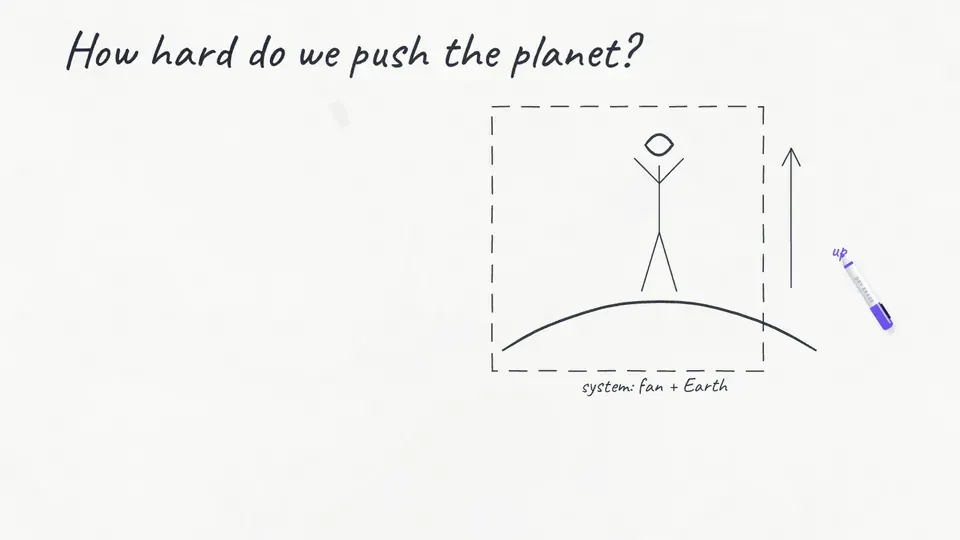
Physicists keep track of this with a box around whatever we care about. Everything inside the dashed line is our system, and everything outside it is the environment. The AP exam asks about that choice of box all the time, so we’ll start every problem today by choosing one. Only a push from outside the box can change the system’s total momentum. We call it an external force, like the floor pushing up on the fan’s feet.
So when a system’s momentum changes, the change came in from outside. It equals the impulse from outside, the net outside force times how long it acts. The floor doesn’t hand out momentum for free, though. While it pushes up on her, she pushes down on it just as hard, for the same split second.
So the two impulses are equal and opposite. That’s Newton’s third law, showing up as momentum. Now make the box bigger. It holds her, the floor, and the whole planet the floor is attached to.
Both pushes are inside the box now, so they’re internal forces. She picks up a hundred and forty kilogram meters per second upward, the Earth picks up the same downward, and the total stays zero. So her legs never gave her that momentum by themselves. They pushed the floor, and the floor pushed her.
Any box you like
The same goes for the whole crowd. Draw the box around just the fans, and watch their total momentum on this chart. It dips as they crouch, shoots up, swings down through zero, and comes back with every jump.
The floor and the Earth’s gravity are both outside the box. They keep pushing and pulling on the fans. This time, the box goes around the fans and the Earth together. Look at the chart. It’s one flat line at zero, and it stays flat through the whole jump.
That’s the law of conservation of momentum. If the net external force on a system is zero, the total momentum of that system stays constant. Momentum itself is conserved in every interaction. It never appears or vanishes. It only moves from one thing to another.
But your box decides whether its total stays put. If the outside pushes add up to zero, it does. If not, it changes. Draw a box around anything you like, hit jump, and find a box whose total momentum never changes.
How hard do we push the planet?
Time to find the Earth’s speed, the way you would on the exam. On the AP, a jump like this counts as an explosion. Two things start at rest, and they push apart. The fan and the Earth go in one box. Up is positive.
Her mass is seventy kilograms and her velocity is positive two meters per second. The Earth’s mass is about six times ten to the twenty-four kilograms, and the total starts at zero. Nothing outside pushes on this box, so the total after the jump equals the total before. Zero equals her momentum plus the Earth’s momentum.
I want the Earth’s velocity, so I’ll move her momentum to the other side and divide by the Earth’s mass. That gives v sub E equals negative m v, over the mass of the Earth. Now the numbers go in. A hundred and forty kilogram meters per second, divided by the Earth’s mass, gives negative two point three times ten to the negative twenty-three meters per second.
Let’s check it. The sign is negative, so the Earth moves down while she moves up. The size makes sense too. The Earth has about ten to the twenty-third times her mass, so its speed is that many times smaller.
Now the whole crowd. Seventy thousand fans with a hundred and forty kilogram meters per second each come to about nine point eight million. That’s seventy thousand times the momentum of one fan, so the Earth moves seventy thousand times faster. That’s about one point six times ten to the negative eighteen meters per second, downward.
Look at the planet. The crowd’s momentum arrow and the Earth’s momentum arrow are the same length, pointing opposite ways. But the Earth’s velocity is so small that we have to magnify it ten to the eighteen times, a billion billion, just to see it. Set the crowd so the Earth recoils a thousand times faster than it did for our stadium crowd, then make them jump.
The point that never moves
There’s another way to watch the fans and the Earth. Every system has a center of mass, the balance point from Unit 2, and the whole system moves like one object sitting at that point.
This purple marker is the center of mass of the fans and the Earth together. It sits at the Earth’s center, and their total momentum is zero. So when all seventy thousand fans jump, what does the marker do?
Let’s test it. The fans fly up twenty centimeters, the Earth sinks inside our magnifier, and the marker doesn’t move a hair. While the fans are in the air, gravity pulls them down and pulls the Earth up toward them. The Earth’s sinking slows and turns around, just like the fans’ rise. Both pulls are inside our box, so the total stays zero.
Now they fall. The fans come down, and the Earth comes up to meet them. Just before they land, the fans carry nine point eight million downward, and the Earth carries nine point eight million upward.
The landing is a collision between the fans and the Earth. The ground doesn’t swallow their momentum. Down and up cancel, so both stop. I should be honest about that seismometer, though. It never felt the planet move. It recorded the ground near the stadium ringing like a drum every time seventy thousand people landed on it.
Bailey Yard
The landing was a collision too small to see, so let’s go where collisions are enormous. This is Bailey Yard in Nebraska, the biggest rail yard in the world. Freight cars roll down a hill called the hump, one at a time. At the bottom, they slam into the waiting cars and lock on.
A car rolling into standing cars and locking on is a classic AP question, and here you get to see one at full size. Here’s a loaded hopper car of about a hundred and thirty tonnes, rolling at one point eight meters per second toward three more loaded cars standing still. Before we work anything out, how fast do you think all four cars will roll away together once car A locks on?
The box goes around all four cars, and positive points the way car A rolls. Railroaders call the three standing cars a cut. The cut has three times car A’s mass and no velocity. We want the velocity of all four right after they lock together.
The couplers slam the cars with huge forces, but those forces are internal. The rails drag a little, but the crash is so short that their push adds almost nothing. So the total right before equals the total right after. Only car A moves before, so its momentum equals the momentum of all four cars after. Dividing by the total mass gives v sub f.
Car A’s momentum, divided by the mass of all four cars, comes out to positive zero point four five meters per second. The tonnes cancel, so we never need kilograms. It’s positive, so they keep rolling the same way. It’s a quarter of car A’s speed, because the same momentum now moves four times the mass.
Let’s watch it happen. The car rolls in, the couplers bang, and all four cars roll away together at zero point four five meters per second. Look at the bars. Car A’s momentum bar shrinks, and the cut’s bar grows by the same amount. The total didn’t move, because the coupler pushed both ways equally hard, for the same short time.
Swap the cars
Now you try one. This time an empty car of only thirty tonnes rolls at one point six meters per second into a loaded car of a hundred and thirty tonnes, which waits. The box goes around both cars again, so the empty car’s momentum before equals the pair’s momentum after. This time, you do the arithmetic.
The empty car brings all the momentum, and afterward the two cars share it. How fast do the two cars roll away together?
The line that doesn’t bend
Put that first crash, car A into the cut, on a position-time graph. Car A’s line is steep while it rolls in. The cut’s line is flat, and when they hit, both lines bend to the same gentle slope.
The purple line is the center of mass of all four cars. It’s the same kind of marker we watched at the stadium. Its line is one straight line, with the same slope before the crash and after it.
That slope is the velocity of the center of mass. Like the center of mass itself in Unit 2, it’s a mass-weighted average, the total momentum divided by the total mass. Before the crash only car A moves, so the top is car A’s momentum and the bottom is the mass of all four cars. That’s zero point four five meters per second.
So the center of mass was already moving at the cars’ final speed. The crash just let the cars catch up with it. Nothing outside pushes, so the total momentum holds steady. The total mass can’t change either. So the center of mass keeps its velocity, however hard the cars crash.
On the 2026 exam, students had to draw this line for two colliding disks. One straight line, with the same slope on both sides, earned the point. Drag the center-of-mass line to where you think it goes for the swapped crash, then release the car and see if you were right.
Coal from the sky
In coal country, a train can load without stopping, creeping under a giant silo that pours coal straight down into each car. In our thought experiment, one empty car rolls free at one point two meters per second, right under the chute. The coal falls straight down into the car as it rolls along. What happens to the car’s speed?
Watch the bar. The sideways momentum of the car and its coal stays flat while the car slows down. Up and down is different. Gravity pulls the falling coal down, and the rails push up on the car as the coal lands. Both forces come from outside, and they don’t always balance.
So momentum can hold steady one way and change the other. Sideways, nothing outside pushes the car and its coal, so p sub x stays constant. Up and down, the outside forces don’t balance, so p sub y changes.
The empty car has a mass of thirty tonnes and rolls at one point two meters per second. It catches six tonnes of coal. How fast is it rolling afterward?
This setup was on the 2025 AP exam, as a block landing on a moving cart. The hardest part asked a question like this one. Does the horizontal momentum of the car and coal change while the coal settles? Justify your answer.
On that 2025 question, a lot of students wrote that momentum is conserved and stopped there. Only about one student in ten earned the point. That answer never says which system it means, or why that system’s momentum stays the same.
To earn it, name the system and give the reason. The forces between the coal and the car are equal and opposite. Both act inside the car-coal system, so they’re internal. No net external force acts horizontally, so the system’s horizontal momentum stays constant.
Don’t skip the outside check. Put the brakes on, and the coal and the car still push each other equally. But now the track drags hard on the braking wheels from outside, for the whole slide, so the momentum changes.
Now a block slides across a cart, and friction between them slows the block. This time the cart’s brakes drag its wheels along the track. Which response correctly says whether the block-cart system’s momentum changes?
The law nobody has broken
Physicists trust this law so much that they once used it to track a particle nobody could see. In 1938, two physicists watched atoms decay in a cloud chamber. A nucleus at rest spits out an electron, and the nucleus recoils.
If those two were the only things flying apart, their arrows would point opposite ways and add up to zero. In the measurements they didn’t, so some momentum was missing. Either this decay broke conservation of momentum, or a particle nobody could see carried the missing momentum away. You can work out where it went.
Drag the third arrow so that all three momentum arrows add up to zero, tip to tail. That invisible particle is the neutrino. Nobody caught one directly until 1956, at a nuclear reactor in South Carolina. If the electron flies off in a different direction, the missing arrow swings around to close the triangle. You know where the invisible particle went without ever seeing it.
Every jump pushes the planet
Let’s go back to Seattle, to the night where it all started. It’s time for one last jump. Seventy thousand fans push off. The Earth sinks at about one point six times ten to the negative eighteen meters per second, and the center of mass of the fans and the planet never moves at all.
Draw the box first, because the box decides whether momentum stays constant. Inside the box, every push has an equal and opposite partner, so what one thing gains, another loses. With no net external force, the total momentum stays constant, and so does the velocity of the center of mass. So in a crash or an explosion, the total right before equals the total right after.
Think back to that first crash in the yard. The cars kept all their momentum. But the bang, with its heat and noise, took away three quarters of something. That’s kinetic energy, and it’s next.