
Topic 4.2 key terms
- change in momentum
- The final momentum minus the initial momentum, . A vector: in one dimension its sign is its direction. Stopping Luke Aikins (up positive) took kg·m/s.
- net external force
- The vector sum of all the forces exerted on a system by objects outside it. It equals the rate of change of the system’s momentum, .
- impulse
- The average force exerted on a system times the time interval it acts, . A vector: the impulse of one force points along that force, and the net impulse, equal to Δp, points along the net force; unit N·s (= kg·m/s).
- impulse–momentum theorem
- The impulse exerted on a system equals its change in momentum: . For the same change in momentum, a longer time means a smaller average force.
- average force
- The constant force that would deliver the same impulse over the same time: the height of a rectangle with the same area as the force–time curve.
- area under a force–time graph
- The impulse delivered by the force (for the net force, the change in momentum). A tall, short spike can have less area than a low, long push: a triangle’s area is ½ × base × height.
- slope of a momentum–time graph
- The net external force on the system. A horizontal momentum–time line means zero net external force, however fast the object moves.
- newton second (N·s)
- The unit of impulse: , the same as the unit of momentum.
Transcript
2,352 words · 8 parts
No parachute
On a summer afternoon in 2016, in the dry hills north of Los Angeles, a crew hung a net twenty stories up between the tops of four giant cranes, and then everybody on the ground looked up. Twenty-five thousand feet above them, a skydiver named Luke Aikins stepped out of that airplane with no parachute at all, and from up there, the net he was aiming for looked smaller than a postage stamp.
He fell for about two minutes, and near the ground the air held him at a steady hundred and twenty miles an hour, more than fifty meters every second. A little more than a second from the net, he rolled over onto his back. And then he hit it. And then he climbed out of the net, walked over and hugged his wife.
The ground could have stopped him from a hundred and twenty miles an hour, and it would have killed him. The net stopped him from the same speed, and he walked away. So what did the net do that the ground couldn’t? Let’s answer that. Then we’ll work out how hard the net pushed to stop him.
The momentum he has to lose
Let’s freeze him one second before he hits, shrink him down to a single point, and call up positive. He’s falling at fifty-three point six meters per second. Down is negative, so his velocity is negative fifty-three point six meters per second. We don’t know his exact mass, so let’s suppose he’s eighty kilograms, a nice round number for a grown man in a jumpsuit.
Last lesson we called mass times velocity momentum. Eighty times negative fifty-three point six is about negative forty-three hundred kilogram meters per second, an arrow pointing straight down. Whatever stops him, the net or the ground, he ends up lying still. So his final momentum is zero.
While the net stops him, his momentum goes from that big downward arrow to nothing at all. Which way does the change in his momentum point? The change in his momentum points up. So does the net force on him during the stop, all the forces added up, even though every bit of him is still moving down.
On the board, the change in momentum, delta p, is the final momentum minus the initial momentum, p minus p naught. Momentum is a vector, so the signs carry the direction. For Luke, that’s zero minus negative forty-three hundred, which is positive forty-three hundred kilogram meters per second, pointing up. In arrows, it’s what you add to his downward arrow to get back to zero.
This is a favorite trap on the AP exam. The change in momentum doesn’t point the way he moves. It points the way the net force points, and here that’s up. Notice that we got this number without knowing a single thing about the net. His mass and his speed decided it, before he ever touched the net.
The net can’t shrink that number, not even a little. In a test, a two-hundred-pound dummy crashed right through it. That dummy still had to end up at rest, so the ground finished the job.
What the net could change
So what could the net change? Its cord barely stretches, so the crew tied it with ropes to four big air cylinders that let the ropes run out as he sank. National Geographic compared it to catching an egg by slowing it gently over a distance. Let’s watch that stop again, ten times slower, and trace the net force on him while he slows down.
Suppose the net gives ten meters. In our model he covers it at about half his speed on average, twenty-seven meters per second, so the stop lasts about thirty-seven hundredths of a second. The shaded area is force times time, so it’s measured in newton seconds, and it lands on about forty-three hundred, the same number as his change in momentum.
Now give him the ground instead, with five centimeters of give. At the same average speed, the stop takes about two thousandths of a second, and the force shoots off the top of the chart, past two million newtons.
But the area lands on the same forty-three hundred. It’s the same area squeezed into a stop two hundred times shorter, so the force has to be about two hundred times bigger. That’s what the net did. It couldn’t make the change in his momentum any smaller, so it made the stop last longer, and a longer stop means a smaller force.
Force times time has its own name. It’s called impulse, and we write it with a J. On a force–time graph, the impulse is the area under the curve. The impulse on him always equals his change in momentum. That’s the impulse–momentum theorem, and it’s printed on your equation sheet.
The F in it is the average net force, because a real push like the net’s builds up and fades away. A newton second is the same unit as a kilogram meter per second. And since the impulse equals his change in momentum, it points the same way, up, the way the net force points.
Here’s one to try. Two identical balls of putty are moving at thirty-eight meters per second. A hard wall stops one dead in six ten-thousandths of a second, and a padded mitt stops the other in six thousandths. Which ball receives the larger impulse?
How hard did the net push?
So how hard did the net push? Divide the theorem by delta t, and the average net force comes out as the change in his momentum over the stop time. That change is stuck at forty-three hundred, so let’s try a few stop times. If the stop took a whole second, the force would be forty-three hundred newtons. Half a second, and it doubles to eighty-six hundred.
The net’s stop took about thirty-seven hundredths of a second, so the force was about eleven and a half thousand newtons. The ground’s two thousandths of a second gives about two point three million. One catch. That eleven and a half thousand newtons is the net force, all the forces added up. The Earth keeps pulling him down the whole time.
Leaving out the air, the push from the net has to be bigger by his weight. With g equal to ten, his weight is eighty times ten, eight hundred newtons. The net pushed about twelve thousand three hundred newtons.
If a question asks for the push from the net, add the weight back on. Mixing up those two forces costs points on the AP exam. Now it’s your turn. You can set the net yourself.
Now you be the engineer. Suppose the crew wants the average net force on him under eight thousand newtons. Choose a give and drop him. If the force is over the limit, change the give and drop him again.
Here are four stops side by side, from the ground’s five centimeters to twenty meters. The pulses go from tall and thin to low and long, and every one has the same area.
Back to the net’s own stop. The real net force on him isn’t flat. It rises and falls. The average force is the height of a flat push with the same area over the same time.
You might think a taller curve means a bigger impulse. Cross that idea out. The area is what counts, and a tall, thin spike can hold less area than a low, long push.
Here are two pushes. Push A spikes to twenty thousand newtons and is over in two tenths of a second. Push B is a steady four thousand newtons for a whole second. Which push gives the bigger impulse?
The slope is the net force
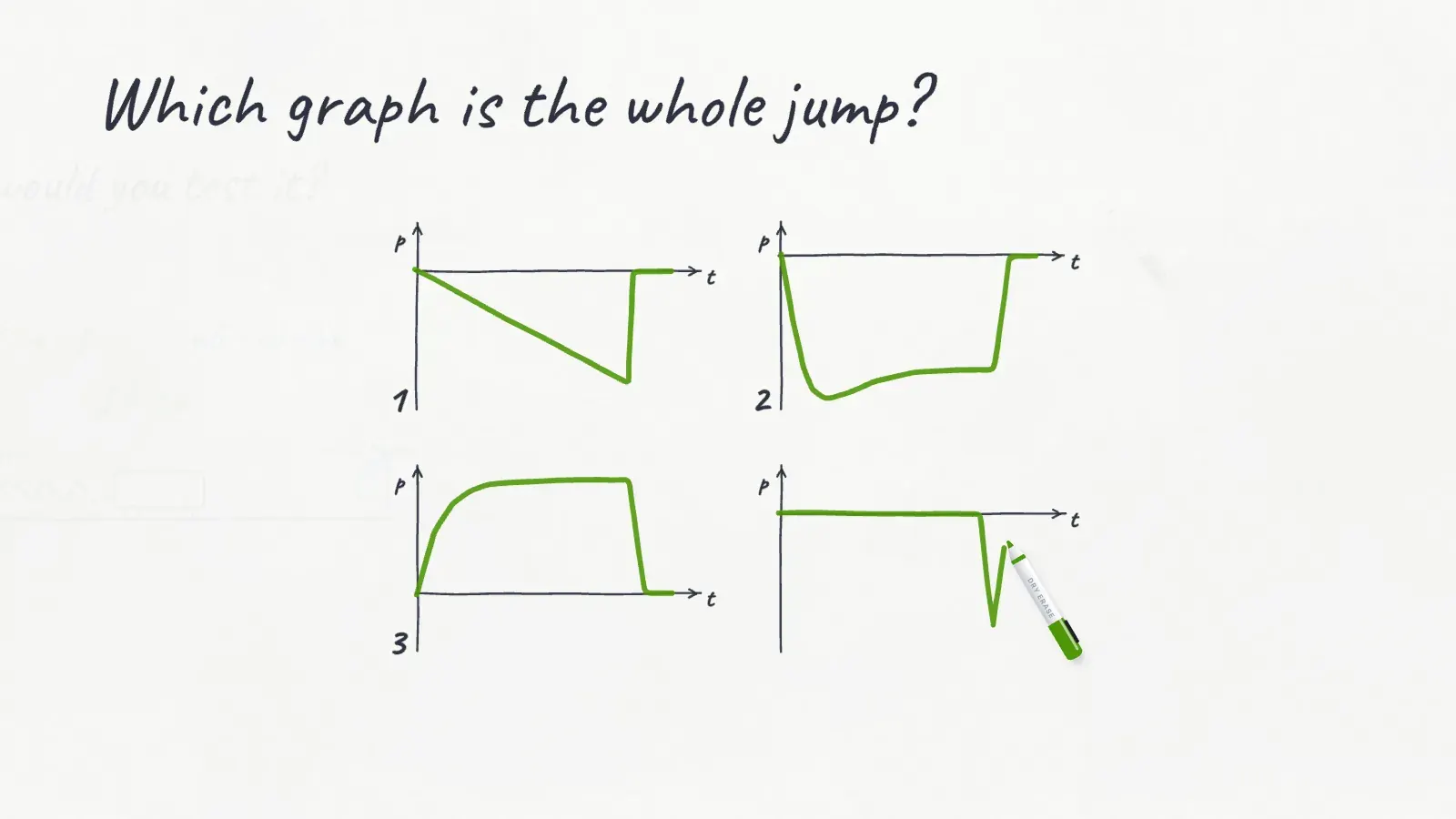
This graph shows his momentum during the same stop. It starts at about negative forty-three hundred and climbs to zero in about thirty-seven hundredths of a second. The slope of this graph is the net force on him. Its average slope is the rise over the run, here a rise of forty-three hundred over a run of thirty-seven hundredths of a second. That’s about eleven and a half thousand newtons, the same average net force we found before.
If the ground had stopped him, this line would be almost vertical. A slope that steep means a huge force. And where the line is flat, the net force is zero. That’s true even while he’s falling at a hundred and twenty miles an hour.
So the net force is how fast his momentum changes, delta p over delta t. His mass stays the same, so delta p is m times delta v. Divide by delta t and you get m a. That’s Newton’s second law.
Here are four sketches of his momentum for the whole jump, from the step out of the plane to lying still in the net. Only one of them could be right. Which of these four graphs could be Luke’s whole jump?
Six ten-thousandths of a second
The net wanted a long, gentle stop. A baseball bat wants the opposite. In May 2025, Oneil Cruz hit a fastball out of the park at almost a hundred and twenty-three miles an hour, the hardest-hit ball since baseball started measuring every one.
Let’s slow it down ten thousand times. The ball flattens against the bat and leaves going the other way, all in about six ten-thousandths of a second. The net stretched its stop out. Here the stop is almost instant, so the same law makes the force enormous.
A catcher only has to stop the ball. The bat has to stop it and then send it back. Your turn. Turn the dial to find the exit speed that gives the bat exactly twice the catcher’s impulse.
Let’s work out Cruz’s hit on the board, with positive pointing back toward the pitcher. We’ll treat the hit as going straight back. The ball’s mass is zero point one four five kilograms. It reaches the plate at thirty-seven and a half meters per second toward the catcher. So its momentum is zero point one four five times negative thirty-seven point five, about negative five point four four.
It leaves Cruz’s bat at fifty-four point nine meters per second toward the pitcher. Its momentum is about positive seven point nine six. In arrows, the momentum before points toward the catcher and the momentum after points toward the pitcher. The change reaches from one tip to the other, so it’s longer than either arrow.
A common mistake is to subtract the sizes, seven point nine six minus five point four four, and get about two and a half, as if the ball just slowed down. It actually turned all the way around. Keep the signs. Positive seven point nine six minus negative five point four four is about thirteen point four kilogram meters per second. Divide by the contact time, six ten-thousandths of a second, and the bat pushed with about twenty-two thousand newtons.
Your turn. Suppose a batter sends that same pitch straight back at forty-five meters per second. What’s the change in the ball’s momentum, with positive toward the pitcher, in kilogram meters per second?
The sentence that earns the point
On the AP exam, you’ll often have to explain in words why something happens. Here’s one to answer together. Throw a water balloon onto the pavement and it bursts. But when someone catches it carefully, it survives. What’s the difference?
Either way, the balloon has the same mass and speed just before, and it ends up at rest. So its change in momentum is the same. The impulse equals the change in momentum, so both stops take the same impulse.
What’s different is the time. Hands that move with the balloon make the stop longer, the way the net sank with Luke. The same impulse over a longer time means a smaller average force, small enough that the rubber doesn’t split. An answer like that earns the point. It ties the same impulse and the longer time to the smaller force, and it’s about this balloon, not balloons in general.
Two answers lose the point. One says the hands absorb the force, but it never says what stays the same, or why. Another says catching reduces the impulse. That’s wrong, because the impulse is the same both ways.
Here’s a new one. A stunt performer falls onto a big air bag instead of the ground, and four students each explain why the air bag is safer. Which explanation would earn full credit?
Same impulse, more time
Back to the net one last time, with a question you might be asking. Why didn’t they just hang a giant trampoline? Suppose a trampoline sank the same ten meters and threw him back up at six tenths of the speed he hit it with. Compared with the air-cylinder net, how big is the impulse on him?
That extra twenty-six hundred is the trampoline throwing him back up at about seventy miles an hour, to fall all over again. That’s why the crew used cord that barely stretches, and let the air cylinders take his momentum away instead of handing it back. The net and the ground had the same job, to take away forty-three hundred kilogram meters per second.
The ground would have stopped him in two thousandths of a second. The net took two hundred times longer, so the net force on him was two hundred times smaller. Add his weight, and the net pushed with about twelve thousand three hundred newtons, not millions. That’s how a man fell twenty-five thousand feet with no parachute and walked away.
The change in momentum is final minus initial, and its sign is its direction. Impulse is the average force times the time, the area under a force–time graph, and it equals the change in momentum.
On a momentum–time graph, the slope is the net force, and flat means no net force at all. For the same change in momentum, more time means less force, like the net, and less time means more force, like the bat. During those six ten-thousandths of a second, the bat felt the ball’s push too, just as big and the opposite way. That’s where we’re going next.