
Topic 2.3 key terms
- Newton's third law
- When two objects interact, the force exerted on B by A is equal in magnitude and opposite in direction to the force exerted on A by B: .
- third-law pair
- The two forces of one interaction: they act on two different objects, their labels swap (A on B, B on A), they are equal in magnitude and opposite in direction, and they are the same kind of force. They never cancel on either object's free-body diagram, because they act on different objects; inside one system they are internal forces and cancel in the system's total.
- thrust
- The force exerted on a rocket by its exhaust gas. Its third-law partner is the force exerted on the gas by the rocket; the surrounding air is not part of the pair.
- free-body diagram
- A diagram of ONE object (a dot) with an arrow for each force exerted on it, starting on the dot. The two forces of a third-law pair always appear on two different diagrams.
- internal force
- A force exerted by one part of a system on another part of the same system. Internal forces come in pairs inside the system and cannot change the motion of the system's center of mass.
- external force
- A force exerted on a system by an object outside the system. Only external forces can change the motion of the system's center of mass.
- tension
- The magnitude of the pull that the segments of a string, cable or chain exert on each other in response to a pull on its ends.
- ideal string
- A string of negligible mass that does not stretch. The tension is the same at every point along it. On the AP exam, strings are ideal unless stated otherwise.
- ideal pulley
- A pulley of negligible mass that turns about an axle through its center with negligible friction. It changes the direction of a string without changing its tension.
Transcript
2,583 words · 10 parts
Something better than a vacuum
On the seventh of February, 1984, an astronaut named Bruce McCandless floated out of the space shuttle Challenger and flew away from it with no rope at all, the first person who ever did that. Out there, he said this. It may have been one small step for Neil, but it’s a heck of a big leap for me. He steered with twenty-four tiny jets that puffed out nitrogen gas, out where there’s no air and no ground, nothing at all to push against. So what was he pushing on?
In 1920, the New York Times was sure that kind of flight was impossible. It mocked a professor named Robert Goddard. A rocket in empty space, it wrote, would need something better than a vacuum against which to react.
Then it added that Goddard only seems to lack the knowledge ladled out daily in high schools. Rockets fire in that vacuum all the time, and out here the exhaust blooms into a huge glowing shell, because there’s no air to hold it in. On the morning after Apollo 11 left for the Moon in 1969, the Times printed a correction, and it ended with five words. The Times regrets the error.
So what does a rocket push on in empty space? The Times missed one piece of high-school physics. Every force has a partner, and you’re about to learn to find it. Let’s start with something a lot smaller than a rocket. Your own hand, pushing on a wall.
You can’t touch without being touched
Put your hand flat against a wall and push. You’re exerting a force on the wall, and I’ll draw it as an arrow on the wall, pointing into it. You can feel something else too. The wall pushes back on your hand, which is why your palm flattens. That’s a second arrow, on your hand, pointing back at you.
That’s two objects, the hand and the wall, with one interaction between them. An interaction always comes with two forces, one on each object. Paul Hewitt, a physics teacher famous for putting big ideas into small sentences, likes to say that you can’t touch without being touched.
We can test that. Hook two spring scales together and pull them apart, one in each hand, and watch the two readings. Pull harder with your right hand, as if the right side is about to win. Both readings go up together, and once they settle, they match every time.
Go ahead and grab either hand. See if you can make one scale read more than the other. The two scales pull on each other, and those two pulls are the two halves of one interaction.
Physicists write it like this. The force exerted on the wall by your hand is equal to the negative of the force exerted on your hand by the wall. Look at the labels. The names swap places, hand on wall and wall on hand, and the minus sign flips the direction, so the two forces are the same size and point opposite ways.
Write it for any two objects, A and B, and you get Newton’s third law. The AP equation sheet doesn’t print this one, so it has to live in your head. Many textbooks still call these two forces the action and the reaction. That second word misleads people, because reaction sounds like it comes second. It doesn’t. Both forces start at the same instant and last as long as the touch does.
The bigger truck
This one fools a lot of people, and it’s a classic AP question. A heavy truck and a small car crash into each other head-on. During the collision, how does the force exerted on the car by the truck compare with the force exerted on the truck by the car?
Now you try to break it. Make the truck as heavy as you like, change the car’s speed, and crash them again. See if you can get one curve taller than the other.
If the forces are equal, why does the small car come off so much worse? Let’s work it out with a crash from the Insurance Institute for Highway Safety. One car has twice the mass of the other. Each is doing forty miles an hour, head-on.
The force on the light car by the heavy car is equal and opposite to the force on the heavy car by the light car. Both cars feel the same size force. But the light car has half the mass, and the same force gives half the mass twice the acceleration. You’ve felt that pushing an empty shopping cart, then a full one. Both forces last for the same short time, so the light car’s velocity changes twice as much as the heavy car’s.
The Institute’s own numbers agree. The light car’s velocity changes by fifty-three miles an hour, and the heavy car’s by twenty-seven. That’s almost two to one. The bigger truck never pushes harder. Both get the same force, and that force does far more to the lighter one.
What a rocket pushes on
Back to space, to answer the Times. A rocket engine burns its fuel and throws the hot gas out of the back, so let’s look inside one. This is an engine sliced open. The fuel burns in this chamber, and hot gas molecules slam into the walls and the closed end, over and over, before they rush out through the nozzle.
Every one of those hits is a tiny interaction. The engine pushes the molecule back toward the nozzle, and at the same instant the molecule pushes the engine forward, just as hard. Add up all those tiny pushes and you get two big forces. The rocket pushes its gas backward, out of the nozzle. The gas pushes the rocket forward, and that forward push is the rocket’s thrust.
The partner of the push on the rocket is the push on its own gas. Look for the air in that pair. It isn’t there at all, and that’s what the Times got wrong. That answers our first question. McCandless was pushing on his own nitrogen. Each of his twenty-four jets is a tiny rocket, and now you get to fly him.
Okay, now he’s drifting away from the shuttle, and you’re flying. Get him back into the payload bay, and remember that each puff pushes him the opposite way from the jet.
Two objects, two diagrams
The clearest way to show a pair is with two free-body diagrams side by side, one for each object. Let’s draw the astronaut and his puff of gas. On the astronaut’s dot, the gas pushes him forward. On the gas’s dot, he pushes the gas backward, with an arrow the same length. Two little tick marks on each show they’re partners.
When you think you’ve found a pair, run four quick tests. The forces act on two different objects, their names swap, they’re equal and opposite, and they’re the same kind of force. This trap catches more students than any other. A book sits on a table. The Earth pulls it down, and the table pushes it up, equal and opposite.
Those two look like a pair, but they aren’t. They both act on the same book, and one is gravity while the other is a push. Even the names don’t swap. Earth on book flips to book on Earth, not table on book.
Push down on the book with your hand, and the table pushes up harder than the Earth pulls down. Now they aren’t even equal. A real pair stays equal however hard anybody pushes. The real partner of the book’s weight is the book pulling the whole Earth up, with a force the same size. In one study, fewer than one in ten strong first-year university students could name it.
The table’s push has its own partner, the book pushing down on the table. So the book’s weight and the table’s push are never partners. Try one. A person stands on a bathroom scale, and the scale pushes up on the person. Which force is the partner of that push?
Gravity pairs work the same way, even for whole worlds. The Earth pulls on the Moon, and the Moon pulls on the Earth just as hard. The third law doesn’t care how big you are.
But their masses are very different. The Earth has about eighty-one times the mass of the Moon. Same size force on both, and the Earth has eighty-one times the mass. How does the Earth’s acceleration compare with the Moon’s?
The man who pulled a jet
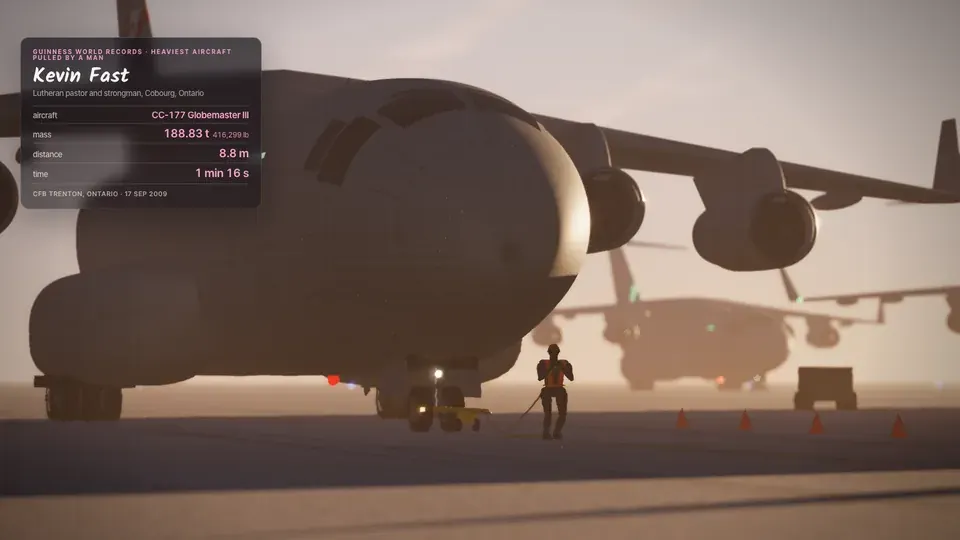
In 2009, at an air force base in Ontario, a strongman named Kevin Fast tied a rope from himself to a military cargo jet of almost a hundred and ninety tonnes. He pulled it eight point eight meters across the concrete in one minute and sixteen seconds, a Guinness world record. But think about that rope. He pulls on the rope, and the rope pulls back on him just as hard. If every pull comes with an equal pull back, how does anything ever move?
The two forces of a pair never act on the same object. His pull acts on the rope, and the rope’s pull acts on him. So his own pull can never cancel the rope’s pull on him.
To see how he moves, look only at the forces on him. The rope pulls him back. The runway pushes his shoes forward just as hard. Those two balance, so he keeps plodding on.
Let’s find the partner of every force on him. One force on the man lights up at a time, and you tap its partner, which has to be sitting on some other object.
Now swap the concrete for a sheet of ice. Here he is in the middle of a heave. Look at the forces on him. The rope pulls him back hard. But the ice can barely push his shoes forward.
Nothing balances the rope’s pull, so he slides toward the plane, and the plane doesn’t budge. Both times, the rope pulled him back. What changed was the ground. Concrete pushed his shoes forward, and ice barely could, so the ground decides who wins.
Let’s see if you believe it. Here’s a tug of war, four people against two, on one rope. Choose the ground under each team, and make the smaller team win.
A rope is a chain of pairs
The two dials on that rope, one at each end, always read the same, and that’s no coincidence. Think of the rope as a chain of short pieces. Each piece pulls on its neighbor, and the neighbor pulls back equally. That’s a third-law pair, and how hard they pull is the tension.
If a string’s mass is small enough to ignore and it doesn’t stretch, we call it an ideal string. Each piece just passes the pull along, so the tension, T, is the same at every point.
An ideal pulley has no mass and turns freely on an axle through its center. It just changes the string’s direction, so the tension is the same on both sides. On the AP exam, every string is ideal unless the question says otherwise. It says so right on the equation sheet.
Try this famous one. A spring scale hangs between two strings, each string runs over a pulley, and a ten-newton weight hangs from each end. What does the scale read?
Real ropes and chains do have mass, though, and then the tension can change along them. Hang a heavy chain from a hook, and think about what each link holds up. Look at the hanging chain. Where do you think its tension is largest?
Forces inside the system
Back to our astronaut and his puff of gas. This time, we’ll draw boundaries. Draw a boundary around just the astronaut. The gas is outside it, so its push on him is an external force, and it changes how he moves.
Now draw the boundary around him and every bit of gas he’s ever thrown. Both forces of every pair are inside it now. On his own diagram, the gas’s push has no partner there to cancel it. Put him and the gas inside one boundary, and the partner is there too. His push on the gas and the gas’s push on him add to zero.
Watch the center of mass of all of it. He started at rest. So it stays right where it was, next to the shuttle. He goes one way, the gas goes the other, and the center of mass doesn’t even flinch. Internal forces, the ones inside a system, can’t change the motion of the system’s center of mass.
Don’t take my word for it. This time he’s drifting, so the center of mass moves along a straight line. Fire his jets any way you like, and try to make that line bend.
What does it take to bend that line? The shuttle’s robot arm gives him one shove. The arm is outside our boundary, so its push is external, and the path of the center of mass bends.
Try one yourself. Take his jet pack away, so he floats at rest beside the bay. The only way he can move is to throw his wrench. He and his suit have a mass of two hundred kilograms.
The wrench is two. Positive is the way he throws it. During the throw, the wrench accelerates at fifty meters per second squared in the positive direction. What’s the astronaut’s acceleration during the throw, sign included?
The sentence that earns the point
Watch that throw in slow motion. He and the wrench push on each other equally, a hundred newtons each. The wrench flies off at ten meters per second. He drifts back at a tenth of a meter per second, a hundred times slower.
An AP question would turn that into a claim. He moves away a hundred times slower than the wrench. Now justify it. A lot of students write that the forces are equal and opposite, and stop there. It’s true, but it never says which forces, and it never connects them to the speeds.
Name both forces, both ways. The force exerted on the wrench by the astronaut is equal in magnitude and opposite in direction to the force exerted on the astronaut by the wrench. Then connect that to the claim. He has a hundred times the mass, so the same force gives him one hundredth of the acceleration. The forces last the same time, so his velocity changes one hundredth as much.
Now you be the grader. Two skaters at rest push off each other, and one has twice the mass of the other. The claim is that the lighter one moves away faster. Here are four students’ answers. Which answer earns full credit?
The Times regrets the error
Every force has a partner on the other object, the same size and the same kind, pointing the opposite way. On one object’s diagram, partners never cancel. Draw one boundary around both objects, and now they do.
Forces inside a system can’t change the motion of its center of mass. An ideal string has one tension all the way along, an ideal pulley only turns it, and a heavy chain pulls hardest at the top. On the exam, name both forces both ways, then connect them to the claim.
Back to the rocket one last time. It pushes its gas backward, and the gas pushes it forward. That’s the physics the Times was missing in 1920. A rocket doesn’t need anything outside to push against. It carries the thing it pushes on, and throws it out the back.