
Topic 6.5 key terms
- molar enthalpy of fusion (ΔH_fus)
- The energy absorbed per mole when a solid melts at constant temperature; freezing releases the same amount (−ΔH_fus). Water: 6.01 kJ/mol. Used in q = nΔH.
- molar enthalpy of vaporization (ΔH_vap)
- The energy absorbed per mole when a liquid vaporizes; condensing releases the same amount, so ΔH_condensation = −ΔH_vap. Water: 40.7 kJ/mol at 100 °C.
- heating curve
- A graph of temperature against heat added: sloped segments are one phase warming (q = mcΔT), flat segments are phase changes at constant temperature (q = nΔH).
Transcript
1,381 words · 4 parts
Energy of phase changes: the thermometer that stops
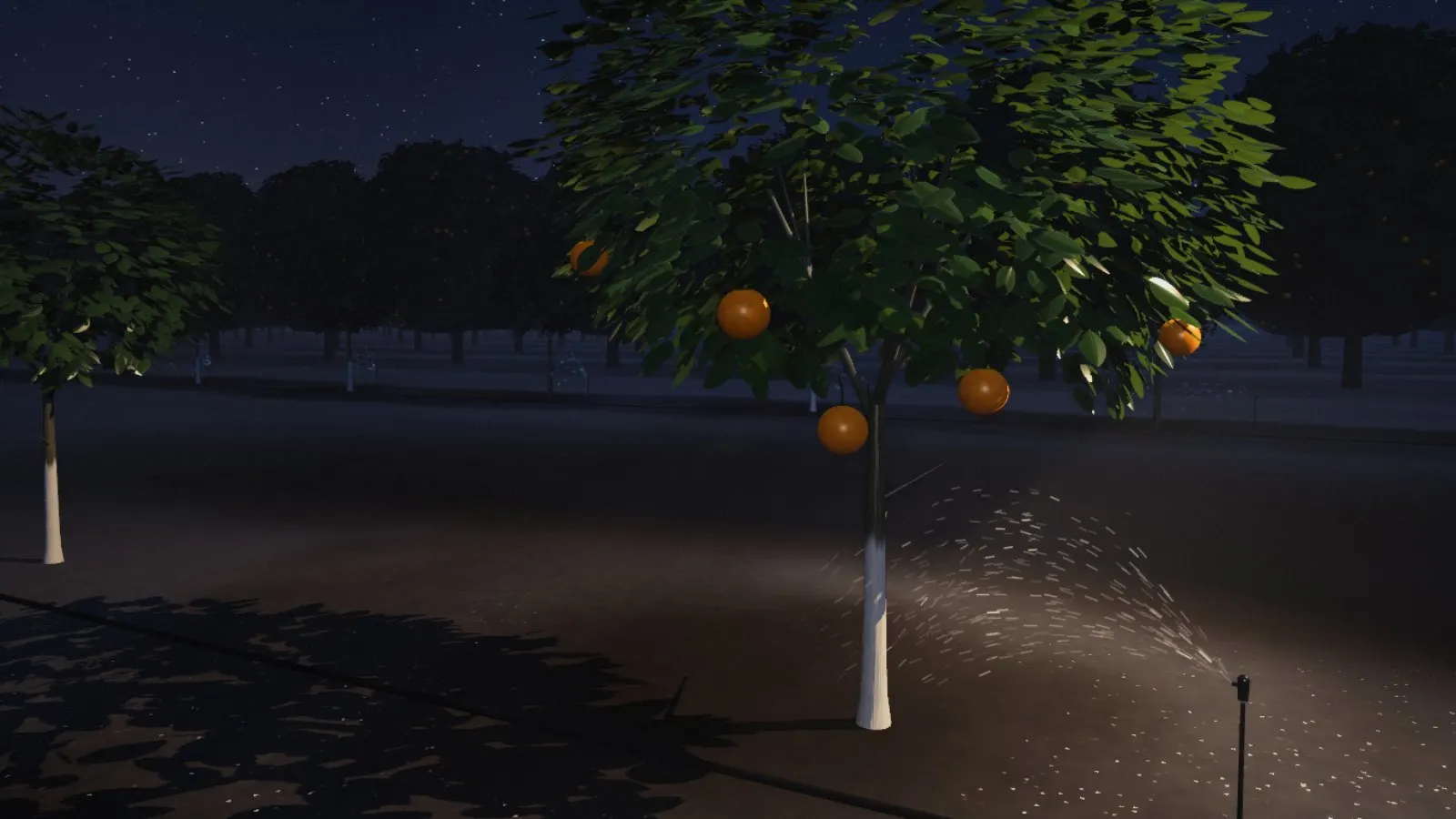
It’s two in the morning on that freezing night in our Florida orange grove, and the growers have been spraying water onto these young trunks for hours to keep them alive. Keep an eye on the thermometers as the night goes on. The air keeps falling, and the young tree with no water on it falls right along with it, but under the ice the thermometer is stuck at thirty-two degrees, hour after hour, while the ice keeps getting thicker.
Think about what q equals m c delta T says about that water, because if its temperature isn’t changing, delta T is zero, and the equation gives zero heat. But the bark is staying warmer than the air, so heat is still flowing into it from somewhere. To see where it’s coming from, we need to get much closer, so let’s go into that ice.
This is the edge of the ice, magnified until we can see single molecules, with the bark at the bottom, the ice in the middle and a thin film of liquid on top. Watch the liquid molecules next to the ice settle, one by one, into its open, six-sided pattern.
Every time a molecule locks into place, it gives off a little energy, shown here as an orange glow sinking into the bark, and that’s where the heat comes from, the freezing itself. Let’s follow one molecule in. As it settles into its spot, the molecules around it hold it more tightly than they did in the liquid, and that drop in energy comes out as heat.
And the thermometer still reads zero point zero, because temperature tracks how fast the molecules jiggle on average, and they’re jiggling just as fast as before, so the energy that leaves comes out of how they’re held together, and their average speed stays the same. So freezing releases energy and the water’s own energy goes down, and the reverse is true too, so to melt ice or to boil water, you have to put energy in.
Let’s test that with your own hands. Use the handle to keep pulling heat out of this water, and keep going until the thermometer finally moves. And that’s exactly why the growers keep the water running all night, because the moment there’s no liquid left to freeze, the heat from freezing stops coming, and the bark starts falling with the air.
q = nΔH: the heat of freezing
So how much heat does the freezing give off? For a phase change we use q equals n delta H, the number of moles times the molar enthalpy of that change. For water, melting takes six point zero one kilojoules for every mole, and that’s called the molar enthalpy of fusion, and freezing gives back exactly the same amount, so for freezing we write minus six point zero one.
Let’s freeze our hundred grams of grove water, which we already found is five point five four nine moles, and five point five four nine times minus six point zero one gives minus thirty-three point four kilojoules. Next to the cooling we did earlier, eight point three seven kilojoules, the freezing handed over about four times as much, so if you guessed freezing back at the start, you were right. Together that’s forty-one point seven kilojoules from every hundred grams of water that lands on the bark and freezes.
If we graph the water’s temperature against the heat it gives off, the cooling is this short slope, and the freezing is this long flat line at zero, and the width of that flat line is the heat. And when the sun comes up and the ice melts, it takes back exactly what the freezing gave, plus thirty-three point four kilojoules for those same hundred grams.
That’s true of every phase change and its reverse, they’re the same size with opposite signs, so vaporizing water at its boiling point takes forty point seven kilojoules per mole, and condensing that steam gives back forty point seven. Thirty-six grams of liquid water freezes at zero degrees, so what’s q for the water, in kilojoules?
Heating curves: both topics on one picture
Now both topics fit on one picture, the heating curve of water. Every slope is one phase warming up, where we use m c delta T, and every flat is a phase change, where we use n delta H. And the boiling flat is about seven times wider than the melting flat, because pulling water molecules all the way apart into a gas takes forty point seven kilojoules per mole, and loosening them into a liquid takes only six point zero one.
Down at the molecules you can see why, and here it’s happening at zero degrees, on the surface of our grove water. A molecule escaping into the air breaks away from all of its neighbors and takes a much bigger chunk of energy with it, and a vapor molecule that lands and condenses gives that same chunk right back.
Let’s work one together. How much heat does it take to turn twenty-five grams of ice at minus ten degrees into liquid water at twenty degrees? All we have to do is walk along the curve and pick the right equation for each piece, and here there are three, the ice warming to zero, the melting, and the water warming to twenty. Warming the ice uses the ice’s specific heat and takes about five hundred twenty-three joules, melting needs moles, twenty-five over eighteen point zero two, times six point zero one, which is eight point three four kilojoules, and warming the water takes two point zero nine two kilojoules.
Add the three and we get ten point nine five kilojoules, just under eleven, and notice that about three quarters of it went into the melting. And if an AP question asks why the temperature stays flat while the ice melts, the sentence that earns the point says the energy goes into overcoming the attractions between the molecules instead of making them move faster, so their average kinetic energy, and the temperature, stay the same.
Your turn, and this one runs the other way. Five grams of steam at a hundred degrees condenses, and then the water cools to twenty-five degrees. What’s the total q for the water, in kilojoules?
The windy night
Back in the grove, let’s change just one thing and make it a dry, windy night. The spray blows sideways, and a lot of the water evaporates before it ever gets a chance to freeze. And now the wet trunk is actually colder than the air. That’s what happened in the windy 1962 freeze, when growers ran overhead sprinklers and the cooling from evaporation killed many of their trees.
Evaporating is a phase change too, liquid to gas, and it takes energy in. At zero degrees it takes about forty-five kilojoules per mole. Cold water molecules hold on to each other a little tighter than boiling ones.
Freezing gives back only six point zero one. Forty-five divided by six point zero one is about seven and a half. A mole that evaporates pulls about seven and a half times as much heat from the tree as a mole that freezes puts back.
Let’s find the tipping point, counting only the freezing and the evaporating. Ten grams of water freezes on this trunk. Use the slider to set how many grams evaporate, and find where the two cancel.
The growers’ guide puts it in gallons, seven and a half gallons have to freeze for every gallon that evaporates, which is why growers watch the wind and the dew point, and never shut the water off in the middle of a freeze, because a wet trunk with no new water coming can drop below the air temperature. By sunrise, we can count every bit of that heat. The water cooling from twenty degrees to zero is q equals m c delta T, the freezing, at a temperature that never moved, is q equals n delta H, and evaporation pulls the other way, seven and a half times as hard.
So now you can work out how much heat that water hands a tree on its way to becoming ice, and explain how the same water can save it or kill it. Next time we’ll count heat the third way, when the substances themselves react.