
Topic 6.6 key terms
- enthalpy change of reaction (ΔH)
- The heat released (ΔH < 0) or absorbed (ΔH > 0) by a reaction at constant pressure, per mole of reaction as written (kJ/mol_rxn).
- exothermic
- A reaction that transfers thermal energy to its surroundings: ΔH < 0 and q for the reaction is negative; the surroundings warm up.
- endothermic
- A reaction that takes in thermal energy from its surroundings: ΔH > 0 and q for the reaction is positive; the surroundings cool down unless heat is supplied.
- mole of reaction
- The reaction exactly as written in the balanced equation: for 2H₂ + O₂ → 2H₂O, one mole of reaction consumes 2 mol H₂ and 1 mol O₂ and forms 2 mol H₂O.
- system and surroundings
- The system is the reacting chemicals; the surroundings are everything else (solvent, container, air). q(surroundings) = −q(system).
- thermal equilibrium
- The state reached when energy transfer between the products and their surroundings has made their temperatures equal.
Transcript
1,864 words · 4 parts
Enthalpy of reaction: the flame you could barely see
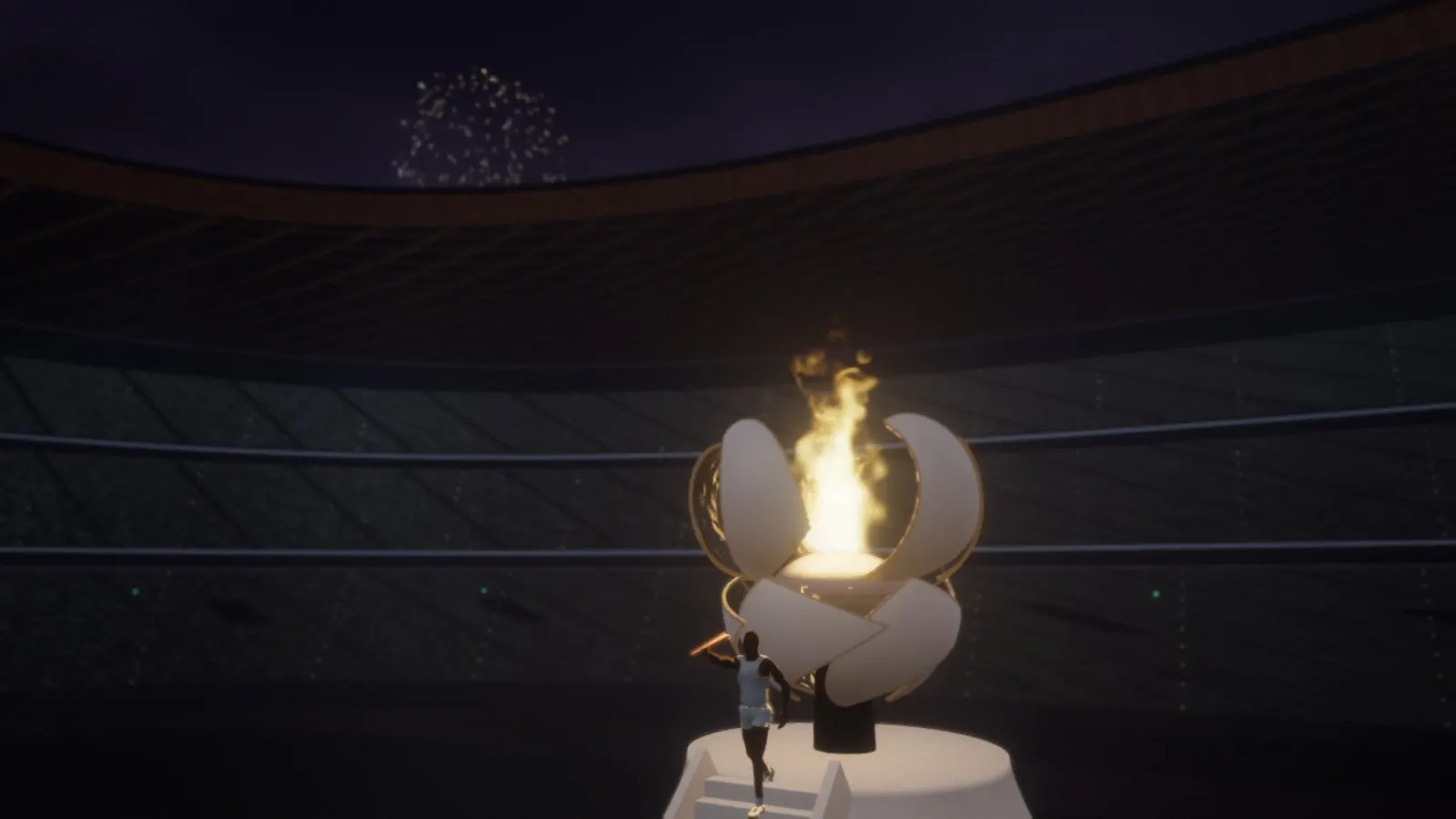
On the night of July twenty-third, 2021, the stands of the Olympic Stadium in Tokyo were almost empty, because the Games were running a year late, in the middle of a pandemic, and fans weren’t allowed in. At the very end of the opening ceremony, the tennis star Naomi Osaka took the Olympic torch for the last leg of the relay, and climbed a staircase that rose out of a white mountain shaped like Mount Fuji, toward a closed white ball at the very top.
Then the ball opened like a flower, ten white panels folding back to show mirrors inside, and she lit it. The designers meant that ball to be the sun, and it was the first cauldron in the history of the Games to burn hydrogen. But hydrogen has a problem if you want to put on a show, because its flame is so faint that under stadium lights you’d barely see it at all. This is roughly what it would have looked like on its own.
So the designers sprayed a fine mist of sodium carbonate solution in from beside the burner, and sodium glows this warm yellow, and they tuned the spray and the valves until the flame flickered like a wood fire someone had just stoked. That means the yellow you’re looking at is really a costume. It shows you where the flame is, and it has nothing to do with where the heat comes from.
The heat comes from the reaction underneath it, hydrogen combining with oxygen from the air to make water, and that reaction is what keeps this whole thing burning. By the end of this lesson, you’ll be able to work out exactly how much heat any amount of hydrogen gives off in a flame like this one, even how much hydrogen it takes to get a million joules out of it.
And you’ll be able to explain where all that heat actually comes from, which is stranger than you’d think, because pulling hydrogen apart doesn’t give you any heat at all. It costs heat. So let’s start with the first thing an engineer would want to know, which is how much heat comes out when you send a certain amount of hydrogen into this flame.
Here’s a first guess to make, before any math. If we send twice as much hydrogen into this flame, what do you think happens?
Heat with a sign
Here’s that reaction again, with the states written in, since the water comes out of a flame as a gas, and next to it is a number called the enthalpy change of the reaction, delta H, minus four hundred eighty-three point six kilojoules. Delta H tells you how much heat a reaction gives off or takes in, and a minus sign means the reaction releases heat, so the heat leaves the reaction, while a plus sign would mean the reaction absorbs heat from around it.
That’s the heat for a reaction running at constant pressure, like a flame burning out in the open air, which describes almost every reaction you’ll meet in this course. The units say kilojoules per mole of reaction, and that phrase is worth slowing down for, because a mole of reaction means the reaction exactly as it’s written, two moles of hydrogen burning with one mole of oxygen to make two moles of water.
So these four go together, and each one can stand in for the others in a calculation. A classic AP question looks exactly like this, an equation with a delta H beside it and an amount of fuel, and it asks how much heat comes out. And it has one trap almost everybody falls into the first time, which is this two, so keep an eye on it. But before we calculate anything, I want to see where that heat actually goes, so let’s go back to the flame.
Here’s a visualization of what an infrared camera would show, since it picks up the infrared light that hot things give off, and as the line sweeps across the flame, the yellow almost stops mattering. What glows now is this plume rising off the flame, which is hot water vapor, the water the reaction just made, and that’s how the heat leaves, carried off by the new water and handed to the air around it.
So let’s go into the flame and watch it happen, one molecule at a time. Hydrogen comes up from the burner, and oxygen comes in from the air along with a lot of nitrogen, which is just along for the ride. Where they meet, the atoms rearrange into water. And look at the new water molecules, because they come flying out of the reaction with far more kinetic energy than the molecules that went in.
The water has less stored energy than the hydrogen and oxygen did, the kind chemists call chemical potential energy, and that difference doesn’t disappear, it turns into kinetic energy, the energy of motion. Temperature is a measure of the average kinetic energy of the molecules, so this is the moment the flame gets hot. Then the fast waters bump into the nitrogen and oxygen around them and speed those up too, and that spreading of motion is heat flowing out into the surroundings.
The flame keeps getting new fuel, so it never settles down, but imagine catching one small puff of it in a glass bubble. The reacting chemicals inside are the system, and everything outside is the surroundings. The reaction finishes, and the inside is suddenly hot, so energy flows out through the wall into the cooler air, the inside slows down and the outside speeds up, until both thermometers read the same, and that’s called thermal equilibrium.
And the water molecules stay water the whole time, they just slow down. Some reactions send heat the other way, though. Here’s ammonia breaking apart into nitrogen and hydrogen inside a hot reactor, and as it reacts, the inside gets colder than the walls around it, so this time heat flows in from the surroundings until the two match again. So an exothermic reaction sends heat out to its surroundings, and an endothermic reaction pulls heat in from them.
Let’s put all of that in one picture. The reactants start up here, with more potential energy, and the products end up lower, and that gap of four hundred eighty-three point six kilojoules is the energy that became motion, and then left as heat. We write heat as q, and from the reaction’s point of view, it lost that heat, so its q is negative, and the surroundings gained exactly that much, so theirs is positive.
The mistake to watch for is reading a thermometer as if it were the reaction, since the air gets hotter and that makes it feel like the sign should be positive. But the thermometer sits in the surroundings, and the reaction is the one that gave the heat away. Let’s check that. A reaction in a cup of water makes the water warmer, so pick the description that gets it right.
From moles to kilojoules
Okay, let’s calculate it. Say we send point two five zero moles of hydrogen into the flame, with plenty of oxygen around, and we want to know how much heat comes out. I always start with what I’m given, so that’s point two five zero moles of H two.
The equation gives me the conversion factor, minus four eighty-three point six kilojoules for every two moles of H two, and there’s that two, because two moles of hydrogen is how much one mole of the reaction burns. Moles of H two cancel, and we get minus sixty point four five kilojoules, or minus sixty point five with three significant figures. So this sample releases sixty point five kilojoules of heat, which is why the answer carries a minus sign.
Now here’s the trap I warned you about. If you forget that two and use four eighty-three point six for every single mole of hydrogen, you get minus one twenty-one, which is twice the real answer, and it’s exactly the wrong answer an AP question will have waiting for you. A quick sanity check helps too, because one mole of hydrogen gives about two forty-two kilojoules, half the equation’s number, and a quarter of a mole should give a quarter of that, about sixty, which is what we got.
Let’s do one together, starting from grams this time, with point eight zero zero grams of hydrogen. What do I need first? The equation only talks in moles, so the first step has to turn the grams into moles.
Hydrogen’s molar mass comes from the periodic table, one point zero zero eight grams per mole for each atom, so two point zero one six for H two, and it goes in with grams on the bottom so the grams cancel. Now you finish it. Take it from moles to kilojoules, and give me q for point eight zero zero grams of hydrogen.
Now what happens if we burn twice as much, one point six oh grams? The heat doubles to minus one ninety-two kilojoules, which makes sense, twice the fuel and twice the heat. But delta H doesn’t change at all, it’s still minus four eighty-three point six kilojoules per mole of reaction, because it describes the reaction itself, not how much of it you run. Let’s watch that in the flame.
Here’s one mole of hydrogen going in, and the counter adds up the heat as it burns, two hundred forty-two kilojoules. Now let’s send in two moles, and think back to your prediction, because the flame doesn’t get any bigger or any hotter, it burns at the same rate for twice as long, and the heat comes out to about four hundred eighty-four kilojoules, the equation’s own number, because two moles of hydrogen is exactly one mole of the reaction.
Now I want you to run it, so set the fuel so the flame releases seven hundred twenty-five kilojoules, and then press burn. Every calculation so far has had heat going out. But we watched one in the bubble that pulled heat in, and it’s worth doing the math on that one too.
When heat flows in
Hydrogen is hard to ship, because it’s so light and takes up so much room, so some engineers, including teams in Japan, want to carry it locked up inside ammonia and crack it back out wherever it’s needed. Cracking ammonia looks like this, two N H three going to N two plus three H two, and its delta H is plus ninety-one point nine kilojoules per mole of reaction.
The plus sign means this reaction absorbs heat from its surroundings, so a cracker has to be kept hot, or it would cool itself down and stop, just like the bubble we watched. So how much heat does it take to crack ten point oh grams of ammonia?
So now we can say how much heat comes out of a hydrogen flame and how much has to go into an ammonia cracker. What we haven’t said yet is why making water gives heat out, while cracking ammonia takes heat in.