
Topic 8.11 key terms
- washer
- A disc with a hole: the shape of a cross section of a solid of revolution when the region does not reach the axis. Its area is πR² − πr².
- outer radius R
- The distance from the axis of rotation to the edge of the region farthest from it.
- inner radius r
- The distance from the axis of rotation to the edge of the region nearest to it: the radius of the hole.
- washer method
- V = π∫ₐᵇ [R(x)² − r(x)²] dx for a horizontal axis (slices of thickness dx), or the same with y and dy for a vertical axis.
- axis of rotation
- The line a region is spun around; every radius is measured from it, so moving it changes both radii and the volume.
Transcript
880 words · 3 parts
Two hundred meters of rings
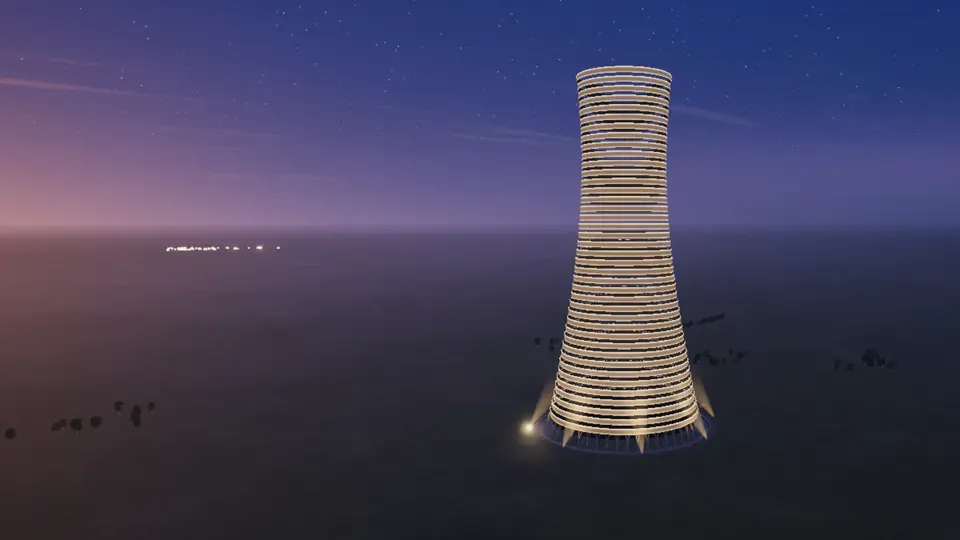
This cooling tower at a power station stands two hundred meters tall, and to make its shape, engineers take a curve you already know, a hyperbola, and turn it all the way around a vertical line. If you took precalculus with us, you met this shape as a tower of straight steel bars, and about a hundred years ago engineers started building it out of concrete instead.
What amazes me is the wall itself, which is only about twenty-five centimeters thick. If you shrank the whole tower down to the size of an egg, its wall would be thinner than the eggshell. Crews build it one ring at a time. They pour a band of concrete about a meter and a half tall, let it harden, climb up onto it and pour the next one, about a ring a day, all the way to the top.
How many truckloads of concrete do you think went into that wall? By the end of this lesson, you’ll be able to take the equations of the tower’s two walls, the outside and the inside, and work it out for yourself. Every one of those rings is a flat shape with a hole in the middle, so let’s pull one out and start right there.
Take away area
This ring comes from the narrowest part of the tower. From the center it’s forty meters out to the outside of the wall, and thirty-nine and three quarters to the inside. Both distances start at the center. Capital R reaches the outside of the wall, little r reaches the inside, and what we want first is the area of concrete between them.
Those numbers are a bit awkward, so let’s find the area of a ring with friendlier ones, an outer radius of three and an inner radius of two. The ring is what’s left of a whole disc after you cut the hole out. The whole disc has area pi times three squared, which is nine pi. The hole takes away pi times two squared, four pi, so our ring has five pi left.
There’s a shortcut that tempts almost everyone, which is to subtract the radii first, three minus two is one, and then square that. It gives you just pi, and pi is the area of this little disc of radius one, a fifth of our ring. Whatever the ring looks like, you always take away the area of the hole, never its radius.
Let’s make sure that one sticks. Take a ring with an outer radius of five and an inner radius of three, so what’s its area?
Now give the ring a little thickness, delta x, and it becomes a washer, like the flat metal ring that sits under a bolt. Its volume is its area times its thickness, pi times R squared minus r squared, times delta x. The word thick shows up twice here, so let’s keep the two apart. R minus r is how thick the ring’s wall is, straight across it, and delta x is how thick the whole slice is, along the line it spins around.
Spin the leaf
Let’s build a whole solid out of washers. Here’s a flat region on a lathe, the leaf-shaped piece between the line y equals x on top and the parabola y equals x squared underneath, from x equals zero to one.
This time you get to spin it, so grab the leaf and drag it once all the way around the x-axis. Cut it straight across at any x between zero and one and you get a washer, because the region only touches the axis at its very tip, so each of those slices has a hole in the middle.
Pick any x between zero and one. The line sits farther from the axis, so it gives us the outer radius, x. The parabola sits nearer, so it gives us the inner radius, x squared. At x equals one half, that’s a half and a quarter. The washer’s area is pi R squared minus pi r squared, which here is pi times x squared minus x to the fourth.
Each washer’s volume is that area times its thickness, delta x. Add up the washers from zero to one and let them get thinner and thinner. The sum becomes the integral from zero to one of pi times x squared minus x to the fourth, dx.
We integrate each power, giving x cubed over three minus x to the fifth over five. The upper limit gives a third minus a fifth, and the lower limit gives zero. Multiply by pi and the volume is two pi over fifteen cubic units, about zero point four one nine. Does that make sense? Spinning the triangle under the line gives a solid cone with volume pi over three, and spinning the region under the parabola gives the hollow, pi over five.
The cone minus the hollow is exactly two pi over fifteen, so the washers took the hole out for us, one thin slice at a time. That’s the washer method. We integrate the area of each washer, pi R squared minus pi r squared, to get the volume, with R measured from the axis to the far edge and r from the axis to the near edge.