
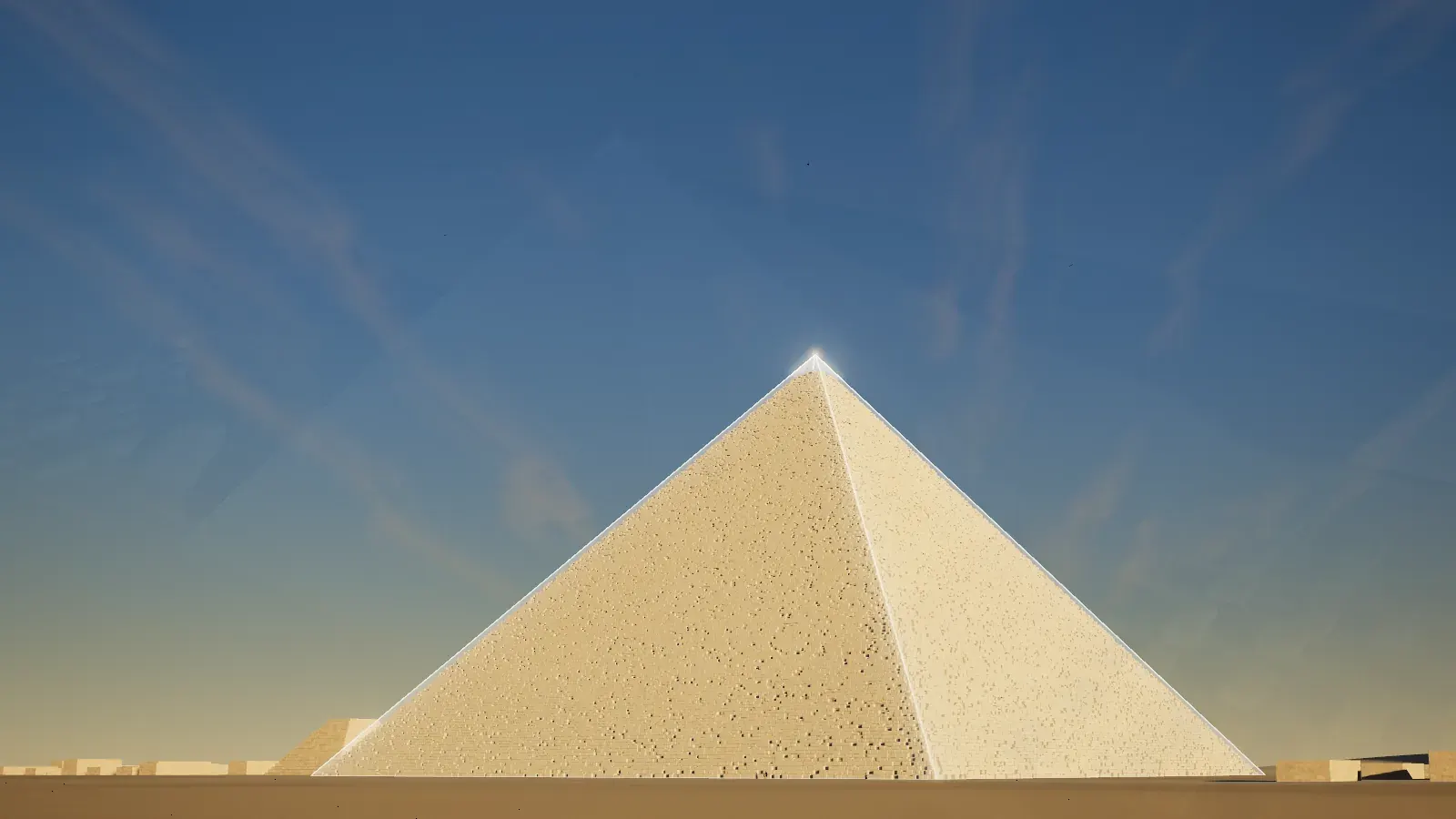
Topic 8.8 key terms
- cross section
- The flat face you get when you cut a solid with a plane. Cut a square pyramid level at any height and the cross section is a square.
- cross-sectional area A(x)
- The area of the cross section at position x (or height z, or y), in square units. For a solid with known cross sections, it comes from the shape's area formula applied to a length you can measure.
- slab
- A thin slice of the solid with face area A and thickness Δz (for the pyramid, sliced by height z); its volume is about A(z)·Δz. When the slices stack along x or y, the same product is A(x)·Δx or A(y)·Δy. Adding the slabs approximates the volume, and the limit is the integral.
- volume by cross sections
- V = ∫ A(x) dx from a to b: integrate the cross-sectional area along the direction you slice. Perpendicular to the x-axis: integrate in x; perpendicular to the y-axis: in y.
- perpendicular to the x-axis
- Each cross section stands in a plane x = constant, which meets the x-axis at a right angle. Its base is a vertical segment of the base region, length top − bottom, and the slabs have thickness dx.
- perpendicular to the y-axis
- Each cross section stands in a plane y = constant, at a right angle to the y-axis. Its base is a horizontal segment, length right − left written in terms of y; the limits are y-values and the thickness is dy.
- shape factor
- When every dimension of the face is tied to the segment s, the face's area is a fixed number times s²: square 1, rectangle with height s/2: 1/2, equilateral triangle √3/4, right isosceles triangle with s a leg 1/2 or the hypotenuse 1/4, semicircle on a diameter s: π/8.
- semicircle on a diameter
- If the segment s is the semicircle's diameter, its radius is s/2 and its area is (1/2)π(s/2)² = πs²/8. Using s as the radius gives an area four times too big.
Transcript
1,536 words · 4 parts
Triangles and semicircles
We already know the integral of s squared on this region is sixteen fifteenths, so let’s keep that work and only change the face. For every shape we’ll meet, geometry gives a number times s squared, so that same number multiplies the volume. For an equilateral triangle standing on the segment, all three sides are s, and I need its height, so I’ll split it down the middle.
That makes a right triangle with hypotenuse s and a base of s over two, so Pythagoras gives the missing height, root three over two times s. Its area is a half times s times that height, which is root three over four times s squared, so that solid’s volume is root three over four times sixteen fifteenths.
For an isosceles right triangle, check which side sits in the base. If the segment is one of the legs, the other leg is s too, so the area is half of s squared. Now flip it so the segment is the hypotenuse. What number goes in front of s squared for that triangle?
Semicircles are the easiest place to slip. The segment is the diameter, so the radius is half of it, s over two. Half a circle with that radius has area one half pi times s over two, squared, which is pi s squared over eight. If you use s as the radius you get pi s squared over two, which is four times too big.
Put all the faces side by side and you can see the pattern, one number for every shape, and that number out front is the only thing that changes from solid to solid. Let’s put semicircles on the same region, each one standing on its segment as the diameter. What’s the volume of that solid?
On the exam, this is the setup that earns the points. You say what the segment is and what job it does in the face, then you write the area, and then the integral between the right limits.
Let the water check it
I’d love to see a real solid check these numbers, so let’s borrow a ship-model testing tank, a long, quiet channel of perfectly still water, and use it as a measuring cup, with four solids built on exactly our region. Let’s take the solid with equilateral triangles, and watch it assemble the way we built it on paper, one triangle on every segment.
The crane hangs it nose down, so the water’s surface will slice it just the way we sliced on paper. The pool is full to the brim, so whatever goes under pushes the same volume of water over the edge into that measuring cylinder. Before we lower it, work out how many liters of water this solid will push into the cylinder.
The cylinder filled slowly, then fast, then slowly again. It fills fastest when the biggest triangle is crossing the surface, because the rate the volume grows is the area of the slice at the waterline. If V of d is the volume under water after lowering it d meters, then V prime of d equals A of d. That’s the fundamental theorem of calculus in a tank of water, and it’s the deepest reason volume is the integral of area.
Before you lower the semicircle solid, build one of its faces yourself. Put the midpoint on the segment and choose the half circle that fits. Your semicircle solid holds about four hundred nineteen liters, so lower it with the lever until exactly half of that is under water.
The exam could ask you about the triangle solid’s curve directly, at what depth is the volume under water increasing fastest? The volume’s rate is V prime, and V prime of d is the area of the face at the waterline, so we’re really asking where that area is biggest, and that means looking at A prime. Let’s find where the area stops increasing, so we differentiate it. The outside square contributes twice its inside, and the inside contributes two minus two d, so multiplying those factors gives this derivative.
Between zero and two the first factor is positive, so A prime has the sign of two minus two d, positive before one and negative after it. A grader wants exactly that in a sentence, that A prime is positive on zero to one and negative on one to two, so the rate rises and then falls, and the volume is increasing fastest when d is one meter.
Slicing the other way
Sometimes the problem slices the other way. Here’s the region under y equals root x from x equals zero to four, and this time the cross sections are squares perpendicular to the y-axis. Perpendicular to the y-axis means we freeze a value of y and cut straight across, so the segment runs sideways, from the curve on the left to the line x equals four.
Everything has to be in y now, so y equals root x becomes x equals y squared. The segment’s length is right minus left, four minus y squared, and y runs from zero at the bottom up to two at the top, because root four is two.
The volume is the integral from zero to two of four minus y squared, squared, d y. Expanding and integrating gives two hundred fifty-six fifteenths, about seventeen point one cubic units. The classic mistakes are the x limits, zero to four, with d y, or root x as the length. When you slice along y, the length and the limits have to be in y too, to match the d y.
Same region, but now the cross sections are semicircles perpendicular to the x-axis, each with its diameter straight across the region. What’s the volume of that solid?
You don’t even need a flat region. A funnel’s slices are circles, so each has area pi r squared, and the volume is still the integral of that area. If the exam hands you the area function itself, there’s nothing to square, so you just integrate it. Say the exam puts equilateral triangles on that region under y equals root x, perpendicular to the y-axis. The points go to setting it up like this, and if the question says write but do not evaluate, you stop right there at the integral.
Half the stone
Let’s go back to Egypt and keep the promise, the one level cut that splits the pyramid into two equal volumes. Drag the cut to wherever you think it splits the pyramid in half, then press cut and see how close you got. You can try as many times as you like.
On the board, the volume above a cut at height c is the integral of the slice areas from c up to the top, a hundred forty-six and a half meters, which I’ll call H. Similar triangles give the side, two hundred thirty times one minus z over H, which is two thirty at the sand and zero at the tip, just like the desk pyramid, and the area is that squared.
The top piece above a cut is a small copy of the whole pyramid, shrunk by one minus c over H in height, width and depth, so its volume is the whole volume times one minus c over H, cubed. Let’s measure down from the tip instead and call that distance w, so w equals H minus z, and the top piece runs from w equals zero down to H minus c.
Its slice area is a constant times w squared, so integrating gives that constant times w cubed over three, just like the desk pyramid, and that’s the whole volume times one minus c over H, cubed. That cube is why the top half held an eighth, because a half cubed is an eighth.
We want the top piece to hold half, so one minus c over H, cubed, equals a half. The cube root of a half is about zero point seven nine four, so c over H is about zero point two oh six, and the cut sits about a fifth of the way up, thirty point two meters above the sand.
There it is. Half of the Great Pyramid’s volume sits in its bottom thirty point two meters, and the other half fills the whole rest of it, more than a hundred meters, all the way up to the point.
Everything today came from one picture. Slice the solid, find the area of one slice wherever you are, and integrate those areas along the direction you sliced. On a flat region, we find the segment first and use the shape to turn that length into an area, and if the problem gives a separate height, we multiply the base by that height.
As you write the integral, check the slicing direction, because perpendicular to x means d x and perpendicular to y means d y. Now you can find the volume of shapes no geometry book has a formula for, and you know exactly where to cut a pyramid in half, about a fifth of the way up. Next time we’ll spin a flat region around an axis, and every slice will turn out to be a circle.