
Topic 8.7 key terms
- cross section
- The flat face you get when you cut a solid with a plane. Cut a square pyramid level at any height and the cross section is a square.
- cross-sectional area A(x)
- The area of the cross section at position x (or height z, or y), in square units. For a solid with known cross sections, it comes from the shape's area formula applied to a length you can measure.
- slab
- A thin slice of the solid with face area A and thickness Δz (for the pyramid, sliced by height z); its volume is about A(z)·Δz. When the slices stack along x or y, the same product is A(x)·Δx or A(y)·Δy. Adding the slabs approximates the volume, and the limit is the integral.
- volume by cross sections
- V = ∫ A(x) dx from a to b: integrate the cross-sectional area along the direction you slice. Perpendicular to the x-axis: integrate in x; perpendicular to the y-axis: in y.
- perpendicular to the x-axis
- Each cross section stands in a plane x = constant, which meets the x-axis at a right angle. Its base is a vertical segment of the base region, length top − bottom, and the slabs have thickness dx.
- perpendicular to the y-axis
- Each cross section stands in a plane y = constant, at a right angle to the y-axis. Its base is a horizontal segment, length right − left written in terms of y; the limits are y-values and the thickness is dy.
- shape factor
- When every dimension of the face is tied to the segment s, the face's area is a fixed number times s²: square 1, rectangle with height s/2: 1/2, equilateral triangle √3/4, right isosceles triangle with s a leg 1/2 or the hypotenuse 1/4, semicircle on a diameter s: π/8.
- semicircle on a diameter
- If the segment s is the semicircle's diameter, its radius is s/2 and its area is (1/2)π(s/2)² = πs²/8. Using s as the radius gives an area four times too big.
Transcript
1,312 words · 4 parts
Where would you cut it?
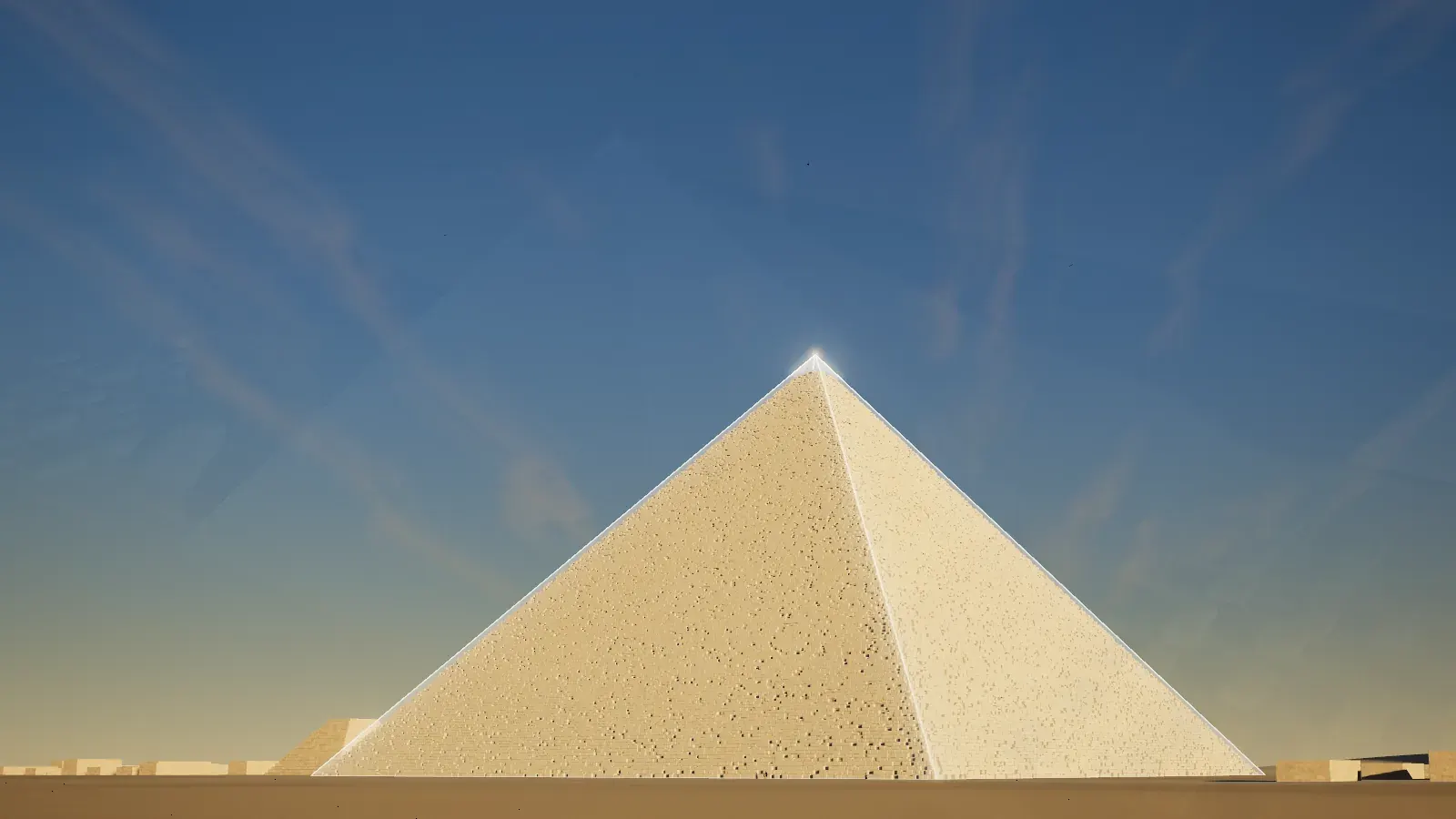
About four and a half thousand years ago, at the edge of the desert near what is now Cairo, Egyptian builders finished this, the Great Pyramid of Khufu. When it was new, it stood about a hundred and forty-six meters tall. Each side of its base runs about two hundred thirty meters, and that whole shape holds roughly two point six million cubic meters.
Let me ask you a question that sounds simple and really isn’t. If you had to cut this pyramid with one flat, level slice so that both pieces hold exactly the same amount of stone, where would you cut?
Before I show you anything, drag the cut to wherever you think it splits the stone in half, and lock it in. Most people’s first instinct is halfway up, so let’s try it, and look at the piece we just lifted off, because it’s a lot smaller than half. That top piece is half as tall, half as wide and half as deep as the whole pyramid, so it holds a half times a half times a half, just one eighth of the stone.
Seven-eighths of this pyramid sits below the halfway line. That means the cut that really splits it in two has to be a lot lower down, and finding exactly where takes more than a good guess.
By the end of this lesson, you’ll be able to find that cut to the nearest meter. Better than that, you’ll be able to find the volume of shapes that no geometry book has a formula for, just by slicing them up. To get there, let’s take the pyramid apart the same way its builders put it together, one layer at a time.
A stack of squares
Look closely and you can see how the builders stacked the stone in more than two hundred rows, each one a little smaller than the one below. Let’s exaggerate those layers with twelve thick slabs and pull them apart. Now imagine slicing the smooth pyramid straight across at any height you like. The flat face on the cut is a perfect square, and we call a face like that a cross section.
As the cut slides up, the square shrinks until it disappears at the top, so the area of the cross section depends on how high you cut. We’ll call that area A of z, where z is the height.
Now I’d like you to take the cut yourself. Drag it up until the square’s area is exactly one quarter of the area of the base.
Next let’s give one of those squares a little thickness. I’ll call the thickness delta z, and what we get is a slab, a flat square block whose volume is the area of its face times its thickness, A of z times delta z. Stack up one slab for every layer and add up their volumes, and you get close to the pyramid’s volume.
The stack has steps where the real pyramid is smooth, but if you make the slabs thinner the steps shrink, and with two hundred of them you can hardly see them at all. When the slabs get thinner and thinner, that sum of A times delta z turns into an integral.
The volume is the integral of A of z, d z, from zero at the bottom of the pyramid to a hundred forty-six and a half at the top. That one line is the whole method, so whatever the solid is, you find the area of a slice wherever you cut and then you integrate.
A pyramid on your desk
Let’s run that method on a pyramid small enough to sit on your desk, with a square base six centimeters on a side and a height of three centimeters. The first job is finding the side of the square at any height z. From the side, this triangle has a half-base of three centimeters and a height of three centimeters. That means climbing one centimeter moves each edge one centimeter inward, and since both edges move, together they take two centimeters off the square’s side.
That makes the side six minus two z, and it checks out at both ends, six at the bottom and zero at the top, where the pyramid comes to a point. The cross section is a square, so its area is that side squared, six minus two z, all squared, in square centimeters. One centimeter up, for example, the side is four and the area is sixteen square centimeters.
Now we add up the slabs from the bottom, z equals zero, to the top, z equals three. The d z is the thickness of each slab, so square centimeters times centimeters gives cubic centimeters, which is exactly what a volume should be. To integrate, I’ll expand the square first, which gives thirty-six minus twenty-four z plus four z squared, and then every term is easy. The antiderivative is thirty-six z minus twelve z squared plus four-thirds z cubed.
At z equals three that’s a hundred eight minus a hundred eight plus thirty-six, and at zero it’s all zero, so the volume is thirty-six cubic centimeters. The geometry formula, a third of the base area times the height, gives a third of thirty-six times three, which is thirty-six, so it matches. That third comes from integrating a square, the same way z squared integrates to z cubed over three.
About thirty-eight hundred years ago, an Egyptian scribe worked out a problem that survives on a papyrus now in a museum in Moscow. It’s a pyramid with its top cut off, four on each side at the bottom, two at the top, and six tall. Use the same method we just used. Find the side of the square at height z, then work out the volume of this truncated pyramid.
Any base, any shape
A pyramid has square slices because of its shape, but the AP exam loves a different way to build a solid. It starts with a flat region on the floor, like this one between the line y equals two x on top and the curve y equals x squared underneath, from x equals zero to two, measured in meters, and we’ll call it R.
Pick any x and draw the segment straight across the region, from the curve at the bottom to the line at the top. Its length is top minus bottom, two x minus x squared, and we’ll call that length s. Now we stand a square on that segment, straight up out of the floor. Problems call these squares perpendicular to the x-axis, because each square stands in a plane that meets the x-axis at a right angle.
The side of each square is the segment, so its area is two x minus x squared, all squared. Keep those parentheses, because at x equals one the square’s area is one, while two squared minus one squared is three.
Add up all those squares from zero to two, and the volume is the integral of two x minus x squared, squared, d x. It’s tempting to raise the power to three and divide by three, but differentiate that and the chain rule hands you an extra factor of two minus two x, so expand the square first. Expanding gives four x squared minus four x cubed plus x to the fourth. Integrating from zero to two gives thirty-two thirds minus sixteen plus thirty-two fifths, which is sixteen fifteenths of a cubic meter, a little more than one.
A rectangle’s height isn’t tied to its base, so the problem has to tell you. If the height is half the base, the area is s times s over two, and the volume is half of ours, eight fifteenths.
Now suppose the problem says each rectangle’s height is x instead. What’s the area of one of those faces? Draw the face, label both edges, and multiply them.