
Topic 8.12 key terms
- washer
- A disc with a hole: the shape of a cross section of a solid of revolution when the region does not reach the axis. Its area is πR² − πr².
- outer radius R
- The distance from the axis of rotation to the edge of the region farthest from it.
- inner radius r
- The distance from the axis of rotation to the edge of the region nearest to it: the radius of the hole.
- washer method
- V = π∫ₐᵇ [R(x)² − r(x)²] dx for a horizontal axis (slices of thickness dx), or the same with y and dy for a vertical axis.
- axis of rotation
- The line a region is spun around; every radius is measured from it, so moving it changes both radii and the volume.
Transcript
1,744 words · 5 parts
Move the axis
Let’s keep the exact same leaf, but spin it around a different line, the horizontal line y equals two, which sits above the region. Before we spin it, make a prediction. How do you think this solid’s volume will compare with the two pi over fifteen we just got?
We kept the leaf exactly the same and made four times the volume just by moving the axis. Let’s measure one washer to see where that extra volume comes from. The axis is up at y equals two now. Grab the orange tape and stretch it from the axis to the edge of the leaf that’s farthest away.
That gives us an inner radius of two minus x and an outer radius of two minus x squared. The volume is pi times the integral from zero to one of two minus x squared, all squared, minus two minus x, all squared. Keep each radius inside its own parentheses, because we square the whole distance from the axis.
Multiply it out and the inside becomes x to the fourth minus five x squared plus four x. Integrating from zero to one gives a fifth minus five thirds plus two. That’s eight fifteenths, so the volume is eight pi over fifteen, just as the solid said. When the exam asks you to set this up, the integral is the whole answer, and you don’t need to multiply anything out.
It also helps to say what each slice is, in one sentence. Each cross section perpendicular to the x-axis is a washer, with outer radius two minus x squared and inner radius two minus x.
Now I want you to do one from start to finish. Spin the same leaf around the line y equals negative one, just below the region, and find the volume to three decimal places, with the calculator if you like.
Stand it up
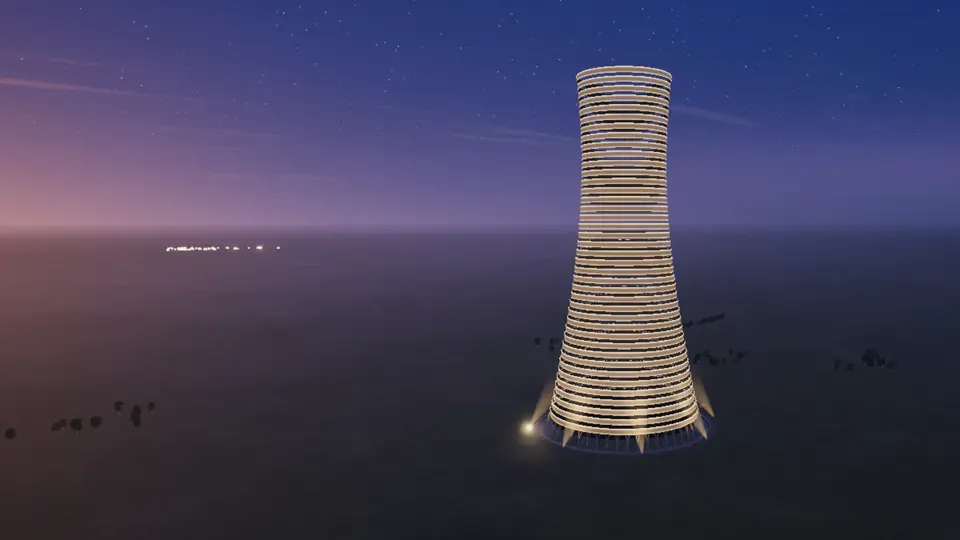
Think back to the tower. Its axis stands straight up, so its rings lie flat, stacked on top of each other like coins. That’s the case we need next, so let’s stand our leaf’s axis up too.
Spin the leaf around the y-axis, and its washers stop standing on their edges and lie flat, just like the tower’s rings. These flat washers stack upward, so each thin strip has height dy. We’ll write both radii and both limits in terms of y, to match the way we’re slicing.
At height y, the strip starts on the line, where x equals y, and ends on the parabola, where x squared equals y, so x is the square root of y. Which end is farther from the y-axis? Between zero and one, the square root of y is bigger than y, the way the square root of a quarter is a half.
That means the parabola gives the outer radius this time, and the line gives the inner one. The volume is pi times the integral from zero to one of y minus y squared, dy, which is pi over six.
The mistake to watch for is mixing the two, writing the radii in x and then integrating dy. If the slice is dy thick, every radius and both limits have to be in y as well.
Let’s move the vertical axis to x equals negative one, just left of the leaf. Which integral measures the solid we get when we spin around that line?
Let’s try the axis on the other side too, at x equals two, to the right of the leaf. From there the line is the farther edge, so R is two minus y, and r is two minus the square root of y. Work it out and you get pi over two again, matching the volume around x equals negative one.
Two thousand trucks
Now we’re ready for the tower. Its wall turns around the vertical line through the tower’s center, so its washers lie flat, and we add them upward from the bottom of the wall to the top. Slice it at any height y. The outside of the wall is capital R of y from the axis, the inside is little r of y, and each ring is dy tall.
We measure y upward from the wall’s bottom edge, in meters, and these equations describe our model tower. The outer wall is R of y, this square root, which is the hyperbola you saw from the side.
The inner wall sits a quarter of a meter inside it, so little r is R minus a quarter. At a hundred and fifty meters up, the squared part is zero, so that’s where the tower is narrowest, forty meters from the axis, and down at the bottom it’s about seventy-two.
The volume of concrete is pi times the integral from zero to two hundred of R squared minus r squared, dy. Each ring’s area is in square meters and dy is in meters, so the answer comes out in cubic meters. That’s the whole setup, and the integral is far too messy to do by hand, which is exactly what the calculator is for.
Use the calculator to find how many cubic meters of concrete are in the wall, to the nearest cubic meter. A concrete mixer truck carries about eight cubic meters, so that’s nearly two thousand truckloads, just for the wall.
Let’s see what the shortcut does here. R minus r is a quarter of a meter all the way up, so pi times R minus r, squared, integrated up the whole tower, gives only about thirty-nine cubic meters.
That’s five truckloads for a two-hundred-meter tower, and that’s how you know it can’t be right. The ring’s area factors into pi times R minus r times R plus r, and the shortcut throws away that R plus r, which is almost eighty meters even where the tower is narrowest.
At the start I asked how many truckloads of concrete went into that wall. You just worked it out yourself, from two equations for the two walls and one integral that adds up every ring. Now think like the crew. They pour from the bottom up, so at what height is exactly half of the concrete in?
Before we pour, make a guess. Drag the ring to the height where you think half of the concrete is in, and when you let go, we’ll pour up to your mark.
That’s exactly the kind of question the exam likes to ask. First it wants an equation for h, and that’s the same integral with h on top, set equal to half of the whole wall.
Then it asks whether h is below a hundred meters, and we can prove it without computing a single integral. Below a hundred meters the tower is wider than it is at a hundred, because it keeps narrowing all the way up to its waist at a hundred and fifty. Above a hundred it’s never wider than that, because it only widens back to the same width at the top.
The wall is a quarter of a meter thick everywhere, so a wider ring holds more concrete. That means the bottom hundred meters holds more than the top hundred, so the halfway height has to be below a hundred.
The ring that doesn’t care
Let’s finish with my favorite washer problem of all, back on the lathe. Here’s a wooden ball five centimeters in radius, and we drill a hole straight through its middle so the ring that’s left is exactly six centimeters long. Now take a ball twice as big and drill it with a much wider hole, so that its ring is six centimeters long too. Both rings are exactly six centimeters long. Which one has more wood in it?
Put the small ball’s center at the origin with the drill along the x-axis. The ring runs from x equals negative three to three, and from the side it’s the region between the ball and the edge of the hole. The hole’s edge meets the ball at the end of the ring, where x is three. That makes a right triangle with the ball’s radius, five, as its long side and three along the axis, so the hole’s radius squared is five squared minus three squared, sixteen.
Slice the ring at any x. The outer radius reaches the ball’s surface, the square root of twenty-five minus x squared, and the inner radius is the hole, four. That makes the washer’s area pi times twenty-five minus x squared, minus sixteen, which is pi times nine minus x squared. Integrate from negative three to three. Nine x minus x cubed over three is eighteen at three and negative eighteen at negative three, so the ring holds thirty-six pi, about a hundred thirteen cubic centimeters.
Let’s do the same calculation for the ball with radius ten. Its outer radius is the square root of a hundred minus x squared. Its hole meets the ball at x equals three too, so the hole’s radius squared is a hundred minus nine, ninety-one. The area is pi times a hundred minus x squared, minus ninety-one, which is pi times nine minus x squared again.
It works for a ball of any size, because the ball’s radius squared comes in with the outer radius and goes right back out with the hole. As long as the ring is six centimeters long, every matching slice has the same area. Try to break it yourself. Make the ball as big as you like and keep an eye on the volume of the ring.
Rings all the way up
Let’s put it all together. A washer is a disc with a hole, and its area is the whole disc minus the hole, pi R squared minus pi r squared, never pi times R minus r, squared.
Every radius is a distance from the axis you spin around, so when the axis moves the radii change, and sometimes the lower curve turns out to be the outer one. Always slice straight across the axis. A horizontal axis gives slices of thickness dx, and an axis that stands up gives flat rings of thickness dy, with everything written in y.
Add up the washers with an integral, and you can measure anything built out of rings, from a wooden napkin ring to fifteen and a half thousand cubic meters of concrete standing in a valley. Next time you pass one of these towers, you’ll know it’s a stack of washers, and you’ll know how to add them up.