
Topic 8.6 key terms
- area between curves
- The area of the region between y = f(x) and y = g(x) from x = a to x = b, where f(x) ≥ g(x): the integral from a to b of [f(x) − g(x)] dx. Each thin vertical slice is top minus bottom, times dx.
- top minus bottom
- The height of a vertical slice between two curves: the higher curve's y-value minus the lower curve's. It is positive wherever the slice is, even below the x-axis.
- points of intersection
- Where the two curves meet, found by solving f(x) = g(x). They give the limits of integration and the places where the curves can trade places.
- right minus left
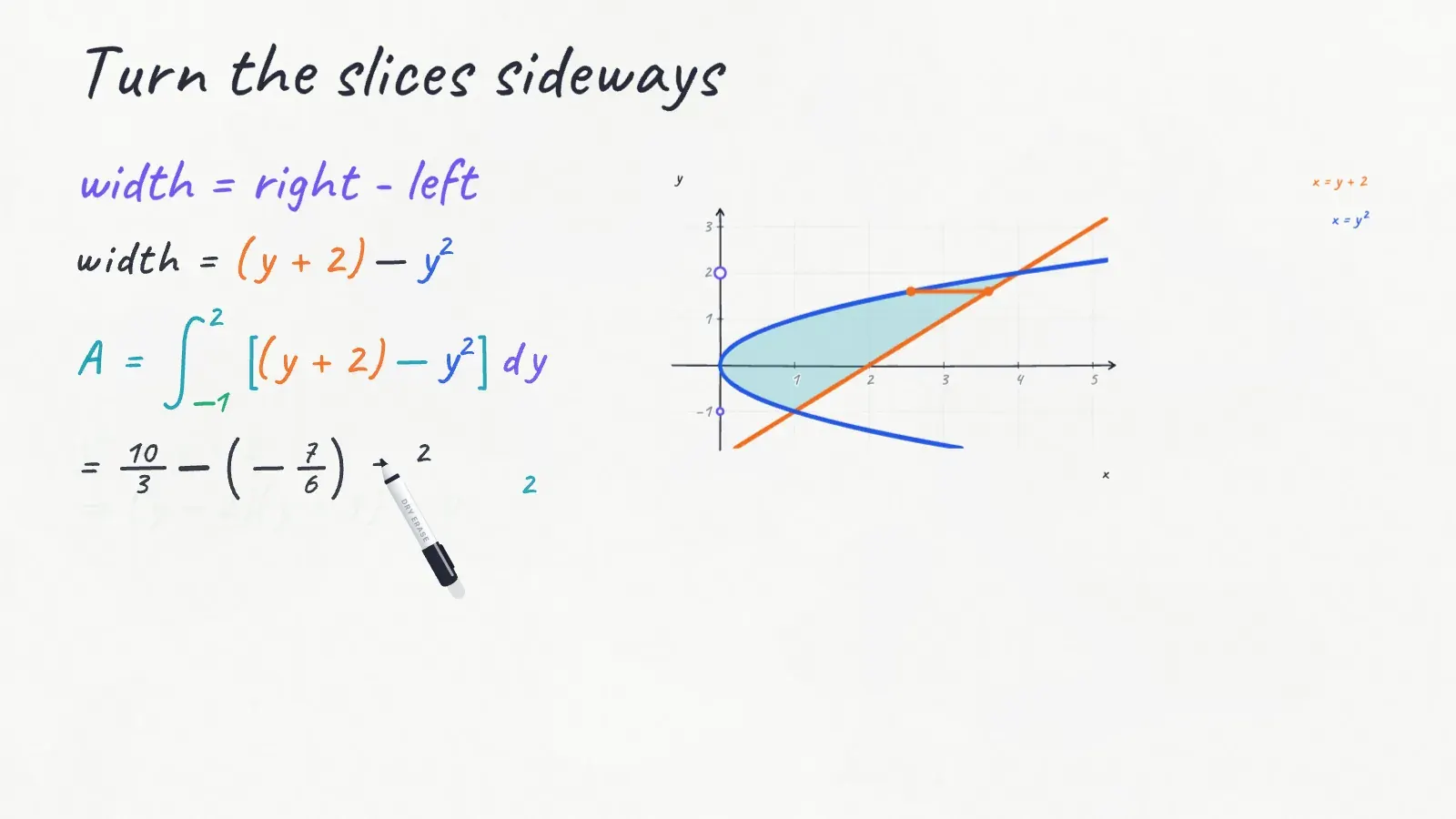
- The width of a horizontal slice between x = R(y) on the right and x = L(y) on the left. The area is the integral from c to d of [R(y) − L(y)] dy, with c and d heights.
- functions of y
- Boundaries written as x = R(y) and x = L(y). Integrating with respect to y is the better choice when vertical slices would change their top or bottom boundary partway across.
- curves that cross
- When the curves intersect more than twice, split the interval at each crossing so each piece is top minus bottom, and add the pieces; or integrate |f(x) − g(x)|. The integral of f − g alone lets pieces cancel.
- lift per meter of wing
- In our small-angle model, the lift on each meter of wingspan is very nearly the integral of (p_under − p_over) dx along the chord, in pascals times meters, newtons per meter. When the pressure curves cross (as at zero lift), the signed integral and the geometric area between the curves differ.
Transcript
630 words · 2 parts
When the curves trade places
Now let’s try the cubic y equals x cubed and the line y equals x. Setting them equal gives x cubed minus x equals zero, which factors into x, times x minus one, times x plus one. They cross three times, at negative one, zero, and one. That makes two lobes, with a different curve on top in each.
Suppose you just type the integral from negative one to one of x cubed minus x into a calculator. What number do you think comes back?
On the right lobe, x cubed is below x, so x cubed minus x is negative there, and that lobe counts as negative one fourth. It cancels the left lobe, and the calculator says zero.
The fix is to keep measuring top minus bottom on every slice. From negative one to zero the cubic is on top, and from zero to one the line is. We split at zero and add two positive pieces.
The right piece is x squared over two minus x to the fourth over four, from zero to one, which is a quarter, and the left piece is a quarter too, so the area is one half. You can also put the absolute value inside the integral, so every slice counts as positive, which is the quickest way on a calculator. Outside is too late, because the lobes have already canceled.
On an AP free-response question, you’d write it out like this. The curves meet at negative one, zero and one. The cubic is above the line from negative one to zero, and the line is above the cubic from zero to one, so the area is the sum of those two integrals.
The wing does this too. Watch the two curves near the front as the pilot pushes the nose down. Go ahead and tilt the nose down until this wing makes no lift at all, and keep an eye on the two curves near the front.
Near the nose the air now pushes the wing down, farther back it still pushes it up, and the two pieces cancel. The wing only cares about that signed total, so this plane can’t hold itself up. But if we count both lobes as positive, their areas add to about two hundred fifty newtons per meter, so neither region disappeared. The lift adds the pieces with their signs, the area counts them both as positive, and an AP area question means the second one.
On the calculator part of the exam, the curves are usually messier, like x cubed minus two x squared and the sine of two x, which also cross three times. Use the calculator to find the crossings and store them with all their digits. The first one is at about negative point six, and it makes a tiny lobe that’s very easy to miss.
Find the total area enclosed between these two curves, correct to three decimal places. That’s the whole toolkit, so let’s take it back to the plane you learned to hold up.
Fly it
Everything we did today came from one idea, which is to slice the region, measure each slice from one curve to the other, and add the slices up. With vertical slices, that’s top minus bottom, dx, between the x-values where the curves meet. With horizontal slices, it’s right minus left, dy, between heights, and you choose the direction whose slices change boundaries the fewest times.
When the curves trade places, split at every crossing so each piece counts as positive, or put the absolute value inside the integral. You started this lesson watching air hold up eleven hundred and fifty-seven kilograms of airplane. Now you can read the pressures along its wing, add up the slices, and find the tilt that holds it up.