
Topic 8.9 key terms
- solid of revolution
- The solid swept out when a flat region spins a full turn around a line, the axis of rotation. A baseball bat, a cone and the inside of a martini glass are all solids of revolution.
- axis of rotation
- The line a region spins around. It can be the x-axis, the y-axis, or any horizontal or vertical line such as y = 4 or x = 2.
- disc
- A thin slice of a solid of revolution cut straight across the axis. Its face is a filled circle, and a short cylinder of radius r and thickness Δx, with volume π r² Δx, approximates the slice.
- disc method
- (or ): add up discs of radius r and thickness dx along the axis; the limit of the Riemann sum of disc volumes.
- radius of a disc
- The distance from the axis of rotation to the edge of the region at that slice, always bigger minus smaller: f(x) for a region above the x-axis, 4 − x² around y = 4, 2 − √y around x = 2.
- dx or dy
- Discs are perpendicular to the axis, so their thickness runs along it: dx for a horizontal axis, dy for a vertical axis, with the radius written in that same variable.
Transcript
1,841 words · 5 parts
Nine home runs
On March twenty-ninth, 2025, the New York Yankees hit nine home runs in a single game, a team record. Several of the hitters who did it were swinging a bat with a strange new shape.
A physicist who worked for the Yankees had moved the fattest part of the bat down toward the hitter’s hands, right where each player tends to hit the ball. Then he thinned out the end, so it looks a little like a bowling pin. It’s legal, too. The rule says a bat has to be one piece of solid wood, a smooth, round stick, no more than forty-two inches long and two point six one inches thick.
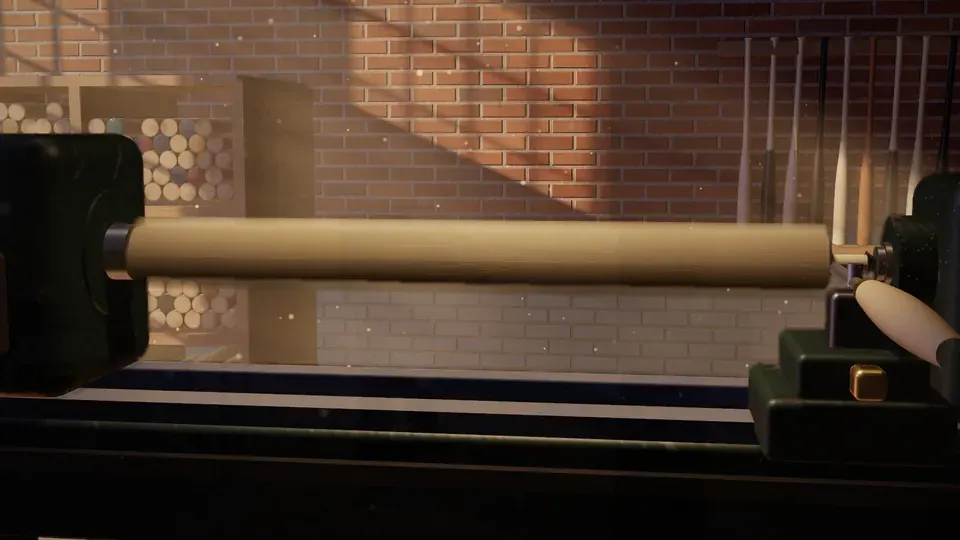
Round is the word I care about, because it means we can make the whole bat by spinning one flat shape around a line. Those size limits still leave plenty of room to move the wood along the bat. By the end of this lesson, you’ll be able to shape your own bat on this lathe, a classic or a torpedo. You’ll know exactly what it weighs before a single chip comes off.
A bat’s a complicated shape, though, so let’s start with the simplest thing a lathe can make, a cone. On the way, we’ll find out where the one third in its volume formula has been hiding all this time.
Spin a flat shape
I’ve drawn a right triangle on this clear plate, under the line y equals x from zero to three inches. Its bottom edge sits right on the lathe’s axis. When the lathe spins this plate one full turn, the triangle sweeps through every angle around the axis and leaves a solid behind it. Before I do that, though, I’d like you to do it yourself. Grab the triangle and drag it all the way around the axis, and watch what it leaves behind.
Let’s approximate the cone with three thick discs, like three fat coins. For each disc, we’ll use the radius halfway along its slice. Let’s pull the middle one out. Its radius runs from the axis straight out to the slanted edge, and its thickness is the width of the slice, which we’ll call delta x. A disc is really just a short cylinder, so its volume is the area of its circle, pi r squared, times its thickness, delta x, and that’s the only geometry we need today.
Three fat discs give us about twenty-seven and a half cubic inches, which is close but lumpy. Let’s cut thinner and thinner discs and watch the total settle down on one number, about twenty-eight point two seven. The discs are closing in on the cone’s exact volume, and the integral is what gets it exactly, so let’s write the whole idea down.
The disc at position x has a radius of r of x, so it holds pi times r of x, squared, times delta x, which is about the volume of that slice of the solid. Adding up all the discs gives an estimate of the whole volume. It’s a Riemann sum, just like the rectangles you’ve added up for area, except every piece is a disc.
When we let the number of discs grow without bound, that sum becomes a definite integral, so the volume is the integral from a to b of pi times r of x, squared, dx. Everything in that formula comes from one picture, so look back at our disc and measure from the axis out to its edge, because that distance is the radius we square in the integral.
Where the one third hides
Let’s do our cone properly. The region sits under y equals x from zero to three, and we’re spinning it around the x-axis. At any x, the radius goes from the axis up to the line, so the radius is just x. That makes the volume pi times the integral from zero to three of x squared, dx. The antiderivative of x squared is x cubed over three, so we get pi times twenty-seven over three, which is nine pi.
Nine pi is about twenty-eight point two seven cubic inches, which is exactly the number our discs were settling on. Let’s check it against geometry. A cylinder with radius three and length three holds twenty-seven pi, a cone is supposed to hold a third of its cylinder, and nine pi is a third of twenty-seven pi on the nose. Now we can finally see where that one third comes from. Look back at our nine pi, which came from twenty-seven over three, and that three came from integrating x squared.
Take any cone, with radius R at its wide end and length h. Its radius grows from zero to R, so r of x is R over h times x, and squaring gives R squared over h squared, times x squared. Integrating x squared gives x cubed over three, and there’s our third. At the upper limit, h cubed divided by h squared leaves one h, so we get one third pi R squared h.
These two flat regions have exactly the same area, two square units each. If we spin both of them around the x-axis, which solid do you think holds more? That squaring is the secret of the torpedo bat, too, because a little extra radius where the bat is already thick adds a lot of wood.
Half a cylinder
Let’s try one together that isn’t a cone. Take the region under y equals the square root of x, from zero to four, and spin it around the x-axis. The radius is the height of the curve, the square root of x. What do you think happens when we square it?
The square root disappears, so we’re just integrating x, which is about as friendly as an integral gets. That’s pi times x squared over two, from zero to four, which is pi times sixteen over two, so eight pi.
Look at that. The cylinder around this solid has radius two and length four, so it holds sixteen pi, and our solid is exactly half of it. Archimedes worked that out more than two thousand years ago, without any calculus at all. This time we integrated x, and x squared over two gave us the half.
Now you try one on your own. Find the volume when the region under y equals x squared, from zero to two, spins around the x-axis, and give your answer to three decimal places.
Stand it up
Now let’s stand the axis up on its end, and I know just the place for it, because some of you have been in this hot shop before. If you took precalc with us, you watched this martini glass fill from a steady tap. The water reached halfway up in just one second out of eight, because the bottom half of the glass holds only an eighth of the water.
We can make the space inside this glass by spinning its flat profile around the stem. Its discs lie flat, like coins stacked on a table, and each one is a thin slice of height delta y.
This card shows the flat shape that spins into the inside of the glass, and this time the height runs up the side. The wall starts at the stem and reaches five centimeters out at the rim, eight centimeters up, so at height y the radius is five y over eight. Everything has turned on its side now, because the discs stack up along the y-axis, so their thickness is dy and the radius has to be a function of y.
The glass is eight centimeters deep inside, so its volume is pi times the integral from zero to eight of five y over eight, squared, dy. Squaring gives twenty-five sixty-fourths times y squared, and the integral of y squared from zero to eight is five hundred twelve over three. Five twelve over sixty-four is eight, so that’s two hundred pi over three, about two hundred nine cubic centimeters, and since a cubic centimeter is a milliliter, the glass holds about two hundred nine milliliters.
In precalc we got that eighth from a little martini glass hiding inside the big one, and now the integral tells the whole story. If the water’s only h centimeters deep, we stop the integral at h instead of eight. The volume comes out to twenty-five pi over one ninety-two, times h cubed, so it grows like h cubed. Halfway up means half the height, and one half cubed is one eighth, which is exactly why the first second of pouring got the water halfway up.
That makes me wonder where the glass is exactly half full. Drag the ring to where you think that line is, and then we’ll pour in exactly half of what the glass holds, about one hundred and five milliliters, and see where the water stops.
Let’s try one more, and this time you’ve got the cube law on your side. Drag the ring to where the glass is a quarter full, and then we’ll pour in exactly a quarter of the water.
Now let’s say we only had the radius every two centimeters up the glass, and we built each disc from the radius at its top edge. Every one of them pokes out through the glass, because the glass keeps getting wider, so the top of each slice is its widest part.
Suppose we build every disc from the radius at its bottom edge instead. How do you think that sum compares with the real volume of the glass?
On the exam this usually comes as a table of radii, so let’s write the top-edge sum out. Each disc is pi r squared times two, because each slice is two centimeters thick. The four of them add up to ninety-three and three quarters pi, about two ninety-four and a half milliliters, way more than the glass holds.
When a question asks you to justify an overestimate, the grader wants the reason in one complete sentence. Top-edge discs make a right Riemann sum, because the top is the right end of each step in y. The right Riemann sum overestimates the volume because r of y is increasing from zero to eight, so pi r squared is increasing too, and every disc uses the biggest radius on its slice.
The glass handed us x in terms of y, but most curves come as y in terms of x, so let’s flip one. Let’s draw y equals x squared, the line y equals four and the y-axis, and shade the region they enclose, and this time we’ll spin it around the y-axis. The discs will be horizontal, so we’ll want the curve as x in terms of y, and in the first quadrant, y equals x squared means x equals the square root of y.
Before we compute anything, which of these integrals do you think gives the volume? Discs around the y-axis, with the radius as a function of y and dy at the end, came up on the 2026 AP exam.