
The four questions
The four questions are always the same four types, in the same order, and each has parts A, B and C. You get two 35-minute parts: questions 1 and 2 with a graphing calculator, then questions 3 and 4 without one.
| Question | Units | Calculator | What it asks you to do |
|---|---|---|---|
| 1. Function Concepts | 1–2 | Required | Work with one function given as a graph or table and another given by a formula: composition, inverses, solving on the calculator, limits, choosing a function type |
| 2. Modeling a Non-Periodic Context | 1–2 | Required | Build a model from real data, work with its average rate of change, and explain where the model stops making sense |
| 3. Modeling a Periodic Context | 3 | Not allowed | Turn a story about something that repeats into five points on a sinusoid, then into , , and , then describe the function on an interval |
| 4. Symbolic Manipulations | 2–3 | Not allowed | Solve exponential, logarithmic and trigonometric equations by hand and rewrite expressions in a required form, with exact answers |
Every free-response point counts the same. One point is of 37.5%, about 1.6% of the exam score, and one multiple-choice question is worth about 1.5%. So a small point here, like the sentence that finishes an explanation or the third decimal place on an answer, counts as much as a multiple-choice question.
The questions appear on screen in the Bluebook app, but you write your answers by hand in a paper booklet, and only the booklet is scored. Within a part you can move between its two questions until time runs out. On the 2026 exam the on-screen clock turned red at five minutes, and the proctor gave no time warnings, so keep an eye on it yourself.
Thirty-five minutes for two questions is 17½ minutes each. Students had 15 through 2026, so the 2027 exam gives you a little more time to write explanations.
Where students lose points
Each fall the College Board publishes a Chief Reader report: the faculty member who leads the scoring describes how students did on each question and gives the average score on every point. The reports for 2024 and 2025, the exam’s first two years, show the same pattern both times, and you can plan your studying around it.
| Point | What it was for | 2024 | 2025 |
|---|---|---|---|
| Question 1 | Function Concepts, mean out of 6 | 2.95 | 3.51 |
| 1 A(i) | Value of a composition, read from a graph or table | 0.63 | 0.64 |
| 1 A(ii) | Inputs for a given output, or an inverse value | 0.61 | 0.72 |
| 1 B(i) | Solve on the calculator: every solution, to three decimals | 0.51 | 0.56 |
| 1 B(ii) | End behavior in limit notation | 0.48 | 0.56 |
| 1 C(i) | The answer: has an inverse or not, or which function type | 0.59 | 0.73 |
| 1 C(ii) | The reason, citing specific values | 0.15 | 0.30 |
| Question 2 | Modeling a Non-Periodic Context, mean out of 6 | 2.03 | 2.16 |
| 2 A(i) | Equations from the data | 0.58 | 0.53 |
| 2 A(ii) | Values of the constants | 0.36 | 0.48 |
| 2 B(i) | Average rate of change, computation shown | 0.58 | 0.63 |
| 2 B(ii) | An estimate from that rate | 0.39 | 0.41 |
| 2 B(iii) | Why those estimates are all too low | 0.04 | 0.06 |
| 2 C | Where and why the model stops working | 0.08 | 0.05 |
| Question 3 | Modeling a Periodic Context, mean out of 6 | 2.96 | 3.13 |
| 3 A, first point | Heights of the five labeled points | 0.71 | 0.77 |
| 3 A, second point | Times of the five labeled points | 0.39 | 0.34 |
| 3 B, first point | and (amplitude and midline) | 0.60 | 0.67 |
| 3 B, second point | and (period and phase shift) | 0.20 | 0.18 |
| 3 C(i) | Positive or negative, increasing or decreasing | 0.68 | 0.67 |
| 3 C(ii) | How the rate of change is changing | 0.38 | 0.51 |
| Question 4 | Symbolic Manipulations, mean out of 6 | 1.28 | 1.93 |
| 4 A(i) | Solve an exponential or logarithmic equation | 0.37 | 0.53 |
| 4 A(ii) | Solve an inverse-trig or trig equation | 0.33 | 0.43 |
| 4 B(i) | Rewrite as a single logarithm | 0.16 | 0.45 |
| 4 B(ii) | Rewrite a trig expression in one function | 0.24 | 0.28 |
| 4 C, first point | One solution (2024) or the quadratic form (2025) | 0.15 | 0.14 |
| 4 C, second point | Every solution | 0.04 | 0.10 |
Most students earn the points for reading and computing. Reading a value off a graph, writing equations from data, computing an average rate of change, finding the heights on a sinusoid: more than half of students earned each of these, both years.
The points for explaining are rarely earned. Question 2’s two explanation points went to between 4% and 8% of students, and the reason in question 1 to 15% in 2024 and 30% in 2025. The 2024 report noted that many explanations stated a correct general rule without evidence from the function itself, and the 2025 report stressed that specific values were required. The section on writing reasons shows what the guidelines accept.
Question 4 is the hardest question on the exam. It had the lowest mean both years, and its last point went to 4% and then 10% of students. In question 3, the point for and , the constants that come from the period and the starting position, went to 20% of students in 2024 and 18% in 2025.
Added up, the average student earned 9.2 of the 24 points in 2024 and 10.7 in 2025.
Rules that apply to every question
These rules come from the general notes in the scoring guidelines and from the question 4 directions. Students lose points to them every year even when the math is right.
Give decimals to three places
In questions 1 and 2, a decimal answer has to be correct to three places after the decimal point. Rounding and truncating are both accepted, so 5.4828 can be written 5.483 or 5.482, and trailing zeros can go: 2.25 is fine for 2.250.
A correct answer with too few digits is a “decimal presentation error.” The first one in a question costs that point; later decimal-presentation errors in the same question do not automatically lose another point if the response is otherwise complete and correct. An inaccurate calculation from early rounding is a different error. The 2026 guidelines, and the 2025 guidelines for question 2, also count an exact answer where a decimal was asked for, such as for 7.961, as a decimal presentation error.
Show the work when the question asks for it
When a part says “show the work that leads to your answer” or “show the computations,” the answer alone doesn’t earn the point. In 2025, question 1 asked for , and students who wrote only 0.333 lost the point: the readers needed to see or on the way. The question 4 directions ask for work in every part, and most of its points require it. In parts without that instruction, a correct answer stands on its own.
A wrong answer next to a right one cancels it
List a correct answer beside an incorrect one and you usually lose the point. The guidelines say it in several places: a list of answers earns the point only with “no incorrect values” in it, and an extra limit statement “must be correct.” In 2025 some students answered with both “0” and “no solution.” Commit to one answer.
Say what is changing
Readers are strict about the subject of a sentence. In 2024, “increasing at a decreasing rate” with no subject was read as describing the rate of change of , which was actually decreasing, so it didn’t earn the point. With the subject, “ is increasing at a decreasing rate,” or simply “the rate of change of is decreasing,” it did. The 2025 and 2026 released versions also asked for concavity, and their points needed both. Also, don’t describe how the rate of change itself is changing. “The rate of change is decreasing at an increasing rate” loses the point even when it’s true, because the guidelines say that conclusion takes calculus.
Which calculator, and when
| Part | Questions | Calculator |
|---|---|---|
| Section I, Part A | 29 multiple choice, 65 minutes | Not permitted |
| Section I, Part B | 13 multiple choice, 40 minutes | Graphing calculator required |
| Section II, Part A | Free response 1 and 2, 35 minutes | Graphing calculator required |
| Section II, Part B | Free response 3 and 4, 35 minutes | Not permitted |
In the calculator parts you can use the Desmos graphing calculator built into Bluebook or a handheld from the College Board’s approved list, which includes the TI-84 and TI-Nspire families. The website and app versions of Desmos are fine all year but not on exam day. Put a handheld in radian mode.
Calculator work still has to be written down, because the reader sees your booklet, not your screen. Write the equation you solved and the solution, or the regression you ran and the values it gave. And 62.5% of the exam score comes from parts with no calculator at all, so practice the algebra by hand even when a calculator could do it.
Question 1: Function Concepts
Question 1 gives you two functions in two forms: one as a graph or a table, the other as a formula. The formula was exponential in 2024, a cubic in 2025 and a logarithm in 2026. The parts move from reading values, to calculator work, to a reason in words.
| Part | What earns the point | What doesn’t |
|---|---|---|
| A(i) composition | The decimal value of , with the inner value shown when the part asks for work | The final number with no sign of ; too few decimal places |
| A(ii) inputs and outputs | Every input that gives the output, or the inverse value read from the graph or table | One input when there are three; a right answer plus “no solution” |
| B(i) solve on the calculator | Every solution, each to three decimals | A solution missed because it was outside the graphing window |
| B(ii) limit | A complete limit statement: “lim,” where is heading, the function, and the value | The right idea in words only; notation with a piece missing, such as the in |
| C(i) the answer | “ does not have an inverse function,” “exponential”: one clear answer | “ is not an inverse,” which says something else |
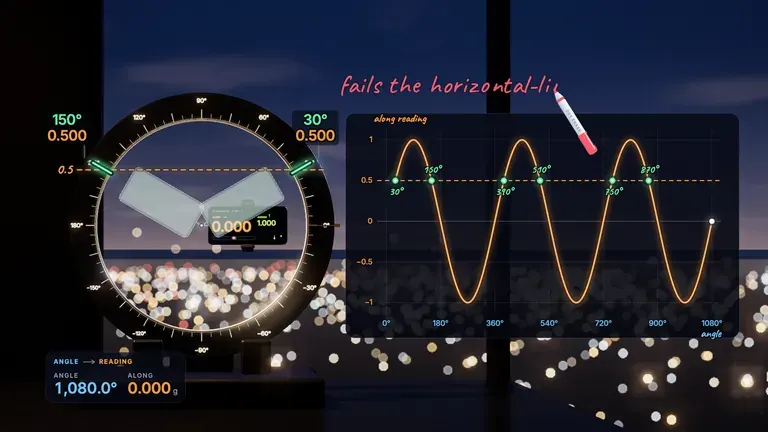
| C(ii) the reason | The property, tied to specific values from this graph or table | “Not one-to-one,” “fails the horizontal line test,” or a regression, with no values |
Part C(ii) is the point students miss most on this question. In 2024 the question asked whether has an inverse, and most students knew it doesn’t. What many of them wrote was a general rule, such as “ isn’t one-to-one,” and the guidelines say a rule isn’t enough. The reason has to point at this graph: , so the output 1 comes from three different inputs, and an inverse would have to send 1 back to three places at once, which no function can do. Only 15% of students wrote something like that.
Worked example
We wrote this question to match the real question 1 in layout and difficulty, with our own six-point practice rubric based on the published task model. Try it on paper before you read the response.
| 0 | 1 | 2 | 3 | 4 | |
|---|---|---|---|---|---|
| 9 | 5.5 | 3 | 1.5 | 1 |
The function is defined and decreasing on its domain, , and the table gives values of at selected values of . The function is given by . A (i) The function is defined by . Find the value of as a decimal approximation, or indicate that it is not defined. Show the work that leads to your answer. (ii) Find the value of , or indicate that it is not defined. B (i) Find all values of , as decimal approximations, for which , or indicate that there are no such values. (ii) Determine the behavior of as increases and gets arbitrarily close to 2. Express your answer using the mathematical notation of a limit. C (i) Based on the table, which function type best models : linear, quadratic, exponential, or logarithmic? (ii) Give a reason for your answer based on how the output values of change over equal-length input intervals. Refer to values in the table.
A (i) , so
A (ii) , so .
B (i) Graphing and and finding where they intersect: and .
B (ii)
C (i) Quadratic.
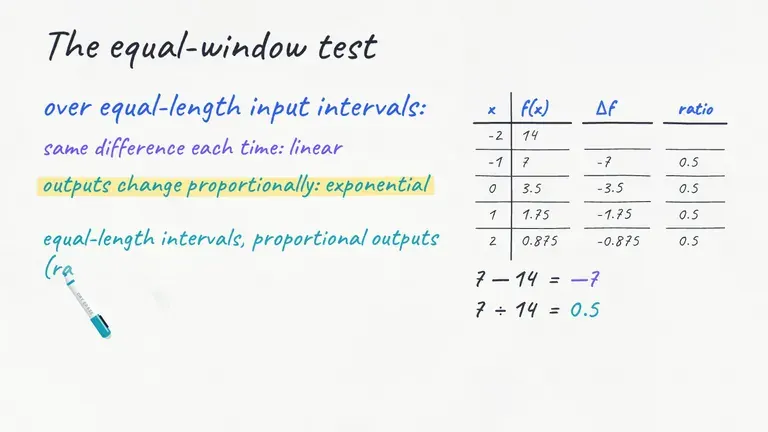
C (ii) The inputs go up by 1 each time. The outputs change by , , and , so the average rates of change over these equal intervals go up by the same amount, 1, each step. These constant second differences make a quadratic the best of the listed models for these data. The outputs aren’t proportional either ( but ), so it isn’t exponential.
How it scores
| A(i): value of | 1/1 | The right decimal, and is on the page, which is the work a reader looks for. Truncating to −3.142 would also earn it. |
|---|---|---|
| A(ii): value of | 1/1 | Read from the table: an inverse swaps inputs and outputs, so look for 3 among the outputs. No work required. |
| B(i): solutions of | 1/1 | Both solutions, each to three decimals. is symmetric about the -axis, so stopping at 3.606 would have lost the point. |
| B(ii): limit | 1/1 | , from the left, because increases toward 2. Just below 2 the numerator is close to 9 and the denominator is a tiny negative number, so falls without bound. |
| C(i): function type | 1/1 | One answer, with no alternatives listed beside it. |
| C(ii): reason | 1/1 | It names the property and shows it with the table’s values for more than one pair. The 2025 guidelines required exactly that for the exponential version of this part, and they ruled out reasons based on a regression. |
Why it works
- In A(i), if had been 2, then , which is undefined because the denominator is 0. That’s why the question offers “indicate that it is not defined.” When you see that phrase, check the domain of the outer function before you compute.
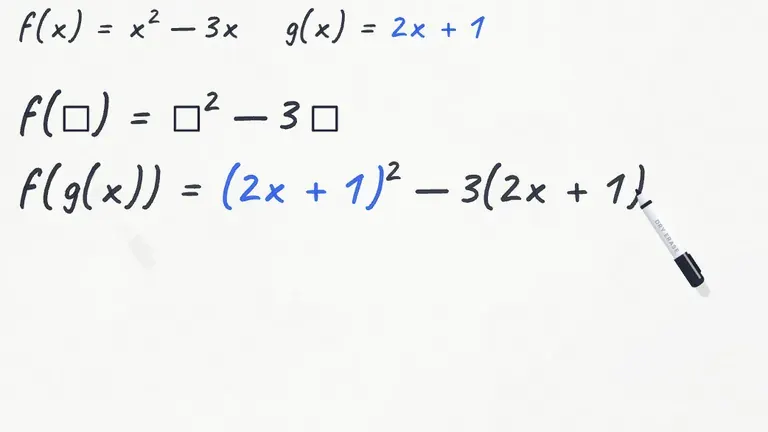
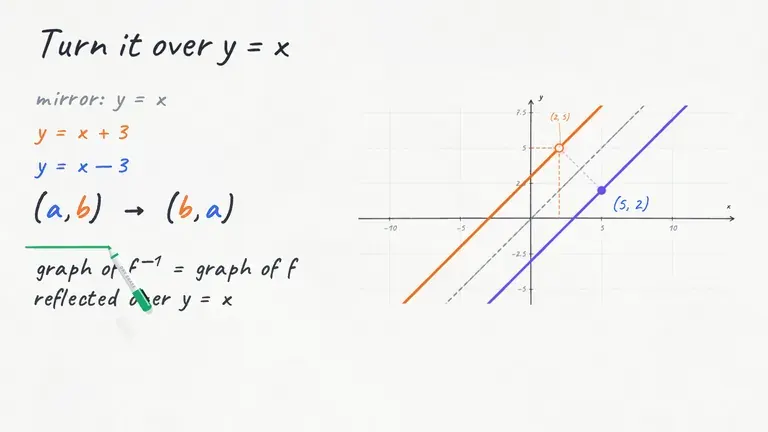
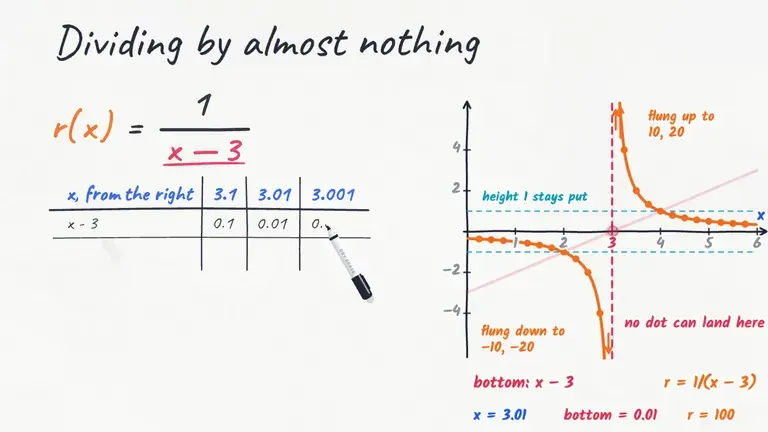
Lessons on the ideas question 1 keeps testing: composition, inverses, end behavior and asymptotes, and how outputs change for each function type.
 Topic 2.722 minComposition of Functions
 Topic 2.819 minInverse Functions
 Topic 1.619 minPolynomial Functions and End Behavior
 Topic 1.723 minRational Functions and End Behavior
 Topic 1.922 minRational Functions and Vertical Asymptotes
 Topic 1.325 minRates of Change in Linear and Quadratic Functions
 Topic 2.221 minChange in Linear and Exponential Functions
Question 2: Modeling a Non-Periodic Context
Question 2 is a story with numbers: daily sales of a video game in 2024, plays of a song in 2025, a car losing value in 2026. You’re given a model with two or three unknown constants, and you build it from the data, use it, and say where it stops working. It’s the second-lowest-scoring question, and the explanation points in its last two parts are almost never earned. For 2027 the College Board changed its layout; the 2024–2026 version comes first because the released questions use it, and the new layout follows.
The parts, 2024 to 2026
| Part | Task | What earns the point |
|---|---|---|
| A(i) | Equations for the constants | Substitute each measured input and output into the given model |
| A(ii) | Values of the constants | The values to three decimals. Work is optional, so the calculator or a regression is fine |
| B(i) | Average rate of change | The difference quotient with the data substituted, then its decimal; follow the particular question’s instructions about units |
| B(ii) | An estimate from that rate | A point on the secant line: start at an endpoint and add rate × elapsed time |
| B(iii) | Why the estimates are too low (or too high) | The concavity of the model on the interval between the data points; in 2024 and 2025 the secant line there too |
| C | A limitation of the model | The model’s behavior set against what the real quantity can do |
The 2025 Chief Reader named a mistake in B(ii) worth knowing: students used a line with the right slope through the wrong point. The song data had three points, and they started from the middle one, , which isn’t on the secant line between and . The estimate has to start from one of the two endpoints of the interval you used for the rate.
The secant-line explanation in B(iii)
Part B(iii) asked the same thing all three years: explain why every estimate made with the average rate of change is below (or above) the model between the two data points. It’s gone from the 2027 sample, but the idea is still part of the course.
The average rate of change between two points is the slope of the secant line through them, so every estimate from B(ii) is a point on that line. Whether the line sits below or above the graph depends only on concavity. A concave-down graph bulges above any secant line between two of its points, so every estimate on the secant line is below the graph. A concave-up graph sags below its secant lines, so the estimates are too high. That was 2026’s twist: the car’s value was concave up, and the estimates were too high.
The 2024 report’s diagnosis was that students mixed up the function with its rate of change. Keep them apart: “ is increasing” is about the function, “concave down” is about its rate of change, and only the concavity decides which side of the graph the secant line is on.
Part C: where the model stops making sense
Part C asks about the model’s limits in the story. The point goes to answers that put two facts side by side: what the model does, and what the real quantity can or can’t do.
- 2024, video game sales. Daily sales fell after day 91, but the model keeps increasing. The two matched on day 91, so the gap between them grows every day after. Earned by 8% of students.
- 2025, song plays. A total number of plays can never go down. The quadratic model peaks at and decreases after that, so it only works up to . Earned by 5%.
- 2026, a car’s value. The owner will donate the car when its value reaches 2 thousand dollars, and at that moment it loses all its value. Solving gives , so the model applies on .
Each of these answers puts two facts together: what the model does, and what the real quantity can or can’t do. The 2025 report noted that few responses did both: decreases after , while the total number of plays never decreases.
What changes in 2027
The College Board restructured question 2 for May 2027. In its updated sample question, part B(iii) is gone. Part B is the average rate of change and what it means in context. Part C is worth two points: write and solve an equation for when the model reaches a threshold, then explain the domain restriction that the answer gives. The secant-line reasoning is still part of the course, so keep it; the example below is in the new layout.
Worked example in the 2027 layout
Our own question and six-point practice rubric, built around the College Board’s updated sample tasks. Use a graphing calculator.
A park ranger tracks a patch of algae spreading across a pond. At weeks after the first measurement, the algae covers 3.1 square meters. At weeks it covers 9.6 square meters. The area covered can be modeled by , where is in square meters and is in weeks since the first measurement. The surface of the pond is 150 square meters. A (i) Use the given data to write two equations that can be used to find the values of the constants and . (ii) Find the values of and as decimal approximations. B (i) Use the given data to find the average rate of change of the area covered, in square meters per week, from to . Express your answer as a decimal approximation. Show the computations that lead to your answer. (ii) Interpret the meaning of your answer from B(i) in the context of the problem. C The model is appropriate until the algae covers the whole pond. (i) Write and solve an equation whose solution gives the time when the model predicts the algae covers the whole pond. Express your answer as a decimal approximation. (ii) Explain how your answer to C(i) can be used to determine an appropriate domain restriction for . Refer to the context of the problem.
A (i) and , so and .
A (ii) Dividing the second equation by the first, , so (stored as 1.457594…) and (stored as 1.459112…).
B (i) square meters per week
B (ii) From week 2 to week 5, the area covered by the algae grew by an average of 2.167 square meters per week.
C (i) with the stored values of and . The graphs of and intersect at weeks.
C (ii) The model predicts the algae covers the whole 150-square-meter pond at weeks. After that the model keeps growing, but the algae can’t cover more than the pond, so the model only makes sense for .
How it scores
| A(i): two equations | 1/1 | Both data points go into the model. |
|---|---|---|
| A(ii): values of and | 1/1 | Both to three decimals. An exponential regression on the two points gives the same values and needs no other work. |
| B(i): average rate of change | 1/1 | The quotient shows the given values, and the answer has three decimals. Leaving it as would be a decimal presentation error. |
| B(ii): interpretation | 1/1 | It says what changed (the area covered), over which interval, at what average rate, with units. The College Board’s sample answer has the same pieces. |
| C(i): equation and value | 1/1 | The equation comes before the answer, and the answer uses unrounded constants. This is the rounding trap from the rules above: rounded constants give 12.287. |
| C(ii): domain | 1/1 | It says why the model stops (the algae can’t cover more than the whole pond) and states the domain that follows, . |
Why it works
- In B(ii), “the algae grows 2.167 square meters every week” would be wrong: an exponential model doesn’t grow by the same amount each week. “On average” over a named interval is what makes the sentence true.
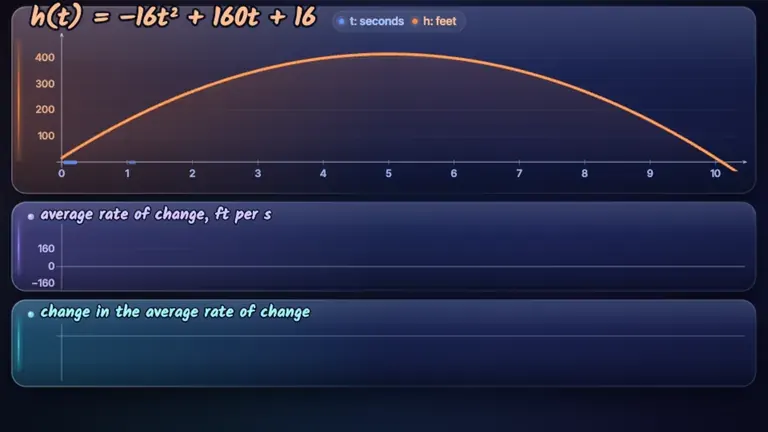
Lessons on building a model from data, average rates of change, and the assumptions behind a model.
- Topic 1.325 minRates of Change in Linear and Quadratic Functions
 Topic 1.1319 minFunction Model Selection and Assumption Articulation
 Topic 1.1423 minFunction Model Construction and Application
 Topic 2.523 minExponential Function Context and Data Modeling
 Topic 2.618 minCompeting Function Model Validation
 Topic 2.1420 minLogarithmic Function Context and Data Modeling
Question 3: Modeling a Periodic Context
Question 3 describes something that goes around or back and forth: a point on a rolling tire in 2024, a vibrating guitar string in 2025, a waterwheel in 2026. There’s no calculator. You turn the story into a sinusoid in three steps, and the first two steps carry 4 of the 6 points.
The graph has been the same picture on all three exams so far. It shows two full cycles and a dashed midline, with no axes and no scale, and five labeled points in the same places. F is a maximum, G is on the midline going down, J is a minimum, K is on the midline going up, and P is the next maximum. Each point is a quarter of a period after the one before it.
Step 1: the five points (part A)
- Read the story for the highest value, the lowest value and the period. The midline is halfway between the highest and lowest values.
- The heights go maximum, midline, minimum, midline, maximum. For the 2025 guitar string that’s 2, 0, −2, 0, 2 millimeters. This is the first point, and about three students in four earned it.
- Find one time when the point is at its maximum. That’s F. Add a quarter period for each point after it. In 2025 the string starts at its highest position at and vibrates 200 times a second, so the period is second and the five times are , , , and .
The times are where students lose points: 39% earned it in 2024 and 34% in 2025. The 2025 report reminds teachers that the period is the reciprocal of the frequency. “200 times in 1 second” is a frequency; one cycle takes of a second.
Step 2: , , and (part B)
Every year so far the form has been .
- is the midline, and is the amplitude, half the distance from the maximum to the minimum. Take positive.
- . A period of 2 seconds gives ; a period of second gives .
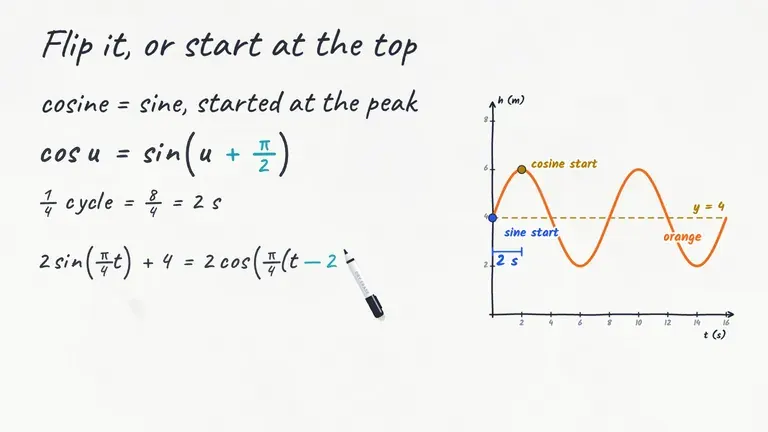
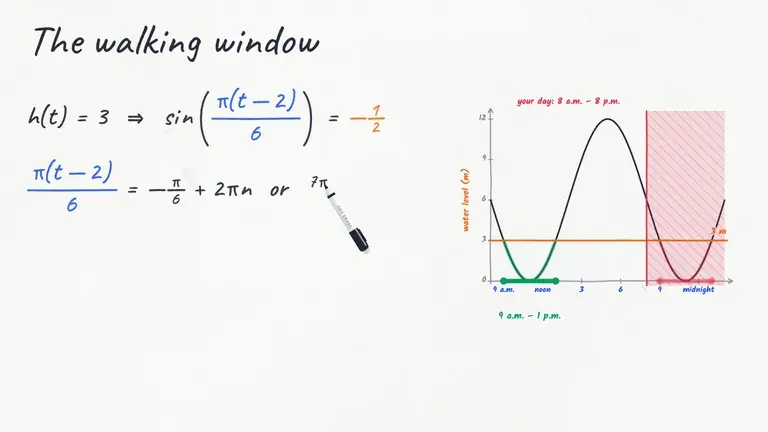
- comes from the first maximum. With , the sine curve peaks when , which happens when is a quarter of a period. So if F is at time , then .
Check it on the 2024 tire. The period is 2 seconds, so , and the first peak on the graph is at . Then and . At that gives , the top of the tire.
A negative is allowed too, with a different . And if your part A times are shifted but still a quarter period apart, the guidelines let you earn the part B points with constants that match your own points. Consistency is rewarded, so finish part B even if you doubt part A.
Step 3: behavior and concavity (part C)
Part C picks two neighboring labeled points and asks about the function between them. C(i) is multiple choice: positive or negative, increasing or decreasing. Positive and negative mean above or below zero, not above or below the midline. On the 2024 tire the height was positive except at the instants W touched the ground.
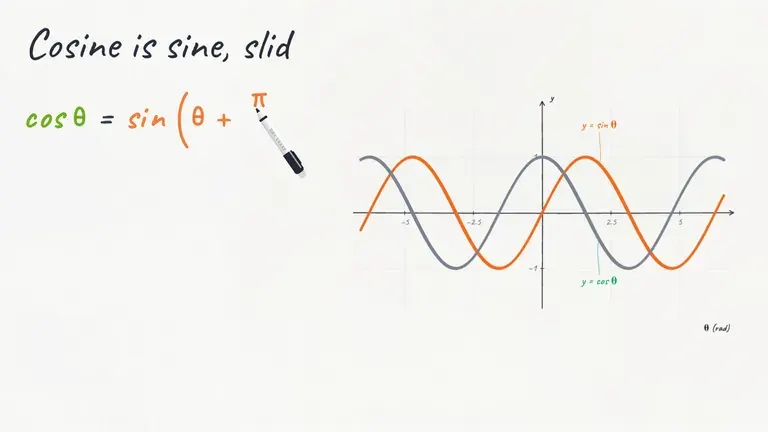
C(ii) asks how the rate of change is changing, and sinusoids have a shortcut. Above the midline the graph is concave down; below it, the graph is concave up. Concave down means the rate of change is decreasing, and concave up means it’s increasing. In 2026 the interval ran from J, the minimum, to K, the midline going up. That stretch is below the midline, so the answer was “concave up, so the rate of change of is increasing,” even though itself was negative there.
Worked example
Our own question and six-point practice rubric, in the same layout and without a calculator. Its part A graph is the standard one described above: two cycles with a dashed midline, F at a maximum, G on the midline going down, J at a minimum, K on the midline going up and P at the next maximum.
Point is on the tip of one blade of a wind turbine. The blade is 40 meters long, and the center of the hub is 80 meters above the ground. The blades turn at a constant rate of 15 full turns per minute. At time seconds, is at its lowest point. The sinusoidal function gives the height of above the ground, in meters, as a function of in seconds. A The graph of and its dashed midline for two full cycles, the standard pattern described above, has five labeled points F, G, J, K and P. Determine possible coordinates for the five points. B The function can be written in the form . Find values of the constants , , and . C The -coordinate of G is , and the -coordinate of J is . (i) On the interval , is positive or negative, and is it increasing or decreasing? (ii) On , describe the concavity of the graph of and determine whether the rate of change of is increasing or decreasing.
A Fifteen turns per minute is one turn every 4 seconds. The highest point is meters, the lowest is , and the midline is 80. is lowest at , so it’s highest half a turn later, at . F , G , J , K , P .
B , , . The first peak is at , so . That gives . Check: .
C (i) is positive and decreasing.
C (ii) The graph of is concave up on , so the rate of change of is increasing.
How it scores
| A: heights | 1/1 | 120, 80, 40, 80, 120: maximum, midline, minimum, midline, maximum. |
|---|---|---|
| A: times | 1/1 | A quarter period (1 second) apart, starting from a maximum at a time that fits the story. , , , , would also be right. |
| B: and | 1/1 | Amplitude 40, the blade length; midline 80, the height of the hub. |
| B: and | 1/1 | from the 4-second period, from the first peak, and the check at confirms both. with would also be right. |
| C(i): behavior | 1/1 | The height is between 80 and 40 meters here, so it’s positive, and it’s falling from the midline to the lowest point. |
| C(ii): concavity and rate of change | 1/1 | Concave up and an increasing rate of change, both stated, with as the subject. Between G and J the graph is below its midline, so it’s concave up. is still decreasing, but more and more slowly, which means its rate of change is increasing toward 0. |
Why it works
- The trap in part C is answering “decreasing” twice. On this interval the function is decreasing and its rate of change is increasing. The 2024 report singles out exactly this confusion between how a function changes and how its rate of change changes.
Lessons on concavity and rates of change, and on building sinusoidal models from a story.
Question 4: Symbolic Manipulations
Question 4 is algebra with exponentials, logarithms and trig functions, with no calculator and no real-world context. It has the lowest average of the four questions, 1.28 out of 6 in 2024 and 1.93 in 2025. The 2024 Chief Reader wrote that students across the exam showed more success with concepts than with algebraic manipulation, and pointed to this question’s scores as the evidence.
The layout hasn’t changed: part A solves two equations, part B rewrites two expressions in a required form, and part C is one harder equation, worth two points.
In 2025, instead of 9, and instead of , didn’t earn the points, because neither was evaluated. Rationalizing denominators isn’t required, though: is fine.
The moves that keep coming back
| Move | Example | The trap |
|---|---|---|
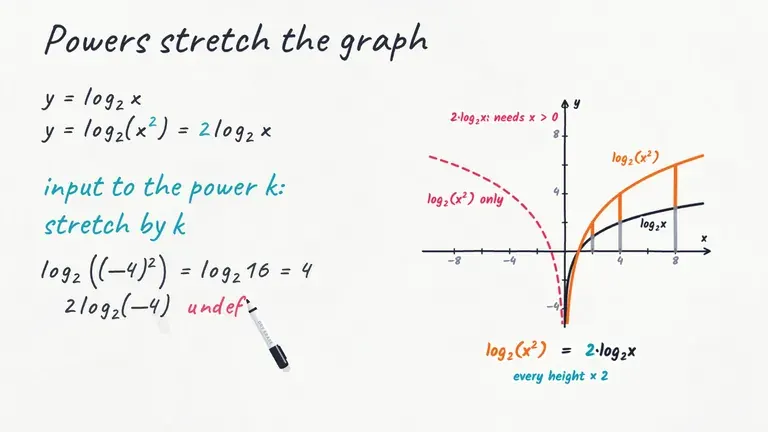
| Undo an exponential with a log | 2024: , so and | Stopping at |
| Undo a log with an exponential | 2026: , so and | Leaving unevaluated |
| Undo an inverse trig function | 2024: , so and | Not knowing the inverse trig functions well, a gap the 2024 report names |
| Combine logs into one | 2024: | Stopping at , or writing with a negative exponent |
| Use a Pythagorean identity | 2025: | Knowing but not the forms that come from it |
| Use a double-angle identity | 2026: | Reaching and not canceling |
| Spot a quadratic | 2025: | Not seeing that ; keeping , which has no solution |
| Find every solution | 2024: gives | Writing , which misses half the solutions |
Part C needs every solution
Part C’s last point went to 4% of students in 2024 and 10% in 2025. The reports and the 2026 guidelines point to these habits.
- Undo the outside function first. In 2024, means ; the report named this step as a gap.
- Look for a quadratic. In 2025, is a quadratic in , which few responses recognized.
- Solve for the inside angle first. For , solve for : . Only then divide by 2, and divide the as well.
- Look for every value of the trig function. means or . In 2026 one of the three answers came from the .
- Check the domain and the interval. has no solution. When the question gives an interval, such as in 2026, the guidelines want the actual values in it, not only a general formula.
Worked example
Our own question and six-point practice rubric. Give exact real answers, finish the requested forms, and show your work without a calculator.
A The functions and are given by and . (i) Solve for values of in the domain of . (ii) Solve for values of in the domain of . B The functions and are given by and . (i) Rewrite as a single natural logarithm without negative exponents in any part of the expression. (ii) Rewrite as an expression in which appears exactly once and no other trigonometric functions are involved. C The function is given by . Find all input values in the domain of that yield an output value of 0.
A (i) , so and .
A (ii) , so and .
B (i) , for
B (ii) , so , on the original domain and
C , so or . Then , or , where is any integer.
How it scores
| A(i): solution | 1/1 | Both sides written as powers of 5, then the exponents set equal. is correct too, but it would have to be evaluated to 2. |
|---|---|---|
| A(ii): solution | 1/1 | Cosine undoes arccosine, and is evaluated exactly. A solution exists because is inside arccosine’s range, . |
| B(i): single logarithm | 1/1 | One natural log, no negative exponents. is equal for but isn’t the form asked for. |
| B(ii): one cosine | 1/1 | Uses the double-angle identity , which is tested because it comes from the sum identity. |
| C: first point | 1/1 | Seeing a quadratic in and factoring it, the same move as 2025’s quadratic in . |
| C: every solution | 1/1 | All three families of solutions. has two solutions in each cycle, one in the third quadrant and one in the fourth, and dropping either loses this point. |
Why it works
- Before you write the last line of part C, count. has one solution per cycle and has two, so the answer needs three families.
Lessons on the algebra question 4 tests. For the identities and exact values you need from memory, see the AP Precalculus formula sheet.
Writing reasons that earn the point
The points for explaining in words are among the least earned on the exam: question 1 C(ii) (15% and 30% in 2024 and 2025), question 2’s last parts (4% to 8%) and question 3 C(ii) (38% and 51%). The scoring guidelines reward the same pattern each time, so it can be learned.
- Name the property in the course’s words: concave down, increasing on its whole domain, proportional over equal-length input intervals, the secant line.
- Point at this function. Give the specific values or the interval: , or “on ,” or .
- Finish the thought. End with the claim you were asked to support, joined by “so” or “because.”
| Question | Doesn’t earn it | Earns it |
|---|---|---|
| 2024 Q1 C(ii): does have an inverse? | “ is not one-to-one.” “ fails the horizontal line test.” | “, so the output 1 comes from three inputs, and has no inverse function.” |
| 2025 Q1 C(ii): why exponential? | “An exponential regression fits best.” | “The inputs go up by 1 and each output is half the one before: .” |
| 2026 Q1 C(ii): is invertible? | “ passes the horizontal line test.” | “ is increasing on its domain, so no two points on its graph have the same -coordinate.” |
| 2025 Q2 B(iii): why are the estimates too low? | “ is increasing, so the line is below it.” | “ is on the secant line through and , and the graph of is concave down on , so that line is below the graph.” |
| 2025 Q2 C: where does the model stop? | “The model can’t go on forever.” | “The total number of plays can never decrease, but reaches its maximum at and decreases after that, so the domain of ends at .” |
| 2024 Q3 C(ii): how is the rate of change changing? | “Increasing at a decreasing rate,” with no subject | “The graph of is concave down on , so the rate of change of is decreasing.” |
The reports add two pieces of advice. Name things instead of writing “it”: the 2024 report suggests teachers show students vague responses, full of “it,” next to precise ones. And reuse the course’s vocabulary (input and output values, rate of change, average rate of change, concave up and down, secant line) because the guidelines are written in it.
What the instruction words ask for
| Word in the question | What it asks for |
|---|---|
| Determine, find, identify | An answer by any correct method; show work when the part asks for it |
| Solve | All the solutions of an equation |
| Rewrite | An equivalent expression in the form the question names |
| Estimate | An approximate value from a model or a rate, with the work that produced it |
| Explain, give a reason, justify | Reasons drawn from the function or the story that support your answer |
| Interpret | What a number means in the story, with units |
| Describe | The behavior in words, with the function named as the subject |
| Express, indicate | The result in the form asked for, such as limit notation, a decimal or units |
What changes in May 2027
The course content is the same. The College Board changed the multiple-choice counts, timing and question 2, and made a minor wording change to sample question 1 C(i) without changing its scoring.
- Each free-response part is 35 minutes instead of 30, so you have about 17½ minutes a question instead of 15.
- Question 2 is restructured. In the updated sample, the secant-line explanation, B(iii), is gone, B(ii) asks what the average rate of change means in context, and part C is worth two points. The details are in the question 2 section.
- Multiple choice changed too. Part A is 29 questions in 65 minutes (it was 28 in 80), and Part B is 13 questions in 40 minutes (it was 12).
The released questions from 2024 to 2026 are still the closest practice to the real exam for questions 1, 3 and 4, and for most of question 2. For question 2’s new parts, use the College Board’s updated sample in the Course and Exam Description and the practice question above. For the rest of the exam, see the 2027 exam format.
Practice with the released questions
All twelve released questions are free on AP Central with their scoring guidelines, and our solutions go through every point. Do them on paper with a 35-minute timer for each pair, then score yourself with the official guidelines, strictly. The guidelines show which wording earns a point; be strictest with yourself on the explanation points.
| Year | Question 1 | Question 2 | Question 3 | Question 4 |
|---|---|---|---|---|
| 2026 solutions | Increasing from a graph; logarithmic | A car’s value, exponential model | A waterwheel | , , , |
| 2025 solutions | Halving from a table; cubic | Song plays, quadratic model | A vibrating guitar string | , , a quadratic in |
| 2024 solutions | from a graph; exponential | Video game sales, logarithmic model | A rolling tire | , arcsine, logs, |
Try the 2026 questions first, mark them with the official guidelines, and record each question’s score below. The 2025 and 2024 solution pages have the same score tracker for their questions.
Record your 2026 free-response scores
Turn your points into an estimated AP score with the score calculator. For the formulas, identities and exact values to know by heart, use the formula sheet and the AP Precalculus cheat sheets.
Sources
- AP Precalculus Course and Exam Description, fall 2026: exam format, free-response task models, task verbs, sample questions and scoring (PDF)
- AP Precalculus Clarifications and Corrections, fall 2026: changes for the May 2027 exam (PDF)
- AP Precalculus Exam: format, timing and weights (AP Central)
- Graphing Calculators for AP Precalculus (AP Central)
- 2026 AP Precalculus Free-Response Questions (PDF)
- 2026 AP Precalculus Scoring Guidelines (PDF)
- 2025 AP Precalculus Free-Response Questions (PDF)
- 2025 AP Precalculus Scoring Guidelines (PDF)
- 2025 AP Precalculus Chief Reader Report (PDF)
- 2025 AP Precalculus Scoring Statistics (PDF)
- 2024 AP Precalculus Free-Response Questions (PDF)
- 2024 AP Precalculus Scoring Guidelines (PDF)
- 2024 AP Precalculus Chief Reader Report (PDF)
- 2024 AP Precalculus Scoring Statistics (PDF)
- AP Precalculus past exam questions, 2024–2026 (AP Central)