
There is no formula sheet
The College Board provides reference information for some AP exams: Biology, Chemistry, Computer Science A and Principles, Environmental Science, the four Physics exams and Statistics. AP Precalculus isn't one of them. The same College Board page says that only reference information it provides can be used during an exam, so you can't bring your own sheet either.
That matters because most of this exam is taken without a calculator. The course description says so outright: “Most of the AP Exam will need to be completed without the use of technology.” The timing shows how much.
| Part | Questions | Time | Calculator | Share of your score |
|---|---|---|---|---|
| Multiple choice, Part A | 29 | 65 min | None | 43.75% |
| Multiple choice, Part B | 13 | 40 min | Graphing calculator required | 18.75% |
| Free response, Part A (questions 1 and 2) | 2 | 35 min | Graphing calculator required | 18.75% |
| Free response, Part B (questions 3 and 4) | 2 | 35 min | None | 18.75% |
Add up the two calculator-free parts and 62.5% of your score rides on what you can do from memory. On question 4, knowing a formula isn't even enough: you have to finish with it. Its directions say: “Determine the exact value of any expression that can be obtained without a calculator.” An answer left as instead of , or as instead of , doesn't earn the point.
What a question will give you is the shape of a model. Released questions hand you or and leave the rest to you: what has to do with the period, which way moves the graph, and how to get when your first data point isn't at time zero.
Unit 1: polynomial and rational functions
Unit 1 is 30–40% of the multiple-choice section, and it feeds free-response questions 1 and 2, the two calculator questions. It has fewer formulas than you'd expect, and the points come from reading them correctly: which repeated factor makes a hole and which makes an asymptote, or how to write end behavior the way the readers want it written.
Rates of change
| Formula | When you need it | The classic mistake |
|---|---|---|
| Average rate of change on : | Any “average rate of change” question. It is also the slope of the secant line through and , in output units per input unit. | Writing only the decimal. In 2025 the rate point needed the quotient with the actual data values in it, so write the setup first. |
| Concave up the rate of change is increasing. Concave down it is decreasing. | Describing a graph's shape, including part C of question 3, which in 2025 and 2026 asked about concavity and the rate of change together. | Saying the rate is “increasing at a decreasing rate.” The 2024 Chief Reader pointed out that this takes calculus to conclude. Say only whether the rate of change increases or decreases. |
| For a polynomial model, over equal input steps: constant nonzero first differences linear; constant nonzero second differences quadratic; constant nonzero th differences degree | Deciding which polynomial fits a table of values. | Taking differences when the inputs aren't equally spaced. The pattern only means something over equal steps. |
Polynomials
| Formula | When you need it | The classic mistake |
|---|---|---|
| is a factor of | Going between zeros and a factored formula. | Sign slips: a zero at gives the factor . |
| Degree means exactly complex zeros, counting repeats. For a polynomial with real coefficients, a nonreal zero comes with its conjugate . | Counting zeros, or finding the last one once you know the others. | Forgetting the partner. If is a zero, so is . |
| A zero of even multiplicity: the graph touches the -axis and turns back. Odd multiplicity: it crosses. | Sketching, matching graphs to formulas, and sign charts for inequalities. | Flipping the sign at a double zero, where the graph only touches. |
| Even function: , symmetric about the -axis. Odd function: , symmetric about the origin. | Symmetry questions, and sine (odd) and cosine (even) in Unit 3. | Calling an even-degree polynomial an even function. has degree 2 and is neither even nor odd. |
| End behavior follows the leading term . Even degree: both ends go the same way. Odd degree: opposite ways. Positive : the right end goes up. | Any end-behavior question, written as a limit such as . | Describing it in words when a limit is asked for. In 2025 the point needed all four pieces: “lim”, “”, the function's name and the value. |
| For with , the quadratic formula is . Vertex at . | Zeros of quadratics without a calculator, including quadratics in disguise such as . | Not seeing the disguise. Let and it's , which factors. |
Rational functions
| Formula | When you need it | The classic mistake |
|---|---|---|
| End behavior: compare degrees. Higher degree on the bottom: . Same degree: . Higher degree on top: no horizontal asymptote, and one degree higher gives a slant asymptote. | Horizontal and slant asymptotes, and limits as . | Believing a graph can't cross its horizontal asymptote. It can; the asymptote only describes the ends. |
| Zeros of : the zeros of the numerator that are in the domain | Solving , and sign charts for . | Counting an input that also zeroes the denominator. It is a hole or an asymptote, never a zero. |
| At a zero of the denominator: a vertical asymptote if repeats more times in the denominator than in the numerator; a hole if it repeats at least as many times in the numerator. | Telling holes from asymptotes once you've factored. | Reading the domain after cancelling. still isn't defined at ; it has a hole at . |
| One-sided limits: or beside a vertical asymptote, approaching from the right ( means from the left). At a hole, , the height of the hole. | Describing behavior near an asymptote or a hole, including the asymptote of a log: when . | Dropping the side. In 2026 the point needed “”, not just “”, along with “lim”, the function and . |
| Long division: , with the degree of less than the degree of | Finding a slant asymptote when : it is . | Stopping at the ratio of leading terms. That gives the slant asymptote's slope but not its intercept. |
| Binomial theorem: the coefficients of are row of Pascal's triangle (1, 4, 6, 4, 1 when ) | Expanding a power like without multiplying it out four times. | Dropping the sign or the powers of the second term: . |
Transformations and models
| Formula | When you need it | The classic mistake |
|---|---|---|
| moves the graph up . moves it left . stretches it vertically by . For , stretches it horizontally by . A negative or adds a reflection. | Building a model from a parent function, and matching graphs to equations. | Shifting before factoring. is a shift of 3 to the left, not 6. |
| Model choice: roughly constant rate linear; rate changing at a roughly constant rate, or one symmetric peak or valley quadratic; uniformly scaled similar shapes: areas quadratic, volumes cubic. Any points with different inputs fit a polynomial of degree at most . | Free-response question 2, and multiple-choice questions that ask which model fits. | Choosing a model that fits the data but not the story. A total that can only grow can't keep following a parabola past its vertex. |
| Inverse variation ; inverse-square variation | One quantity shrinks as another grows: gravitational force against distance is the course's own example. | Dropping the square. “Inversely proportional to the square of the distance” means . |
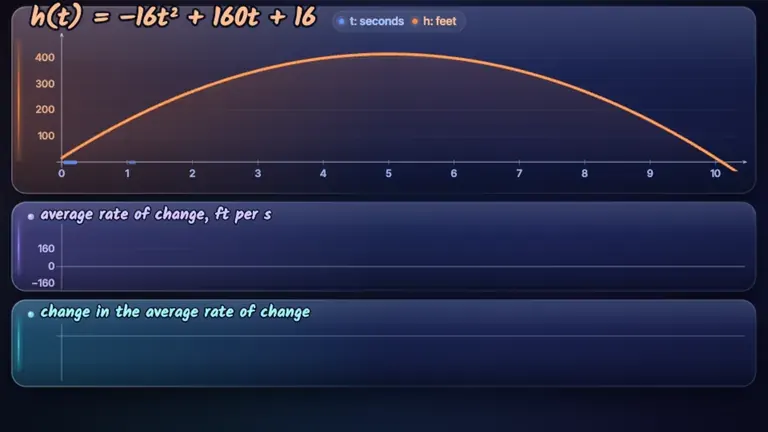 Topic 1.325 minRates of Change in Linear and Quadratic Functions
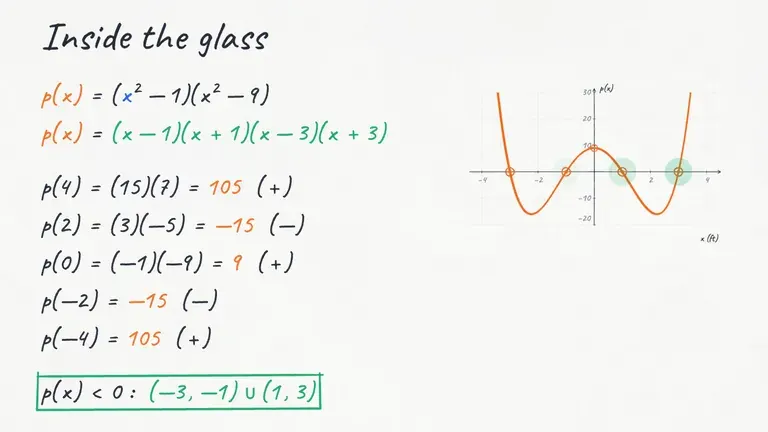 Topic 1.523 minPolynomial Functions and Complex Zeros
 Topic 1.619 minPolynomial Functions and End Behavior
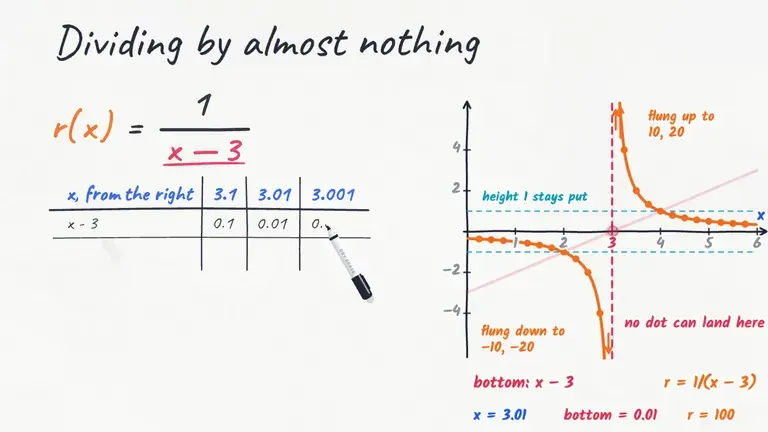 Topic 1.922 minRational Functions and Vertical Asymptotes
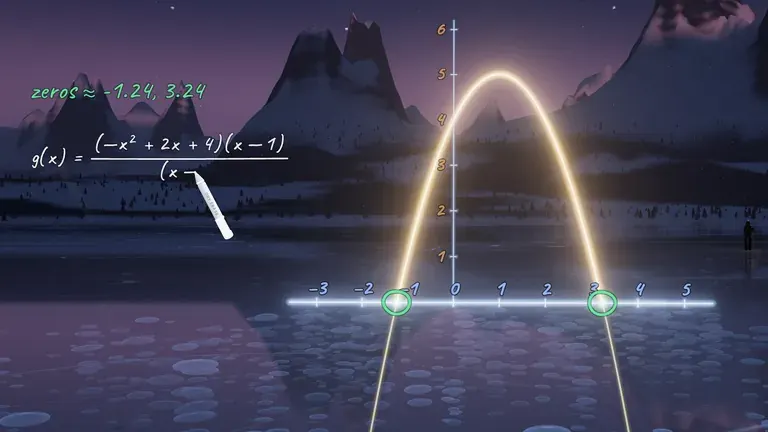 Topic 1.1018 minRational Functions and Holes
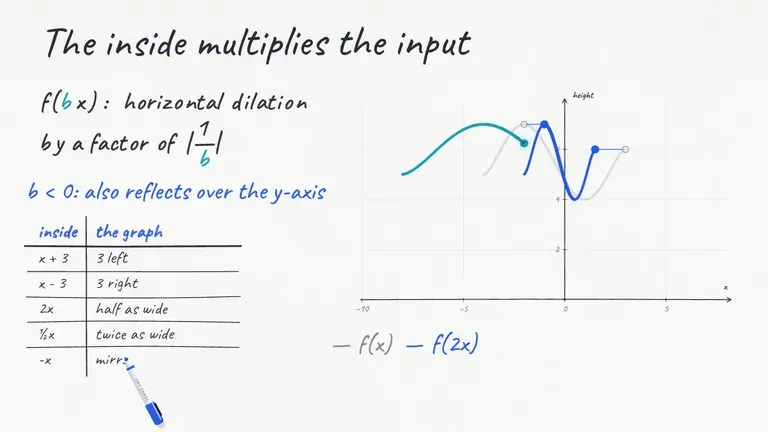 Topic 1.1219 minTransformations of Functions
Unit 2: exponential and logarithmic functions
Unit 2 is 25–40% of the multiple-choice section and shows up in three of the four free-response questions: 1, 2 and the calculator-free question 4. After the 2024 exam the Chief Reader noted that students did better with concepts than with algebraic manipulation, and question 4 is where that shows: the algebra has to be finished by hand, with nothing to check it against.
Sequences, linear and exponential models
| Formula | When you need it | The classic mistake |
|---|---|---|
| Arithmetic: , or . Geometric: , or . | Patterns that add the same amount each step (arithmetic) or multiply by the same factor (geometric). | An off-by-one start. If the first term is , use the form with . |
| Linear: , or . Exponential: , or . | Building either model from a point and a rate or ratio. Two points with different inputs determine a line. They determine an model with when both outputs are nonzero and have the same sign; equal outputs give a constant model. | Treating the first data point as . In 2026 the first value given was at year 1, so it equaled , not . |
| Over equal input steps: constant differences support a linear model; a constant positive output ratio other than 1 supports an exponential model | Explaining why a table is linear or exponential. | Giving a reason that isn't about the ratios. In 2025 a reason citing “exponential regression” didn't count; it had to show the same factor, 0.5, across more than one pair of equal steps. |
| with , , . For : growth if , decay if . Horizontal asymptote ; no extrema, no inflection points. | Reading growth or decay from the base, and sketching. | Thinking decay means concave down. is decreasing and concave up. |
| has the asymptote . Subtract and the ratios become constant. | Data that level off at something other than 0, like a drink cooling toward room temperature. | Testing ratios on the raw data instead of on the data minus the level. |
Exponent rules and growth factors
| Formula | When you need it | The classic mistake |
|---|---|---|
| For and positive integer : , , , , | Every rewrite in question 4, and turning a shift into a stretch: . | Adding exponents across a sum. , not . |
| Growth factor : up 6% per year is ; down 6% per year is | Writing a model from a percent change, and reading the percent back from . | Using for a 6% decrease, or for a 6% change. |
| Changing the time unit: , so doubling every day means multiplying by 128 every week | Rewriting a model per week instead of per day, or per month instead of per year. | Dividing the base by 7 instead of raising it to the 7th power. |
| The natural base . Any exponential can be rewritten in base : . | Models written with , and switching bases. | Typing 2.718 instead of the key, then rounding before the last step. |
Composition, inverses and residuals
| Formula | When you need it | The classic mistake |
|---|---|---|
| : acts first | Composing functions given as a table, a graph or a formula, often mixed together in question 1. | Giving only the final number. In 2025 a correct decimal alone didn't earn the composition point; the work had to show the inner value. |
| Inverse: if , then , and . The graph reflects across ; domain and range trade places. | Reading inverse values from a table or graph, and finding by swapping and and solving. | Reading as . The means inverse, not reciprocal; as the 2025 Chief Reader put it to teachers, inputs and outputs swap. |
| Residual actual value predicted value | Judging a regression. A residual plot with no pattern supports the model. | Subtracting the other way. A positive residual means the model came in too low. |
Logarithms
| Formula | When you need it | The classic mistake |
|---|---|---|
| , for , , . Plain means base 10; means base . | Every log equation: rewrite it as an exponential equation. | Keeping a solution that makes an argument zero or negative. Check each answer in the original equation. |
| , and for | Undoing an exponential or a log in one step. | Losing the parentheses: , the whole exponent. |
| For , , and : product: . Power: . Quotient, which follows from those two: . | Combining logs into one, and expanding one into pieces. | Inventing a rule for sums. doesn't split. |
| Change of base: (any base works on top and bottom, as long as it's the same) | Evaluating an unusual base on a calculator, or comparing logs with different bases. | Flipping the fraction: , not . |
| , with , and : domain , range all real numbers, vertical asymptote | Domains of log models: set the argument greater than 0. | Giving the domain of as . It's . |
| Semi-log plot: if with , and log base , then , a line with slope and intercept | Spotting exponential data on a plot with a log-scaled -axis, and recovering and from the line. | Reading the slope as . The slope is , so . |
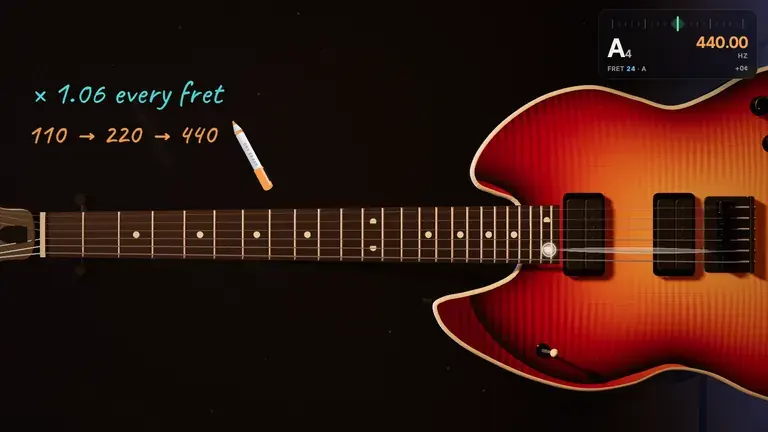 Topic 2.121 minChange in Arithmetic and Geometric Sequences
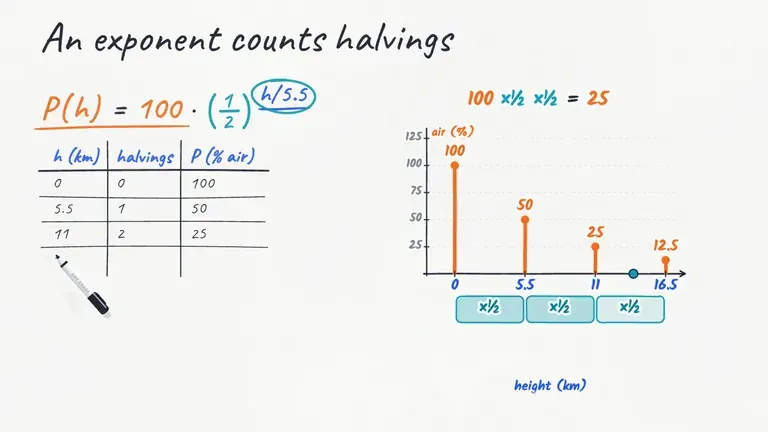 Topic 2.421 minExponential Function Manipulation
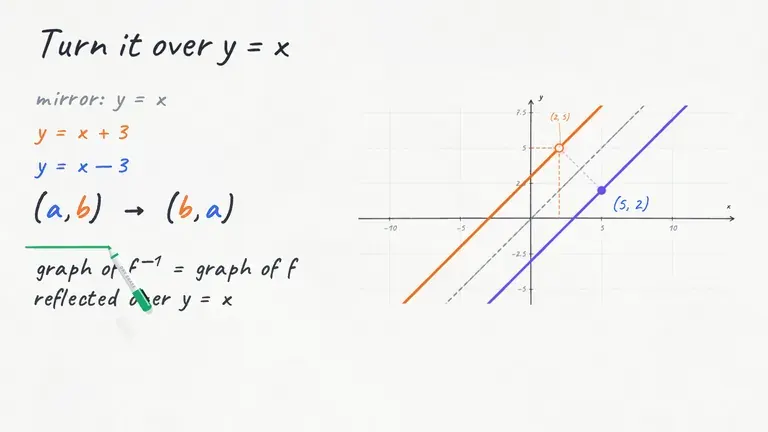 Topic 2.819 minInverse Functions
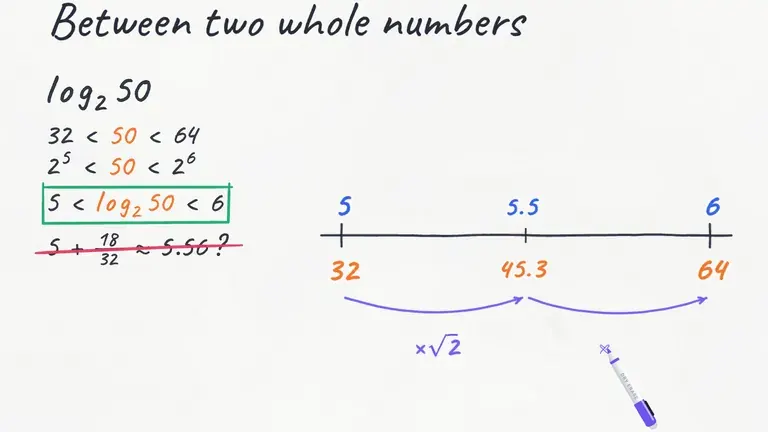 Topic 2.920 minLogarithmic Expressions
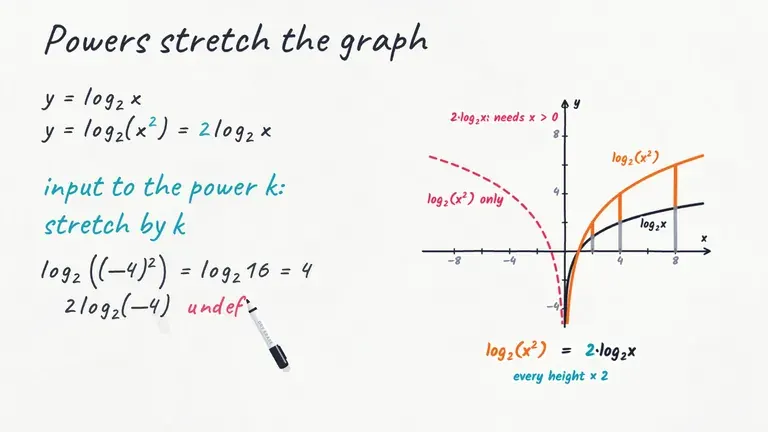 Topic 2.1221 minLogarithmic Function Manipulation
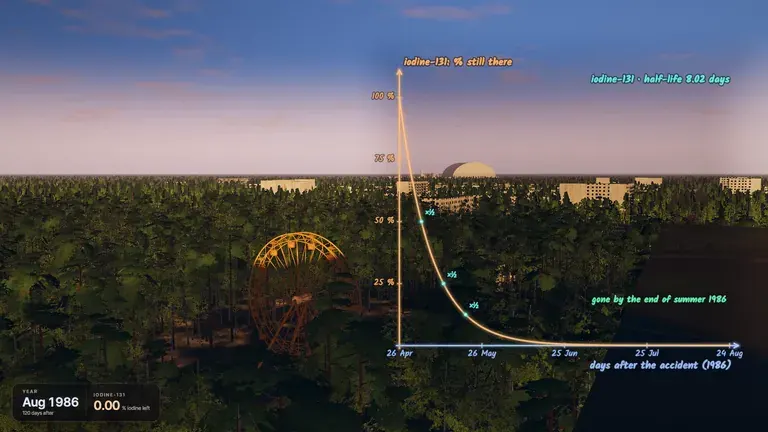 Topic 2.1320 minExponential and Logarithmic Equations and Inequalities
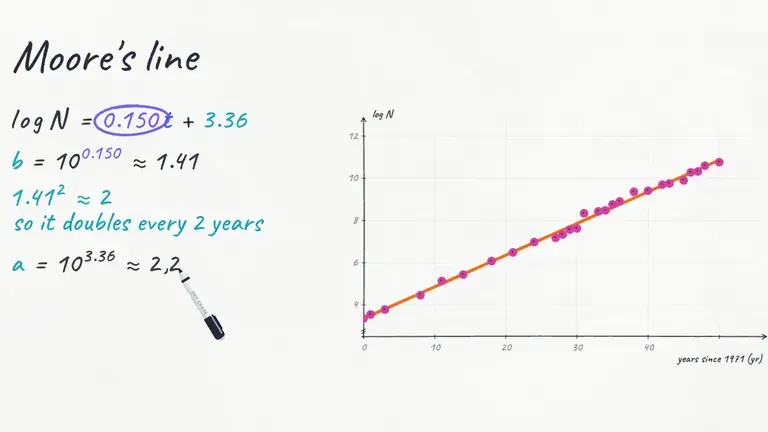 Topic 2.1519 minSemi-log Plots
Unit 3: trigonometric and polar functions
Unit 3 is 30–35% of the multiple-choice section, and free-response questions 3 and 4 both lean on it with no calculator. This is the unit where memory pays the most. On the exam you can't look up ; you either know it's or you can rebuild it from a triangle in a few seconds, as the next section shows.
Angles and the unit circle
| Formula | When you need it | The classic mistake |
|---|---|---|
| Radian measure: , arc length over radius, so . A full turn is . | Going between arc length and angle. | Putting degrees into . The formula needs radians, and the exam assumes radians unless it says otherwise. |
| The point at angle on a circle of radius is , so , and . | Coordinates of a turning point: the wheel, tire or string in question 3. | Swapping sine and cosine. Cosine is the horizontal coordinate; sine is the vertical one. |
| Exact values at multiples of and , in the table below | Reference angles for the calculator-free parts; identities also give exact values at other angles. | Getting the size right and the sign wrong. Find the quadrant first. |
| undefined |
Sinusoids
| Formula | When you need it | The classic mistake |
|---|---|---|
| and : period , range , midline , amplitude 1. Sine is odd, cosine is even, and . | Sketching, and turning a cosine model into the sine form a question asks for. | Answering with cosine when the question names sine. In 2026 a correct cosine model earned only partial credit. |
| Amplitude ; midline | Finding and from the highest and lowest values in a context. | Using the maximum as the amplitude when the midline isn't . |
| For and , : amplitude , period , midline , phase shift | Every question 3. Choosing : . | Setting equal to the period or the frequency. Period and frequency are reciprocals, and is times the frequency. |
| Phase shift: is the graph of moved units to the left | Finding from a known point, such as where the wheel starts. | Getting the sign of backward. Check it: put the starting time into your model and see whether the starting height comes out. |
Tangent and the reciprocal functions
| Formula | When you need it | The classic mistake |
|---|---|---|
| : period , vertical asymptotes at , increasing between them. For , has period . | Tangent graphs and equations. | Using as tangent's period. |
| , , | Rewriting everything in sines and cosines, the usual first move in an identity question. | Pairing secant with sine. Secant goes with cosine, cosecant with sine, and neither ever takes a value between and . |
| Asymptotes: where ; and where . Cotangent has period and decreases between its asymptotes. | Graphs and domains of the reciprocal functions. | Putting the asymptotes of where . An asymptote sits wherever the denominator is zero. |
Inverse trig functions and trig equations
| Formula | When you need it | The classic mistake |
|---|---|---|
| (also ): input in , output in . : input in , output in . : any input, output in . | Evaluating inverse trig exactly, and undoing it in an equation. | Reading as , a misreading the 2024 Chief Reader listed by name. is arctangent; is . |
| With any integer and from the corresponding inverse function (sine and cosine require ): gives or . gives . gives . | “Find all solutions” and “solutions in the interval” questions. | Stopping at the one angle the inverse function gives you, or dropping the after a square root. In 2026 a squared tangent equal to 1 had three solutions in the interval, and the last point needed all three and nothing extra. |
Identities: the only ones tested
The course description is unusually exact here. It says the Pythagorean identities and the sum, difference and double-angle identities for sine and cosine are assessed, and that half-angle identities, tangent sum and difference identities and other identities not listed are not. Along with the definitions above (tangent, secant, cosecant and cotangent in terms of sine and cosine, sine odd and cosine even, ), these are the ones to know:
The course description also uses the Pythagorean identity on inverse functions, with an example worth recognizing: for .
Every question 4 released so far, and the sample in the course description, has a part that asks you to rewrite a trig expression in terms of one named function, such as a single . Turn everything into sines and cosines, look for or an angle you can double or split, and keep simplifying toward the function they named. Watch the minus sign in the cosine sum: has a minus, a plus.
Polar coordinates
| Formula | When you need it | The classic mistake |
|---|---|---|
| , | Polar to rectangular. | Forgetting can be negative. sits opposite the ray, in quadrant III. |
| ; if , and if . For , use when and when ; at the origin any angle represents the same point. Add multiples of as needed | Rectangular to polar, including writing a complex number as . | Using plain when . The point is at , not . |
| For , the input is an angle and the output a signed radius. Average rate of change: , in radius units per radian. | Polar graphs, and whether a point is moving toward or away from the pole. | Saying a decreasing means moving closer. If is negative and decreasing, the point moves away: distance from the pole is . |
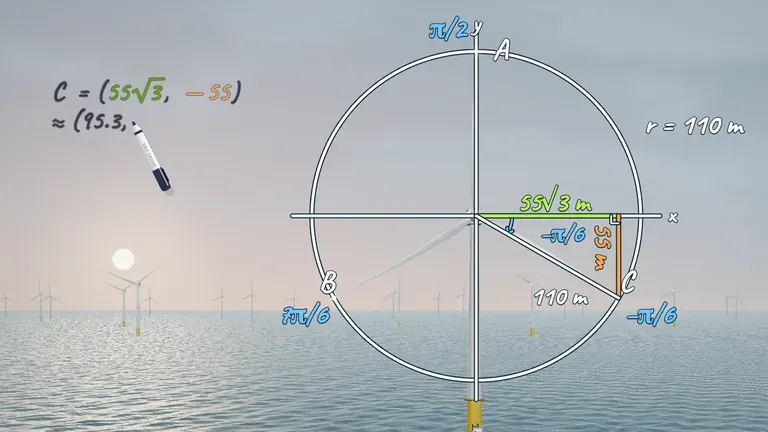 Topic 3.319 minSine and Cosine Function Values
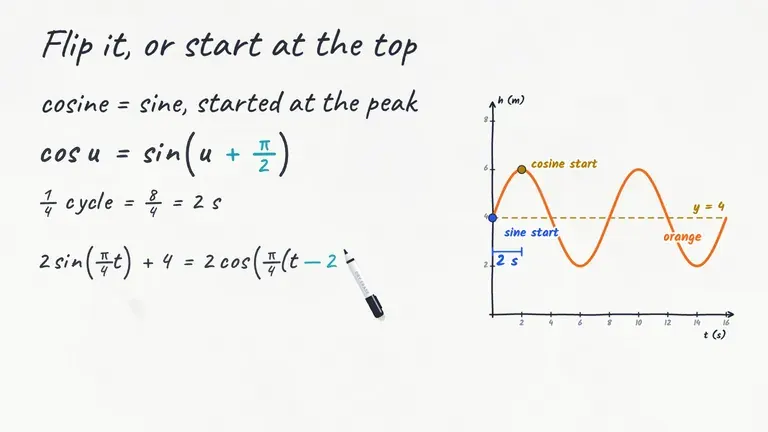 Topic 3.620 minSinusoidal Function Transformations
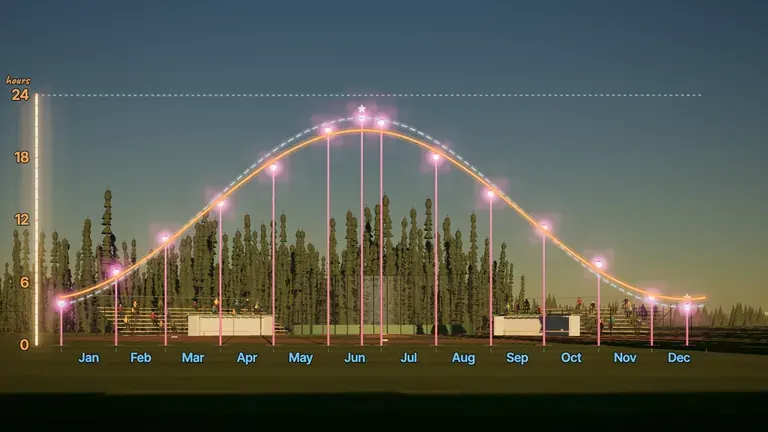 Topic 3.718 minSinusoidal Function Context and Data Modeling
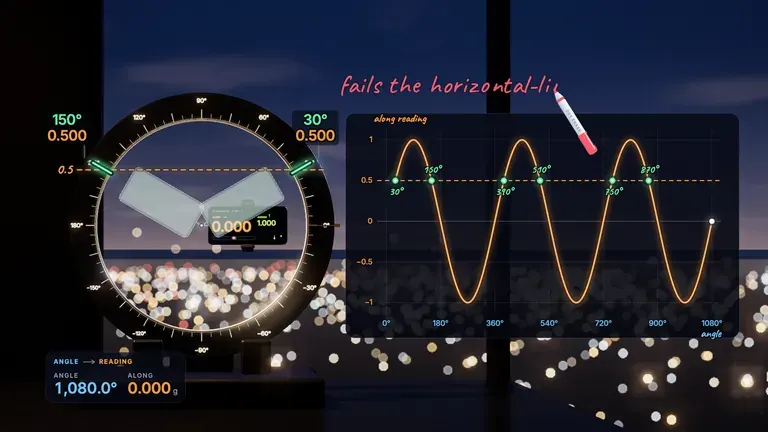 Topic 3.918 minInverse Trigonometric Functions
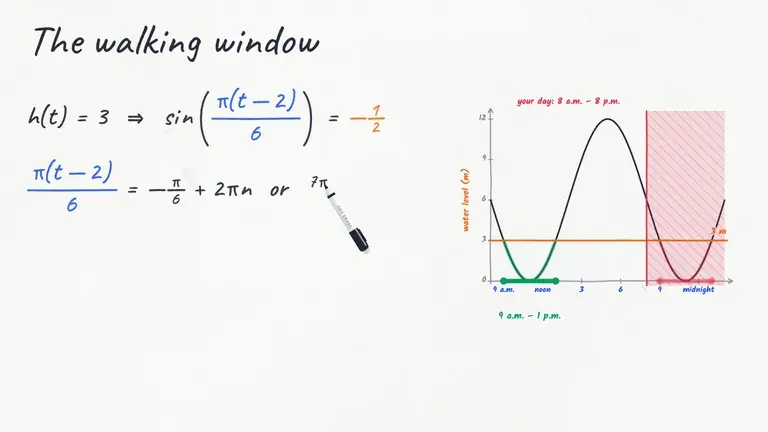 Topic 3.1019 minTrigonometric Equations and Inequalities
 Topic 3.1221 minEquivalent Representations of Trigonometric Functions
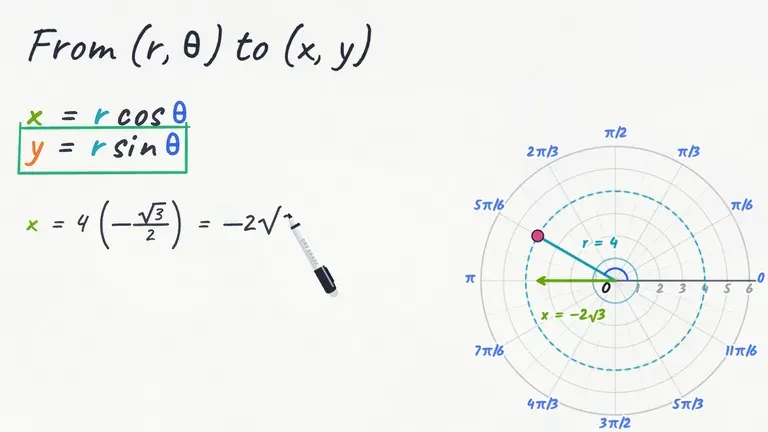 Topic 3.1320 minTrigonometry and Polar Coordinates
Rebuild these instead of memorizing them
A lot of this page comes out of the rest of it in a line or two. If you can do these six derivations, you only need to remember where they start, and you have a way to check yourself when a sign looks wrong in the middle of question 4.
Difference identities, from the sum identities
Replace with . Cosine is even and sine is odd, so and :
The same move turns the cosine sum identity into .
Double-angle identities, from the sum identities
Set :
Swap for and you get ; swap for and you get . Use whichever version leaves only the function you want.
The other Pythagorean identities
Divide by and you get . Divide by instead and you get . The course description's own example is the first one rearranged, , so you may meet it in that form.
The unit circle, from two triangles
Put a 45-45-90 triangle with hypotenuse 1 inside the unit circle and both legs are . A 30-60-90 triangle with hypotenuse 1 has a short leg of , opposite the 30° angle, and a long leg of . Those three numbers, with the quadrant's signs, fill in the whole exact-value table above. The angle tells you which leg is which: at the point is far out and low, so cosine gets the long leg.
The quotient rule for logs
For , and , that is the product rule and the power rule used one after the other, which is why the course description lists only those two, plus change of base.
b from the period
Choose . One full cycle of happens while runs from to , that is, while runs from to . So the period is , and turned around, . A string that vibrates 200 times a second has a period of second, and .
What's not on the exam
Most formula sheets online were made for a general precalculus class, and a lot of what's on them never appears on this exam. The course description puts these outside the course or off the exam:
Appendix B excludes half-angle and tangent sum/difference identities from the exam. It includes the Pythagorean identities and the sine and cosine sum, difference and double-angle identities.
- Half-angle identities and the tangent sum and difference identities, and every trig identity not in the list above, such as product-to-sum and sum-to-product formulas. Power-reducing formulas aren't on the list either, but they are only the cosine double-angle identity solved for or , and using the identity that way is fair game: part B(ii) of the question 4 below does it.
- All of Unit 4: parametric functions, conic sections, vectors and matrices. That takes the dot product, determinants, matrix inverses and the Law of Sines and Law of Cosines (which the course uses only with vectors) off the exam too. Your class may still cover Unit 4; the College Board excludes it from the AP Exam.
- Series. Arithmetic and geometric sequences are tested; the formulas for adding up their terms are not.
- Partial fractions, which the course leaves out, and synthetic division, which it doesn't require. Long division is the method the course uses.
- The rational root theorem and Descartes' rule of signs. Factoring without a calculator is limited to taking out a common factor and factoring quadratics.
- **Log scales on the -axis.** On the exam, semi-log plots scale only the -axis.
- Open versus closed endpoints on intervals where a function increases or decreases. The Fall 2026 clarifications put this outside the course and exam, so you won't be asked to choose between and for where a function increases.
- **Interpreting and in a logarithmic model in context.** You still build log models; the course leaves out explaining what each parameter means in the story.
Two formulas that turn up on general precalculus sheets aren't in the course framework at all: the compound-interest formula and the area of a sector. An interest question can still appear as a context, but you build its model from the growth factor, per period, like any other exponential.
Question 4: where memory turns into points
Question 4 is the part of the exam this page matters most for. There's no calculator and no story, just equations to solve and expressions to rewrite with exponents, logs and trig. It has been the lowest-scoring of the four free-response questions in every year with published results: an average of 1.28 points out of 6 in 2024 and 1.93 in 2025.
| Point | 2024 task | 2024 | 2025 task | 2025 |
|---|---|---|---|---|
| A(i) | Solve an equation with a power of | 0.37 | Solve a log equation | 0.53 |
| A(ii) | Solve an equation with arcsine | 0.33 | Solve a cosine-squared equation on an interval | 0.43 |
| B(i) | Combine three base-10 logs into one | 0.16 | Combine two base-2 logs into one | 0.45 |
| B(ii) | Rewrite as a single term in | 0.24 | Rewrite with appearing once | 0.28 |
| C, first point | An inverse cosine of a tangent: one solution | 0.15 | An equation that is quadratic in : set it up as one | 0.14 |
| C, second point | All of its solutions | 0.04 | Solve it | 0.10 |
Every one of those points needs something from this page, and none of it can be looked up. Below is a question built the same way as the released ones, with new functions and numbers, then a response scored with our six-point practice rubric, based on the published question-4 tasks.
The question
No calculator. Give exact values, combine terms where you can, and show the work for each part.
- A. and . (i) Solve . (ii) Solve .
- B. and . (i) Rewrite as a single logarithm base 3 with no negative exponents. (ii) Rewrite as an expression in which appears exactly once and no other trigonometric functions are involved.
- C. . Find all values of in the interval for which .
A(i). , so and .
A(ii). means , so .
B(i). Power rule first: .
Then the product and quotient rules: .
B(ii). Double-angle identities: .
Simplify: .
C. , so and .
For in , is in , so .
So .
How it scores
| A1: solves | 1/1 | Exact answer, with the step that undoes shown. is already finished: there is nothing left to evaluate or combine. |
|---|---|---|
| A2: solves | 1/1 | Needs from memory. Stopping at is correct but unevaluated, and the 2026 guidelines don't give the point for that. |
| B1: one logarithm, base 3 | 1/1 | Power rule, product rule, quotient rule, then simplify. is two logs, and breaks the no-negative-exponents rule. |
| B2: exactly once | 1/1 | Both double-angle identities, written out. In 2026 this kind of point required supporting work, so on its own wouldn't earn it. |
| C1: one correct value | 1/1 | Any one correct value of or , with work, such as . |
| C2: every value, nothing extra | 1/1 | All four values in . Dropping the loses two of them. A general solution with and no list doesn't earn this point either; in 2026 the guidelines said so outright. |
Why it works
- Each point rests on one line of this page: undoes , the exact value of , the log rules, the double-angle identities, and the exact sines with their quadrant signs.
- The rewrites keep the original domains: for B(i), and for B(ii). The response checks the domain elsewhere too. In A(ii), is a legal input for arccos, and is inside its output range . In C, doubling the interval for gives the interval for , and that's where the third and fourth answers come from.
Question 3: getting b and c right
The other calculator-free question rests on one formula, , and one translation: from a story about something turning or vibrating to four numbers. This is part B of a question 3 built like the 2025 one, which gave a frequency instead of a period.
The center of a speaker cone vibrates. At time seconds it is at its farthest point out, 0.3 millimeter in front of its resting position. It moves to 0.3 millimeter behind the resting position and back out again, and it completes this motion 100 times every second. Its position, in millimeters in front of the resting position, is modeled by . Give values of , , and .
Highest , lowest . Amplitude: . Midline: .
100 cycles per second, so the period is second and .
At the cone is at its maximum, so , which gives .
. Check: .
How it scores
| B1: and | 1/1 | Half the distance from highest to lowest, and their average. This is the point most students get: it averaged 0.60 in 2024 and 0.67 in 2025. |
|---|---|---|
| B2: and | 1/1 | Both have to be right. The usual wrong answers are (the frequency) or (the period), and , which starts the cone at its farthest point behind rest. |
Why it works
- Other answers are also correct: for any integer , or with . Any set with , , period and works, which is why the one-line check at the end is worth the five seconds it takes.
The topics behind the lowest-scoring points
After the 2024 exam, the Chief Reader pointed teachers to six topics for more question 4 practice: 1.11, 2.4, 2.12, 2.13, 3.10 and 3.12. For the -and- point in question 3, add 3.6. If you're short on time, start with those seven.
For how every point on all four free-response questions is scored, see the AP Precalculus FRQ guide. To keep the formulas on paper, the AP Precalculus cheat sheets cover each unit, ready to print.
Sources
- AP Precalculus Course and Exam Description, effective Fall 2026: topics, exam format, technology use and Appendix B scope notes (PDF)
- AP Precalculus Course and Exam Description: Clarifications and Corrections, Fall 2026 (PDF)
- AP Precalculus Exam: format, timing and section weights (AP Central)
- Reference Information for Specific AP Exams: the exams that come with reference sheets (AP Central)
- AP Precalculus graphing calculator policy (AP Central)
- 2026 AP Precalculus Free-Response Questions: directions for question 4 (PDF)
- 2026 AP Precalculus Scoring Guidelines (PDF)
- 2025 AP Precalculus Free-Response Questions (PDF)
- 2025 AP Precalculus Scoring Guidelines (PDF)
- 2025 AP Precalculus Chief Reader Report (PDF)
- 2025 AP Precalculus Scoring Statistics (PDF)
- 2024 AP Precalculus Free-Response Questions (PDF)
- 2024 AP Precalculus Chief Reader Report (PDF)
- 2024 AP Precalculus Scoring Statistics (PDF)
- AP Precalculus past exam questions, 2024–2026 (AP Central)