
Topic 3.6 key terms
- midline
- The horizontal line halfway between a sinusoid's maximum and minimum values. For the midline is .
- amplitude
- The distance from the midline to a maximum (or a minimum): half the difference between the maximum and minimum. For it is .
- vertical translation
- Adding to a function moves its whole graph, midline included, units up (down if ).
- vertical dilation
- Multiplying a function by stretches every output's distance from the midline by a factor of ; if the graph also flips over its midline.
- period
- The length of one complete cycle. For the period is .
- horizontal dilation
- Replacing with squeezes or stretches the graph sideways: the period changes by a factor of .
- phase shift
- A horizontal translation of a sinusoid. Replacing with translates the graph by units: is moved 1 unit right. Factor out first: is shifted right.
- sinusoidal function
- A function of the form or with , . Since , the same transformations work for both.
Transcript
2,619 words · 8 parts
Nothing moves sideways
This is a sculpture made of a thousand and twenty-four copper drops. Every one of them hangs from its own thin steel wire, with its own little motor, up in the ceiling. And when all those motors start running together — this is what they do. Now keep your eye on this orange one. It goes straight up and straight back down, and that’s all it ever does, so it never moves sideways, not even a centimeter.
Here’s its height traced out against time, and it’s a perfectly smooth wave. The drop next to it does exactly the same thing, just a moment later, and so does every other drop in the room.
So if no drop ever moves sideways, then how is there a wave rolling across the whole room? There’s a real sculpture like this in Singapore’s Changi Airport, called Kinetic Rain, with twelve hundred and sixteen drops. Every move a sculpture like this makes comes out of a program, and for a wave like this one, that program is a sine function.
By the end, you’ll write the program for one drop yourself. It sets how high the drop rides, how far it swings, how fast it bobs, and when it peaks. Then you’ll send your own wave rolling across every drop in the room. So let’s do what the sculpture’s designer would do, and start with one drop and the plainest wave there is.
Lift it, then stretch it
Let me park the other drops up near the ceiling so we can watch this one alone. We’ll start with the simplest wave we know and try out h of t equals sine t, with t in seconds and h in meters. Here’s a preview of what that would do, and we have a problem. Sine swings between one and negative one, so half the time this drop would be under the floor, as much as a meter down.
So let’s lift it. If I add four to the program, every height the drop reaches goes up by four meters, the top and the bottom and everything in between. That includes the middle of the motion, the midline, halfway between the highest and lowest points. It used to sit at floor level, and now it’s this glass sheet four meters up.
A one-meter swing is pretty timid for a room this tall. So let’s multiply the sine by two — and keep an eye on the midline while I do it. Now the drop reaches two meters above the midline and two below it, and the midline hasn’t moved. That distance from the midline up to the top is the amplitude, and multiplying by two doubled it.
Here’s the program so far. Adding four lifted every point four units, and multiplying by two stretched every distance from the midline by two. The exam has names for these two moves. Adding d is a vertical translation, and everything rises by d, midline too. Multiplying by a is a vertical dilation, and the amplitude is the absolute value of a, since a can be negative.
So the lowest point is d minus the amplitude and the highest is d plus the amplitude, which puts two sine t plus four between two and six. Here’s one to think about. Right now the drop swings between two and six meters. If I double the number in front of the sine, where do you think its highest point ends up? So the highest point is always the midline plus the amplitude, never the amplitude on its own.
The inside clock
There’s one thing a designer would hate about this drop. Right now, one bob takes two pi seconds, about six point two eight, which is an awkward number to build a show around. To fix it, look inside the sine. The angle in there, just t right now, works like the hand of a clock, and every time the hand makes a full turn of two pi, the drop finishes one bob.
Say we want one bob to take eight seconds. Then the hand has to get all the way round, two pi, in eight seconds, so it turns two pi over eight, pi over four, every second, and we multiply t by pi over four. And there it is, one smooth bob every eight seconds.
Now let’s double that to pi over two. The inside clock runs twice as fast, the hand gets round in half the time, and the drop bobs every four seconds. Okay, now you take the controls. Turn the inside clock until the drop bobs exactly once every three seconds.
Here are both programs on the same time axis. The number in front of t is b, so the inside angle is b times t, and one bob is one full turn of it. So a bigger number in front of t means a shorter period, which is the part people get backwards. That number is how fast the inside clock turns, and the faster it turns, the less time each bob takes.
If one bob takes P seconds, the inside angle grows by b times P during that bob, and that has to equal one full turn, two pi. Divide by b and you get the period, two pi over b. It gets an absolute value because a negative b just runs the inside clock backwards, and that doesn’t change how long a bob takes.
With b equal to one we got about six point two eight seconds, pi over four gave eight, pi over two gave four, and your two pi over three gave three, so as b gets bigger, the period gets smaller. The exam calls multiplying the input by b a horizontal dilation by a factor of one over the absolute value of b, the whole graph squeezing or stretching sideways.
Later means minus
Now, let’s bring the drop’s neighbor back. I’ll give it exactly the same program, but I’ll start it one second late. Its trace is the orange drop’s trace slid one second to the right, and here’s the program that does it, two sine of pi over four times t minus one, plus four.
Notice that it says minus one, even though the neighbor is one second later. That’s because at any moment t, the neighbor is doing whatever the orange drop did one second earlier, at t minus one.
So subtracting one inside the parentheses makes everything happen one second later, which is one unit to the right on the graph. Try it yourself. Slide the neighbor until it peaks exactly two seconds after the orange drop.
Now, here’s where it gets good. Let’s give every drop in the front row this program, each one starting half a second after the drop on its left. And there’s your wave. Every drop still goes only up and down, but each one is half a second behind its neighbor, so the peak gets handed along the row.
Freeze the row and the drops line up in a sine shape, but that’s a snapshot of the whole row at one instant. The graph on the card is still one drop’s height over time. Now let’s do it to all thousand and twenty-four, every column half a second behind the one before. And that’s the wave from the start of the lesson. It’s one program, run with a different delay for each column, and you just wrote it.
Let’s write down why minus means later. At time t the neighbor does what the orange drop did at t minus one, so its height is h of t minus one. Exams write the input as theta, in the form a sine of b, times the quantity theta plus c, plus d. The graph shifts by negative c, and that sideways shift is called the phase shift.
Our neighbor has t minus one inside, which is t plus negative one, so its c is negative one, and negative c is positive one, a shift of one second to the right. This move always works. Set the inside of the parentheses to zero, and solve. For the neighbor, t minus one is zero at t equals one. That’s where its wave starts, on the midline, heading up.
It’s the same rule as f of x minus h, back in the drone show. This time, f is sine. Here’s a third drop, running two sine of pi over four times t plus three, plus four. Compared with the orange drop, how is this drop different?
Sometimes, though, a program arrives without b pulled out, like two sine of pi over four t minus pi over four, plus four. Is that a shift of pi over four? Hold that thought, because we’ll come back to it in a few minutes.
Flip it, or start at the top
There are two more moves, and the first one is a minus sign. This drop gets the orange drop’s program with a negative two in front. When the orange drop rises this one falls, and when it falls this one rises. Both swing two meters around the same midline, so each is the other flipped over the midline. So a negative a flips the wave over its midline, and the amplitude is still two, the absolute value of a.
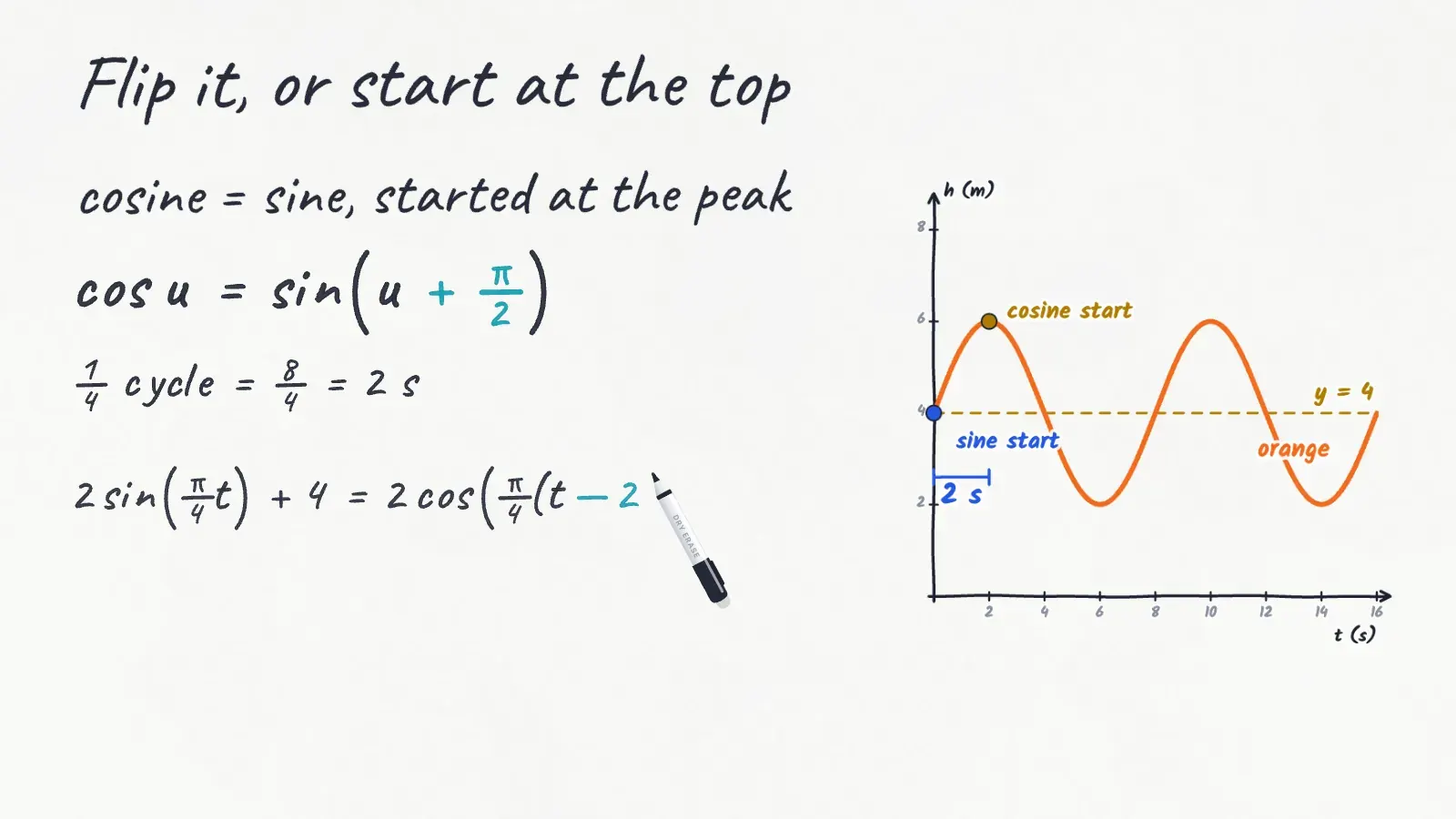
The second move is about where you start the clock. A sine wave starts on the midline heading up, which the orange drop does at t equals zero, and a cosine wave starts at the top, which it reaches at t equals two. So we can write the very same motion as two cosine of pi over four times t minus two, plus four. The drop hasn’t changed at all, only the moment we call the start.
Every rule we’ve learned works the same way for cosine. A cosine wave is just a sine wave with a different starting point. Picture a plain cosine wave of the same size. It peaks right at t equals zero. Our drop doesn’t peak until t equals two.
To match our drop, the cosine has to wait two seconds. What goes inside its parentheses? Waiting means minus, just like the neighbor. Let’s slide the cosine two seconds later, and it lands right on our drop.
Two seconds is a quarter of the eight-second bob. The cosine start always comes a quarter of a cycle after the sine start. Both programs draw the same wave, the sine one and the cosine one with t minus two inside. Now the neighbor. How would you write its program, two sine of pi over four times t minus one, plus four, with a cosine instead?
Read any sinusoid
On the exam, the input is theta. f of theta equals a sine of b, times the quantity theta plus c, plus d. The outside numbers act on heights, so the amplitude is the absolute value of a and the midline is y equals d. The inside numbers act on the input, so the period is two pi over the absolute value of b, and the phase shift is negative c.
Let’s read a tough one, negative three sine of two theta minus pi over three, plus four. Before I read anything from the inside, I have to pull the two out. The shift only shows up when the inside looks like b, times the quantity theta plus c. Two theta minus pi over three becomes two, times the quantity theta minus pi over six. You can check it, since two times pi over six is pi over three.
Now I can read all four. The amplitude is three, the period is two pi over two, which is pi, the midline is y equals four, and the phase shift is pi over six to the right.
To draw it, I’ll use the five landmarks of a sine cycle. The inside takes the values zero, pi over two, pi, three pi over two and two pi. The inside is zero at theta equals pi over six. Each next landmark is a quarter period later, so add pi over four each time. Pi over six plus pi over four is five pi over twelve, and so on.
The heights start at four on the midline. Because a is negative, the wave goes down first, to one, back to four, up to seven and back to four. Connect them smoothly and there’s one full cycle. And here’s what you’d get if you skipped the factoring and shifted by pi over three. The wave has the right size and the right period, but every single landmark is in the wrong place.
And that settles the question we left hanging. Pi over four t minus pi over four is pi over four times t minus one, so that drop is just our neighbor, one second late.
This is exactly the kind of question the exam asks. What are the period and the phase shift of f of theta equals five cosine of three theta plus pi over two, minus two? You can read any sinusoid you’re handed now. So let’s go back to the sculpture, and build one from scratch.
Your wave
Now it’s time to keep that promise. Here’s an order sheet from the sculpture’s designer, for a brand new wave. The orange drop should swing between two and six meters, make one full ripple every six seconds, and hit its peak at exactly two and a half seconds. Then the ripple should spread outward from it across the whole field. Set the four numbers so the orange drop swings between two and six meters, makes one full ripple every six seconds, and peaks at exactly two and a half seconds.
Let’s write the program it needs. The midline is four and the amplitude is two, and six seconds per ripple means b is two pi over six, which is pi over three. For the timing, a sine wave reaches its peak a quarter of a cycle after it starts, and a quarter of six seconds is one and a half. So the wave has to start at two and a half minus one and a half, at t equals one, and that means t minus one.
So the orange drop’s program is two sine of pi over three times t minus one, plus four. If you’d rather start from the peak, two cosine of pi over three times t minus two and a half, plus four, is the very same wave. And that’s exactly the job in the periodic modeling question on the AP exam, which gives you heights and times like these and asks you for a, b, c and d.
Now for the ripple. All the other drops run exactly the same program, each one delayed by how far it is from the orange drop, so a drop three meters away starts two seconds later. And there goes your wave, rolling out across all thousand and twenty-four drops, and not one of them is moving sideways. Every drop in this room is running your program, and the only thing that changes from one drop to the next is the c.
What to remember
So, whenever you meet a sine or cosine function, here’s how to read it, one number at a time. The d lifts or lowers the whole wave, and the midline is y equals d. The amplitude is the absolute value of a, and a negative a flips the wave over its midline. The period is two pi over the absolute value of b, because b is how fast the inside clock turns.
The phase shift is negative c once you’ve factored out b, so minus means later, to the right. Sine and cosine follow the same rules. They sit a quarter of a period apart.