
Topic 3.4 key terms
- sine function
- f(θ) = sin θ gives the vertical coordinate (height) of the point P where the terminal ray of θ meets the unit circle. Its graph is the set of points (θ, sin θ).
- cosine function
- f(θ) = cos θ gives the horizontal coordinate (sideways position) of P on the unit circle. Its graph is the set of points (θ, cos θ).
- unit circle point
- The point at angle θ on the unit circle is P = (cos θ, sin θ). The graph points are (θ, sin θ) and (θ, cos θ): the angle first, then one coordinate.
- domain of sine and cosine
- All real numbers: negative angles turn clockwise and angles bigger than 2π turn more than once, and every one of them gives a point on the circle.
- range of sine and cosine
- −1 ≤ y ≤ 1. As θ increases the outputs oscillate between −1 and 1 and take every value in between.
Transcript
2,248 words · 9 parts
You can hear a circle
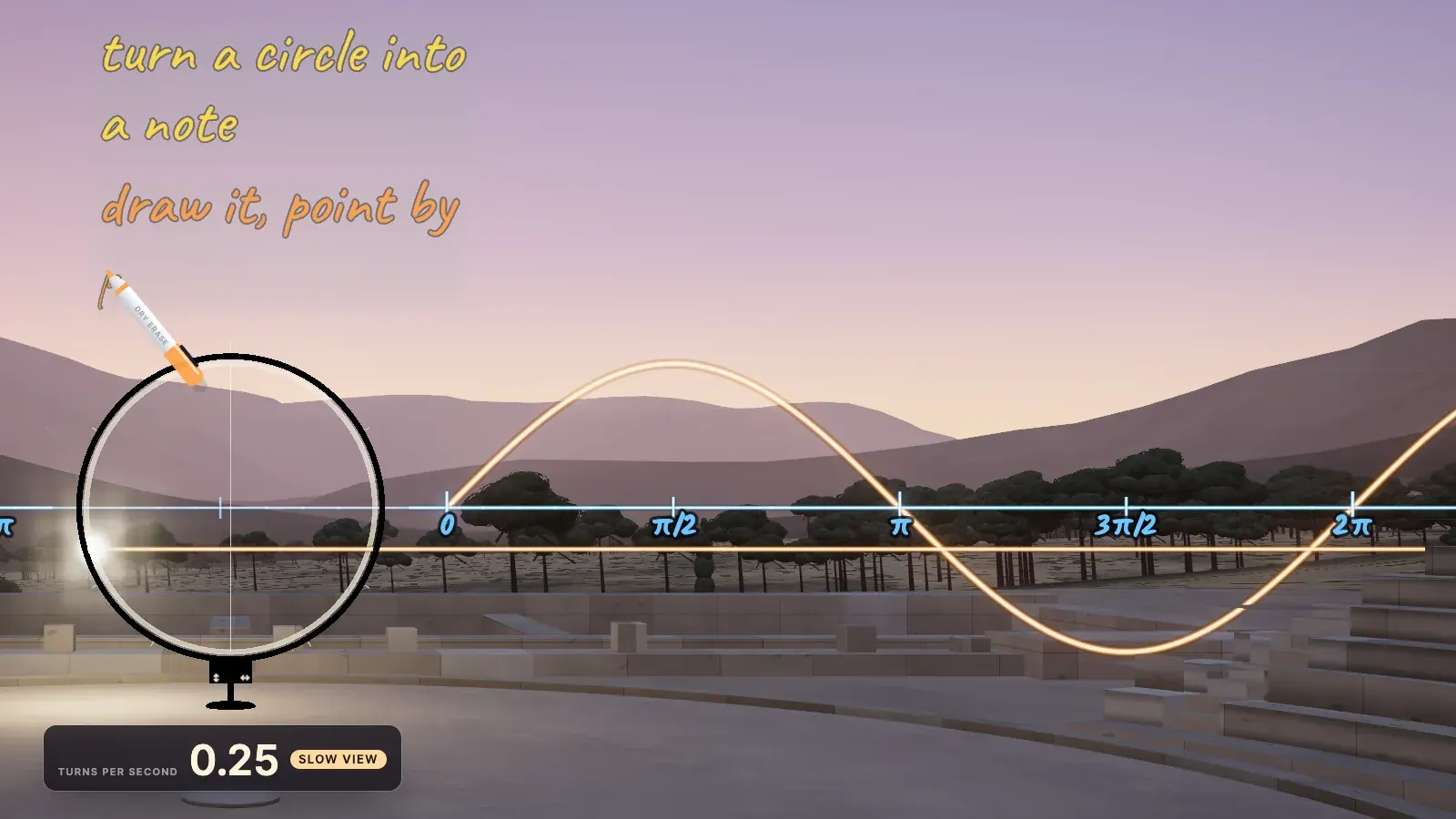
This is the ancient theater at Epidaurus, in Greece, and it was first built more than two thousand three hundred years ago. People still come here for the sound, because an actor down on that stage can be heard in the very last row, by up to fourteen thousand people, without a microphone. Tonight there’s only one thing on that stage, a circle, and the note you’re hearing is coming out of it.
A point of light is racing round that ring four hundred and forty times a second, so fast it looks solid, and its height is pushing a speaker back and forth. That’s all it takes to make a perfect A, the note an orchestra tunes to. So let’s slow it way down, until we can actually watch it go round.
Now follow the height of that point as it turns, carried straight across to the right, and look at the shape it draws. That’s what a pure note looks like, and it came out of a circle.
By the end of this lesson, you’ll be able to turn a circle into a musical note yourself, and draw that note point by point, for any angle at all. You’ll also find the second wave this circle has been hiding the whole time. So let’s start with that one point and its height, and work out exactly where every bit of this wave comes from.
Carry the height across
Let’s start the point at the far right of the circle, where the angle is zero, just like in standard position. Its height there is zero, so the pen starts at zero too. Now turn it a quarter of the way around, counterclockwise, to an angle of pi over two. The point climbs to the top of the circle, one unit high, so the pen climbs to one.
Before I keep going, where do you think the pen will be at pi? And then at three pi over two? At pi the point is over on the left, level with the middle, so the pen comes back down to zero, and at three pi over two it’s at the very bottom, so the pen goes down to negative one. One more quarter turn brings it home to where it started, at two pi, and the pen is back at zero.
That height has a name you already know. On the unit circle, the height of the point P is the sine of the angle, so this curve is the graph of y equals sine theta, with the angle across the bottom and the sine up the side.
Let’s build that wave again on the board, slowly, the way you would with a pencil, with a table of the angle, the point P, and P’s height. At zero, P is at one comma zero, so its height is zero. At pi over six it’s at root three over two comma one half, so the height is one half, then about point eight seven at pi over three, and one at pi over two.
Now look at what happens to the height when the angle goes up in equal steps. The first step climbs a whole half, the next only about point three seven, and the last barely point one three. Near the top, P is moving across more than it’s moving up, so the climbing slows down, and that’s why the top of the wave is round instead of pointed.
Here’s a quick one. Halfway between zero and pi over two is pi over four. When P has turned that far, how high is it?
The other three quarters work the same way. At pi the height is back to zero, at seven pi over six it’s negative one half, because P is below the axis, then negative one at three pi over two, and zero again at two pi. Join them all with one smooth curve, rounded at the top and the bottom, and that’s one full turn of the sine graph.
Be careful with one thing. As a point on the circle, P is cosine theta comma sine theta, but the matching point on the graph is theta comma sine theta, with the angle first and only the height coming along. The point stays on the circle the whole time, and the wave is just the record of its height.
The other coordinate
Back at the theater, let’s put the point at zero again. And this time, watch how far it is to the side. Right now P is one whole unit to the right of the middle. Take that sideways distance, stand it straight up, and plant it on the line at an angle of zero.
At pi over three, P is only one half to the right, so we plant a stick one half tall. At pi over two, P is right on the vertical line, zero to the side, so there’s no stick at all. And at pi, P is one unit to the left, so this stick points down, to negative one.
Do that at every angle on the way around, and the tops of the sticks trace out a second wave. This one is the cosine, because on the unit circle the sideways position of P is the cosine of the angle.
It has the same shape as the sine wave. But it starts at the top, at one, where the sine started in the middle. Here’s that move again, slowly. At pi over three, P is one half to the right of the vertical axis, so we swing that piece up and stand it on the graph at pi over three, one half tall.
Reading the sideways position off the circle all the way around gives one, one half, zero, then negative one at pi, zero again at three pi over two, and one at two pi. Join those points with one smooth curve, and that’s the graph of y equals cosine theta. The reason the two graphs start in different places is right there on the circle. At zero, P is at one comma zero, zero high, so sine starts at zero, and one to the right, so cosine starts at one.
Let’s make sure the two kinds of points are clear. Here’s P at an angle of pi over three, at one half comma root three over two. Which of these points is on the graph of y equals cosine theta?
Every angle there is
So far we’ve only turned one way, but what if the point goes backwards? Turning clockwise makes the angle negative, and both records keep drawing, off to the left. Watch them run out past the ring and through the side entrance, and the line they’re drawn on keeps going, out toward the hills.
Now let’s turn it forward, much further than one turn. The point passes its starting spot again and again, but the angle never starts over, two pi, three pi, four pi, and the records keep going right. So every angle there is, positive or negative, as big as you like, puts the point somewhere on the circle, which means sine and cosine both take every real number as an input.
Now you take the controls. Drag the bead to an angle of negative pi over two. If you’d gone the other way round, to three pi over two, the bead would be sitting in exactly the same spot, and yet that’s a different angle, so on the graph it’s a different input, way over on the right.
And while we’re here, how high can that pen ever go? Slide a beam of light up through the ring, and wherever it crosses the circle, the point can be at that height. At a height of one, the beam just touches the top of the circle, and above that, it misses the circle completely, so no angle at all has a sine bigger than one.
Here are both graphs on the board, three full turns of each. They keep going forever in both directions, so the arrows at the ends really mean it. So you can read values straight off the graph, even for angles past a full turn. Five pi over two is a full turn plus a quarter, so the point is at the top again, and the sine of five pi over two is one.
And the cosine of negative pi over two is zero, because a quarter turn clockwise puts the point straight below the middle. So the domain of both functions is all real numbers. The angles along the bottom are in radians for a good reason. Drawn to scale in degrees, one turn would stretch three hundred and sixty units across a wave only two units tall, and it would look flat. In radians the angle is the distance P travels round the circle, in the same units as its height, so the wave keeps its real shape, and the AP exam works in radians too, so keep your calculator in radian mode.
Every height from −1 to 1
Let’s go back to that beam, at a height that isn’t special at all, point three seven. It cuts the circle in two places, so every turn has two angles with that sine, and on the graph the line crosses the wave twice per turn.
Slide that line anywhere between negative one and one and the same thing happens, because the point slides smoothly round the circle through every height. So the range of sine, all of its outputs, is every number from negative one to one, including the ends, where the line just touches. Cosine works the same way with an up-and-down line, so its outputs also run from negative one to one.
That line catches the two points sitting point six to the left of the middle, and on the cosine graph, where the sideways position stands up, it becomes a level line at negative point six, crossing the wave twice every turn. Between zero and four pi, how many angles have a sine of exactly point three seven?
One coil, three views
Night has fallen, and both records are still hanging in the air. I want to show you that these two waves are really one thing. Let’s tip the cosine record down flat, and slide every point of the sine record back by exactly its cosine. Now look at it from the seats. You can’t see how far back anything was pushed, so nothing seems to have changed at all, and it’s still the sine wave.
But fly up and look straight down, and the very same shape is the cosine wave. From up there, all you can see of each point is the angle and how far back it was pushed, and that push was exactly its cosine. And now look straight down its length. Every turn lands exactly on top of the others, and it’s the circle we started with, because from here the angle disappears, and all that’s left of each point is its cosine and its sine.
So this coil holds the whole story. As the angle grows, the ring slides along it like a nut on a screw, with the point tracing the coil, and depending on where you stand you see the circle, the sine, or the cosine. The point itself only ever goes round the circle, and the coil just spreads its angles out in a line. Now you take the camera. Move around the coil until it turns into the cosine wave.
Fix the graphs
Here are four graphs, each one claiming to be sine or cosine, and only one of them is telling the truth. Matching a function to its graph like this is exactly the kind of question the AP exam likes to ask. Look carefully at where each one starts, how low it goes, and its shape. Which one is drawn and labeled correctly?
Now let’s repair the other three. A really is a cosine, so it just needs the right label. B needs its bottom half flipped back down, below zero. And C needs rounding out, so it reaches about point seven one at pi over four.
Play the note
Let’s go back down to the stage one last time. I promised you’d turn this circle into a note yourself, and the speaker’s ready, but its cable isn’t plugged in. Plug the speaker into the coordinate that draws the sine wave.
Now we spin the point faster and faster, and once it’s going round about twenty times a second, its height becomes a sound you can hear, rising until it’s going round four hundred and forty times a second. And there it is, the A again. You just turned a circle into a musical note, and you know exactly where its shape comes from, the height of a point going round a circle, carried across one angle at a time. And the sideways position was there all along, drawing the cosine right beside it.
What to remember
Here’s what to take with you. Sine is the height of the point on the unit circle, and cosine is its sideways position, and their graphs carry those two numbers across, against the angle. Both graphs run forever in both directions, because every real number is an angle, and both stay between negative one and one, hitting every value in between.
Sine starts at zero and cosine starts at one, because the point starts at one comma zero. And the next time you hear a pure note, you’ll know there’s a circle hiding inside it.