
Topic 3.8 key terms
- tangent function
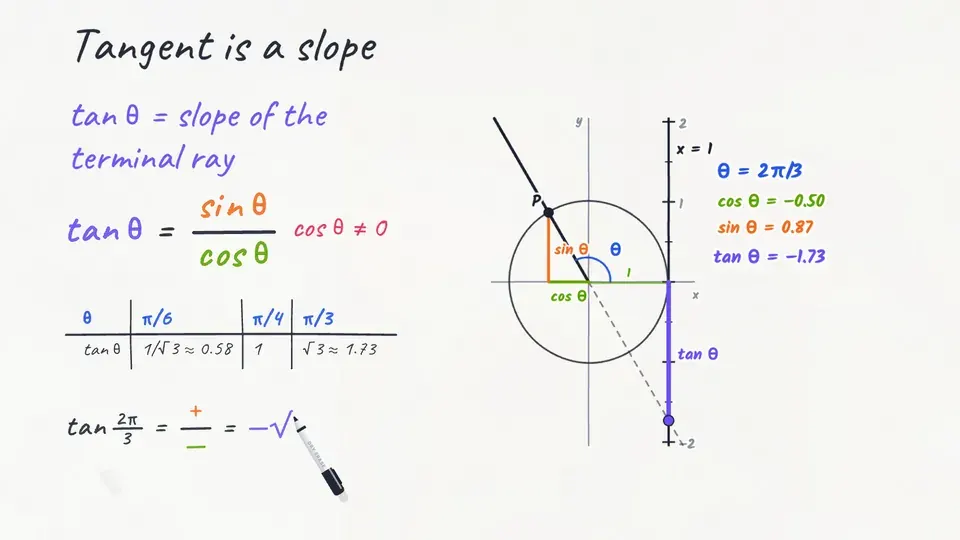
- For an angle θ in standard position, tan θ is the slope of the terminal ray: the ratio of the change in y to the change in x between any two points on the ray, which equals sin θ / cos θ when cos θ ≠ 0. It is also the height where the ray's line meets the line x = 1.
- tangent line (of a circle)
- A line that touches a circle at exactly one point. The line x = 1 is tangent to the unit circle at (1, 0); the tangent function is named after the segment of this line cut off by the terminal ray's line.
- period of the tangent
- π. Half a turn moves the point (cos θ, sin θ) to (−cos θ, −sin θ), which has the same ratio, so tan(θ + π) = tan θ. The zeros at θ = kπ are π apart, so no smaller period works.
- vertical asymptote
- A vertical line the graph approaches without bound but never reaches. y = tan θ has vertical asymptotes at θ = π/2 + kπ (k an integer), where cos θ = 0.
- domain and range of the tangent
- Domain: every real θ except π/2 + kπ. Range: all real numbers.
- concave down / concave up
- A graph is concave down where its rate of change is decreasing and concave up where its rate of change is increasing. Between consecutive asymptotes the tangent increases, concave down and then concave up.
- inflection point
- A point where a graph changes concavity. y = tan θ has inflection points at (kπ, 0), the center of each branch.
- transformations of the tangent
- g(θ) = a·tan(b(θ + c)) + d: a vertical dilation by |a| (reflected over the x-axis if a < 0), period π/|b| (reflected over the y-axis if b < 0), a phase shift of −c, and a vertical shift by d of the graph and of the line through its inflection points. The tangent has no amplitude.
Transcript
2,553 words · 8 parts
The spot that disappears
This light turns at exactly the same speed the whole time, one slow, steady turn every half minute, and you can hear its gear ticking away like a clock. But look at the spot it throws on that wall. Right across from the light, it barely creeps along the stones. Then it starts to speed up, faster and faster, and it’s gone.
And now look at the other end of the wall. It’s coming back in from the far side. It never came back past us, it left at one end and came in at the other, and the light never changed speed once. Down on the wall itself, you can see just how fast it goes. A kilometer down the wall, it’s covering two kilometers every second, a hundred times faster than when it passed in front of the light.
By the end of this lesson, you’ll be able to say exactly where that spot lands for any turn of the light, and where it goes when it disappears. Then we’ll rebuild the machine, and you’ll predict what it does before it runs. The secret is a function you’ve already met, hiding in the slope of that beam. So let’s float up and look at this harbor from straight above.
Where does it land?
From up here the wall is a straight line, exactly one hundred meters from the light, so let’s call that distance one unit. Turn the light to forty-five degrees, and the spot lands exactly one unit along. To reach the wall the beam always runs one unit across, and however far along the wall it lands is how much it rose.
So the beam’s slope, rise over run, is that distance over one, which means the spot’s position is the slope of the beam. The beam is the terminal ray of the angle the light has turned. Its slope has a name you already know: the tangent of that angle. Wherever the spot lands, you’re reading off the tangent.
Now let’s draw a circle of radius one around the light. The wall is one unit out, so it just touches the circle. The beam crosses the circle at P, whose coordinates are cosine theta and sine theta, so under P there’s a little triangle that runs cosine theta and rises sine theta. It’s the same beam, so both triangles have the same slope, and tangent theta over one equals sine theta over cosine theta.
Now turn the light on to a hundred and twenty degrees. The white beam points away from the wall. But its line keeps going, back through the light and out the other side. That’s why the light has a second lens. The green spot lands where the line lands. Now, onto the board.
On the board, the wall is the line x equals one. The terminal ray’s line meets it at a height of tangent theta. The slope is the same between any two points on the ray, so let’s use the origin and P, which gives us sine theta over cosine theta, as long as cosine theta isn’t zero. If P is three fifths, four fifths, the tangent is four fifths over three fifths, four thirds, and that’s exactly where the line of the ray hits the wall.
The angles you know work the same way. At pi over six it’s one over root three, about zero point five eight, at pi over four it’s one, and at pi over three it’s root three, about one point seven three. When the ray points left, like at two pi over three, it never reaches the wall, but its line does, back through the origin, at negative root three, because the sine is positive there and the cosine is negative.
Now you try one. The terminal ray goes through the point negative zero point six, zero point eight on the unit circle. What’s the tangent of theta? The tangent is a slope you can actually see. Now let’s go back and keep the light turning.
Half a turn
Back at the harbor, the light is at thirty degrees, so the white spot sits about fifty-eight meters along the wall, and I’ll leave a marker there. Now you turn the light, and keep going until a spot lands on that marker again, watching how far you’ve turned. After half a turn the white beam points exactly the opposite way from where it started, but it lies on the same straight line, and one line has one slope, so it lands in the same place.
On the unit circle, half a turn takes P to the point straight across the origin, where both coordinates have flipped sign, negative cosine theta and negative sine theta. Divide them, and the two negatives cancel, so the tangent of theta plus pi is exactly the tangent of theta.
So the tangent repeats every half turn, and its period is pi, half of the two pi that sine and cosine need. And it can’t repeat any sooner, because the tangent is zero only when the ray lies flat, at zero, pi, two pi, and the next zero after zero is all the way at pi.
Where does it go?
So where does the spot go when it disappears? Let’s keep turning the light, closer and closer to ninety degrees. At eighty degrees the spot is already about five hundred seventy meters away, at eighty-five more than a kilometer, and at eighty-nine almost six kilometers, way past the end of the stones, so we follow the wall’s line out to sea. At eighty-nine point nine it’s fifty-seven kilometers.
So what happens at exactly ninety degrees? Where’s the spot then? At exactly ninety degrees the beam runs parallel to the wall. It never meets it, not far away, not anywhere, so there’s no spot at all.
Here cosine theta is zero, so sine over cosine would mean dividing by zero. The tangent of ninety degrees is undefined, and a lot of people hear that as really, really big, but it means there’s no number there at all.
Turn just a tenth of a degree past it, and the green beam lands fifty-seven kilometers down the wall the other way. That’s the spot we saw racing back in at the start. Now let’s turn the spot’s position into a graph. As the light turns, we carry the spot across and plot it above each angle, in radians.
The graph climbs slowly through the middle, then shoots up as the beam turns toward parallel, and at pi over two, where there’s no spot, it has a vertical asymptote, a line it gets closer and closer to but never reaches. Past it, the graph comes back up from far below, just like the spot coming in from the far end. And every half turn it starts again. Now let’s lay it flat.
Here’s the graph of the tangent. Its asymptotes come wherever cosine is zero, at pi over two and every half turn from there, either way, which we write as pi over two plus k pi, for any integer k. So the domain is every angle except those, and the range is every real number, because the spot can land anywhere along the wall, as far out as you like.
Steady turn, racing spot
One mystery is left, why a steady turn makes the spot race. So let’s have the light flash every fifteen degrees and leave a mark on the wall each time. The flashes come at a perfectly even beat, but look at the marks. Near the middle they’re bunched up, about twenty-seven meters apart, and out toward the ends they spread out, seventy-three meters, then two hundred.
Coming in, each step is shorter than the one before, so the spot slows down, and going out each step is longer, so it speeds up, but it never turns around. Let’s write those steps down.
Here are equal steps on the board, every pi over twelve, the light’s fifteen degrees, from negative pi over three up to pi over three, with the tangent of each angle, and in the last column, how much the tangent went up since the row before. Let’s check where the first change comes from. Going from negative pi over three to negative pi over four, the tangent goes from about negative one point seven three up to negative one, so it went up by negative one minus negative one point seven three, which is zero point seven three.
Every change is positive, so the tangent increases the whole way. Coming in toward zero, the changes shrink, from zero point seven three down to zero point two seven, the same seventy-three and twenty-seven meter gaps we saw on the wall, and on the way out they grow again.
So on which interval is the tangent increasing at an increasing rate? When it’s increasing at a decreasing rate, the graph bends like this, and we call that concave down, and when it’s increasing at an increasing rate, it bends the other way, and that’s concave up.
The bend flips right at zero, the middle of the branch, and a point where the concavity changes is called an inflection point. In the harbor, that’s the spot passing right across from the light, at its slowest. The exam describes the tangent this way. It’s increasing between any two consecutive asymptotes, and its graph goes from concave down to concave up.
That stretching hides in most 3D games you play. The camera treats your screen as a flat wall a distance f in front of your eye, so something an angle theta off to the side lands f times the tangent of theta from the center. That’s why the edges of a wide view look stretched, and why a flat view can never show a full hundred and eighty degrees, since that would need the tangent of ninety degrees, which doesn’t exist.
Four knobs
Now let’s rebuild the machine. Every change we can make to it turns the tangent into a function of this form, a times the tangent of b times the quantity theta plus c, plus d. The easiest knob is d. Slide the light d units along the wall and every spot moves with it, so the graph and the line through its inflection points both move up by d.
Be careful with the word midline here. The tangent never reaches a highest or lowest value, so it has no amplitude, and the line through its inflection points is the one we track instead. Next is a. Move the light twice as far from the wall and every spot lands twice as far along, so the graph stretches vertically by two while the asymptotes stay put. And if a is negative, every height flips sign, so the graph reflects over the x-axis and every branch runs downhill instead.
The dial is theta, the number you feed in. Knob b is a gear between the dial and the light. Set b to two, and the light turns twice as fast. It reaches parallel when the dial reads only pi over four. That halves the period, to pi over two.
A negative b runs the gear backward, and that reflects the graph over the y-axis. The last knob, c, is a head start on the dial. With c equal to negative pi over four, the light only points straight across when the dial reads pi over four, so the whole graph slides right by pi over four, which is a phase shift of negative c. In general the center sits where theta plus c is zero, at theta equals negative c, so a minus sign inside the parentheses slides the graph right, and a plus slides it left.
Let’s sketch one the way the exam expects, two times the tangent of two times the quantity theta minus pi over eight, plus one. Call the inside u. Every landmark comes from a value of u we know. First, u is zero when theta is pi over eight.
The tangent of zero is zero. That makes g two times zero, plus one, which is one. The center is the point pi over eight, one. Your turn. Where’s the center of three times the tangent of two times the quantity theta minus pi over six, plus one?
Next, the asymptotes. They come where u is pi over two. Divide both sides by two. Theta minus pi over eight is pi over four. Add pi over eight, which is half of pi over four. Theta is three pi over eight.
The same steps with negative pi over two give negative pi over eight. Those two asymptotes are pi over two apart. That’s one period. Halfway out, u is plus or minus pi over four. Halve that and add pi over eight. Theta is zero or pi over four.
The tangent there is negative one or one. Two times negative one, plus one, is negative one. Two times one, plus one, is three. The graph passes through zero, negative one, and pi over four, three. Now the curve just has to rise through those three points between the asymptotes, concave down and then concave up, and repeat every pi over two.
Back to y equals three times the tangent of two times the quantity theta minus pi over six, plus one. Which of these is a vertical asymptote? That method works for any machine. Let’s go back to the harbor and build one.
Build the machine
Back at the harbor, there’s a new job for this machine. It’s drawn in the sky as the graph the spot has to follow. Its branch is centered at pi over four, two, its asymptotes are at zero and pi over two, and it passes through three pi over eight, five. Now turn the four knobs. Keep going until your machine’s graph sits right on top of that one.
Now let’s switch it on and step the dial. At pi over eight the spot lands at negative one. At pi over four it’s at two, the center. At three pi over eight the tangent is one. Three times one, plus two, puts the spot at five, right where the graph said.
And as the dial comes up to pi over two, the spot races off down the wall and disappears. That’s exactly where the asymptote said it would. And here’s our original sweep again. It still creeps, races and vanishes, but now you know where it lands at every turn, and when it disappears, it isn’t anywhere at all, until the other lens brings it back.
What to remember
The tangent of theta is the slope of the terminal ray, sine over cosine. It’s where the ray’s line meets the line x equals one. It repeats every half turn, so its period is pi. Wherever cosine is zero, at pi over two plus k pi, it’s undefined, and between those asymptotes it always increases, concave down and then concave up.
Then the four knobs. The absolute value of a sets the stretch, and the period becomes pi over the absolute value of b. The graph shifts by negative c, and d moves the center line to y equals d. So the next time a light sweeps across a wall, you’ll know exactly where its spot is going. And you’ll know where it goes when it’s gone.