
Topic 3.1 key terms
- periodic relationship
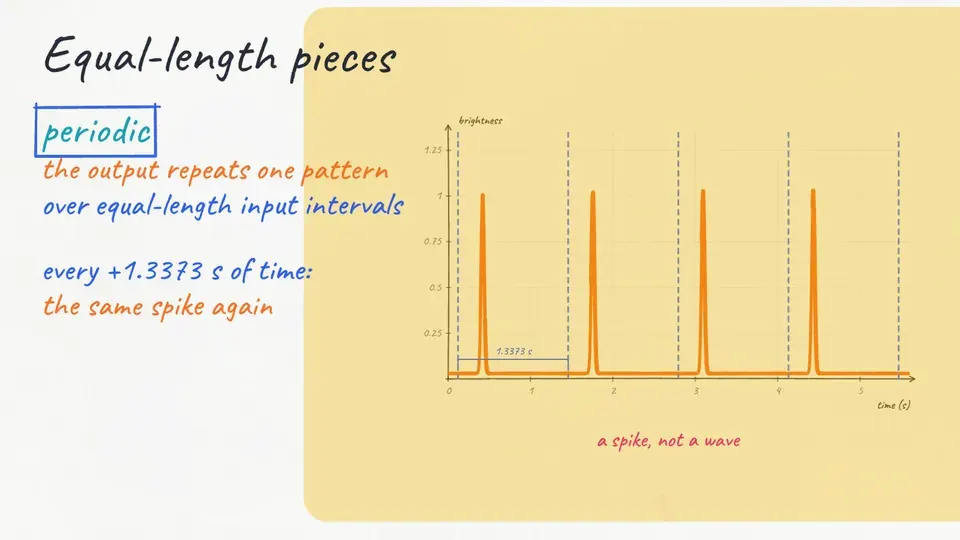
- A relationship is periodic if, as the input values increase, the output values show a repeating pattern over successive equal-length intervals. The pattern can have any shape (spikes, corners, flat stretches), not just a smooth wave.
- period
- The smallest positive value k such that f(x + k) = f(x) for every x in the domain. Any whole-number multiple of the period is also a repeat, but it is not the period. The behavior of f is completely determined by any interval of width k.
- cycle
- One full repetition of a periodic pattern: the graph over one interval whose length is the period. The whole graph can be built by copying one cycle end to end.
Transcript
2,346 words · 8 parts
Little Green Men
Before anything else, listen to this, just for a moment. That isn’t a clock, and it isn’t a machine. It’s a signal from space, and it’s been ticking like that, once every second and a third, for millions of years. In nineteen sixty-seven, a twenty-four-year-old student named Jocelyn Bell was checking the recordings from a brand-new radio telescope outside Cambridge, in England, up to ninety-six feet of chart paper every night, and all of it by hand.
Somewhere in all that paper, she spotted a tiny smudge that she called a bit of scruff, and it kept coming back. So she recorded it again at high speed, and the scruff turned into this, a pulse, then another, then another, so evenly spaced that her team half-jokingly nicknamed it Little Green Men.
It wasn’t aliens. It was a dead star about the size of a city, spinning so fast that a beam from it sweeps past the Earth once every one point three three seven three seconds, and every sweep is one tick. Stars like this are called pulsars. Now cut that signal into pieces one beat long, and stack eighty of them, one behind the other, and you get a picture you might have seen on a T-shirt.
By the end of this lesson, you’ll be able to find the beat hiding in a signal like hers. Then, you’ll pull a star out of a recording that looks like nothing but static. That’s a trick pulsar hunters still use today. Both of those come down to one idea, and it has a name you’ve probably heard before, periodic, so let’s look really carefully at what this star is doing.
The same, over and over
Here’s the star’s signal as a graph, with time going across and the brightness the telescope picked up going up, and every one of those spikes is one sweep of the beam. Now let’s cut it the way we just did, into pieces that are all the same length, one point three three seven three seconds each, and every piece has the same thing inside it, a flat stretch, one sharp spike, and flat again.
That’s exactly what the word periodic means. A relationship is periodic when, as the input keeps increasing, the output repeats the same pattern over and over, on intervals that all have the same length. On the exam you’ll want to say it in a way that ties the input to the output, like this. Every time we move one point three three seven three seconds later, the brightness goes through the same spike again.
And notice this isn’t a smooth wave at all. A periodic pattern can have any shape, spikes and corners and flat stretches included, as long as it keeps coming back on the same schedule.
Let’s try one that’s a lot closer to home, your own heartbeat. Here’s how a doctor would describe one beat on a heart monitor, just in words. First there’s a small rounded bump, then a tall, sharp spike with a little dip on each side of it, then a broader, gentler hump, and then the line stays flat until the next beat starts.
A resting heart does that about seventy-five times a minute, so one beat lasts about zero point eight seconds, and if we copy that one beat again and again, every zero point eight seconds, we’ve drawn the whole heart monitor. A real heart speeds up and slows down a little from beat to beat, so it’s only nearly periodic, but one ideal beat is how we’d model it.
Plenty of things repeat without being periodic. The carbon dioxide in the air over Hawaii rises and falls with the same shape every year, peaking around May, but every May it’s higher than the May before. So no month ever comes back to the same value, and it isn’t periodic. Old Faithful, in Yellowstone, erupts again and again, but the wait can be anywhere from about an hour to two hours, so the intervals aren’t equal, and it isn’t periodic either.
Here are three graphs of a basketball’s height, each one two seconds long, and only one of them matches what I’m about to describe. Now you try one, so picture a player dribbling a basketball in place. The ball leaves her hand, hits the floor, and bounces straight back up into her hand, twice every second, without missing a beat. Which graph shows the ball’s height?
Fold it
Let’s go back to the star, because that stack of rows is exactly how astronomers check a beat like hers. Every row is one piece of the signal, and right now each one is one point three three seven three seconds long. That’s why all the spikes line up in one straight spine, but nobody knew that number ahead of time. You have to guess a length, cut the signal, and look, so let’s see what a wrong guess does.
Suppose we make every row a little too short, one point three zero seconds instead of one point three three seven three. What do you think happens to the spikes as we go up the stack?
And if the rows are too long, say one point three seven seconds, each spike lands a little earlier in its row, so the whole thing leans the other way. Now it’s your turn to find the beat, so drag the row length until every spike lines up in one straight spine.
There’s the spine again, at one point three three seven three seconds. Now watch what happens if we make the rows twice that long, two point six seven four six seconds. They line up perfectly again, but now every row holds two beats, so we get two spines. The signal really does repeat every two point six seven seconds, but that’s two beats stuck together, and that’s going to matter.
Back to one beat. Take a window one beat wide, and slide it anywhere. It always holds one full beat. Copy what’s inside end to end, and you rebuild the whole signal.
The smallest repeat
Let’s write that down. Call the star’s brightness at time t, f of t. Wait one beat, and the brightness is right back where it was. In symbols, f of t plus one point three three seven three equals f of t. That’s true at every time t.
Jump two beats, and it still works. Three beats work too. Any whole number of beats lands you on the same part of the pattern. Which one is the period? The smallest.
The period is the smallest positive jump, k, that makes f of t plus k equal f of t, for every t. For this star, that’s one point three three seven three seconds. Notice I said every t. A jump that works only some of the time doesn’t count.
Try a jump of half a second. From one flat spot to the next, the height matches. Now start on a spike. Half a second later, you’re on flat ground. It fails.
Astronomers usually don’t get a smooth graph, though. They get readings at equal time steps, like these, one every quarter of a second, from a made-up star that sends a tall pulse and then a smaller one every turn. Find the place where this list starts over. What’s the period of this signal, in seconds?
One beat builds them all
The rows in the stack aren’t quite identical. Each pulse is a little taller or shorter than the last. Only the timing is perfect. Like your heartbeat, the star is only nearly periodic. Averaging all the rows gives one ideal pulse, the star’s fingerprint.
That one pulse is one cycle, and if we stamp it out end to end, one copy every beat, we get the whole signal back, tick and all, because every cycle is a copy of this one. Mark the spot where the pulse rises fastest. The same mark lights up in every row of the stack at once. The peak, the fall and the long flat stretch light up too. Whatever a periodic function does in one cycle, whether it’s rising or falling, bending one way or the other, or holding still, it does in every cycle.
Let’s bring back the player’s dribble, and draw just one dribble, from one bounce to the next, half a second long. For the first quarter of a second the ball rises toward her hand, slowing down as it goes, and for the next quarter second it falls, speeding up, so the whole arch bends downward, and it’s concave down.
At every bounce there’s a sharp corner, where the rate of change jumps from falling fast to rising fast. Now stamp that one dribble again every half second, and we have the ball’s height for as long as she keeps going. And this is where it really pays off. What’s the ball doing at nine point four seconds? That’s way off our graph, but we don’t need any more graph.
Eighteen half-second dribbles take nine seconds, so nine point four is eighteen whole dribbles plus zero point four seconds. That means the ball is doing exactly what it does at zero point four, which is falling, and speeding up, on its way down toward the floor. The ball keeps dribbling exactly like this. On which of these time intervals is it falling?
On the exam
This is exactly where the exam’s periodic question starts. Question 3 on the 2026 AP exam opened with a water wheel that turns counterclockwise and completes one revolution in ten seconds, with a point W on its edge starting six feet directly above the center. One revolution takes ten seconds, so the motion repeats every ten seconds. The period is ten seconds, read straight out of a sentence.
Point W starts at the top, six feet above the center. Call W’s height above the center h. Below the center, h is negative. A quarter of a turn later, at two point five seconds, it’s level with the center, on the left side. At five seconds it’s at the very bottom, six feet below, at seven point five it’s level with the center again, on the right, and at ten seconds it’s back at the top, ready to go around again.
Those are exactly the five points the exam asked for, one quarter of a period apart, and the scoring guide wanted the times zero, two point five, five, seven point five and ten, give or take whole periods. And the second turn draws exactly the same curve again, one cycle copied, just like the star’s pulse.
This is exactly how the exam asks it. On the interval from fifteen to seventeen and a half seconds, which of these is true about W’s height? On that same stretch the curve is shaped like a cup, so it’s concave up, and W climbs faster and faster as it swings toward the side, so the rate of change of the height is increasing.
That’s the last part of the exam’s question, and the scoring guide wanted both halves of the answer, concave up and the rate of change of the height increasing, so a response that only says concave up doesn’t earn the point. The exam also asked for this curve’s formula, and we’ll learn to write one in a few lessons. Everything we needed today came from one sentence and one turn of the wheel.
What to remember
So let’s pull it all together before we go find a star. A relationship is periodic when its output repeats the same pattern over equal-length intervals of its input. The period is the smallest positive length that works, and you can find it by folding, or by seeing where a list of readings starts over. And one cycle tells you everything, because whatever happens in one cycle happens in every cycle.
A star in the static
Here’s a recording like the ones pulsar hunters sift through every day, and as far as your eye can tell, it’s nothing but static. Cut it into rows, and not a single row shows a pulse. But if a beat is hiding in there, folding at exactly the right length puts every buried pulse in the same spot, and when we add up all the rows, the random noise mostly cancels out while the pulses pile up.
So go ahead and be the pulsar hunter. Drag the row length slowly and keep an eye on the signal meter. Stop when a pulse comes up out of the static.
Its beat is zero point seven one four five seconds. At twice that length you’d get two pulses side by side, which is a repeat, but the period is still the smallest one. That’s the real beat of a real pulsar, one that spins about seven times every five seconds, and we hid it in this static for you. Astronomers find faint pulsars exactly the way you just did, by folding.
Because its beat is periodic, we know where every pulse is, even the ones we can’t see. If one arrives at time zero, the hundredth one after it comes a hundred beats later, at about seventy-one point four five seconds. And there it lands, right on the mark.
Pulsars keep such good time that in nineteen seventy-seven NASA etched a map of fourteen of them on the covers of the Voyager probes’ golden records, with each pulsar’s period written in, so anyone who ever found one of the probes could work out where we live. And it all started with a student who noticed a little bit of scruff that kept coming back. In nineteen seventy-four her supervisor shared a Nobel Prize for the discovery, and she was left out.
Decades later, she gave away the three million dollars from a big prize of her own, to help other students become physicists. You started this lesson listening to a tick from space, and now you can find the beat hiding in a signal and pull a star out of the noise, because once you know one cycle of a periodic pattern, you know them all.