
Topic 3.9 key terms
- arcsine
- The inverse of sine on the restricted domain [−π/2, π/2], also written sin⁻¹x. arcsin x is the angle in [−π/2, π/2] whose sine is x; its domain is [−1, 1] and its range is [−π/2, π/2].
- inverse trig notation
- sin⁻¹x, cos⁻¹x and tan⁻¹x mean arcsin x, arccos x and arctan x. The −1 marks an inverse function, not an exponent: sin⁻¹x is not 1/sin x.
- restricted domain
- Because trig functions are periodic, they are one-to-one only on a restricted interval. The standard restrictions are [−π/2, π/2] for sine, [0, π] for cosine and (−π/2, π/2) for tangent; each becomes the range of the inverse.
- arccosine
- The inverse of cosine on the restricted domain [0, π], also written cos⁻¹x. arccos x is the angle in [0, π] whose cosine is x; its domain is [−1, 1] and its range is [0, π], so it never gives a negative angle.
- arctangent
- The inverse of tangent on the restricted domain (−π/2, π/2), also written tan⁻¹x. arctan x is the angle in (−π/2, π/2) whose tangent is x; its domain is all real numbers and its range is (−π/2, π/2), with horizontal asymptotes y = ±π/2.
Transcript
2,298 words · 9 parts
One number, two phones
Turn your phone on its side and the picture on the screen turns to stay upright, so somewhere inside, your phone always knows exactly which way it’s tilted. But there’s no tiny protractor in there. Instead there’s a speck of silicon hanging on springs thinner than a hair, and all it can feel is how much of gravity pulls it along the phone.
Tilt the phone thirty degrees, and the pull along it is exactly half what it would be standing straight up. So the chip reports one number, point five, and that’s all it knows. But now turn the phone almost upside down, to a hundred and fifty degrees, and that little block feels exactly the same pull, so the chip says point five again. That’s one number for two completely different positions, and that number alone can’t tell you which.
By the end of this lesson, you’ll be able to take a reading like point five and turn it back into an angle, and you’ll understand exactly how your phone tells these two positions apart. The tool for all of it is a function you already know, running backwards, so let’s go back to that little block and work out what its number really means.
Running sine backwards
Turn the phone level, on its side, and gravity pulls straight across it, so nothing pulls along the phone and the chip reads zero. Stand it straight up, and all of gravity pulls along it, so the chip reads one. And at thirty degrees it reads one half. That number should look familiar, because the sine of thirty degrees is also one half, and it’s no coincidence. The chip’s reading is the sine of the tilt.
Put a circle of radius one around the phone, and the reading is exactly the height of the phone’s tip on that circle, the same height sine has always measured. So the chip runs sine forward, angle in and reading out. We want the trip back, reading in and angle out, so the reading and the angle have just traded jobs.
On the board, the chip’s fact is sine of pi over six equals one half, since thirty degrees is pi over six, and on the board we’ll work in radians. Sine takes pi over six to one half, and running it backwards takes one half back to pi over six, which we write as arcsine of one half equals pi over six. You’ll also see it written another way. It’s sine, with a little negative one up top.
That negative one is the same one as in f inverse from Unit 2, so it never means one over sine. One over sine of pi over six just flips the one half into a two, and that’s nowhere near the angle pi over six. So arcsine answers a single question, which angle has this sine, and the trouble, as the two phones showed us, is that more than one angle does.
Every reading comes back
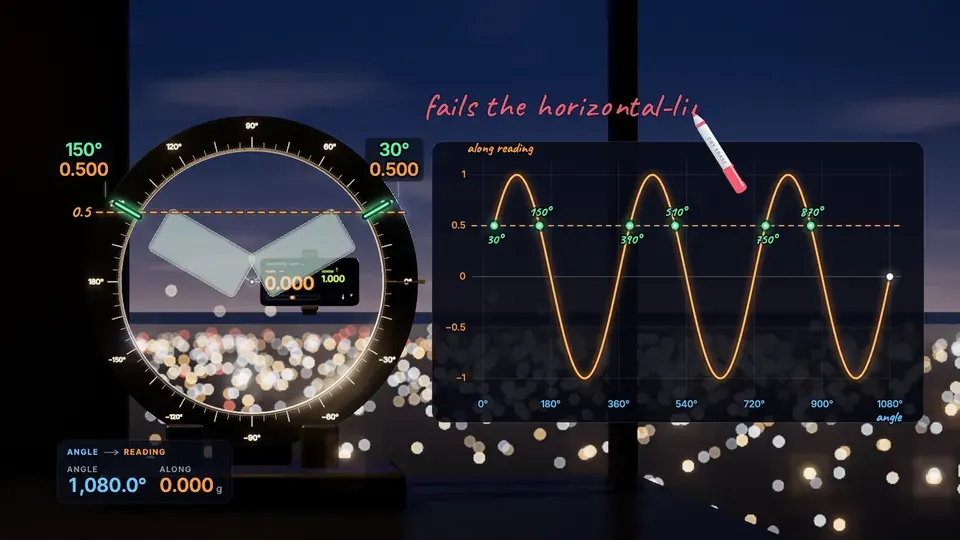
Let’s give the phone a graph. As it turns, this chart plots its reading against its angle, and the line across it marks a reading of exactly one half. I’m going to let the phone spin all the way around three times. How many times do you think the chip will read exactly one half?
Here it goes. Thirty degrees, a hundred and fifty, then three ninety and five ten on the second turn, and seven fifty and eight seventy on the third. That’s twice every turn, forever, because sine repeats itself every full turn, so a reading of one half belongs to infinitely many angles.
This is the horizontal line test from Unit 2. A horizontal line that crosses a graph more than once means you can’t run it backwards, and this one crosses it again and again. So if arcsine is going to be a real function, with exactly one answer for every reading, we have to make a choice, and I’m going to let you make it.
You choose the window
We’ll only allow angles inside one window on the ring, and these two lights will judge your window. The first light checks that no reading comes from two angles in your window. The second checks that every reading from negative one to one still has an angle in there. Let me try one. From zero to ninety degrees, every reading has only one angle, so the first light comes on, but the phone never reads anything negative in there, so the second light stays off.
Zero to a hundred eighty is worse. Thirty and a hundred fifty are both inside it, so the first light goes off, and there’s still nothing negative, so neither light is on. Now it’s your turn to find one that works, so drag the two ends of the window around the ring, until both lights come on.
Lots of people find negative ninety to ninety, and some find ninety to two seventy, and both work. But arcsine has to give the same answer to everybody, so mathematicians agreed on negative ninety to ninety. It’s centered on zero, and all the way through it, the reading keeps climbing, from negative one all the way up to one.
Now ask for any reading, like negative one half, and exactly one phone lights up, and the same for point eight, while the other poses just fade out. In radians that window runs from negative pi over two to pi over two, and it’s sine’s restricted domain, the one every calculator uses for arcsine. Let’s take that piece of the sine curve to the board. We’ll build arcsine out of it.
Building arcsine
Here are five angles from the window, negative pi over two, negative pi over six, zero, pi over six and pi over two, and next to each one, its sine, negative one, negative one half, zero, one half and one. To run sine backwards, we swap the two numbers in every pair, so now the reading is the input and the angle is the output. On the graph, swapping every pair flips sine’s piece over the line y equals x, and each point lands where its swapped pair says it should.
That’s the graph of arcsine, climbing from the point negative one, negative pi over two, through the origin, up to the point one, pi over two. Its domain is from negative one to one, every reading the chip can give, and its range is from negative pi over two to pi over two, exactly the window we agreed on. The range of the inverse is the window.
Now arcsine of negative one half. The height negative one half meets the circle twice, but only one of those points is on the right half, inside the window. That point is pi over six below the axis, and we get there by turning clockwise from zero, so arcsine of negative one half is negative pi over six.
Now you try one. What’s the arcsine of negative root three over two? So arcsine gives exactly one angle for every reading. Cosine is next, and it turns out to need a different window.
Cosine needs a different window
Back to the phone, because its chip has a second channel. This one measures the pull across the phone, and that reading is the cosine of the tilt, the tip’s sideways position on the circle. Let’s try sine’s window. At thirty degrees the across reading is about point eight seven, and at negative thirty, nose down, it’s point eight seven again, so the first light goes off.
So which of these windows gives cosine exactly one angle for every reading? The top half of the circle, from zero to pi, works. As the phone turns from level, over the top and down to level the other way, the across reading falls from one to negative one, passing each value once.
So arccosine starts from cosine on zero to pi and swaps its pairs. One goes to zero, zero goes to pi over two, and negative one goes to pi. Its graph runs from the point negative one, pi, down to the point one, zero, so arccosine is decreasing, the opposite of arcsine. Its domain is negative one to one again, and its range is zero to pi, the top half, so arccosine never gives you a negative angle.
So the same input can give very different answers. Arcsine of negative one half is negative pi over six, but arccosine of negative one half is two pi over three. A negative input doesn’t always mean a negative angle, because it depends on whose window you’re in.
What’s the arccosine of negative root three over two? That’s sine and cosine done. Tangent is the last one, and the phone has one more reading to show us.
Tangent: the phone’s slope
Now divide the two readings, along over across, and you get the slope of the phone itself, rise over run, which is the tangent of the tilt. Tangent has its own twin problem. Turn the phone exactly upside down and both readings flip sign, so the slope comes out exactly the same.
So tangent uses the right half again, because it holds exactly one phone from every upside-down pair. We leave out its top and bottom points, because straight up or straight down the across reading is zero, and a vertical phone’s slope is undefined. As the phone creeps toward vertical, the slope climbs to ten, then a hundred, then a thousand, and the angle gets closer and closer to ninety degrees without ever getting there.
On the board, here’s tangent on its window, climbing between two vertical asymptotes. Swap the pairs and it turns over into arctangent, and the vertical asymptotes turn into horizontal ones, at pi over two and negative pi over two.
So arctangent takes any real number at all, and its range is from negative pi over two to pi over two, with both ends left out. A phone tilted forty-five degrees below level has a slope of negative one, so arctangent of negative one is negative pi over four. And remember the Stoosbahn, the Swiss cliff railway? Its steepest grade, a hundred and ten percent, is a slope of one point one, so right there it climbs at about forty-seven point seven degrees.
Here are all three in one table, and it’s exactly the table the exam expects you to know cold. Just like arcsine, the other two are also written with that little negative one up top. Each inverse takes the trig function’s outputs as its inputs, and each one’s range is its window.
Back to the two phones
Now we can explain the two phones. A hundred and fifty degrees is five pi over six, so what’s arcsine of sine of five pi over six? Work from the inside out. Sine of five pi over six is one half, and arcsine of one half is pi over six, so the answer is pi over six, not five pi over six.
Pi over six has the right sine, and it’s inside the window. Five pi over six has the right sine too, but it’s outside the window, so the inverse can never give it back. So if you start with a reading, take its arcsine and then the sine, you always get your reading back. But if you start with an angle, take its sine and then the arcsine, you only get your angle back when it was in the window. The exam loves this question.
Try this one the same way. What’s the arctangent of tangent of three pi over four? Now let’s go back to the lab. Let’s see what arcsine makes of a phone that just keeps on turning, around and around.
The bright phone shows what arcsine says about the real one. As the real phone goes all the way around, arcsine’s answer swings up, back down, and never once leaves its window. Now for the real test. This phone is sealed in a box, and all we get are its two readings, point six along the phone and negative point eight across it.
To the nearest tenth of a degree, what’s the tilt of the phone in the box? Arcsine of point six is about thirty-six point nine degrees, if you want somewhere to start.
Arcsine of point six says thirty-six point nine degrees, arccosine of negative point eight says one hundred forty-three point one, and arctangent of the slope says negative thirty-six point nine. Only one of them matches both readings. Along is positive, so the phone points up, and across is negative, so it points left. Up and to the left is in the top half of the circle, arccosine’s window, so arccosine’s answer is the right one.
Let’s open the box. There it is, at one hundred forty-three point one degrees, exactly where the two readings said it would be. And that’s how your phone tells thirty degrees from a hundred and fifty. It reads two channels at once, and the across reading is positive at thirty degrees but negative at a hundred and fifty.
What to remember
A trig function repeats, so to run it backwards we keep one window of angles where every value shows up exactly once. Each inverse takes a value and gives back the angle in its window, so its range is the window. For arcsine that’s negative pi over two to pi over two, for arccosine zero to pi, and for arctangent it’s negative pi over two to pi over two again, with both ends left out.
And arcsine of sine of theta is theta only when theta was already in the window. So the next time the picture on your screen turns, think of a tiny block of silicon feeling a fraction of gravity, and an inverse trig function turning it back into an angle.