
Topic 3.3 key terms
- unit circle
- The circle of radius 1 centered at the origin. The terminal ray of an angle θ in standard position meets it at (cos θ, sin θ).
- isosceles right triangle
- Half of a square, cut along its diagonal: angles 45°, 45°, 90°. With hypotenuse 1, each leg is √2/2, which gives cos(π/4) = sin(π/4) = √2/2.
- equilateral triangle
- A triangle with three equal sides and three 60° angles. Cut in half by an altitude it gives a 30°-60°-90° triangle; with hypotenuse 1 its legs are ½ and √3/2.
- reference triangle
- The right triangle formed by the terminal ray, the x-axis and a vertical segment from the point on the circle. Its leg lengths give the sizes of cos θ and sin θ; the quadrant gives their signs.
- exact value
- A value written with integers, fractions and radicals, such as √3/2, rather than a rounded decimal such as 0.866.
- point on a circle of radius r
- For an angle θ in standard position, the terminal ray meets the circle of radius r centered at the origin at P = (r cos θ, r sin θ).
Transcript
2,431 words · 8 parts
The diagonal glitch
This is a tiny game we built for this lesson. It has a bug in it. And that bug is older than you are. Press right, and our little robot, Pip, dashes six meters and lands on the pad at the edge of the island. Press up, and you get the same thing, six meters.
Now watch closely. This time you press right and up at the same time. It flew right off the edge. That diagonal dash went about eight and a half meters, which is forty-one percent farther than a straight dash.
And it isn’t only our bug. Not long after Doom came out, players found that running forward and sideways at the same time carried them faster than running straight, and speedrunners still run diagonally on purpose, because it’s the fastest way through a level.
By the end of this lesson, you’ll fix this bug yourself. You’ll write down the exact coordinates that send Pip the same distance toward every pad on that ring, and you won’t need a calculator, just two triangles you can draw from memory. So let’s start with the dash that went wrong. Where should it have landed?
Forty-one percent too far
Let’s look down on the island from straight above, so the floor turns into a coordinate plane, with Pip’s starting spot at the origin. That diagonal dash sent Pip to the point six, six. It moved six meters to the right and six meters up, and those two moves meet at a right angle, so the distance Pip actually traveled is the hypotenuse, the square root of six squared plus six squared. Six squared plus six squared is seventy-two, and the square root of seventy-two is six root two, about eight point four nine meters.
That’s root two times the six meters a dash should go, and root two is about one point four one, so the diagonal went forty-one percent too far. Every dash is supposed to end on this ring, six meters from the start, whichever way Pip goes. That ring is a circle centered at the origin, and a perfect diagonal dash has to land on it at forty-five degrees, which is pi over four.
To keep the numbers simple, let’s measure in dashes for a while, so the ring’s radius is one. Last lesson you saw that on a circle of radius one, the point at angle theta is cosine theta, sine theta.
So the coordinates we’re after are the cosine and the sine of pi over four, and finding them exactly is the whole job. Most people’s first guess is one half and one half, because forty-five degrees is halfway between right and up. Let’s try it. Pip stops well inside the ring, short of a full dash from the start, so one half is too small.
So how far should it go? Slide the diagonal dash out until Pip lands exactly on the ring, then press dash. But why zero point seven oh seven? Let’s work it out exactly.
At forty-five degrees the two coordinates are equal, so let’s call both of them a. The two legs a and a and the radius one make a right triangle, so a squared plus a squared equals one.
That’s two a squared equals one, so a squared is one half, and a is the square root of one half, which is one over root two. Multiply the top and bottom by root two, and one over root two becomes root two over two. It’s the same number, about zero point seven oh seven, just written without a root on the bottom, and either form is fine on the exam.
Here’s another way to see it. Cut a square with sides of one along its diagonal, and that diagonal is root two long. Now shrink the whole triangle until the diagonal is exactly one, by dividing every side by root two, and each leg becomes one over root two. That’s the triangle hiding under a perfect diagonal dash, so the cosine and the sine of pi over four are both root two over two.
Notice that a decimal like zero point seven doesn’t quite work, because zero point seven squared plus zero point seven squared is only zero point nine eight. Root two over two is the exact number, and it’s the one the no-calculator part of the AP exam expects you to know.
Half an equilateral triangle
Lots of games let you aim in any direction, not just the eight you get from the arrow keys, so let’s aim Pip at pi over six, which is thirty degrees, just a little above straight right. Here’s a perfect dash at pi over six, and here’s its mirror image at negative pi over six, the same angle turned clockwise, below the axis.
Now join the two landing spots to each other, and look at the triangle you get. The angle at the start is thirty plus thirty, which makes sixty degrees. Both sides that leave the start are one dash long, so the other two angles match, and they share the hundred and twenty degrees that are left. That makes all three angles sixty degrees, so the triangle is equilateral, one dash on every side.
So the gap between the two landings is exactly one dash, and the x-axis cuts it right down the middle, which means the dash at pi over six climbs exactly one half. A clean one half, from nothing but symmetry. Let’s take this triangle to the board and find the other coordinate.
Here’s that triangle again, with every side equal to one. The x-axis is its line of symmetry, so it cuts the triangle into two right triangles, and it splits the vertical side into two halves. Pythagoras gives us the other leg. x squared plus one half squared equals one, and one half squared is a quarter, so x squared is one minus a quarter, which is three quarters. Then x is the square root of three quarters, and that’s root three over two.
So the dash at pi over six lands at root three over two, one half. If you’ve met the thirty-sixty-ninety triangle in geometry, with sides one, root three and two, this is the same triangle, just shrunk to half its size so its longest side fits a circle of radius one. We just found where pi over six lands. Where do you think a dash at pi over three lands?
This swap trips people up. It’s the one they mix up most. Here’s how to keep it straight. The bigger angle climbs higher, so the sine of pi over three is the bigger value, root three over two, and the sine of pi over six is the small one, one half.
Every direction
So now we have both triangles, and they’re all we need to reach every pad on this ring. Here’s the forty-five degree tile, sitting in the first quadrant. Flip it over the y-axis and it lands at three pi over four. Its legs are exactly as long as before, but now the horizontal one points left of the origin, so the x-coordinate is negative root two over two.
Flip them both below the x-axis, and you get five pi over four and seven pi over four. The sizes never change, root two over two every time, and only the signs follow where the pad is. The thirty and sixty degree triangles flip the same way, and they light up eight more pads. Add the four pads on the axes, and that’s sixteen exact landing spots, at every multiple of pi over six and pi over four.
Negative angles work the same way. Negative pi over three means turning sixty degrees clockwise, down below the x-axis. Pip lands at one half, negative root three over two. Only the vertical coordinate went negative, because that pad is below the x-axis but still to the right of the y-axis.
Now you aim one. Set the two coordinates for a dash at seven pi over six, and press dash to see where Pip lands. Let’s write the method down. It works for every one of these angles.
Step one is finding the triangle, so ask whether the angle belongs to the pi over four family or the pi over six family, and what angle its ray makes with the x-axis. Step two, read the two leg sizes off that triangle, and step three, give each coordinate the sign of where the point really is.
Let’s try the cosine of five pi over six. Five pi over six is pi over six short of a half turn, so it’s the thirty degree triangle, flipped over to the left. Its horizontal leg is the long one, root three over two, and the point is left of the y-axis, so the cosine is negative root three over two.
Now the sine of negative pi over three. That’s the sixty degree triangle, turned clockwise below the axis. Its vertical leg is the long one, root three over two, and it points down, so the sine is negative root three over two. And an angle like thirteen pi over six is just pi over six plus a full turn, so it lands on exactly the same point as pi over six.
Here’s one the way the exam asks it, with no calculator. What’s the exact value of the cosine of seven pi over four?
Any size of circle
So far we’ve measured everything in dashes, but Pip’s dash is really six meters long. Where does the pi over six dash land, then, in meters? Watch the triangle as its circle grows from one meter to six. The angle stays the same, so every side grows by the same factor, and both legs end up six times longer.
So the dash lands at six times root three over two, which is three root three, and six times one half, which is three. And that works on any circle. So let’s write it down.
The small triangle and the big one are similar, the same shape at two different sizes, so on a circle of radius r, the point at angle theta is r cosine theta, r sine theta. Cosine and sine are ratios with no units, so all the meters come from r. Let’s put Pip on the pad at five pi over six with a six meter dash. On the unit circle that pad is at negative root three over two, one half, so in meters it’s negative three root three, three.
Let’s check that it’s really six meters from the start. Three root three, all squared, is twenty-seven, and three squared is nine, and twenty-seven plus nine is thirty-six, which is six squared. And the diagonal that started all this should go six times root two over two in each direction, which is three root two, about four point two four meters.
A hundred and ten meters
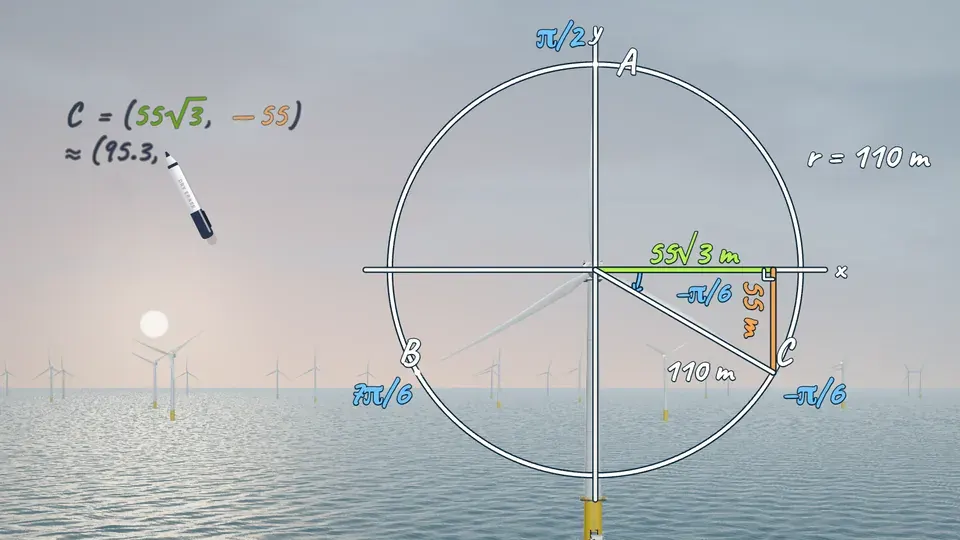
Now let’s take the same two triangles somewhere much bigger. This is Dogger Bank, far out in the North Sea, and every one of these turbines is a giant. Each blade is a hundred and seven meters long, longer than the wingspan of the biggest passenger jet ever made, and the rotor is two hundred and twenty meters across, so every tip sits a hundred and ten meters from the center of the hub.
Seen from the front, these turbines turn clockwise, so every blade’s angle keeps going down, which is just what a negative angle means. Let’s stop the rotor with blade A pointing straight up, at pi over two. The three blades are a third of a turn apart, two pi over three, so blade B points to seven pi over six, and blade C to negative pi over six.
And look at the three tips. They make an equilateral triangle, with the hub right in the middle, and every angle here is a multiple of pi over six, so our triangles give every tip exactly.
Blade C is pi over six below the horizontal, so its tip is a hundred and ten times root three over two to the right, and a hundred and ten times one half down, which makes it fifty-five root three, negative fifty-five. Drones fly right up to these tips to inspect them, so let’s plan a drone’s flight the way we planned Pip’s dashes, measuring everything from the center of the hub.
Now let the rotor turn a twelfth of a turn clockwise, which is pi over six, and stop it again. Every blade’s angle drops by pi over six, so blade C is now at negative pi over three.
So where’s the tip of blade C now? Measure it from the center of the hub. It’s the same two triangles you used for Pip, just a hundred and ten meters long.
Fix the game
Back on the island, it’s time to fix the game. Pip’s dash is six meters, so this time you’ll write the coordinates in meters. Write the exact dash that lands Pip on the pad at four pi over three, and press dash to test it.
Now let’s put every one of those exact dashes into the game. All sixteen land on their pads, and the ring closes into one perfect circle. And here’s the dash that started it all, right and up together.
Three root two, three root two, and Pip lands right on the pad, exactly six meters away. And this is exactly the kind of question the AP exam asks. An angle’s terminal ray meets a circle of radius r at a point P, and you have to give P’s exact coordinates without a calculator.
Here’s a game that runs the whole thing backwards. Someone gives you the value first, and you have to come up with a question that has that answer. Here’s an answer, negative root three over two. Which of these questions gives it?
What to remember
So here’s what to take with you. Half a square gives root two over two, at every multiple of pi over four that isn’t on an axis. Half an equilateral triangle gives one half and root three over two, and they trade places between pi over six and pi over three. The triangle gives you the sizes. Where the point sits gives you the signs.
And on a circle of radius r, the point at angle theta is r cosine theta, r sine theta. That’s true for a six meter dash, and for a blade tip a hundred and ten meters out. Next time we’ll let theta keep on turning, and watch these numbers trace out a wave.