
Topic 3.2 key terms
- standard position
- An angle drawn with its vertex at the origin and its initial ray along the positive x-axis. Counterclockwise rotations from that ray are positive, clockwise rotations negative.
- terminal ray
- The ray where an angle in standard position ends, after rotating from the positive x-axis.
- coterminal angles
- Angles in standard position that share a terminal ray. They differ by a whole number of full turns: θ + 360°·k, or θ + 2πk, with k an integer.
- radian
- The radian measure of an angle in standard position is the length of the arc it subtends on a circle centered at the origin divided by that circle's radius. On the unit circle, one radian is the angle subtended by an arc of length 1; a full turn is 2π radians.
- unit circle
- The circle of radius 1 centered at the origin. There, the point where the terminal ray of θ meets the circle is (cos θ, sin θ).
- sine
- For an angle in standard position whose terminal ray meets a circle centered at the origin at P, sin θ is P's vertical displacement from the x-axis divided by P's distance from the origin. On the unit circle it is P's y-coordinate.
- cosine
- cos θ is P's horizontal displacement from the y-axis divided by P's distance from the origin. On the unit circle it is P's x-coordinate.
- tangent
- tan θ is the slope of the terminal ray, if it exists: y/x for any point (x, y) on the ray, which equals sin θ / cos θ. It is undefined when the ray is vertical (θ = π/2 + πk).
Transcript
2,469 words · 8 parts
Thirteen hundred kilometers an hour
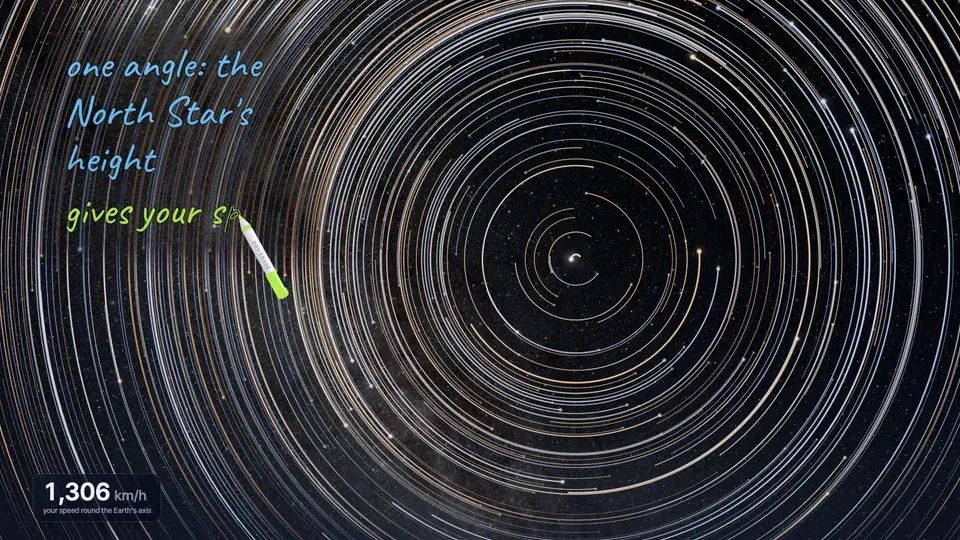
This camera is sitting on a rock in the Utah desert, taking one photo after another all night long. Let’s play the whole night back in a few seconds. Every star in the sky is swinging around that one star in the middle, the North Star, in almost perfect circles. Except it isn’t really the stars that are moving, it’s us. The ground under this tripod turns with the Earth, carrying the camera, the rocks and anyone standing here at about thirteen hundred kilometers an hour, faster than the speed of sound.
By the end of this lesson, you’ll be able to measure one angle, how high the North Star sits in this sky, and work out how fast the spinning Earth is carrying you, wherever you live. You’ll also know the calculator mistake that would send you flying backwards. To get there, we need a good way to describe turning, and this sky has been turning all night, so let’s start with it.
Which way is positive?
Let’s put some math on this sky. I’ll put the origin on the North Star and draw a ray from it straight to the right, along what we’ll call the positive x-axis, and that’s the initial ray.
Next, I’ll draw a second ray. This one goes out to Dubhe, a bright star in the Big Dipper. That’s the terminal ray, and an angle drawn like this, with its vertex at the origin and its first ray on the positive x-axis, is in standard position. As the night goes on, the whole sky turns counterclockwise around the North Star, and the terminal ray sweeps right along with it. Counterclockwise is the positive direction, so the angle keeps growing.
Run the film backward and the sky turns clockwise, which is the negative direction, so now the counter drops below zero. Now let the sky run for a whole day. After twenty-three hours and fifty-six minutes the Earth has turned exactly once, so the sky is back to the same picture, and the angle has grown by three hundred sixty degrees.
One more day gives the same picture and another three hundred sixty degrees, so the terminal ray is right where it was, and yet the angle keeps changing. We call angles that share a terminal ray like that coterminal, and they always differ by a whole number of turns.
Here’s the same idea on the board. Take an angle of a hundred twenty degrees. Adding one full turn, three hundred sixty degrees, gives four hundred eighty, and that lands on exactly the same terminal ray.
Turning clockwise two hundred forty degrees lands there too, so negative two hundred forty is coterminal with a hundred twenty as well. In general, every angle coterminal with theta is theta plus three hundred sixty times an integer k.
Snowboarders do this math in the air, because a trick’s name is its angle. In twenty twenty-five Hiroto Ogiwara landed the first twenty-three forty in competition, six and a half spins. That’s six full turns plus a hundred eighty more, so it’s coterminal with a hundred eighty, and he landed facing the opposite way from how he took off, exactly as if he’d done a half turn. Now you try one. Which of these angles ends on the same terminal ray as three hundred degrees?
Measure the turn with the radius
Degrees work fine, but three hundred sixty is just a number people chose long ago, and there’s a way to measure angles that comes from the circle itself. This is just one hour of the night. Every star turned through the same angle in that hour, but the stars far from the center drew much longer trails.
So a trail’s length can’t tell you the angle by itself. But divide each trail’s length by its distance from the North Star, and both trails give the same number, about zero point two six.
That number is the angle, measured in radians. An angle’s radian measure is the length of its arc divided by the radius, and it comes out the same on every circle. Here’s the cleanest way to see one radian. Take a piece of string exactly as long as the radius, and lay it along the circle. The angle it covers is one radian.
So how long does the sky take to turn one radian? Drag the sky until the star’s trail reaches the end of the string. And how many radians make a full turn? The string fits around the circle six times plus a little more, about six point two eight times, which is two pi.
On the board, a full turn’s arc is the whole circumference, two pi r, and dividing by the radius leaves two pi. So two pi radians is three hundred sixty degrees, and pi radians is half a turn, a hundred eighty degrees. To turn degrees into radians, then, multiply by pi over a hundred eighty, because each degree is a hundred-eightieth of pi radians. Our desert sits at thirty-eight point seven degrees north, about zero point six seven five radians.
On the unit circle, the circle with radius one, dividing by the radius changes nothing, so the arc length and the angle are the same number. Coterminal angles work the same way, only now a full turn is two pi, so they’re theta plus two pi k. Radians matter on the AP exam, too: its directions tell you to keep your calculator in radian mode.
The steepest funicular on Earth
Now let’s go somewhere bright. This is the Stoosbahn in the Swiss Alps, a train pulled up a cliff by a cable, and it’s the steepest railway of its kind in the world. Watch the cabins. They’re shaped like barrels, and as the track gets steeper, each one turns so its floor stays perfectly level, which means the cabin turns by exactly the track’s angle.
On its steepest stretch the track climbs at forty-seven point seven degrees. Follow a cabin for a hundred meters of track, and it rises about seventy-four meters and moves about sixty-seven point three meters across. That’s the right triangle from geometry class. The rise over the distance along the track, seventy-four over a hundred, is the sine of the angle, and the distance across over the distance along the track, sixty-seven point three over a hundred, is the cosine.
Now ride twice as far. The rise doubles to about a hundred forty-eight meters, but the sine is still zero point seven four, because the sine is a ratio, and both of its lengths doubled together.
The third ratio, the rise over the distance across, is the tangent, about one point one zero, and that’s this railway’s grade, a hundred ten percent, because a grade is a tangent written as a percent. A hundred ten percent sounds impossible if you think a hundred percent means straight up, so let’s find out what a hundred percent really looks like.
Now you get to drive, so take the train up the mountain and stop it where the grade is exactly one hundred percent. Now let’s tilt a ghost track up toward vertical. The grade shoots past two hundred, five hundred, a thousand percent, and when the track stands straight up, the grade stops being a number at all.
So here are the three ratios. You might know them as soh-cah-toa, opposite over hypotenuse, adjacent over hypotenuse, and opposite over adjacent. Let’s say them in a way that works for every angle. The sine is vertical over distance, the cosine is horizontal over distance, and the tangent is vertical over horizontal, which is a slope.
From a triangle to a circle
But triangles have a limit. The railway can’t tilt past ninety degrees, and yet the sky swung its ray all the way around, and no right triangle has a hundred-fifty-degree angle. So let’s stand the triangle at the origin. The track becomes the terminal ray, the cabin becomes a point P on that ray, and the distance along the track becomes the radius of a circle.
Now the sine is P’s vertical displacement from the x-axis, divided by its distance from the origin, and the cosine is P’s horizontal displacement from the y-axis, divided by that same distance. And just like on the railway, the size of the circle doesn’t matter. Make the circle bigger and P’s height grows, but the ratio stays exactly the same.
So let’s pick the easiest circle, radius one. Dividing by one changes nothing, so on the unit circle the sine is just P’s y-coordinate and the cosine is its x-coordinate. That makes P the point cosine theta, sine theta: cosine first, like x before y.
Now the angle can keep going. Past ninety degrees, theta won’t fit inside a right triangle anymore, but P still has a height and a sideways displacement, and that displacement turns negative when P is left of the y-axis.
And when P drops below the x-axis, the height turns negative. That’s why we said displacement, not distance: a displacement can be negative. At pi over two, a quarter turn, P is at the very top, zero, one, so the sine is one and the cosine is zero, and at pi, P is at negative one, zero, so the cosine is negative one.
If P keeps going around, its height climbs to one, falls to negative one and climbs again, over and over, and in a couple of lessons that picture turns into a wave. Let’s try a circle that isn’t the unit circle. Suppose the terminal ray passes through the point three, four. By the Pythagorean theorem, its distance from the origin is five, so the sine is four fifths and the cosine is three fifths.
A quarter turn later the point is at negative four, three, so the sine is three fifths and the cosine is negative four fifths, because P is now left of the y-axis. Let’s check. The terminal ray of an angle theta passes through the point negative five, twelve. What’s the cosine of theta?
Tangent is a slope
The last of the three is the tangent, and it’s the one you’ve known the longest, because it’s the slope of the terminal ray, rise over run. On the unit circle the ray goes from the origin to P, so it rises sine theta while it runs cosine theta, and its slope is sine over cosine, which is also y over x. Now watch the ray swing up toward vertical. The run shrinks and the slope grows and grows, and at exactly pi over two the run is zero, so there’s no slope at all.
That’s why the definition says the tangent is the slope of the terminal ray, if it exists. At pi over two and three pi over two it’s undefined, which doesn’t mean it’s huge. It means there’s no number there at all. Past straight up, the ray leans back over to the left, so it falls as it runs to the right, and its slope turns negative.
So in the first quadrant all three are positive, and in the second, where x is negative, only the sine is. In the third, x and y are both negative, so the tangent is positive, and in the fourth, where y is negative, only the cosine is. Here’s one like the exam’s. The terminal ray of theta passes through negative three, negative four. What’s the tangent of theta?
How fast are you going?
Now we have everything we need. Let’s keep our promise. We’re back on the rock in Utah. There’s a sighting arm on the tripod, pointing at the horizon. Raise the arm until it’s pointing right at the North Star.
Let’s see why. The Earth’s axis points almost straight at the North Star, so from the equator you’d see it on the horizon, and from the North Pole it would be straight overhead. In between, it climbs one degree for every degree you travel north, so its height is your latitude, to within less than a degree.
Now cut the Earth in half through the poles. Our desert is a point P on this circle, and its latitude, thirty-eight point seven degrees, is P’s angle in standard position, measured up from the equator. As the Earth spins, P travels around the axis on its own circle, and the axis is the y-axis here, so the radius of P’s circle is P’s horizontal displacement from the y-axis.
Divide it by the Earth’s radius, P’s distance from the center, and you get the cosine of the latitude, about zero point seven eight. Every one of these circles goes around once a day, so a circle seventy-eight percent as big moves seventy-eight percent as fast. The equator moves at one thousand six hundred seventy-four kilometers an hour, so the desert moves at about thirteen hundred six, the number we started with.
Now you do one. New York City is at about forty point seven degrees north. Using the equator’s speed of one thousand six hundred seventy-four kilometers an hour, how fast does the spin carry New York, to the nearest kilometer an hour?
Now here’s the mistake I promised you. In radian mode, cosine of forty point seven means forty point seven radians, six full turns and almost half a turn more, which lands on the far side of the circle.
Over there the cosine is about negative zero point nine nine, so your answer comes out to about negative sixteen hundred sixty kilometers an hour, as if New York were flying backwards. The AP exam tells you to keep your calculator in radian mode, so convert first. Forty point seven degrees is about zero point seven one radians, with the same cosine, zero point seven five eight.
And now you can do this for anywhere. Boston, at forty-two point four degrees, moves at almost exactly the speed of sound. Sydney is south of the equator, so its latitude is negative, about negative thirty-four degrees, but its cosine is still positive, and it moves at about thirteen hundred ninety.
And at the North Pole, ninety degrees, P sits right on the axis. The cosine is zero, so you would just turn in place, once a day. So the next time you find the North Star, its height is your latitude, and one press of the cosine button turns it into how fast you’re flying around the Earth’s axis right now.
What to remember
An angle in standard position starts on the positive x-axis, counterclockwise is positive, and angles whole turns apart share a terminal ray. A radian is the arc divided by the radius, so a full turn is two pi radians, three hundred sixty degrees. Sine and cosine are P’s vertical and horizontal displacement over its distance from the origin, just y and x on the unit circle. And the tangent is the slope of the terminal ray, sine over cosine, whenever that slope exists.