
Topic 3.12 key terms
- Pythagorean identity
- sin²θ + cos²θ = 1 for every real θ: the unit-circle point (cos θ, sin θ) is one unit from the center, so Pythagoras applies to its legs.
- identity
- An equation whose two sides are equal for every input where both are defined, like sin²θ + cos²θ = 1 (unlike an equation such as cos θ = 1/2, true only for some inputs).
- tan²θ = sec²θ − 1
- The Pythagorean identity divided by cos²θ; it holds only where cos θ ≠ 0 (θ ≠ π/2 + kπ).
- sum identities
- sin(α + β) = sin α cos β + cos α sin β and cos(α + β) = cos α cos β − sin α sin β.
- difference identities
- sin(α − β) = sin α cos β − cos α sin β and cos(α − β) = cos α cos β + sin α sin β (replace β by −β in the sums).
- double-angle identities
- sin 2θ = 2 sin θ cos θ; cos 2θ = cos²θ − sin²θ = 2cos²θ − 1 = 1 − 2 sin²θ (set β = α in the sums).
Transcript
2,551 words · 9 parts
Switch off the sun
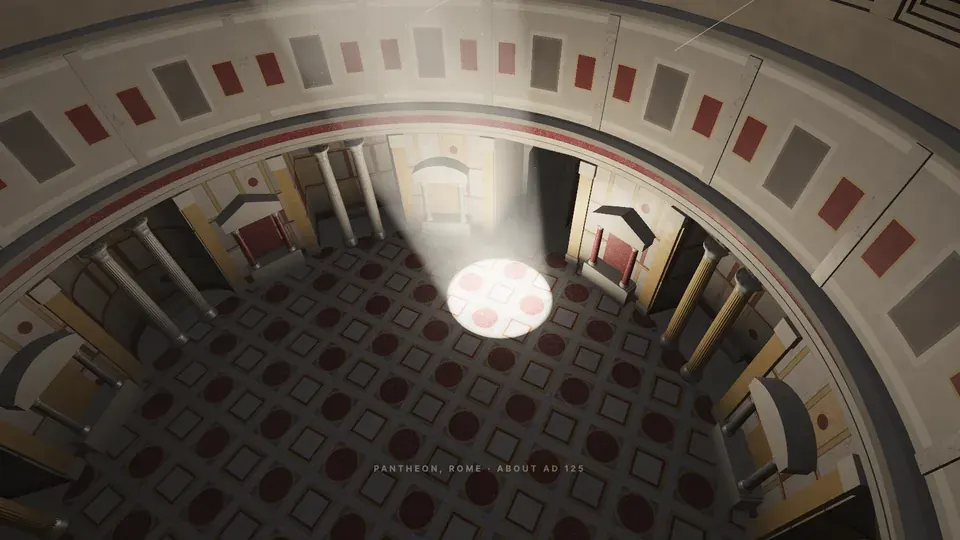
This is the Pantheon in Rome, almost two thousand years old, and apart from the front doors, its only opening is that round hole at the very top of the dome. At noon in June the sun shines straight through it. It lands on the marble floor like a spotlight.
Let’s hang a filter in the beam, a polarizing filter, the same stuff that’s in polarized sunglasses. It lets about half of the sunlight through. Let’s hang a second one underneath it, and slowly turn it. The floor gets darker, and darker, and then the light is gone.
The sun is still pouring in at the top. But not one bit of it reaches the floor. So let’s take a third filter, which can only ever block light, and slide it in between the other two. The floor is already dark. What could it possibly do?
And the light comes back. We added something that can only block light, and more light reaches the floor. Turn the middle filter, and the floor gets brighter and dimmer, so somewhere there’s a best angle.
By the end of this lesson, you’ll be able to explain exactly why that happens. And you’ll work out the angle that makes the floor as bright as it can possibly get, with nothing but a pencil. The answer is hiding in a few trig identities, which are different ways of writing the same expression. And the first one starts with what one filter does to light.
What one filter does
Let’s lift the middle filter out. Then we’ll turn the bottom one back, so the floor is lit again. Sunlight wiggles in every direction, but the light leaving the top filter wiggles in just one, along that filter’s axis. Let’s draw that direction as an arrow, one unit long, and we’ll call the light leaving the top filter a brightness of one.
Now turn the bottom filter by an angle theta. Its axis splits our arrow into two pieces, cosine theta along the axis, and sine theta straight across it. Only the piece along the axis gets through, and the brightness that comes out is the square of that piece, cosine squared theta. That’s the one rule from physics we’ll need today.
At ninety degrees the piece along the axis shrinks to nothing, so cosine squared is zero and the floor goes dark. That’s why the crossed filters blacked out the sun. Now you try it. Turn the bottom filter so that exactly one quarter of the top filter’s light reaches the floor.
Where did the other three quarters go? The filter soaked up the piece across its axis, and its square, sine squared theta, is three quarters at sixty degrees. Draw squares on the two pieces, and their areas are the light that passes and the light that’s stopped. A quarter plus three quarters is one.
As the filter turns, the two squares trade area, but they always add up to one. Cosine squared theta plus sine squared theta equals one, at every angle. That’s the most famous identity in trigonometry. So let’s take it to the board and see why it’s true.
Squares on a circle
Here’s that arrow on the unit circle. It’s a radius ending at the point P, and P’s coordinates are cosine theta across and sine theta up. Drop a line from P to the x-axis and you get a right triangle, with legs cosine theta and sine theta, and a hypotenuse of one.
Pythagoras says leg squared plus leg squared equals the hypotenuse squared, so cosine theta, squared, plus sine theta, squared, equals one. We write it as cosine squared theta plus sine squared theta equals one, the Pythagorean identity, and those are the same squares we saw on the filter. Careful with the notation. Sine squared theta means take the sine first and then square it, not the sine of theta squared.
But legs are lengths, so what happens when a coordinate is negative? Let’s swing P around to two pi over three. Now cosine theta is negative one half, but the leg is still one half long, and squaring negative one half gives positive one quarter anyway. So one quarter plus three quarters is one again. Squaring wipes out the sign, which is why the identity works in every quadrant.
That’s what makes it an identity. It’s true for every input where both sides are defined, unlike cosine theta equals one half. Let’s use it. If sine theta is three fifths and theta is in the second quadrant, what’s cosine theta?
The same fact in other clothes
Rearrange the identity and you get sine squared theta equals one minus cosine squared theta, or cosine squared theta equals one minus sine squared theta. Those let you trade a sine for a cosine. Now let’s be bolder, and divide every term by cosine squared theta. Sine over cosine is tangent, and one over cosine is secant, so tangent squared theta plus one equals secant squared theta.
But we divided by cosine squared, so this only holds where cosine theta isn’t zero, which leaves out pi over two and every half turn from there. It’s our same triangle, blown up until its bottom leg is one, so the tall leg is tangent theta and the long side is secant theta. Rearranged, that’s the form you’ll often see written, tangent squared theta equals secant squared theta minus one. Only one of these is an identity, true for every angle where both sides are defined. Which one?
The identity even connects the inverse functions. Let theta be arcsine x, for an x between zero and one, so theta is a first-quadrant angle whose sine is x. In a right triangle with hypotenuse one and opposite side x, the identity makes the other leg the square root of one minus x squared. That leg is cosine theta, so theta is also the arccosine of the square root of one minus x squared.
So arcsine x equals that arccosine, for x from zero to one. But try x equals negative one half, and arcsine gives negative pi over six. The right side gives the arccosine of root three over two, positive pi over six, so the two sides don’t match. Arccosine never gives a negative angle, so this identity only holds for x from zero to one, and that restriction is part of it.
Two turns
Back in the Pantheon, the middle filter is in again at an angle theta, which puts the bottom filter ninety degrees minus theta away from it. So we’ll need the cosine of a difference of two angles. Let’s get there through a sum. The middle filter sits in a mount. Turn it thirty degrees inside the mount, then turn the mount forty-five, and the axis points at seventy-five degrees.
Seventy-five isn’t one of our special angles, but forty-five and thirty are, so can we build seventy-five out of them? Most people’s first guess is sine forty-five plus sine thirty, but that’s about one point two one, and a sine can never be bigger than one.
Let’s go one turn at a time. Before the mount turns, the axis splits into cosine thirty along the mount’s line, and sine thirty across it. Now the mount turns forty-five degrees, and both pieces ride along with it.
The first piece is cosine thirty long, and it’s tilted up forty-five degrees. A stick tilted up at an angle climbs its length times the sine of that angle, so this one climbs cosine thirty times sine forty-five.
The second piece is sine thirty long, and it’s tilted forty-five degrees from straight up. Measured from straight up, the climb uses the cosine instead, so it climbs sine thirty times cosine forty-five. Together, the two climbs reach exactly the height of the tip. So the sine of seventy-five is sine forty-five cosine thirty, plus cosine forty-five sine thirty.
Sideways, the first piece reaches right by cosine thirty times cosine forty-five, but the second leans back to the left, so we subtract its shadow, sine thirty times sine forty-five. So the minus sign in the cosine formula is just a shadow pointing backward. None of this depended on forty-five and thirty, so let’s write it for any two angles.
Sine of alpha plus beta is sine alpha cosine beta, plus cosine alpha sine beta, one product for each climb. Cosine of alpha plus beta is cosine alpha cosine beta, minus sine alpha sine beta, with the minus from the piece that leans back.
So the sine of seventy-five degrees, which is five pi over twelve, is root two over two times root three over two, plus root two over two times one half. That’s root six plus root two, all over four, about point nine seven, which makes sense for an angle that points almost straight up. Now use the cosine formula to find the exact value of the cosine of five pi over twelve.
One machine, three settings
Turning the filter backward inside the mount is the same as adding a negative angle, and it flips the arm across the mount’s line, so the across piece points the other way and the along piece doesn’t change. So sine of negative beta is negative sine beta, and cosine of negative beta is still cosine beta.
Put those into the sum formulas and only the sine beta terms flip, so the sine difference has a minus, and the cosine difference has a plus. And that’s exactly what the light needed. Cosine of ninety minus theta is zero times cosine theta, plus one times sine theta, so it’s just sine theta. That’s the result we were after, so the bottom filter lets through sine squared theta of whatever reaches it.
Now lock the two turns together, both theta, and the sine of two theta becomes two sine theta cosine theta, because the two climbs are equal. The cosine of two theta becomes cosine squared theta minus sine squared theta.
Using the Pythagorean identity, swap sine squared for one minus cosine squared, and that’s two cosine squared theta minus one, or swap cosine squared for one minus sine squared, and it’s one minus two sine squared theta. Three forms of one function, so pick the one that matches the rest of your problem. Which of these is equal to one minus two sine squared of three x?
Rewrite, then solve
Identities also help solve equations, like two sine squared x plus cosine x minus one equals zero, from zero to two pi. It has a sine and a cosine, so let’s get rid of one. The sine is squared, and the identity turns sine squared into one minus cosine squared. Multiply out and tidy up, and you get two cosine squared x minus cosine x minus one equals zero.
That’s a quadratic in cosine x, so it factors, into two cosine x plus one, times cosine x minus one. So cosine x is negative one half, at two pi over three and four pi over three, or cosine x is one, at zero and at two pi. The interval includes both ends, so all four count, and that’s exactly the kind of equation the exam’s symbolic manipulation question asks you to solve.
One more, because it hides a trap, sine two x equals sine x, this time from zero up to, but not including, two pi. It’s tempting to divide both sides by sine x. But sine x can be zero, so dividing by it would quietly throw those solutions away. Instead, write sine two x as two sine x cosine x, move everything to one side, and factor out sine x.
Sine x is zero at zero and pi, and cosine x is one half at pi over three and five pi over three, and dividing would have lost the first two. Now you try one. Solve two cosine squared x equals three sine x, from zero up to two pi.
Bring the light back
Back to the Pantheon. The middle filter, at angle theta, lets through cosine squared theta of the light. The bottom filter is ninety degrees minus theta away, so it passes sine squared theta of that, and the floor gets cosine squared theta times sine squared theta. At ten degrees that’s only about three hundredths. At thirty degrees it’s three sixteenths, and at sixty, three sixteenths again.
So where’s the brightest? In this form it’s hard to tell, because one factor grows while the other shrinks. But watch what happens when we rewrite it. Cosine squared times sine squared is sine theta cosine theta, all squared.
Sine theta cosine theta is half of sine two theta, so the floor gets one quarter of sine squared two theta. We only rewrote one side, using algebra and identities we already trust, and that’s exactly how you verify an identity. Both forms draw the same curve, but only the second one shows you its maximum at a glance.
Sine squared can never be more than one, so the floor never gets more than a quarter. And it gets exactly a quarter when sine two theta is one. Now you try it. Set the middle filter to the angle that makes the floor as bright as it can possibly get.
There it is. That’s the brightest the middle filter can ever make this floor, a quarter of the light, and you found the angle with a pencil. So why does the trick work? Besides blocking light, a filter turns whatever gets through to line up with its own axis, so the middle filter turns the light forty-five degrees and keeps half of it.
Then the bottom filter turns it forty-five more and keeps half again, and half of a half is a quarter. Without the middle filter the light had to turn ninety degrees at once, and none of it made it.
One last question. If a photographer needs at least three sixteenths of the light, which angles from zero to ninety degrees work? Multiply by four, so sine squared two theta is at least three quarters. Two theta is between zero and a hundred eighty degrees, where sine isn’t negative, so sine two theta is at least root three over two.
That happens when two theta is between sixty and a hundred twenty degrees, so theta can be anywhere from thirty to sixty degrees, pi over six to pi over three. A whole band of angles works. And the double-angle form found every one of them in a few lines.
What to remember
Let’s put it all together. Sine squared plus cosine squared is one. You can rearrange it or divide it, as long as you keep track of what you divided by. Turning a turned arrow gives the sums. Sine of a sum is sine cosine plus cosine sine, and cosine of a sum is cosine cosine minus sine sine.
Turn one angle backward for the differences, and make the angles equal for the doubles. To solve an equation, get it down to one function and factor. Never divide by something that could be zero, and pick the form that shows you what you need.
Next time you’re wearing polarized sunglasses, tilt your head while you look at a laptop screen. A lot of screens shine through a polarizing filter of their own, so at one angle you’ll watch the screen go dark. Now you know exactly why.