
Topic 3.11 key terms
- secant function
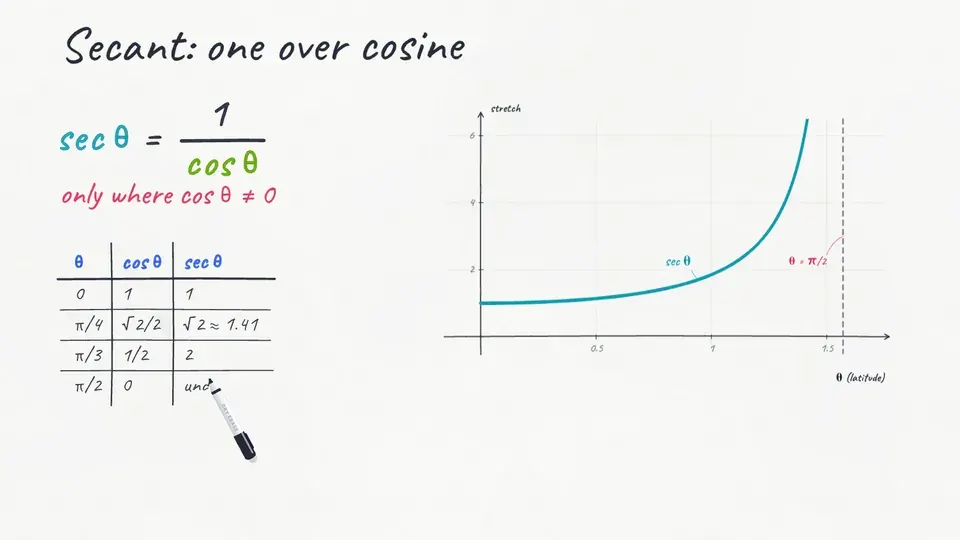
- sec θ = 1/cos θ, defined wherever cos θ ≠ 0. On a Mercator map, sec φ is how much lengths are stretched at latitude φ.
- cosecant function
- csc θ = 1/sin θ, defined wherever sin θ ≠ 0. For a pole of height h and a sun at angle θ, the sunbeam from the top of the pole to the tip of its shadow is h csc θ.
- cotangent function
- cot θ = cos θ / sin θ, defined wherever sin θ ≠ 0; it equals 1/tan θ wherever tan θ exists and is not 0. A pole of height h casts a shadow h cot θ long when the sun is at angle θ.
- reciprocal of a function
- The function that keeps every input and replaces each output u with 1/u. It is undefined where the original output is 0. It is not the inverse function (cos⁻¹ θ means the inverse cosine).
- vertical asymptotes of sec, csc, cot
- Each has a vertical asymptote wherever its denominator is 0: sec θ at θ = π/2 + kπ (cos θ = 0); csc θ and cot θ at θ = kπ (sin θ = 0), which are also the zeros of tan θ.
- range of secant and cosecant
- (−∞, −1] ∪ [1, ∞). Since every sine or cosine value u satisfies 0 < |u| ≤ 1 where the reciprocal exists, |1/u| ≥ 1; the values ±1 are reached where the parent equals ±1.
- period of sec, csc, cot
- Secant and cosecant repeat every 2π, like cosine and sine. Cotangent repeats every π: after half a turn both cos θ and sin θ change sign, so their quotient is unchanged.
- cotangent is decreasing
- On every interval between consecutive vertical asymptotes, (kπ, (k + 1)π), the cotangent decreases from +∞ to −∞. It is not decreasing over its whole domain, because it jumps back up at each asymptote.
- Mercator projection
- Gerardus Mercator's 1569 world map, made for navigation: every circle of latitude is drawn as wide as the equator, and north–south lengths are stretched by the same factor, sec φ, so small shapes keep their true shape and areas grow by sec²φ.
Transcript
2,415 words · 8 parts
The map that lies
Here’s our planet the way it really is, a ball turning slowly in the sunlight. Now watch what happens. Let’s try to flatten it out into a map. This is the map on so many classroom walls, and it’s been quietly lying to you for years. Look at Greenland up at the top. On this map it looks about as big as Africa.
Now let’s slide Greenland down to the equator. Keep your eye on how big it is. That’s its real size. Africa is about fourteen times bigger than Greenland, and the map made them look like twins.
The map isn’t sloppy, though. It blows up every place on Earth by an exact amount that depends only on how far north or south it is, and it’s been doing that on purpose since 1569. By the end of this lesson, you’ll be able to point at any spot on this map. You’ll work out exactly how much it’s been blown up. And you’ll do it with a function your calculator probably doesn’t even have a button for.
And along the way you’ll meet its two partners, which are hiding in every shadow you’ve ever cast. So where does the stretch come from? To find out, we have to put the map back on the globe.
Why the map stretches
Every line of latitude is a circle around the Earth. The farther north you go, the smaller those circles get, until at the pole there’s nothing left but a point. Back when we first met cosine, we found the size of each of these rings. If we call the Earth’s radius one, the ring at latitude phi has a radius of cosine phi.
So at sixty degrees north, right across the southern tip of Greenland, the cosine is one half, and that ring is exactly half as long as the equator. The mapmaker has a problem, because on the map every one of these rings has to become a straight line exactly as wide as the equator.
Over to you: how much does the map have to stretch the sixty-degree ring to make it fit? So the map doubles it. Watch the sixty-degree line grow until it’s exactly as long as the equator. Gerardus Mercator, who drew this map for sailors in 1569, stretched every place up and down by exactly as much as sideways.
That way a small circle on the globe stays a circle on the map, and at sixty degrees it’s twice as wide and twice as tall. So at any latitude phi, the stretch is the equator divided by the ring, and the ring is cosine phi times the equator, so the stretch is one over cosine phi. That number shows up so often that mathematicians gave it its own name, the secant of phi.
Here are the same circles all the way up, with a stretch of one at the equator, about one point four at forty-five degrees, two at sixty, and almost four by seventy-five. Now let’s slide a circle up toward the pole. The ring underneath it shrinks toward a single point, its cosine heads toward zero, and the stretch climbs and climbs without any limit.
At the pole itself the cosine is zero, and one over zero isn’t a number at all, which is why the map has to stop somewhere, and this one stops near eighty-five degrees, with the pole infinitely far up. Let’s put every one of those stretches on a graph against the latitude. Then we’ll carry that picture over to the board.
So the secant of theta is one over the cosine of theta, and it only exists when the cosine of theta isn’t zero. Let’s make a table. We’ll find the cosine first, and then flip it over.
Zero gives a cosine of one and a secant of one, pi over four gives root two over two and root two, pi over three gives one half and two, and pi over two gives a cosine of zero and no secant at all. The row with one half and two is our sixty-degree ring, doubled, and the row with nothing to divide by is the pole.
Be careful with the notation, though. Two to the minus one is one half, but cos to the minus one doesn’t mean one over cosine. It means the inverse cosine, which we met a couple of lessons ago, and that’s a different thing entirely. And since most calculators have no secant button, you type one divided by cosine, with the calculator in radians or degrees to match your angle.
Flip the wave
Now let’s leave the map behind, because secant works for any angle at all, not just latitudes, including the angles where the cosine is negative. Here’s the rule for turning cosine into secant. Every point keeps its input and trades its height for one over that height.
A point at a height of one half goes up to two. A point at one tenth goes up to ten. And one hundredth shoots all the way up to a hundred, way off the top of the board. So small heights turn into big ones, but a height of exactly one stays at one, because one over one is one, and negative one stays at negative one.
A negative height stays negative, so negative one half becomes negative two. And where the cosine is zero, there’s nothing to flip at all, so instead a vertical asymptote goes up. Right beside it the cosine is tiny, like that one hundredth, so the secant shoots away, up on one side and down on the other. So what does the whole wave turn into? Let’s flip every point at once.
The secant’s branches sit right on top of cosine’s hills and hang under its valleys. They touch at the top of every hill and the bottom of every valley. And look at this band between negative one and one, because nothing ever lands in it. To get an output of one half, you’d need a cosine of two, and cosine never gets bigger than one.
So the range of secant is everything from negative infinity up to and including negative one, together with everything from one up to infinity, and that’s exactly how the exam likes to ask about it. The asymptotes sit wherever the cosine is zero, at pi over two plus any multiple of pi. Secant repeats every two pi, just like cosine, and it’s never zero, because one divided by anything can’t come out to zero. Which of these numbers can secant theta never equal?
A shadow on the equator
Secant came from holding a width fixed, the equator. Its two partners come from holding a height fixed instead, and my favorite place to see them is a sundial built right on the equator. This is the Quitsato sundial in Ecuador, with the snow-capped volcano Cayambe off to the east, and that orange pole in the middle is ten meters tall.
Today is an equinox, which means that here on the equator the sun rises due east, passes straight overhead at noon and sets due west, moving fifteen degrees across the sky every hour. At nine in the morning the sun is forty-five degrees up, and look at the triangle the sunlight makes.
The pole is ten meters, and the shadow is ten meters. The sunbeam runs from the top of the pole down to the tip of the shadow. It’s about fourteen meters long. The tangent of the sun’s angle is the pole over the shadow, so the shadow is the pole’s height divided by that tangent, and one over tangent is called the cotangent, so the shadow is ten cotangent theta.
The sine is the pole over the sunbeam, so the sunbeam is the height divided by the sine, and one over sine is called the cosecant, so the sunbeam is ten cosecant theta. At eight o’clock, with the sun only thirty degrees up, the shadow stretches to about seventeen meters, and the sunbeam is exactly twenty, because the cosecant of thirty degrees is two.
There’s a stone exactly twenty meters from the pole. Take hold of the sun and drag it until the tip of the shadow lands right on the stone.
Now let’s watch the sun climb toward noon. At noon it’s straight overhead, and the shadow disappears completely, tucked right under the pole. The sunbeam runs straight down the side of the pole now, ten meters, so the cosecant of ninety degrees is exactly one. And the shadow is zero meters long, so the cotangent of ninety degrees is zero. But the tangent of ninety degrees doesn’t exist, so one over tangent can’t be the whole story.
In the afternoon the shadow swings around to the east side of the pole. We’ve been measuring toward the west, so its position is now negative: at three o’clock, with the sun a hundred and thirty-five degrees from where it rose, it’s negative ten. And at sunset it runs off east without end, because the last rays skim the ground and never land.
Here’s where the tip of the shadow was every hour, all day long. Let’s lift those marks up into a graph, with the sun’s angle going across and the shadow per meter of pole going up. All day long the sun’s angle went up and the tip’s position went down, from huge and positive at sunrise, through zero at noon, to huge and negative at sunset. That’s one whole branch of the cotangent, so let’s take it to the board.
Cotangent and cosecant
So the cotangent of theta is the cosine of theta over the sine of theta, which exists whenever the sine isn’t zero, and wherever the tangent exists and isn’t zero, it’s the same as one over the tangent. That’s what rescued us at noon. At pi over two the tangent doesn’t exist, but the cosine is zero and the sine is one, so the cotangent is zero over one, which is just zero.
The asymptotes are wherever the sine is zero, at every multiple of pi, which are exactly the places where the tangent is zero, and in our sundial they were sunrise and sunset. After half a turn, the cosine and the sine both flip their signs, and changing the sign of both the top and the bottom leaves the ratio the same, so the cotangent repeats every pi, and the same branch shows up again and again.
Every branch goes down from left to right, so we say the cotangent is decreasing between consecutive asymptotes, and the tangent, here in gray, does the opposite, because it increases on every branch. Careful, though, because the cotangent isn’t decreasing everywhere, it jumps back up at every asymptote. It takes every real number as an output, and it crosses zero at pi over two plus any multiple of pi. Over to you: what’s the cotangent of three pi over two?
The cosecant is one over the sine, and it only exists when the sine isn’t zero. Let’s flip the sine wave exactly the way we flipped cosine. The asymptotes go up wherever the sine is zero, at every multiple of pi, and over the daytime half, from zero to pi, you get a cup whose lowest point is exactly one, at pi over two.
That’s our sunbeam at noon, never shorter than the pole. The other cup hangs underneath, so the range is the same as secant’s, never between negative one and one, and it repeats every two pi. One more trap, because the co in cosecant does not pair it with cosine. Cosecant goes with sine, and secant goes with cosine, which feels backwards to almost everybody.
Read it like the exam
Here are all three side by side, the way the exam expects you to know them. Secant has its asymptotes at pi over two plus k pi, a range with a gap from negative one to one, no zeros, and a period of two pi. Cosecant is the same except that its asymptotes are at k pi. And cotangent has its asymptotes at k pi too, but it hits every real number, crosses zero at pi over two plus k pi, and repeats every pi.
The exam also likes to put something inside, like the cosecant of two theta. Always start with the denominator, so the asymptotes are wherever the sine of two theta is zero. That happens when two theta is a multiple of pi, so theta is a multiple of pi over two, like zero, pi over two, pi, and so on.
Between each pair of asymptotes there’s one cup, and an up cup and a down cup together take just pi, so the period shrinks from two pi to pi, but the range doesn’t change, and it still never lands between negative one and one. Which of these is a vertical asymptote of y equals secant of two theta?
Catch the map lying
Now we can catch the map in the act. The middle of Greenland is at about seventy-two degrees north. The cosine there is about point three one. One over point three one is about three point two, so the map draws the middle of Greenland about three point two times too wide and three point two times too tall, and that makes about ten times the area. So the middle of Greenland gets blown up about ten times over, and its far north even more, while Africa, sitting across the equator, hardly stretches at all, and that’s the whole illusion.
Now it’s your turn to make the map lie. Drag the circle north until the map draws it three times as wide as the same circle at the equator.
And that latitude runs right across Greenland, which is why it looks so huge. So that’s the promise kept. Point at any spot, read its latitude, and one over its cosine tells you how much the map blows it up. And now watch Greenland go back up north. The map blows it right back up to the size of Africa.
What to remember
Secant is one over cosine, cosecant is one over sine, and cotangent is cosine over sine. Each one has a vertical asymptote wherever its denominator is zero. Secant and cosecant never land between negative one and one, and they repeat every two pi. Cotangent takes every value, repeats every pi, and goes down between its asymptotes. And the next time you see that classroom map, you’ll know exactly how much it’s blowing Greenland up, and why.